

More news on this day
Abu Dhabi’s main gateway, now known as Zayed International Airport, remains open in March 2026, but passengers face a patchwork of reduced flight schedules, evolving airspace restrictions and heightened security-related travel advisories across the wider Middle East.
Get the latest news straight to your inbox!
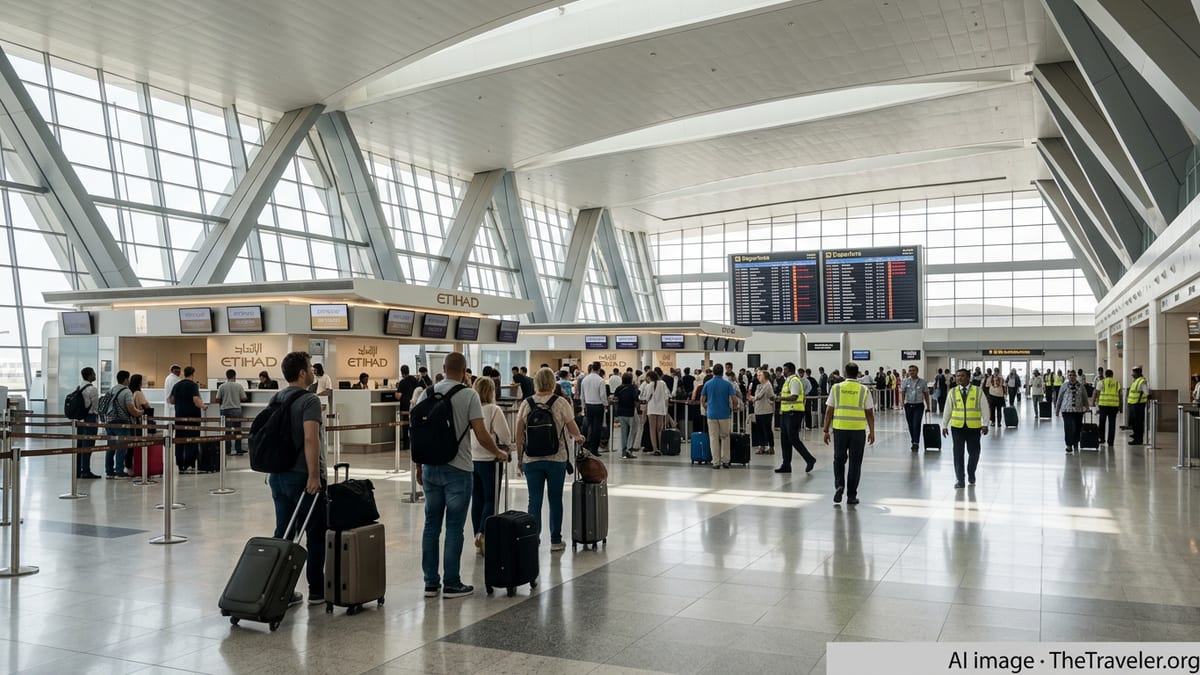
Current Operational Status: Open but Constrained
Zayed International Airport, the new name for Abu Dhabi’s former international airport, is open and functioning as the capital’s primary passenger hub in 2026. Publicly available traffic figures for 2025 describe record passenger numbers and position the airport as one of the fastest-growing mega hubs in the EMEA region, underscoring that the infrastructure and terminals themselves remain fully operational.
The picture in early 2026 is shaped less by airport capacity and more by the security environment. Regional tensions, including missile and drone activity affecting several Gulf states, have led to periodic closures of sections of Middle East airspace. Reports on recent events describe limited debris incidents near the airport perimeter and precautionary slowdowns, but no sustained damage that would force a long-term shutdown of the facility.
As a result, Zayed International is technically open, yet operating below its usual volume. Airlines are running selective services, with schedules subject to rapid adjustment. Travelers can still depart and arrive via Abu Dhabi, but options may be fewer, routings more circuitous and flight times compressed into narrower operational windows as carriers work around restricted air corridors.
International travel advisories reflect this complexity. Recent guidance for the United Arab Emirates urges travelers to reconsider nonessential trips while also noting that key airports, including Abu Dhabi, continue to function. This combination of open infrastructure and elevated security posture defines the airport’s live status in March 2026.
From Abu Dhabi International to Zayed International: Terminal A’s Role
The airport’s recent transformation is central to understanding how it is handling current disruption. In February 2024, the hub was formally renamed Zayed International Airport, honoring the UAE’s founding father. The change coincided with the full opening of the long-awaited Terminal A, a vast new facility designed as a next-generation gateway for Etihad Airways and partner airlines.
Terminal A consolidates most passenger operations under one roof, replacing the fragmented layout of the older terminals. Architecture and aviation industry coverage highlight its scale, advanced baggage systems and upgraded security and immigration areas. In normal conditions, these features allow the airport to process tens of millions of passengers annually with considerable spare capacity for growth.
That modern infrastructure is now being tested in a very different way. During recent episodes of regional airspace closure, Abu Dhabi’s terminals have served as holding points for stranded travelers and as staging grounds for limited evacuation and relief flights. Operational updates from aviation analysts and travel management companies show that when departures were temporarily paused, the airport facilities remained accessible, with ground staff focused on rebooking passengers and managing large volumes of schedule changes.
Despite intermittent suspensions of airline departures, there have been no indications that Terminal A or the wider Zayed International complex has closed to passengers in a structural sense. Check-in areas, security lanes and boarding gates are functioning, even when the flight schedule is scaled back or briefly halted for security reasons.
Airlines, Schedules and What Passengers Are Experiencing Now
The most visible impact for travelers is on airline schedules rather than on the airport building itself. Etihad Airways, based at Zayed International, announced several short-term suspensions of departures as airspace restrictions tightened at the end of February and in early March 2026. Statements cited regional security concerns and widespread closures of neighboring airspace as reasons for grounding flights during defined time windows.
By early March, Etihad began moving from a full pause to a limited commercial schedule, gradually reintroducing routes to key destinations while keeping others canceled or rerouted. Independent travel advisories for corporate clients describe a pattern in which flights to and from Abu Dhabi were suspended until specified dates and times, then restarted in reduced numbers once overflight permissions and risk assessments allowed.
Other carriers using Abu Dhabi have adopted similar caution. Low-cost and regional airlines have trimmed schedules, shifted frequencies or temporarily suspended specific city pairs. At the same time, a small number of special or evacuation-focused flights have operated to facilitate the departure of foreign nationals and residents seeking to leave the region, sometimes under government-supported arrangements.
For passengers on the ground, this translates into longer queues at airline service desks, frequent rebooking, and a strong emphasis on digital notifications. Industry alerts recommend checking flight status repeatedly on the day of travel, enrolling in airline alert systems and being prepared for last-minute gate changes or cancellations even after check-in.
Security Context and Government Travel Alerts
The broader security picture around the Gulf is a key driver of conditions at Zayed International. Since late February 2026, regional coverage has documented large-scale missile and drone exchanges involving Iran, Israel and several Gulf states, with air defence systems intercepting many projectiles. The resulting debris risks and uncertainty have prompted temporary closures or severe restrictions of airspace segments that commercial airlines typically use.
Government travel advisories mirror this heightened risk environment. Recent updates for the United Arab Emirates cite a higher alert level, urging travelers to reconsider trips due to the potential for sudden escalation and disruption to air travel. Multinational security consultancies and travel management firms have echoed that message, advising companies to defer nonessential travel and maintain contingency plans for staff movement.
These advisories do not state that Abu Dhabi’s airport is closed. Instead, they emphasize that while the airport is operational, flights can be suspended with little warning, routes may avoid conflict-adjacent airspace, and layovers in regional hubs may carry greater uncertainty than usual. Travelers are urged to factor potential delays, diversions and overnight stops into their plans.
Insurance implications also come into play. Some policies treat conflict-related disruption differently from weather or technical delays, and travelers connecting through Zayed International in the coming weeks are being encouraged by brokers and airlines to review coverage details closely before departure.
Practical Guidance for Travelers Using Zayed International in 2026
For those with upcoming journeys via Abu Dhabi, the central message is that the airport is open but the operating environment is fluid. Schedules that looked stable a week earlier may change within hours as airlines respond to updated security assessments and air traffic control directives. Flexibility and preparation are essential.
Travel industry advisories recommend a layered information approach. Passengers are encouraged to monitor both their airline’s official channels and general news outlets for developments related to regional airspace. Many carriers serving Zayed International are waiving change fees or allowing one-time, no-cost alterations to itineraries that touch affected countries during specified periods, which can provide an opportunity to reroute or delay trips.
At a practical level, experts suggest arriving earlier than usual for departures from Abu Dhabi, carrying essential medications and valuables in hand luggage in case of unexpected overnight stays, and having a backup plan for accommodation if connections are missed. Given the potential for queues at customer service points, using airline apps or call centers to request changes before reaching the airport can reduce stress.
For now, Zayed International Airport continues to function as the UAE capital’s key international gateway, supported by modern terminals and robust ground operations. Yet until the regional security situation stabilizes, anyone traveling through Abu Dhabi in 2026 should treat schedules as provisional and keep a close watch on real-time travel alerts.