

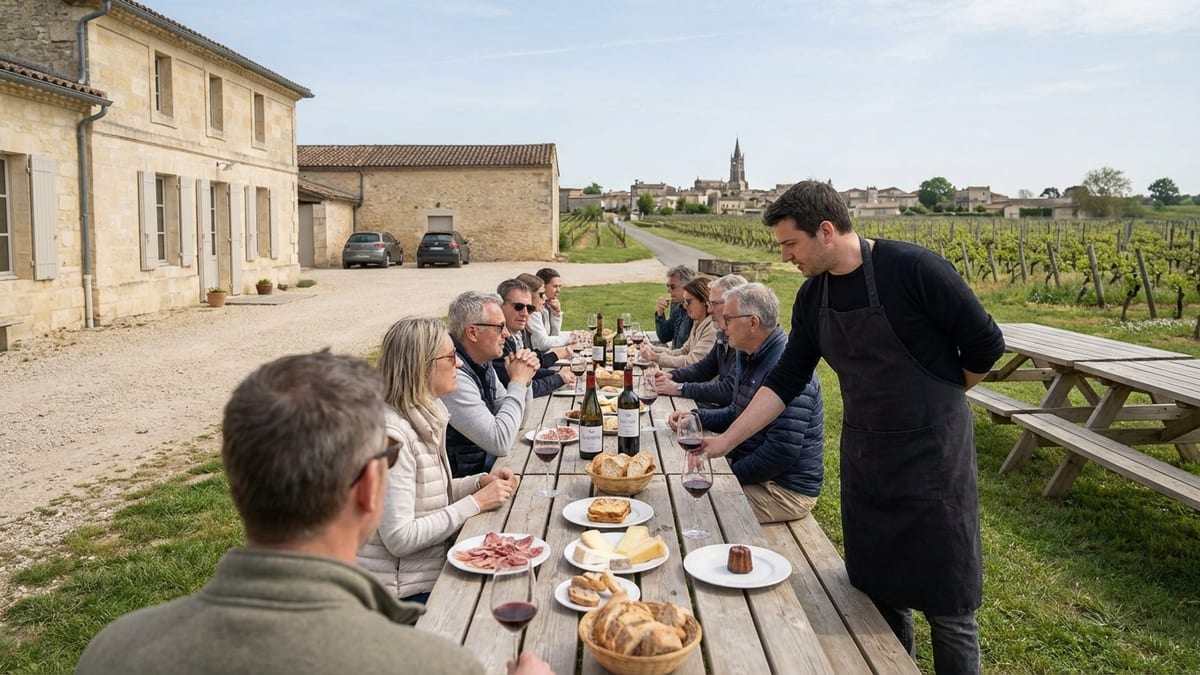
I had been to Saint Emilion a few times before, but Château Ambe Tour Pourret kept popping up in conversations and searches as one of the “experiential” estates: organic grand cru wines, cooking classes in the château kitchen, relaxed picnics and pairings instead of stiff, scripted tastings.
It sounded like the kind of place that tries to make wine less intimidating and more about pleasure. So on my most recent trip I finally booked a visit and tasting to see if the reality justified the glowing comments. What I found was a friendly, food‑centric estate with some genuine highlights, a few frustrating details, and a vibe that will absolutely suit some visitors better than others.
Booking, Communication and First Impressions
I booked directly through their online platform a couple of weeks in advance, choosing a late morning tour and tasting that included cheese pairings. At this stage, things were clear and efficient. The confirmation spelled out the time, price per person, and that the visit would last about an hour. What it did not emphasize very clearly, though, was the seasonal rhythm of the estate. Between November and March, they are essentially open on weekends for visits, tastings and purchases, with weekday visits mostly possible only for pre‑booked groups. In spring and summer there is more flexibility and more activities, including picnic options, brunches and their wine bar with simple plates.
Because of that weekend focus outside high season, I had to adjust my wider Saint Emilion plan, shuffling other château visits around to land at Ambe Tour Pourret on a Saturday. That was manageable, but if you like to travel mid‑week in the off‑season, you will want to double‑check availability directly by email or phone instead of assuming you can just swing by. The estate does expect you to have a reservation for anything beyond a simple purchase, even in busier months, and I encountered a couple who tried to drop in for a tour and were politely turned away or asked to wait a long time.
Driving up, the setting is quite attractive without being postcard‑perfect. The château buildings are modest rather than grand, low stone structures framed by vines that reach toward the village of Saint Emilion in the distance. It feels more like a working family estate than a showpiece. Parking was straightforward and close to the entrance, which I appreciated after some of the more labyrinthine gravel lots elsewhere in Bordeaux. First impressions inside were warm: a small reception area doubling as a shop, shelves of their own wines and some local products, and a staff member who greeted me promptly in both French and English.
The Estate, Sustainability and Vineyard Tour
Château Ambe Tour Pourret presents itself as an organic Saint Emilion Grand Cru estate, and the tour is built around that identity. We began outside among the vines with a short walk and an overview of the property. The guide explained their organic certification, some of the challenges of working without synthetic herbicides and pesticides in the often damp Bordeaux climate, and how that translates into more manual effort and monitoring in the vineyard. I liked that the explanations were concrete and specific, not just marketing slogans about “respecting nature.”
However, the walk itself was relatively brief and somewhat constrained. We stayed close to the buildings rather than really roaming the parcels, and while I understand the need to manage groups and timing, it felt a bit like a quick tick‑the‑box moment before moving indoors. If you are the kind of visitor who loves to dive into soil profiles, grape clones and pruning systems, you might find this section a little light. The guide clearly had the knowledge but kept to a simplified script that seemed aimed at people less familiar with wine.
On the positive side, the organic focus generated a few good questions from the group about copper use, biodiversity and the reality of converting an existing property to organic farming. The guide answered honestly, even acknowledging that organic does not automatically mean “better” in every vintage and that yields can be lower and risks higher. It was refreshing to hear nuance instead of the over‑simplified “organic equals superior” narrative that some estates fall into.
Visually, the estate lacks the sweeping river views or dramatic hilltop setting of some of its neighbors, but there is a calm charm in being surrounded by the vines with the medieval village on the horizon. If you are expecting an Instagram‑ready backdrop in every direction, you might be slightly underwhelmed. If you care more about the production story, you will probably be content.
Cellar Visit and Winemaking Explanations
From the vines we moved into the vinification cellar and then the barrel room. This is where the visit became more technical, and for me, more interesting. Stainless steel tanks, their sizes, the temperature control systems, and the difference between the main estate wine and other cuvées in the Lannoye family of properties were all covered. The guide walked us through harvest timing, how they decide on maceration lengths, and the balance they try to strike between fruit, structure and oak.
The explanation was clear and well structured, but I sensed a tension in tone. The group was mixed, with a couple of serious enthusiasts, some casual wine tourists and a family who admitted they were “mainly here for the cheese.” The estate tries to pitch the content in the middle, which means that if you already know Bordeaux basics, a lot of what you hear will feel like a refresher rather than new insight. I found myself wishing for a little more depth in certain areas, such as concrete examples of how they had adapted in specific tricky vintages, but I also recognize that not everyone wants or needs that level of detail on holiday.
The barrel cellar, with its neat rows of French oak and the subtle smell of wood and wine, provided the expected atmospheric moment. There is a short segment here about the choice of barrel suppliers and toast levels. It is solid, but again, not unique. Compared with some larger classified growths, the scale is small, which I personally liked. You can sense that decisions here are made by a compact team, not a corporate board. Still, nothing in the cellar visit particularly surprised me or set the estate apart; it was just a competent, well‑paced walk through familiar ground.
Where Ambe Tour Pourret notably differs from many neighbors is the way the cellar visit is integrated with their optional cooking classes. On certain days, people in aprons were moving between the kitchen and the dining space as we completed the tour, and we briefly crossed paths. It adds a feeling of life and activity: you are not touring a museum, but a working estate where guests are also actively cooking and eating.
Wine Tasting Quality and Structure of the Experience
The core of my visit was the guided tasting of three wines, each paired with a different cheese. We were seated around a long table rather than standing at a bar, which immediately shifted the mood to something more convivial and relaxed. The tasting room itself is functional rather than luxurious: wooden tables, simple glassware, and large windows that let in light but not dramatic views.
The wines came from across the Lannoye family properties, including the organic Saint Emilion Grand Cru from Ambe Tour Pourret itself. I appreciated that the tasting was not limited to a single label, as it allowed for comparison between appellations and styles. The first wine, a simple, fruit‑forward Bordeaux, was pleasant but unremarkable. It did a good job as a palette opener, but I would not travel specifically for it. The second, from another right‑bank appellation, had more structure and interest. The star of the lineup, unsurprisingly, was the estate’s own Saint Emilion Grand Cru, which showed more depth, finer tannins and a clear sense of place.
The pairing element was well thought out, and this is where the estate’s food focus really shines. Each cheese had been chosen to highlight a particular aspect of the wine, and the guide encouraged us to taste the wine before and after the cheese to see how the interaction changed things. This might sound basic, but many châteaux still pour wine in isolation, as if everyone is tasting for a competition rather than for pleasure. At Ambe Tour Pourret, there is a clear assumption that you will be drinking these wines with food in real life, and the experience is designed around that idea.
That said, there were small details that did not quite meet my expectations. Glassware, for example, was decent but not ideal for fully expressing the wines. In a place that leans so strongly into pairing and sensory experience, I would have liked slightly better, larger glasses. Pours were also on the modest side. I understand that an estate cannot be overly generous with every group, but when you are being guided through how the wine shifts with food, a second small pour to re‑test with a pairing would go a long way. Instead, we were asked to manage the same small pour for multiple comparisons, which felt a little restrictive.
Overall, the tasting itself was enjoyable and informative, and I came away with a clearer idea of the house style: approachable, balanced wines rather than powerhouse blockbusters. If your taste runs to overtly oaky, ultra‑concentrated Bordeaux, you might find the wines a bit restrained. If you like freshness and drinkability, you will likely be satisfied, especially with the estate’s own grand cru.
Food, Cooking Classes and “Gourmet” Extras
One of the main reasons I chose Château Ambe Tour Pourret was the reputation of its cooking classes and food‑centric experiences. They offer private “Prestige” cooking classes for small groups, usually either 10:00 to 14:00 or 17:00 to 21:00. These include a tour of the barrel cellar, the cooking session itself, and then a full meal with pairings: a glass of Crémant de Bordeaux, a red from the family’s vineyards, and the organic Saint Emilion Grand Cru, along with coffee or tea and a classic macaron from Saint Emilion.
I joined one of these sessions on a separate day, and it was, in many ways, the highlight of my time at the estate. The kitchen is well equipped but not intimidating: individual stations, induction hobs, and everything prepped so you can actually focus on technique and enjoyment rather than washing endless herbs. The chef struck a good balance between demonstrating and letting us do things ourselves. We cooked a seasonal three‑course menu that leaned into local ingredients without being cliché, and there was enough hands‑on time to feel genuinely involved.
However, two caveats are important. First, the price. The cost escalates quickly for small groups, with two participants paying a significantly higher per‑person rate than, say, a group of ten. For a couple, it becomes a serious splurge, and you will want to consider carefully whether you value the intimacy enough to justify it. At larger group sizes, it feels more reasonably priced for what you get. Second, the pace can feel a bit compressed. With a four‑hour window covering tour, instruction, and a three‑course meal, there is not much slack in the schedule. I sometimes felt we were rushing plating or eating to stay on time, which detracted slightly from the relaxed, “slow lunch in the vines” ideal I had in mind.
Beyond the formal cooking classes, the estate also offers simpler food options like a tasting tour followed by a picnic, or cheese and charcuterie plates at their wine bar during the middle of the day on the same days the estate is open. The picnic formula is pleasant, with a prepared plate that might include charcuterie, cheeses, a truffled croque, a canelé and a glass of wine, plus coffee. It is not a customizable gourmet hamper; think more semi‑gourmet café plate than elaborate basket under a tree. When the weather cooperates, eating overlooking the vines is lovely, but you are not exactly on a secluded hilltop either. There is a road nearby and the occasional agricultural noise, which keeps the atmosphere grounded in reality rather than fantasy.
Service, Atmosphere and Group Dynamics
Service at Château Ambe Tour Pourret felt genuinely friendly throughout my time there. Staff spoke very good English and at least some Spanish, and they appeared comfortable switching languages as needed. Questions, even basic ones, were treated respectfully, which matters a lot in wine country where some estates still maintain an air of quiet snobbery. Here, the goal seems to be accessibility: to demystify wine and bring it closer to the experience of cooking and eating.
At the same time, that accessibility comes with a slightly informal tone that will not appeal to everyone. If you are looking for a hushed, museum‑like château visit with lots of architectural history and a strong sense of prestige, this probably is not your place. The buildings are relatively simple, and volunteers or staff occasionally cut through the space with trays, equipment or deliveries. It feels lived‑in and busy, not staged. Personally, I liked that, but someone expecting classic Bordeaux grandeur might leave underwhelmed.
Group size is another factor. For the tour and tasting, my group was around ten people, which was just about manageable. Any larger and it would have been hard to hear the guide consistently in the cellar and to ask individual questions without feeling like you were holding everyone up. The cooking class, capped at a smaller number, felt more intimate, but even there, if several people are more talkative or competitive in the kitchen, the dynamic can tilt quickly. This is less about the estate itself and more about the nature of group activities, but it is worth considering your own tolerance for group tourism before booking the most interactive options.
What I did miss a little was a deeper sense of the property’s history. The narrative emphasized the wines, the organic approach and the current ownership, but there was relatively little storytelling about the château over the centuries, notable past owners or how the estate’s identity had evolved. In a region with as much history as Saint Emilion, that felt like a missed opportunity. If you are more interested in architecture and history than in food and contemporary wine tourism, you may find the visit a bit one‑dimensional.
Practicalities: Getting There, Scheduling and Who It Suits
Château Ambe Tour Pourret is located just outside the village of Saint Emilion, and there are essentially two ways to reach it: by car or by a combination of train and walking. By car, it is a straightforward drive from Bordeaux or Libourne, and the estate has on‑site parking. This is the most convenient option if you are visiting multiple châteaux in a day or traveling with a group. The downside, obviously, is that someone has to remain under the legal alcohol limit for the drive back.
Without a car, you can take a train to the Saint Emilion station from Bordeaux and then either walk about 1.5 kilometers or arrange a taxi. The walk is feasible in good weather if you are reasonably mobile and comfortable on roads without dedicated sidewalks, but I would not recommend it with heavy bags, in intense summer heat, or in heavy rain. Local taxis do serve this route, but availability can be patchy at peak moments, so advance planning is wise.
Scheduling-wise, the estate’s opening pattern matters. From roughly November to March the château focuses on weekends for visits, tastings and activities. Weekday bookings in that period tend to be reserved for groups, and you will have more luck if you contact them directly by email or phone. From spring through early autumn, the calendar opens up with more mid‑week possibilities and add‑on experiences, including picnics, occasional brunches and special evenings like raclette nights. Classes and dining activities usually require booking at least several days in advance, and they do enforce that. This is not a place where you can decide on a whim to join a cooking class the same morning.
All of that means Château Ambe Tour Pourret is best suited to travelers who are willing to plan at least part of their Saint Emilion time around it. If you like to wander into places spontaneously, see if they have space, and let the day evolve, you may find the booking expectations and limited off‑season openings restrictive. On the other hand, if you enjoy anchoring your day around a longer, immersive experience involving food and wine, the estate lends itself well to that, particularly in good weather.
The Takeaway
So, is Château Ambe Tour Pourret worth visiting for a wine tasting and overall experience? For me, the answer is a measured yes, with clear conditions. I left having enjoyed my time there, learned a bit, and appreciated the thoughtful focus on pairing wine with food. I also left feeling that this is not a universal must‑see for every visitor to Saint Emilion. It will appeal strongly to some and feel just adequate to others, depending very much on expectations.
If your primary interest is grand architecture, deep historical narratives and tasting the most prestigious, widely known labels, this estate is unlikely to be the highlight of your trip. It is a relatively modest, working property that puts its energy into hospitality, cooking, and making wine approachable rather than into monumental spaces or collector‑grade experiences. In pure wine geek terms, the visit is solid but not revolutionary; the wines are good, sometimes very good, but not transcendent. The tasting explanations are clear but pitched more toward the curious amateur than the seasoned enthusiast.
Where Château Ambe Tour Pourret really earns its place on a Saint Emilion itinerary is for travelers who see wine and food as inseparable. The cooking classes, pairing tastings and picnic formulas create an environment where you are not just sipping and nodding through a script, but actively engaging your senses. I would happily return for another cooking class, especially as part of a small group of friends or family, and I would recommend it in that context. I would be more selective about repeating the basic tour and tasting unless I was with first‑time visitors to the region.
If I were to do it again, I would plan my visit for late spring or early autumn, when the weather supports outdoor eating and the estate’s full range of food experiences is running. I would book a cooking class with at least four people to bring the price down to a more comfortable level, and I would combine it with a stroll in Saint Emilion village rather than trying to fit in multiple other château visits on the same day. In that configuration, Château Ambe Tour Pourret is absolutely worth it: a relaxed, flavorful slice of Bordeaux life that favors conviviality over spectacle.
FAQ
Q1: Do I need to book in advance to visit Château Ambe Tour Pourret?
Yes. While you might be able to walk in to buy wine, tours, tastings and especially cooking classes generally require advance booking. This is particularly true outside the main season, when the château mainly opens on weekends for visits and tastings.
Q2: Is the château open all year round?
It is active year round, but access for visitors fluctuates. From roughly November to March the estate focuses on weekends and pre‑booked groups, while from spring through early autumn there are more days and experiences available. Always check current schedules and book ahead.
Q3: How long does a standard tour and tasting last?
The typical Bordeaux vineyards and cellar tours followed by a tasting of several wines lasts about one hour. If you add food pairings or a picnic option, plan for around 1.5 to 2 hours total on site.
Q4: Are the cooking classes worth the higher price?
They can be, depending on your expectations and group size. The classes are well run and include a full meal with wine pairings and a short cellar visit, but they are expensive for couples. For groups of four or more the per‑person cost feels more reasonable for the quality of the experience.
Q5: Can I visit without a car?
Yes, but it requires some planning. You can take the train to Saint Emilion and then either walk approximately 1.5 kilometers to the estate or arrange a taxi. The walk is pleasant in good weather but not ideal in extreme heat, heavy rain or for visitors with mobility issues.
Q6: Is this a good visit for serious wine enthusiasts?
Enthusiasts will appreciate the organic approach and the chance to compare wines from different family estates, but the explanations are pitched to a general audience. If you are looking for highly technical, in‑depth discussions, you may find the content a bit basic unless you actively ask more advanced questions.
Q7: How does the wine quality compare to other Saint Emilion châteaux?
The estate’s wines are well made, balanced and clearly focused on drinkability with food rather than sheer power. They are not at the very top tier of prestige in the appellation, but they offer honest quality, especially the organic grand cru, at a level that matches the overall experience.
Q8: Is Château Ambe Tour Pourret suitable for non‑experts or first‑time wine travelers?
Very much so. The tone is friendly and educational without being condescending, and the use of food pairings helps newcomers understand the wines in a concrete way. It is a comfortable starting point for people who may feel intimidated by more formal châteaux.
Q9: Will children or non‑drinkers find anything to enjoy?
Children and non‑drinkers can join parts of the visit, especially if you book a picnic or cooking‑focused activity, but the estate is fundamentally oriented around wine. There are no dedicated children’s programs or playgrounds, so families should think of it as an adult‑focused outing with some flexibility, not a child‑centric attraction.
Q10: Would I return to Château Ambe Tour Pourret on a future trip?
I would return, but selectively. I would prioritize the cooking class or a leisurely lunch and tasting on a sunny day over repeating the basic tour. For a food‑loving group that wants an interactive, convivial experience in Saint Emilion, I would recommend it as a worthwhile stop.