

I went to Chobe National Park with embarrassingly high expectations. I had seen the photos of elephants piled along the riverbank and boats drifting past pods of hippos in golden light. I had also read the warnings about crowds, dust, heat, and prices that keep creeping up year after year.
After finally experiencing Chobe for myself, I came away impressed, frustrated, and occasionally underwhelmed all at once. If you are wondering whether Chobe is worth visiting, the honest answer is: it depends very much on when you go, how you go, and what kind of safari you are actually dreaming of.
First Impressions: Kasane, Logistics and Sticker Shock
My Chobe experience really began in Kasane, the small frontier town that functions as the park’s main gateway. It is a strange blend of dusty truck stop, border hub and serious safari staging point. Trucks rumble through on the road linking Botswana with Namibia, Zambia and Zimbabwe, while at the same time you see air-conditioned safari vehicles queuing outside supermarkets to pick up guests from riverfront lodges.
Reaching Kasane was surprisingly straightforward. I crossed via the Kazungula border after a stay in Victoria Falls, using one of the standard transfer shuttles. The drive took around an hour and a half including immigration formalities. What I had not fully appreciated before arriving was how much of Chobe day-trip tourism runs on this cross-border conveyor belt. By 8:30 in the morning, I was sharing a check‑in desk with people who had woken up in Zambia, Zimbabwe and Botswana, all funneling into the same boats and vehicles bound for the park.
The second jolt came with the costs. Botswana has deliberately pushed its park fees upward over the last few years, and Chobe, as a flagship reserve, is on the higher end. As an international visitor, I was paying a daily conservation fee in the ballpark of 270 pula for park entry, plus separate charges for the boat cruise and game drive. A full‑day combo of river cruise and drive from Kasane was priced around 140 US dollars per person, not including my cross‑border transfer. None of this is outrageous by African safari standards, but Chobe is not a cheap quick detour; it is a serious ticket item, especially if you are traveling as a family.
Practical details matter here. The park gate times shift with the seasons: roughly 5:30 to 19:00 during the hot, wetter months from October to March, and 6:00 to 18:30 from April to September. That sounds generous, but in reality most organized activities stick to stricter schedules. My morning boat cruise left around 9:30, and my afternoon game drive was back at the gate by 16:30. There was no lingering for that last bit of magical sunset light inside the park; rules are rules.
Boat Safari on the Chobe River: Spectacular and Crowded
If you have seen one iconic Chobe image, it is almost certainly shot from the water. For my first activity, I joined a mid‑morning boat cruise heading west along the Chobe River, with Namibia’s Caprivi floodplain on one side and the national park on the other. The river here is broad and slow, dotted with islands. It is a beautiful landscape, especially in the dry months when the interior has parched and everything alive is magnetized to this permanent water.
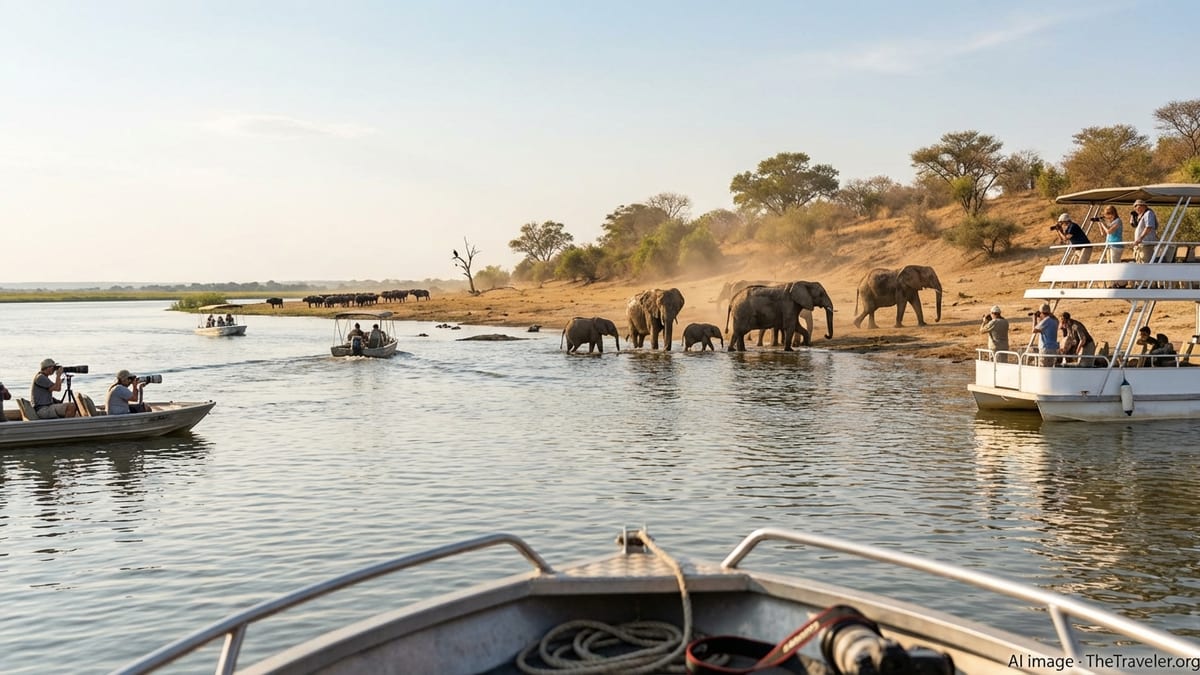
Wildlife sightings from the boat were, in fairness, excellent. I saw more elephant behavior in three hours than I have seen in some parks over several days. Herds crossed the river in single file, trunks lifted like snorkels. Calves stumbled up muddy banks. Hippos snorted in the shallows. Crocodiles lined up on sandbars. On the Namibian side, fish eagles perched theatrically on dead trees as if posing for postcards. For anyone new to Africa, this part of Chobe delivers exactly what the brochures promise.
Where things frayed a little was in the sheer density of boats. By the late morning our small craft was sharing the water with an armada: big double‑deck vessels carrying fifty or more passengers, smaller photographic boats with swivel chairs, and private launches from high‑end lodges. When a lioness appeared briefly on the riverbank, engines throttled, boats converged, and the sighting turned into a traffic jam. Our guide was respectful and tried to keep a distance, but a couple of other craft edged much closer. It felt more like an aquatic safari theme park than a wild river.
This is the trade‑off with Chobe’s riverfront. The concentration of animals is extraordinary in the dry season, especially from about August through October. But because that same spectacle is so reliable, every operator builds their product around it. If you are imagining a quiet, contemplative drift past wildlife with only one or two other boats in sight, you may be disappointed. I certainly was at times, especially when a roaring diesel engine cut through the sounds of feeding elephants.
Game Drives Along the Riverfront: Hit, Miss and Dust
In the afternoon I swapped the boat for an open 4x4 and entered Chobe at Sedudu Gate for a game drive along the famed riverfront tracks. On paper, this is one of the most productive stretches of parkland in Africa: ribbon‑like loops following the river, pans and open plains dotted with buffalo and antelope, and acacia thickets where lions and leopards are frequently spotted. For me, the reality was a mix of outstanding moments and flat, dusty stretches where not much happened at all.
Timing and season matter enormously here. I went in the dry months, which is arguably the best period. Even then, wildlife was not magically lined up beside the track at all times. We drove for long stretches seeing only impala and baboons. In one sense, that is simply what a real safari is: long periods of nothing punctuated by sudden drama. But Chobe’s reputation had primed me to expect an almost continuous parade of sightings, and that expectation was not met.
When we did hit something special, it was very special. Near a shallow pan we encountered a massive herd of buffalo, hundreds of dark bodies tightly bunched, with red‑billed oxpeckers hopping across their backs. Later we watched a group of elephants come down to drink, the afternoon sun catching dust in the air so that the whole scene looked like it was shot through a sepia filter. These were the moments when I understood exactly why Chobe is considered one of Africa’s great parks.
The flip side was the traffic. Although Botswana’s park authorities restrict off‑road driving and keep vehicles on designated tracks, there is no effective cap on how many vehicles can congregate at a given sighting along the river at peak times. At one lion sighting, I counted more than a dozen vehicles, all jostling for a view. Guides tried to rotate fairly, but the combination of narrow tracks and excited guests turned it into a circus. I have seen worse in some East African reserves, but if you are imagining a private wilderness, Chobe’s busiest corner is not it.
Seasons, Expectations and the Risk of a “Bad” Chobe
Something I wish I had taken even more seriously before going is how sharply the experience shifts between dry and wet seasons. Chobe is technically open year‑round, but it is not an equal park in all months. In the dry season, usually from about April to October, wildlife is concentrated along the river, vegetation is sparse, and the odds of seeing elephants and buffalo are extremely high. Temperatures can be pleasantly cool in the mid‑winter months from June to August, then escalate into severe heat by September and October.
In the wet season, from roughly November to March, the first rains transform the park. It turns lush and green, waterholes fill, and many animals disperse into the interior rather than hugging the river. Game viewing becomes more challenging. You can still see plenty, especially birds, but the classic Chobe sequences of endless elephant herds on the riverbank are less reliable. I met a couple who had visited in February and were quietly disappointed. They had imagined the dry‑season scenes they saw online and had not realized how different the park looks, and feels, under thunderclouds with tall grass obscuring the view.
My own visit fell toward the later part of the dry season, which brought its own complications. Animals were concentrated and sightings were strong, but the heat in the middle of the day was brutal. Dust got into everything. The light can be harsh for photography during most daylight hours, with that beautiful soft glow only arriving in the last half‑hour before sunset. Given the gate rules, most organized drives do not linger right up to closing time, so you lose the very best light. I found myself fantasizing about the cooler, quieter shoulder months like May and early June, when there are still good concentrations of game but fewer crowds and gentler temperatures.
If you are thinking of Chobe, you have to be honest with yourself about what you want. If you care primarily about sheer volume of big animals, especially elephants, you should aim for the later dry season and accept the heat, dust and crowds as part of the package. If you care more about solitude, atmosphere and birdlife, then a shoulder or wet‑season visit might suit you better, but you must moderate your expectations about mega‑herds on the riverbank.
Self‑Drive, Campsites and the New 24‑Hour Transit Corridor
Chobe is not just about guided lodge safaris. A significant number of visitors are self‑drivers, coming in from Namibia or deeper within Botswana, often with rooftop tents, long‑range fuel tanks and detailed GPS maps of sandy tracks. I spent part of my time based in Kasane and part on a self‑drive, and the difference in experience was dramatic.
On the self‑drive days, entering through Ngoma Gate and looping toward Kasane, I appreciated how big Chobe really is beyond the busy riverfront. Once I was a few kilometers away from the main boat and vehicle clusters, the park opened into broad, quiet spaces. I could drive for twenty minutes without seeing another car. This was still along official transit routes and not deep wilderness, but it felt calmer, more like the wild Africa I had imagined.
There has been a recent change that matters significantly for overlanders and budget travelers: the Sedudu Ngoma transit route, which links the western and eastern sections of Chobe, now operates 24 hours a day for through‑traffic. On a practical level, this means that vehicles can use this corridor between Kasane and Ngoma at night without being locked out. In theory, this is about facilitating local movement and regional connectivity rather than tourism. As a visitor, I found it reassuring to know that I was not racing a hard gate closure on that section, but I also noticed a modest increase in through‑traffic compared with older reports I had read before my trip.
Camping inside the park is both magical and demanding. Campsites at places like Ihaha and Savuti have become more expensive in recent years, especially for international visitors. They are also fully unfenced, which is part of the appeal and the challenge. During one night at Ihaha, elephants wandered through camp in the dark and I could hear the low rumble of lions somewhere out on the floodplain. It was unforgettable. It was also slightly stressful, and I would not recommend this style of trip to anyone who is not comfortable with genuine wild camping etiquette and risk management.
Guides, Ethics and the Human Side of Chobe
One consistent positive surprise during my time in Chobe was the quality of guiding. My boat skipper and safari driver both had deep knowledge of the area, a strong sense of humor, and, crucially, a relatively low tolerance for bad behavior at sightings. On the water, my guide kept a respectful distance from animals and gently asked other skippers over the radio to pull back from crowding elephants on a small island. On land, my driver refused to join a feeding frenzy of vehicles blocking a track where a leopard was hiding, choosing instead to wait some distance back. I later heard some guests grumble that we should have “gotten closer,” but I respected the stance.
That said, ethics in Chobe are under constant pressure from volume. With so many operators and freelance guides competing for tips, there is always the risk that someone will push too close or bend the rules in pursuit of a better view. I saw at least one instance of a vehicle edging off the main track to sneak behind a bush for a slightly better angle, and another of a boat creeping closer to a skittish antelope than felt necessary. These were not extreme abuses, but they added to the sense that Chobe is walking a tightrope between mass tourism and genuine conservation‑minded safari.
On the human experience side, Chobe is efficient but not particularly intimate, at least around Kasane. Many activities feel standardized: same timetable, same routes, same packed lunch options, same quick photo stops at the riverbank. This is the reality of a park that handles large numbers of international visitors daily. If you choose an upmarket lodge farther from town, or base yourself at a wilderness campsite, you can escape this conveyor belt feel somewhat. Personally, I found the combination of one night on the riverfront in Kasane followed by a couple of nights deeper in the park to be a good compromise.
Moments That Fell Flat and How I Would Do It Differently
Not everything in Chobe lived up to the fantasy I had carried in my head. There were very real frustrations and a few outright disappointments. One was the midday lull built into most standard itineraries. After the morning boat cruise, I was dropped back in Kasane for lunch and a long break before the afternoon drive. On paper this makes sense. In reality, I found myself trapped in that “between” space: not quite relaxed at the lodge, not out in the park, half‑waiting for the next activity. It made the day feel fragmented and less immersive than I had hoped.
Another disappointment was the level of crowding along the busiest stretches of river track near Sedudu. I knew Chobe could get crowded. I still underestimated the effect it would have on my enjoyment. There is something dispiriting about watching a rare cat sighting unfold through a thicket of other vehicles, each jostling for position as if in a city traffic jam. I found myself quietly wishing that Botswana would implement stricter caps on vehicles at a sighting, even if that meant fewer sightings for each individual guest.
If I were to do Chobe again, I would make several changes. First, I would avoid the absolute high‑season weeks when tour buses from nearby countries are at their peak. Shoulder months like May, June or early November strike me as a better balance between good game viewing and manageable numbers of visitors. Second, I would limit my time on the standard Kasane day‑trip circuit to perhaps a single boat cruise and a single drive, then spend the rest of my visit either self‑driving or staying with a lodge that operates in quieter parts of the park.
I would also take the costs more seriously in planning. Chobe is not an add‑on; it is a main course. By the time you factor in park fees, activities, transfers and accommodation, it can rival the cost of some private reserves that offer a more exclusive, fully guided experience. If your budget is tight, it may be better to give Chobe the time and resources it deserves rather than squeezing in a rushed day trip from Victoria Falls and coming away slightly underwhelmed.
The Takeaway: Is Chobe National Park Worth It?
So, after dust, heat, boats, buffalo and a fair amount of self‑questioning, do I think Chobe National Park is worth visiting? For me, the answer is still yes, but with a long list of caveats. Chobe delivers some of the most dramatic elephant encounters you can have anywhere in Africa. Watching a herd cross the river at sunset, or seeing hundreds of buffalo moving in a single dark mass, is something I will never forget. The variety of experiences, from boat safaris to self‑drive loops and wilderness camping, is also a real strength.
At the same time, Chobe is not a serene, hidden gem. It is busy, increasingly expensive, and at times feels more like a wildlife showcase than a wilderness. Crowding along the riverfront can seriously erode the sense of remoteness. Seasonal differences are extreme, and anyone arriving with dry‑season expectations during the rains is likely to be disappointed. If you already know and love quieter, less commercial parks, you may find Chobe a little brash.
I would particularly recommend Chobe to first‑time safari travelers who want a high chance of seeing large mammals in a relatively short visit, and to photographers focused on elephants and river scenes, especially in the dry months. It is also a logical and rewarding add‑on if you are already visiting Victoria Falls or traveling overland across southern Africa. I would be more cautious recommending it to those who prioritize solitude, predator viewing over elephants, or a feeling of deep remoteness.
Ultimately, I am glad I went. Chobe gave me both the iconic images and the behind‑the‑scenes reality of a modern African mega‑park grappling with its own success. It is worth visiting if you go in with open eyes, realistic expectations, and a willingness to accept that sharing a magnificent elephant sunset with a dozen other boats is sometimes the price of seeing such abundance at all.
FAQ
Q1: When is the best time of year to visit Chobe National Park?
For classic Chobe scenes with big elephant herds along the river, the dry season from about April to October is best, with peak concentrations around August to October, though those later months are very hot and busier with visitors.
Q2: Is a day trip to Chobe from Victoria Falls or Livingstone worth it?
A day trip can be worthwhile if you have limited time and mainly want to see elephants and hippos, but it feels rushed and standardized, and you will only sample the busiest corner of the park, so it is not the same as a multi‑day, more immersive visit.
Q3: How expensive is Chobe compared with other African parks?
Park entry fees for international visitors are relatively high and activities like boat cruises and game drives quickly add up, so by the time you factor in transfers and accommodation, Chobe can rival some private reserves in overall cost.
Q4: Will I definitely see elephants in Chobe?
Nothing is guaranteed in wildlife, but in the dry season the chances of seeing elephants are extremely high and it would be unusual to spend a full day in the riverfront area without multiple close encounters.
Q5: Is Chobe suitable for first‑time safari travelers?
Yes, as long as you are prepared for some crowds, Chobe works very well for first‑timers because the logistics from nearby hubs are straightforward and the odds of seeing big, impressive animals are strong.
Q6: How crowded does Chobe really get?
Along the main riverfront tracks near Kasane in peak season, you can easily see a dozen or more vehicles at popular sightings and several boats clustering along the river, which can feel busy compared with quieter parks.
Q7: Can I self‑drive in Chobe without a guide?
You can self‑drive on designated routes if you have a suitable vehicle and are comfortable with sandy tracks and basic navigation, but you must respect park rules, carry enough supplies, and accept that you may see less than you would with an experienced guide.
Q8: Is camping inside Chobe safe?
Campsites inside the park are unfenced and wildlife can move through at any time, so camping is only appropriate if you understand and follow wild‑camping safety practices, keep food secured, and remain vigilant after dark; it feels adventurous but is not for everyone.
Q9: How many days should I spend in Chobe?
If you want more than a quick taste, I would plan at least two full days, ideally three, which allows for a boat cruise, a couple of game drives, and some flexibility for different areas or a self‑drive loop without feeling rushed.
Q10: Who is Chobe National Park best suited for?
Chobe is best for travelers who value high densities of big game, especially elephants, and do not mind sharing the experience with other visitors, and for those who can afford higher park and activity fees in exchange for reliably impressive wildlife viewing.