

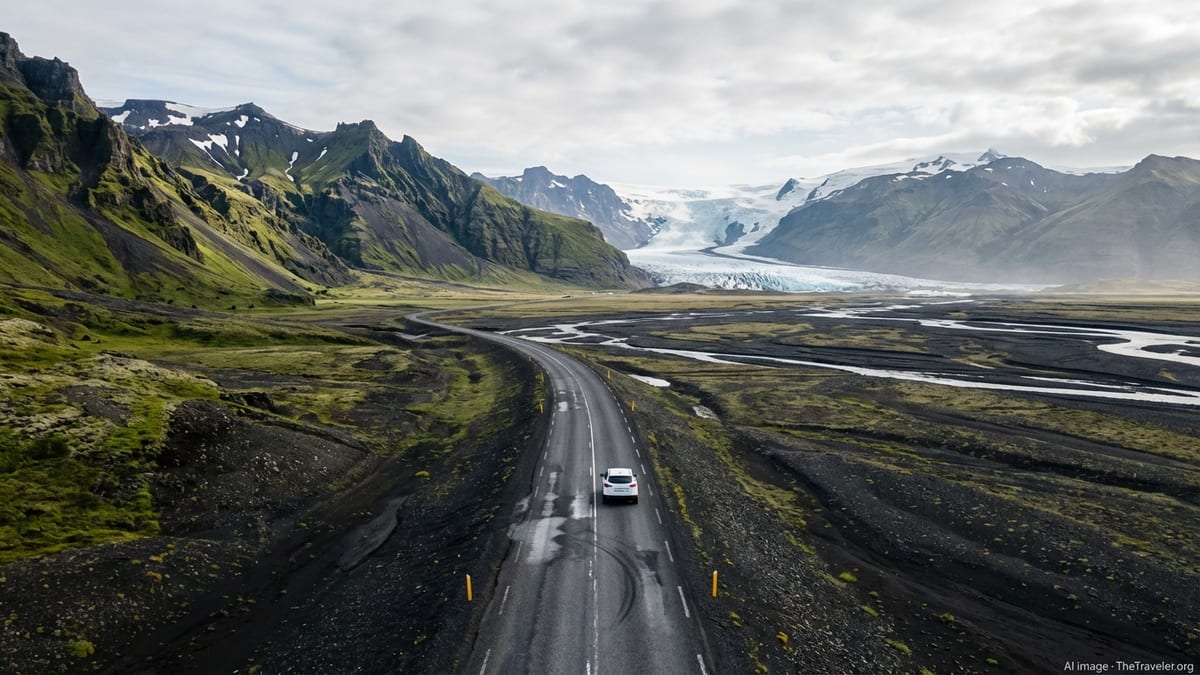
Driving to Vatnajökull National Park is one of the great road journeys in Iceland, threading along the country’s famous Ring Road with glaciers and black-sand plains unfolding outside the window. For many travelers, the question is not whether it is beautiful, but whether it is actually easy and safe to drive there on their own. The honest answer is that it depends heavily on the season, your experience, and how carefully you prepare.
Where Vatnajökull Is and How You Reach It by Road
Vatnajökull National Park sprawls across a huge swath of southeast and central Iceland, built around the massive Vatnajökull ice cap and its outlet glaciers. For most visitors, the practical “driving to Vatnajökull” question really means reaching the easily accessible southern areas, especially Skaftafell, Jökulsárlón Glacier Lagoon and the nearby Diamond Beach. These lie directly off Route 1, Iceland’s paved Ring Road, which circles the island and connects Reykjavík with the south coast and the east.
From Reykjavík, the standard approach runs east along the south coast on Route 1 through Selfoss, Vík and Kirkjubæjarklaustur before continuing to Skaftafell and Jökulsárlón. Under calm summer conditions, the journey from Reykjavík to Skaftafell typically takes about four and a half to five hours of pure driving time, and about five and a half to six hours to Jökulsárlón, not counting sightseeing stops. Because the route is paved and well maintained, many first-time visitors manage this drive in a standard rental car without difficulty.
The park is also reachable from the east, driving west on Route 1 from the town of Höfn. That section of the Ring Road is likewise paved but can feel more remote, with fewer services and longer gaps between fuel stops. Whether you come from west or east, what makes driving to Vatnajökull feel straightforward is that you remain almost entirely on the country’s main highway, without needing gravel highland tracks or specialized off-road vehicles.
How Easy Is the Drive in Summer Conditions?
In late spring, summer and early autumn, most travelers find the drive to Vatnajökull surprisingly manageable. The Ring Road is paved, two-lane and prioritized for maintenance, and traffic along the south coast is steady but not usually overwhelming compared with urban motorways. For drivers used to rural roads, the geometry and surface quality are generally comfortable, though you should expect occasional narrow bridges, curves and short single-lane sections rather than a continuous high-speed highway.
What often surprises visitors is that even in summer there are no hard shoulders like those found on major highways elsewhere, and there are few long passing lanes. Overtaking must be done cautiously and only where visibility is excellent. The posted speed limit on open paved sections is around 90 kilometers per hour, but many visitors choose to drive slightly below that, both to enjoy the scenery and to allow more reaction time for sudden gusts of wind or changes in road surface.
In good weather, the main challenges are more about concentration and planning than about technical driving skills. Distances are longer than they look on the map and long, straight stretches across the sandur plains between Vík and Skaftafell can be monotonous. Fatigue can creep in, especially for those who have just landed after an overnight flight and try to drive directly from the airport toward the park. Breaking the journey with a night in Vík or Kirkjubæjarklaustur can make the experience feel much easier and safer.
Winter and Shoulder Seasons: When “Easy” Becomes “Challenging”
In winter and the shoulder months, driving to Vatnajökull becomes much more serious, even though the road itself is the same. Iceland’s south coast is exposed to the North Atlantic, and storms can bring heavy snow, ice and fierce winds. Local authorities regularly warn of strong gusts along the stretch between Kirkjubæjarklaustur and Jökulsárlón, and closures or difficult driving conditions in southeast Iceland are not unusual when winter weather systems pass through.
The Icelandic Road and Coastal Administration classifies and updates conditions for each region of the Ring Road, including Southeast and South Iceland. Sections may be described as slippery, snow-covered or subject to drifting snow. In poor storms, the road can be temporarily closed or travel discouraged, as seen in recent winters when the stretch between Skaftafell and Jökulsárlón has been shut because of intense winds and blowing snow. Travelers should accept that in these seasons, itineraries may need to change at short notice.
Winter also means very limited daylight, especially around December and early January when there may only be a few usable hours of light along the south coast. Combining darkness, unfamiliar roads and ice magnifies risk. Authorities and local travel advisers strongly recommend planning winter driving so that the longest stretches occur in daylight, avoiding departures or arrivals in the dark where possible. Having flexibility in your schedule and being willing to wait out a storm in Vík, Skaftafell or Höfn is part of responsible planning.
Road Quality, Hazards and Typical Driving Conditions
Route 1 around Vatnajökull is paved, but that does not mean it feels like a multi-lane expressway. The road is usually two lanes with no median, and it crosses several single-lane bridges along the south coast. These bridges require oncoming drivers to coordinate and take turns. Visitors unused to single-lane structures should slow down well in advance, yield where indicated and proceed only when the bridge is clearly free.
Weather-related hazards are the bigger concern. High winds are common on the open sandur plains, where glaciers and volcanoes have deposited fine sediments. Gusts can be strong enough to push light vehicles sideways or slam doors open if you are not careful when exiting the car. Black ice can develop quickly in shaded or wind-exposed areas, even when the rest of the road appears wet but clear. Snowfall may reduce visibility, and blowing snow across the pavement can make lane markings difficult to see.
In general, the Ring Road is a priority route for snow clearing and winter maintenance. Crews plow and treat it as conditions allow, and the aim is to keep it open whenever it is safely possible. Nonetheless, there is no guarantee that every stretch will be passable at every moment in winter. Drivers should be prepared for slower travel times, sudden weather changes and the possibility that a particular day’s plan has to be postponed in favor of staying put.
Car Rental Choices: Do You Need a 4x4 to Reach Vatnajökull?
For the typical summer visitor driving only the Ring Road and paved access roads to visitor centers and parking areas, a standard two-wheel-drive rental car is usually sufficient. The parking lots at Skaftafell, Jökulsárlón and the Diamond Beach are reached by short paved or well-graded gravel access roads that most passenger cars handle without difficulty in dry conditions. Many Icelanders and visitors alike make this journey in small hatchbacks and compact sedans during the warmer months.
The calculation changes if you travel outside of peak summer, or if you want to explore side roads and less-developed viewpoints. In late autumn, winter and early spring, a vehicle with four-wheel drive and decent ground clearance provides greater stability on snow and ice, and can be a valuable safety margin on days with mixed conditions. It is still crucial to remember that a 4x4 does not make you invincible: speed, wind and visibility matter far more than drivetrain alone.
Off the Ring Road, F-roads and highland tracks that lead deeper into the interior are generally closed for much of the year and are never suitable for ordinary passenger cars. Even when they open in summer, they require a true 4x4 and experience with rough terrain, and they are not necessary for visiting the popular glacier lagoons and southern park highlights. For most travelers whose goal is to reach Vatnajökull’s glacier viewpoints and short hiking trails, choosing a car that is comfortable, fitted with appropriate seasonal tires and well insured is more important than seeking extreme off-road capability.
Planning Your Route, Fuel and Stops
Because Vatnajökull National Park sits along one of the most remote feeling stretches of the Ring Road, advance planning makes the drive feel easier. Fuel stations become less frequent east of Vík and especially between Kirkjubæjarklaustur and Höfn. Topping up the tank whenever you pass a station is a simple habit that prevents stress later in the day. Many rural stations are automated and accept major cards, but having a backup payment option is sensible.
Services such as restaurants, cafés and accommodations cluster in a few main hubs: Vík, Kirkjubæjarklaustur, Skaftafell, Höfn and some smaller settlements. Skaftafell has a visitor center, parking, facilities and a nearby campground in season, making it a natural base for exploring the park. Jökulsárlón and the Diamond Beach have large parking areas and limited on-site services, so most travelers combine them with stops in nearby villages before or after their visit.
It is wise to build extra time into your schedule for photo stops, short walks and delays. The scenery is striking almost continuously, and pulling into designated lay-bys rather than stopping on the roadside is essential for safety. Many accidents and near-misses on the south coast involve vehicles that suddenly stop in unsafe places or pedestrians wandering into the roadway while admiring the view. Treating the drive as part of the experience, not merely a transfer, encourages safer behavior.
Safety Tools and Real-Time Information You Should Use
Perhaps the single most important factor in making the drive to Vatnajökull feel easy is how well you use Iceland’s excellent safety information tools. The national road authority maintains a detailed, color-coded map of road conditions that is updated throughout the day, with specific layers for Southeast and South Iceland. Before setting off, and again during longer driving days, you should check this map to see whether sections of Route 1 are clear, icy, snow-covered or closed, and whether strong-wind warnings are in place.
The Icelandic Met Office publishes regional weather forecasts and hazard alerts that complement the road information. When meteorologists issue yellow or higher-level warnings for the south coast, local authorities often advise against unnecessary travel on exposed sections such as the sandur plains near Vatnajökull. Rental agencies and park visitor centers can also provide current, practical advice, including whether certain times of day are better for driving and whether any recent landslides or floods have affected access.
Inside the car, winter drivers should carry warm clothing, sturdy footwear, gloves and a scraper for windows, even if they do not plan to spend long outside. Mobile coverage on the south coast Ring Road is generally good, but there are still patches with weaker signal, and conditions can change faster than forecast. Sharing your daily route plan with accommodation hosts or family, and being willing to turn back if conditions deteriorate, are all part of responsible self-drive travel.
The Takeaway
So is driving to Vatnajökull National Park easy? In calm summer weather, for drivers comfortable with rural two-lane roads, the answer is often yes. The approach is almost entirely along Iceland’s main Ring Road, the surface is paved, and thousands of independent travelers make the journey every year in ordinary rental cars. With sensible planning, rest stops and respect for speed limits, the drive can feel straightforward and deeply rewarding.
However, the same road can become demanding or even hazardous in winter, during storms or for those unaccustomed to wind, ice and limited daylight. The fact that Route 1 is a priority road does not eliminate the risk of closures, drifting snow or black ice. Anyone considering the drive outside of the summer peak should approach it with humility, build flexibility into their schedule, and make full use of Iceland’s road and weather information services.
If your travel style favors independence and you are willing to prepare, self-driving to Vatnajökull can be one of the highlights of an Iceland trip, putting glacier views and wild landscapes within your reach. If, on the other hand, you feel uneasy about winter driving or sudden weather changes, combining limited self-drive days with guided tours from Reykjavík or from south coast bases may be a better fit. The key is to choose the option that matches your skills, the season and your appetite for adventure.
FAQ
Q1: Can I drive to Vatnajökull National Park in a small 2WD car?
Yes, in late spring, summer and early autumn a small two-wheel-drive car is generally sufficient for reaching Skaftafell and Jökulsárlón via the paved Ring Road in normal weather.
Q2: How long does it take to drive from Reykjavík to Skaftafell?
Under good summer conditions, expect roughly four and a half to five hours of pure driving time from Reykjavík to Skaftafell, not counting rest, fuel or sightseeing stops.
Q3: Is the road to Vatnajökull open year-round?
The Ring Road along the south coast is maintained through winter and kept open whenever safely possible, but sections can close temporarily during storms, heavy snow or extreme winds.
Q4: Do I need winter tires to drive there in cold months?
Yes, cars driving in Iceland during the winter season are expected to use appropriate winter or studded tires, and you should confirm with your rental company that the vehicle is properly equipped.
Q5: Are there gas stations between Vík and Vatnajökull?
Yes, but they are more widely spaced than in southwest Iceland, so it is wise to refuel whenever you pass a station, especially between Kirkjubæjarklaustur, Skaftafell and Höfn.
Q6: Is it safe to drive the route in the dark?
While the road is technically open at night, driving in darkness on unfamiliar rural roads with possible ice, wind and wildlife is more demanding, so most visitors try to drive mainly in daylight.
Q7: Can I reach Jökulsárlón and the Diamond Beach without driving on gravel?
The access roads and parking areas at Jökulsárlón and the Diamond Beach are short and generally well maintained; some sections may be gravel but are usually passable for standard rental cars in good conditions.
Q8: Do I need a 4x4 to go into the interior of Vatnajökull?
Yes, routes into the highlands and interior areas often involve rough tracks and F-roads that require a proper four-wheel-drive vehicle and experience; they are not necessary for visiting the main south coast viewpoints.
Q9: What should I check before starting my driving day?
Each day you should review the latest road condition map and weather forecast for South and Southeast Iceland, confirm there are no closures or high-wind alerts, and ensure your car is fueled and properly equipped.
Q10: Is it better to self-drive or join a guided tour to Vatnajökull?
Self-drive offers flexibility and independence, and suits confident drivers in stable weather, while guided tours are often the safer and less stressful choice in winter or for those anxious about Icelandic road conditions.