

More news on this day
As the Gulf crisis and the 2026 Iran war continue to disrupt airspace across the United Arab Emirates, Qatar, Bahrain and Kuwait, travelers are scrambling for alternatives to shuttered or thinning mega-hubs like Dubai and Doha. One of the most obvious substitutes on the map is EgyptAir, using Cairo as a bridge between Europe, Africa, Asia and North America, but the carrier’s mixed reputation and its own regional exposure raise a key question: is Egypt’s flag airline a dependable Plan B while Gulf networks remain in turmoil?
Get the latest news straight to your inbox!
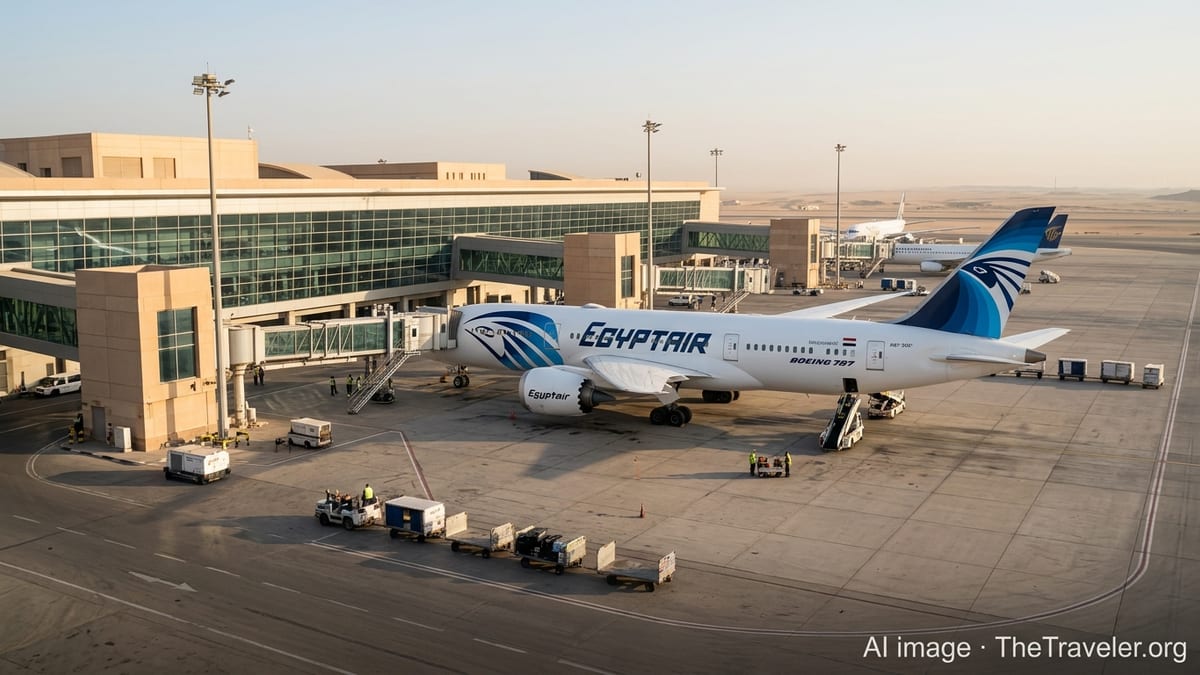
Gulf Closures Push Travelers to Look Beyond Dubai and Doha
Since late February 2026, the war involving Iran and its neighbors has produced one of the most severe aviation shocks since the pandemic, with large sections of Gulf airspace repeatedly closed or tightly restricted. Publicly available air traffic and schedule data indicate that airlines serving the United Arab Emirates, Qatar, Bahrain and nearby states have been forced to cancel or reroute thousands of flights, cutting off normal flows through the region’s largest hubs.
Coverage from regional outlets and industry briefings describes Emirates, Etihad and Qatar Airways operating sharply reduced timetables or suspending services altogether on some days as missiles, air defense activity and changing airspace notices reshape flight paths. Analysts describe a cascade effect in which long haul itineraries from Europe, Asia, Oceania and the Americas that once flowed almost automatically through Dubai, Abu Dhabi or Doha now require complex rebooking through secondary hubs.
In this environment, travelers and corporate travel managers have widened their search to include non Gulf connections in Istanbul, Cairo and Amman, along with more circuitous routes via Europe. EgyptAir and its Cairo hub sit at the crossroads of these shifting patterns, offering an alternative that avoids the heart of the Gulf while still remaining geographically close to the region.
EgyptAir’s Network Strengths: Geography, Alliance Ties and New Long Haul Routes
EgyptAir’s core selling point in the current crisis is geography. Cairo lies just west of the most volatile Gulf airspace but still within practical range of key markets in Saudi Arabia, the Levant and North and East Africa. The airline operates an extensive regional network into these markets, supplemented by longer haul services to Europe, Asia and North America, which allows many passengers to bypass closed Gulf hubs while keeping total travel time relatively competitive.
Publicly available network maps and schedule filings show that EgyptAir is expanding its long haul reach in 2026, with new nonstop links planned from Cairo to Los Angeles and Chicago. These additions build on existing services to destinations such as New York and European capitals, reinforcing Cairo’s role as a transfer point for travelers moving between North America, Africa and parts of the Middle East without passing through the Gulf.
As a member of Star Alliance, EgyptAir can also connect passengers onto partner carriers in Europe, Asia and the Americas. That alliance integration matters during disruption, as it increases options for through ticketing and interline reaccommodation when flights are delayed or canceled. For travelers whose usual Gulf carriers belong to different alliances or operate largely stand alone, EgyptAir’s membership can be a practical advantage when contingency planning.
Operational Reality: Disruptions, Schedule Volatility and On Time Performance
While EgyptAir benefits from geography and alliances, it is not insulated from the wider turbulence enveloping the region. Recent reports on flight boards at Cairo International Airport and regional coverage highlight rolling cancellations and delays on some EgyptAir routes to Beirut, Riyadh and other Middle Eastern destinations as the carrier adjusts to shifting safety assessments and demand swings. These cuts underscore that Cairo is close enough to the conflict zone to feel operational ripples, even if Egyptian airspace itself remains open.
Public timetable data and industry commentary also suggest that EgyptAir’s schedule can be more volatile than that of the largest Gulf carriers in normal times, with relatively frequent last minute aircraft swaps or time changes. For leisure travelers with flexible plans, that may be an inconvenience. For business travelers on tight connections, it can erode the appeal of using Cairo as a precision hub replacement for highly choreographed Dubai or Doha connections.
Independent safety and service assessments further paint a nuanced picture. International safety audit results indicate that EgyptAir meets global baseline standards, operating under Egypt’s civil aviation oversight and subject to external code share and alliance checks. At the same time, customer review analyses and academic work examining passenger sentiment in recent years point to persistent concerns about punctuality, cabin condition and service consistency. Together, these factors suggest that while EgyptAir is a functional alternative from an operational standpoint, reliability may not match the best in class Gulf benchmarks that travelers are used to.
Risk Profile and Safety Perceptions Outside the Gulf Hot Zone
One of the drivers pushing travelers away from Gulf carriers at the moment is perception of risk, as images of missile strikes, emergency airspace closures and grounded superjumbos dominate coverage. Egypt, by contrast, has maintained a more stable security posture during the 2026 crisis, with no comparable closure of national airspace or large scale grounding of its national carrier reported so far. That relative stability is an important psychological factor for passengers looking to minimize exposure to rapidly changing no fly zones.
However, flying via Cairo is not risk free. Egypt borders conflict affected regions, and its aviation sector has previously faced intense scrutiny following high profile incidents in earlier years. Safety improvements, regulatory changes and international partnerships have helped rebuild confidence, but some travelers retain lingering concerns, particularly when compared to the polished safety reputations of leading Gulf airlines before the current war.
Travel risk consultants and insurer advisories published in March 2026 generally focus on avoiding overflight of active conflict zones, monitoring airspace notices in real time and maintaining flexible tickets rather than singling out individual non Gulf airlines for heightened concern. In practical terms, this means EgyptAir can be seen as operating within an acceptable risk envelope for most travelers, provided routes are planned to steer clear of contested skies and passengers remain prepared for last minute rerouting.
Value Proposition: Fares, Flexibility and Who EgyptAir Works Best For
With capacity squeezed and demand concentrated on a shrinking number of viable corridors, airfares through remaining hubs have risen notably. Published fare comparisons on major booking platforms show that itineraries via Cairo on EgyptAir often price below those that still manage to use Gulf carriers or that rely on long detours through Western Europe. That price gap can be considerable on routes connecting Africa or South Asia with North America, making EgyptAir attractive for cost conscious travelers willing to accept some operational uncertainty.
The carrier’s rebooking and fare rules, which are periodically updated in response to the crisis, also influence its value as a backup option. Publicly available advisories show EgyptAir issuing travel waivers on affected regional routes and offering date changes in some cases, but the level of automatic flexibility has tended to be narrower than the most generous waiver policies announced by large US or European airlines. Travelers who prioritize maximum flexibility may therefore prefer to hold tickets on carriers with more expansive change options, even if that means a less direct route.
In practice, EgyptAir appears best positioned to serve travelers whose origin or destination lies in Egypt, North Africa or nearby parts of the Middle East and who can use Cairo as a reasonably direct hub without requiring very tight connections. For long haul passengers originating in North America or Europe, EgyptAir can function as a viable Plan B when Gulf routings are unavailable, particularly on journeys to African destinations. For those whose primary concern is replicating the ultra smooth, high frequency connection experience once offered by the Gulf super hubs, Cairo and EgyptAir are more of a pragmatic workaround than a like for like replacement.