

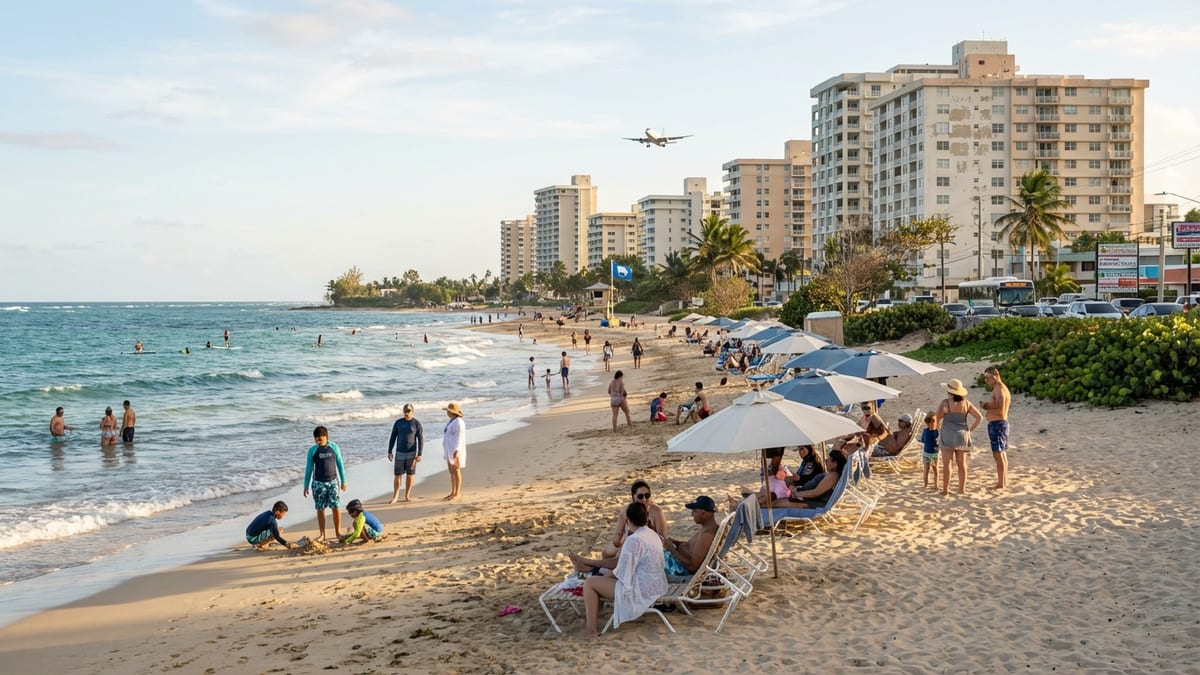
I went to Isla Verde with the kind of expectations that glossy hotel photos and “best urban beach in Puerto Rico” articles tend to create. I pictured a Caribbean version of Miami light: walkable, beachy, easy to reach from the airport, with enough restaurants and nightlife to keep things interesting but not overwhelming.
What I found was a mix of all of that, plus a few very real tradeoffs that I had not fully appreciated before I booked. Isla Verde is not a bad place to stay in the San Juan area, but it is not the universally perfect base that some marketing copy suggests either. If you are considering it, it helps to be very clear about what it is, what it is not, and what you personally care about most.
First Impressions: A Beach Town Next To a Runway
Arriving at Isla Verde could not be easier. From Luis Muñoz Marín International Airport, it took me about ten minutes by taxi to reach my hotel, and the official flat taxi rate to the Isla Verde zone is around 12 dollars before surcharges and tip, with similar pricing reflected in recent airport transport guides. Uber and other rideshares were in the same ballpark, sometimes a little cheaper, sometimes a little more, depending on demand. From a convenience standpoint, this is one of the biggest arguments in favor of staying here: you land, pick up bags, and you are essentially on the beach in less time than a normal city airport commute.
The downside of that convenience shows up quickly. The area is fundamentally an airport-adjacent strip. Planes are part of the soundscape. I could hear takeoffs from the beach and sometimes faintly from my room, although the hotel’s windows did a decent job of muting it. If you are extremely sensitive to noise or you fantasize about a remote, quiet island vibe, Isla Verde will not feel like that dream. It felt more like a modern coastal neighborhood that just happens to be a few minutes from a major runway.
Urban is the right word here. Isla Verde is technically in the municipality of Carolina, not Old San Juan, and you feel that difference. The main drag is a busy avenue with hotels, fast-food chains, local restaurants, pharmacies, and a fair bit of traffic. The beach is gorgeous when you are facing the water, but turn around and it is high-rises, resorts, and some rather anonymous buildings. I did not find it ugly, but it reminded me more of certain parts of Miami or Fort Lauderdale than of a quaint Caribbean town.
The Beach: Beautiful, Crowded, And Not Always As Calm As The Photos
The headline reason people stay in Isla Verde is the beach, and visually it lived up to the hype. The sand is wide and soft, the water a believable shade of turquoise, and there is a long, walkable shoreline that connects several distinct sections, from the Balneario de Carolina on one end to more local spots near Piñones on the other. There is no entrance fee to walk onto the sand, and Puerto Rico’s public beach laws mean access is open. Some parking lots and hotel garages charge a fee, generally a few dollars, which is about what local beach guides describe.
Swimming was where reality diverged from some of my expectations. Many reviews describe Isla Verde as “calm” compared to Condado, which has a reputation for stronger currents and more frequent incidents. That comparison is fair. But “calm” is relative. On most days during my stay, the water in front of my hotel was swimmable but not pool-flat. There were rolling waves and a noticeable pull in some sections. Official safety information and local guides mention that some segments, like Balneario de Carolina and Hobie Beach, are better for general swimming, while Pine Grove draws surfers precisely because the waves are bigger and the water deeper. Those distinctions matter on the ground.
I ended up being more selective than I expected. When I wanted an easy swim, I would walk toward the Balneario area, where the Blue Flag designation, lifeguards, and family orientation made me feel more comfortable. The sea felt calmer there, and the presence of bathrooms, showers, and lifeguards during the day added peace of mind. Closer to my hotel, I sometimes chose to just wade and sit near the shoreline instead of fully swimming, especially when the flags indicated stronger surf. Anyone traveling with kids or less confident swimmers should be prepared to adapt day by day and stick to lifeguarded sections.
Another aspect that surprised me was how busy the sand gets on weekends and holidays. Locals and tourists both love this stretch, and by late morning chairs, umbrellas, and coolers filled up the most accessible pieces of shade. Chair and umbrella rentals were easy to find, but prices were not bargain-level, and vendors preferred cash. The atmosphere was energetic and fun rather than rowdy, but if your idea of a perfect beach is a quiet, nearly empty shoreline, Isla Verde in high season will likely feel too dense.
Daytime Convenience vs. Character: What It Is Like To Stay There
On a practical level, staying in Isla Verde was extremely convenient. I could walk to a supermarket to stock up on water and snacks. There were bakeries, coffee spots, and casual restaurants within a few blocks of my hotel, plus a couple of nicer sit-down places. I never felt stranded or forced to eat resort food if I did not want to. Prices varied. A simple breakfast or lunch at a local spot was reasonably affordable, but anything on the beach with a view tended to be more expensive, often at near-mainland US resort pricing.
That said, the area lacks a strong sense of historic or cultural character compared with Old San Juan. The tradeoff is clear. In Isla Verde, you get doorstep access to the beach and easy access to the airport, but you do not step out of your hotel into cobblestone streets or colonial plazas. When I wanted that, I had to get in a car. Uber rides into Old San Juan usually took around 20 to 30 minutes with traffic and cost somewhere between 12 and the mid-20 dollar range one way, which lined up with recent general estimates for rides between these zones. The drive itself is straightforward, but doing it often adds up in both time and money.
I ended up structuring my days around that reality. Beach time and casual meals happened in Isla Verde. When I wanted museums, forts, or a real night out in Old San Juan, I treated it as a dedicated outing rather than something I would casually pop into. If your ideal San Juan trip centers on history, architecture, or nightlife in Viejo San Juan, it might feel inefficient to be based in Isla Verde for your whole stay. You can absolutely do it, but you will be in a car a lot.
Security-wise, I felt reasonably comfortable walking around during the day along the main streets and beach access points. Like any urban beach neighborhood, there are warnings about petty theft. Local advice emphasizes not leaving valuables unattended on the sand and being aware of your surroundings, especially at night. I followed that guidance, took only what I needed to the beach, and had no issues. I would not describe Isla Verde as unsafe, but I would not treat it as a sealed resort bubble either.
Noise, Nightlife, And The Real Sleep Situation
Before I arrived, I had read conflicting reports about Isla Verde’s nightlife. Some people portrayed it as quiet and family friendly, while others mentioned music late into the night. My experience landed somewhere in the middle. This is not a wild party strip in the way some Caribbean resort zones are, but it is lively. There are beach bars and hotel lounges that play music, and on certain nights the scene felt more like an outdoor nightclub with a mix of locals and visitors.
From my room, I heard a noticeable low thump of bass on one of the weekend nights, even on a high floor. It was not loud enough to keep me up with earplugs, but it would bother a very light sleeper. The airplane noise was there too, although less constant than I feared. The real wild card was street noise. Traffic, the occasional loud motorcycle, and people talking after midnight seeped up more than I expected, perhaps because my hotel faced the main avenue instead of being angled fully toward the beach.
If uninterrupted sleep is a top priority, choosing your specific hotel and room location within Isla Verde is crucial. Beachfront resorts nearer to the Balneario side felt a bit more insulated from outside bustle, at least from what I could see and hear while walking around. Inland hotels that market “easy beach access” may require you to cross busy streets and accept more traffic noise. Personally, next time I would pay extra for a true oceanfront room on a quieter part of the strip and explicitly ask for a higher floor away from bars and music speakers.
On the plus side, having nightlife options within walking distance meant I did not have to Uber to Old San Juan every time I wanted a drink in the evening. I could wander out, listen to live music, have a cocktail by the water, and walk back to my room in under ten minutes. That kind of low-effort evening is exactly what many visitors want from a beach base. It just comes attached to the ambient noise that naturally trails behind it.
Getting Around: Easy Airport Access, Mixed City Connectivity
Transportation is one of Isla Verde’s strongest and most frustrating qualities at the same time. From the airport, as mentioned, it is almost unbeatable. Flat-rate taxis, rideshares, and even public buses connect the terminals to the hotel strip. Bus routes such as the D53 and T5 have been running between the airport, Isla Verde, Condado, and Old San Juan at very low fares, usually under a couple of dollars, though the buses are slow and not ideal for anyone with large luggage. For a budget traveler, that is a legitimate option; for me, the time tradeoff made taxis or Uber more appealing.
Once you are in Isla Verde, though, the neighborhood is not especially pleasant to navigate on foot beyond the immediate beachfront and a few side streets. Sidewalks exist but are not always shaded or charming. Crossing major intersections can feel like crossing any busy urban arterial road. I did not feel unsafe, but this was not the kind of place where I wandered aimlessly just to explore. Most of my walking was purposeful: hotel to beach, hotel to dinner, hotel to pharmacy. For anything beyond that radius, I defaulted to ride-hailing.
Traffic also surprised me. At certain times of day, especially late afternoon and early evening, the main road through Isla Verde clogged up. That meant what should be a 15 minute car ride into Condado or Old San Juan stretched closer to 30. It is not gridlock in the sense of a major mainland city, but if you plan multiple in-and-out trips per day, it can get tiresome. This is another case where you feel the “urban” part of “urban beach” more than the brochures suggest.
Parking is another practical issue. Official guidance and local sites talk about paid parking lots near beach entrances, charging around 3 to 10 dollars depending on location and time. That was consistent with what I saw. Hotels charge their own daily parking fees as well. If you are renting a car mainly to sit in hotel parking while you enjoy the beach, I would rethink that choice. Within Isla Verde itself, I did not find a rental car necessary. For longer trips out to places like El Yunque or the island’s west coast, a car can be useful, but for a stay that is mostly beach plus San Juan city exploring, taxis and Ubers made better sense.
Costs, Crowds, And Value For Money
One of my hopes going in was that Isla Verde might present a slightly better value than staying right in Condado or Old San Juan. The reality is more nuanced. Some midrange hotels and non-oceanfront properties in Isla Verde were indeed a bit more affordable. A couple of blocks back from the beach, I noticed options that were cheaper per night while still allowing easy access to the sand. Some hotels that are not directly on the water offer access to reserved sections of Isla Verde Beach, which can be a good compromise if you want to save on room rates but still have chairs and umbrellas in a defined area.
However, once you are factoring in the full trip cost, Isla Verde does not feel like a budget play. Restaurant prices, especially for anything beach-adjacent, were comparable to major US city dining. Cocktails frequently hit double digits. Beach rentals, while not outrageous, added up if I wanted shade every day. Transport to and from Old San Juan for multiple evenings came out to a noticeable sum. I did not feel gouged, but I did not feel like I had discovered some underpriced gem either. It felt fairly priced for a popular, convenient urban beach district, not a bargain.
The crowd composition is part of that picture. Isla Verde is firmly established on the tourist map, both for mainland visitors and for Puerto Ricans doing staycations or day trips. That creates an interesting mix: hotel guests from abroad, families from the metro area, cruise passengers on a pre- or post-cruise night, and digital nomad types working from cafes. I liked that energy, but it also meant that very local, non-touristed experiences were not the default. If your goal is to feel far from the mainstream vacation circuit, you will not find that feeling here.
In terms of value for money, my opinion is that Isla Verde makes the most sense if you are going to actually use the beach extensively. If you spend long stretches on the sand, swim often, and make use of the short airport transfer, you get your money’s worth. If you end up spending most of your time in Ubers to Old San Juan and doing inland excursions, you may start wondering why you are paying beach zone prices to mostly look at the sea through the car window.
Did Isla Verde Match My Expectations?
My expectations going in were shaped by two conflicting narratives: the promotional one that painted Isla Verde as the perfect base for almost anyone, and the cautionary one that insisted Condado and Old San Juan were more “real” or interesting. The truth, as so often, sat in between. Isla Verde is a very practical, visually appealing place to stay if beach time is central to your trip. The water is generally more forgiving than in some nearby neighborhoods, and the combination of lifeguarded sections, Blue Flag recognition in parts, and wide sandy areas makes it objectively good for families and casual swimmers when conditions cooperate.
Where it fell short for me was in atmosphere and distinctiveness. Sitting on the beach, I loved it. Walking the main road at night, I sometimes could have been in any warm-weather resort corridor in the world. I did not regret staying there, but I did occasionally regret staying there for my entire trip. There were evenings when, after yet another Uber ride back from Old San Juan, I wished I had split my stay between a few nights in the historic center and a few nights on this beach.
Some frustrations were minor but cumulative. The combination of plane noise, traffic, and nightlife hum made it impossible to pretend I was on a remote island. The need to constantly think about where to leave valuables when going into the water was a reminder that this is an urban beach, not a secluded cove. And the mismatch between glossy photos of perfectly calm seas and the reality of sometimes choppy conditions made me more cautious in the water than I had expected to be.
On the other hand, a few things exceeded expectations. The sheer ease of landing and being at my hotel in minutes was a genuine joy after dealing with longer transfers elsewhere in the Caribbean. The ability to mix with locals on the sand rather than being in an entirely sealed resort bubble made the place feel more alive. And I appreciated how quickly I could duck out for a coffee, pharmacy run, or inexpensive meal without relying on hotel infrastructure.
The Takeaway
After staying in Isla Verde, I would describe it as a good place to stay in the San Juan area for a specific kind of traveler, under specific conditions, rather than as a universal recommendation. If your main priorities are a long, attractive beach, very short airport transfers, and a mix of casual and resort-style amenities within walking distance, Isla Verde delivers. You will swim, you will stroll the sand at sunset, you will find plenty of food options, and you will never be more than a short ride from the airport or other parts of the city.
If, however, your image of San Juan revolves around colorful colonial streets, live salsa in small bars, and wandering through centuries-old forts, then basing yourself entirely in Isla Verde might not be ideal. You can and should visit Old San Juan from here, but each visit involves transport logistics and time that chip away at spontaneity. In that case, I would strongly consider splitting the trip: a few nights in Old San Juan or Condado for city life, and a few nights in Isla Verde primarily for the beach.
Personally, if I went back, I would change two things. First, I would be more deliberate about my hotel choice within Isla Verde, prioritizing oceanfront rooms on quieter sections, away from the densest nightlife and street noise. Second, I would avoid making Isla Verde my only base, instead treating it as the “beach chapter” of a larger San Juan stay. Under those conditions, I think I would enjoy it more, appreciating its strengths without getting stuck on its limitations.
In the end, Isla Verde is not the dreamlike escape that some photos suggest, but it is also not the generic, characterless strip that some critics describe. It is a busy, beautiful, slightly chaotic urban beach district that rewards travelers who arrive with realistic expectations: you get convenience and coastline, you accept planes and crowds. If that tradeoff feels acceptable to you, Isla Verde can absolutely be a good place to stay.
FAQ
Q1. Is Isla Verde actually part of San Juan?
Technically, Isla Verde is in the municipality of Carolina, directly east of San Juan, but in practical travel terms it feels like part of the greater San Juan metro area. You can reach Old San Juan by car in about 20 to 30 minutes depending on traffic.
Q2. How long does it really take to get from the airport to Isla Verde?
In my experience, it took around ten minutes by taxi from Luis Muñoz Marín International Airport to my hotel in Isla Verde. Official flat taxi fares list Isla Verde as the closest tourist zone, and rideshares were similarly quick unless traffic was unusually heavy.
Q3. Are the beaches in Isla Verde safe for swimming?
Generally, yes, but it depends on the specific section and daily conditions. Areas like Balneario de Carolina and Hobie Beach are considered better for typical swimmers and families, with lifeguards during the day. Sections like Pine Grove have stronger waves and are popular with surfers. I always checked flags and preferred to swim where lifeguards were present.
Q4. Is Isla Verde a good choice for families with kids?
For many families, yes. The combination of a wide sandy beach, relatively calmer areas, daytime lifeguards, and easy access to hotels and food makes it practical. The downsides are urban factors: noise, crowds on weekends, and the need to watch your belongings on the sand. Families who value convenience and are comfortable in busy environments will likely do well here.
Q5. How expensive is it to stay and eat in Isla Verde?
Hotel prices vary widely, but beachfront resorts are usually in the same range as other major Caribbean city beaches. A bit inland, you can find somewhat cheaper options. Restaurant prices felt similar to a mid- to high-cost US city, especially on the waterfront. It is not a budget destination, but you can manage costs by mixing local spots with occasional splurges.
Q6. Is it easy to visit Old San Juan from Isla Verde without renting a car?
Yes, but it takes planning. I used Uber most of the time, and rides typically cost from the low teens to mid-20 dollars one way, with travel times around 20 to 30 minutes. There are also public buses that connect the airport and hotel zones to Old San Juan for a very low fare, but they are slower and not ideal for late-night returns.
Q7. How bad is the noise from planes and nightlife?
You will notice both. Planes are part of the soundscape, especially outdoors and on some hotel balconies. Nightlife noise depends heavily on where you stay; areas near beach bars and main intersections can have music and chatter late into the night. In my case, it was manageable with earplugs, but light sleepers should choose hotel and room locations carefully.
Q8. Is Isla Verde walkable?
Within the immediate hotel and beach strip, yes. I walked to the sand, nearby restaurants, pharmacies, and small shops without trouble. Beyond that, walking becomes less pleasant because the main avenue is busy and not especially scenic. For anything more ambitious, I relied on ride-hailing rather than treating Isla Verde as a deeply walkable neighborhood.
Q9. Should I rent a car if I stay in Isla Verde?
For Isla Verde itself and basic trips into San Juan, I did not find a car necessary. Taxis, Uber, and buses covered those needs. A rental car makes more sense if you plan multiple day trips outside the metro area, like to El Yunque, Luquillo, or the west coast. Just factor in hotel parking fees and the hassle of traffic when deciding.
Q10. Who is Isla Verde best suited for as a base in the San Juan area?
In my view, Isla Verde is best for travelers who prioritize beach time and convenience: people on short trips who want to be on the sand within minutes of landing, families who like a turnkey beach setup, and visitors comfortable trading some local charm and quiet for practical amenities. If your heart is set on nightlife and historic atmosphere, you may prefer to base in Old San Juan or split your stay between there and Isla Verde.