

I had been hearing about Johannesburg Zoo for years before I finally went. Locals described it as a Joburg institution, somewhere between nostalgic family outing and slightly faded city landmark.
When I found a free weekend in Johannesburg, I decided it was time to see for myself whether the zoo still deserved a spot on a modern itinerary, especially with so many South Africans now questioning the role of zoos in general. What I found was a day that was pleasant in parts, frustrating in others and, ultimately, worthwhile in a specific, limited way.
Planning the Visit: Expectations vs Reality
Before going, I checked the practical details carefully. The zoo is open daily from around 08:30 to 17:30, with last entry at 16:00, which suited my loose schedule. Knowing it was open almost every day of the year removed the usual anxiety about unexpected closures. Ticket prices as of 2025 are not cheap by local standards, especially for families, but they are still relatively reasonable compared with big-city attractions elsewhere. There are occasional specials and discount periods, which are worth looking out for if you are flexible with dates.
I appreciated that I could now buy tickets online and avoid queuing at the gate. That felt like a small but important step forward. The process was not complicated: choose the date, pay, and receive a digital ticket that I showed on my phone at the entrance. It was not entirely seamless, though. The confirmation email arrived a bit slowly, and there was still a small cluster of people at the gate who had pre-booked but were unsure which line to stand in. Staff sorted it out eventually, but the whole experience felt less streamlined than the promise of “go digital” might suggest.
In my head, I had pictured Johannesburg Zoo as a more modern, polished cousin of some older city zoos I have visited. The official messaging talks about high animal welfare standards, conservation and education programs, and even special events like “Zoo Snooze” overnight stays and night tours. I arrived expecting at least a mid-range, well-maintained facility with a clear conservation focus. What I actually found was a mixed bag: areas that looked modern and well kept, others that felt tired and dated, and a general sense of a place trying to stretch limited resources a very long way.
Getting There: Easy by Car, Awkward Without
Physically reaching the zoo was straightforward for me because I had access to a car. The main entrance is in the leafy northern suburbs, right by Jan Smuts Avenue and Upper Park Drive. Traffic can be busy, but the location is central and easy enough to plug into a navigation app. There is a purpose-built parkade with plenty of parking, and the fee was minor compared with the entry ticket. I never felt my car was unsafe, which is something you cannot always take for granted in a big city.
However, when I looked at how I would have come without a car, the logistics seemed less attractive. It is technically possible to take the Gautrain to Rosebank or Park Station and then connect to buses or a rideshare, but it is not a simple “train-to-gate” experience. For a solo traveller or a couple comfortable with city transport, it is manageable, but for families with small children, prams and picnic gear, it becomes a hassle. I saw a few school buses and tour buses pulling up, which is clearly how many local groups handle it.
Inside the entrance, navigation was mostly intuitive but not perfect. There is a map at the gate, and printed maps are sometimes available, though I had to ask for one rather than seeing stacks available. Signage around the grounds is better in some sections than others. In a few places, I found myself backtracking because a path dead-ended or led me away from the animals I had intended to see. The site is not impossible to navigate, but it could be more thoughtfully laid out, especially for first-time visitors.
First Impressions: Green, Spacious and Slightly Worn
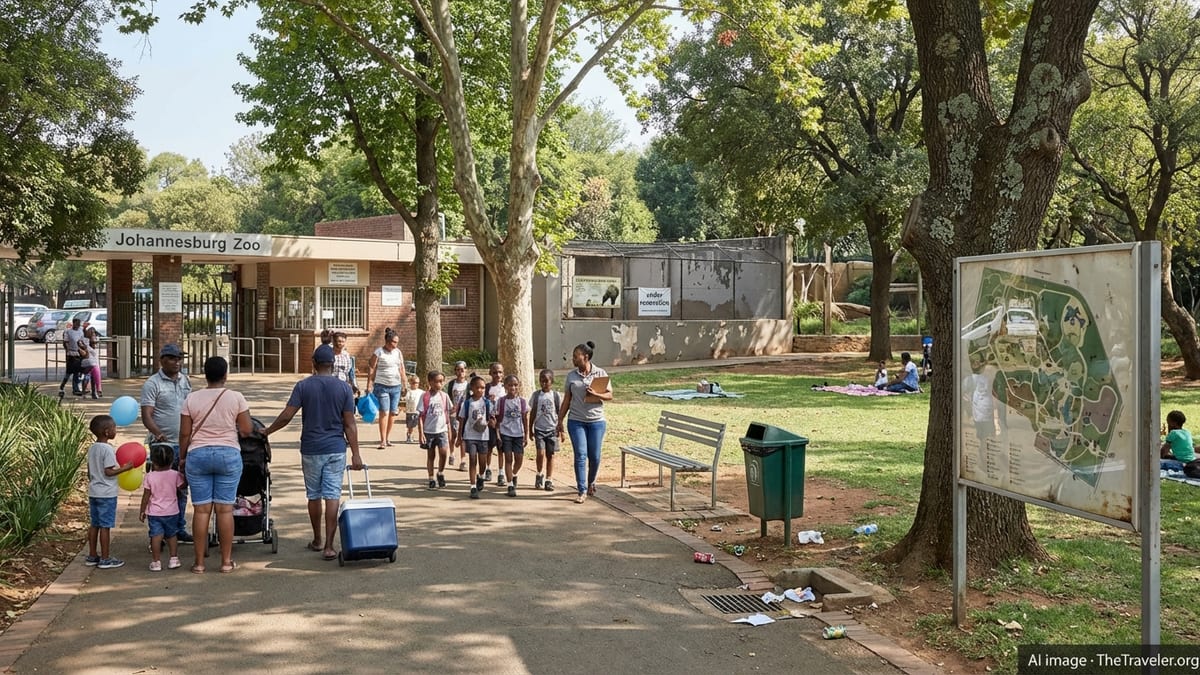
My first impression as I walked in was actually quite positive. Johannesburg is one of the world’s more wooded cities, and the zoo benefits from that. The grounds are lush, with big old trees providing shade, grassy patches for picnics, and wide paths. On a sunny day, it feels like a big, slightly old-fashioned city park that happens to have animals in it. Children were running ahead, families were dragging cool boxes and picnic baskets, and the general mood felt relaxed and friendly.
Look a little closer, though, and the age of the place starts to show. Some enclosures are clearly from an older era of zoo design: concrete, heavy mesh and limited enrichment visible inside the animals’ spaces. In other sections, newer habitats feel more in line with modern standards, with more naturalistic landscaping and better viewing areas. The contrast between the two styles is quite stark. It almost feels like you are walking through layers of zoo history in a single afternoon.
Cleanliness was acceptable but inconsistent. Most of the main paths were clean, and bins were available, yet I noticed litter gathering in some corners and around busy picnic lawns, especially later in the day. Toilets varied from “fine” to “I would rather wait.” Some blocks were reasonably clean and stocked; others were clearly due a more thorough scrub and better maintenance. It was not enough to ruin the day, but it chipped away at the sense of care and investment I had hoped to see.
The Animals: Highlights, Concerns and Empty Enclosures
The reason people come to the zoo is, of course, the animals. Johannesburg Zoo has a long history and a large collection, including several of the iconic “big” African species. On paper, that sounds exciting. In practice, my experience ranged from absorbing to frankly a little depressing, depending on the exhibit and the time of day.
Some of the animals looked well, active and engaged with their environments. I stood for a long time watching a group of primates interact, grooming and chasing each other in an enclosure that, while not enormous, at least had climbing structures and varied spaces. A pair of big cats were lying in the shade, clearly relaxed, occasionally lifting their heads as visitors shuffled past. Birds in the aviary section seemed lively and vocal, and I enjoyed lingering there more than I expected.
Elsewhere, I found things harder to reconcile. A few enclosures looked undeniably small for the animals they were housing, especially when I compared them with modern standards I had seen in newer zoos elsewhere. In some habitats, I could not see much in the way of environmental enrichment: a few logs, a patch of grass, maybe a small pool. That might be adequate on paper, but as a visitor watching an animal pace the same path repeatedly, it did not feel entirely comfortable. I cannot definitively judge welfare based on one day’s visit, but there were moments when I felt uneasy.
I was also caught off guard by how many enclosures were empty or appeared to be under some kind of renovation, often without clear explanation. More than once, I arrived at a habitat that the map listed as housing a particular species, only to find fencing, construction tape or a sign noting that the animal was “off display.” In some cases, there was a brief explanation; in others, nothing at all. If you are coming specifically hoping to see certain flagship species, you may leave disappointed.
Visitor Experience: Crowds, Families and Facilities
On the positive side, the general atmosphere on the day I visited was warm and lively. The zoo is clearly beloved by many local families. Children squealed at every monkey and zebra, parents snapped photos and grandparents settled in with folding chairs and picnic spreads. Hearing kids argue excitedly about whether the lions were “actually looking at them” is the sort of moment that reminds you why zoos have retained their grip on the public imagination for more than a century.
The flip side of that popularity is that certain areas get very crowded, especially around midday when the weather is pleasant. Viewing windows can be clogged with prams and school groups, and it can be difficult to get close enough to see anything without waiting patiently. On one occasion, I simply gave up on an indoor viewing area because it felt claustrophobic and noisy. If you dislike crowds, you will want to arrive as close to opening time as possible and head straight for the headline exhibits before they fill up.
Facilities for visitors are uneven. You are allowed to bring your own food, which many people do, and there are a number of lawns and shaded areas where picnics are welcome. This is one of the zoo’s real strengths: it feels more like a day in the park, with animals as a bonus, than a purely transactional attraction. There is also on-site food available, including a main restaurant and smaller vendors. The food I tried was mediocre but edible, priced roughly in line with what you would expect from a captive-audience venue. I would not come here for the cuisine, and if you are picky, you are better off bringing your own lunch.
Services, Education and Events: Ambitious but Patchy
Johannesburg Zoo likes to present itself as more than just a place to look at animals. It offers guided walks, school programs, themed events and even overnight “Zoo Snooze” experiences. On paper, this is exactly the kind of diversification a historic zoo needs to stay relevant and generate revenue for conservation and maintenance. In practice, my experience of these extras was mixed.
During my visit, there were educational signs around many enclosures, some of which were informative and up to date, others clearly older and faded. A few signs were missing altogether. I noticed that school groups were being led by guides from the education department, and their energy and engagement seemed genuine. Hearing someone explain the difference between various antelope species to an attentive class was a bright spot that made the zoo feel like a living classroom rather than a static menagerie.
At the same time, for an independent visitor not on a tour, it was easy to miss out on this educational layer. There was no obvious schedule of public talks or feeding times posted in a central, visible way, at least not where I looked. If such events were happening, they were not well advertised on the day. It felt like there is good content and expertise on site, but the delivery to casual visitors is not as strong as it could be.
The zoo also runs periodic promotional campaigns and special events, including discounted entry periods and themed evenings with music and lights. I did not time my visit with any of these, which may have been a blessing in terms of avoiding extra crowds. However, the marketing focus on these events does raise a wider question: how much of the zoo’s current energy is going into being a multi-purpose events venue versus investing in core animal habitats and infrastructure. From the ground, it sometimes felt like the balance was tilted toward the former.
Ethical Reflections: A Zoo in a Changing World
It is impossible, at least for me, to visit a zoo these days without thinking about the ethics of keeping wild animals in captivity. Johannesburg Zoo is over a century old, and it carries that legacy visibly. Some of its enclosures and design choices reflect an era when the primary goal was to showcase exotic animals to the public. Today, the rhetoric has shifted toward conservation, breeding programs and education, but the physical reality has not always caught up.
To its credit, the zoo does emphasize animal welfare in its public communication. Staff I spoke to seemed committed and knowledgeable. There are signs explaining conservation projects and breeding successes. I do not doubt that there are people working very hard behind the scenes with the resources they have. However, walking past a large, intelligent animal in a space that still feels small and artificially constrained is something I find increasingly hard to justify, even when accompanied by educational plaques.
For families and especially for children who might never get to see these animals in the wild, the zoo offers a powerful, tangible connection to wildlife. Standing a few meters away from a big cat or a rhino, you cannot help but feel something visceral. That experience can, and often does, translate into empathy and concern for conservation. At the same time, I think it is important to be honest about the compromises involved: these animals are there for our benefit and education as much as for any conservation agenda.
Personally, I left with mixed feelings. I was glad to have gone, to have observed the animals closely and to have seen the role the zoo still plays in local life. But I also felt that Johannesburg Zoo sits at a crossroads. Parts of it clearly need reinvestment and redesign to meet modern expectations. Without that, I worry it risks becoming a slightly melancholy relic: a place people still visit out of habit and convenience rather than conviction.
Is It Worth It and What I Would Do Differently
So, is Johannesburg Zoo worth visiting? My answer is a cautious yes, with conditions. If you are travelling with children who are animal-obsessed, or you are a local looking for an affordable day out in a safe, green environment, the zoo still delivers a certain kind of simple, old-school family outing. The grounds are pleasant, there are enough animals visible to keep everyone interested for a few hours, and the freedom to picnic makes it feel less commercial than many other attractions.
If you are a traveller with limited time in Johannesburg, particularly if you are already planning a trip to a game reserve or national park where you will see animals in more natural settings, the zoo drops down the priority list. It is not an essential stop in the way that an open-air museum or a uniquely local cultural experience might be. You will probably appreciate your time more by focusing on neighbourhoods, galleries, history museums and, eventually, a proper safari outside the city.
Looking back on my own visit, there are a few things I would do differently. I would aim to arrive closer to opening time to have the quieter, cooler part of the day in the animals’ sections, leaving the afternoon for slow walks and picnicking rather than trying to see everything in one go. I would bring my own food and enough water to avoid relying on the onsite options. I would also check ahead for any specific closures or big events that might affect crowds or access, rather than assuming the map and website fully reflect the on-the-day reality.
If you are particularly sensitive to animal welfare issues, I would recommend going in with open eyes and an honest inner dialogue. You will likely find both moments of joy and moments of discomfort. For me, acknowledging that complexity was more satisfying than pretending everything was either terrible or wonderful.
The Takeaway
Johannesburg Zoo is not a polished, cutting-edge conservation showcase, nor is it a neglected disaster. It is something in between: a historic city zoo, set in beautiful green grounds, doing its best with finite resources, carrying the weight of its past while trying to be relevant in the present. My day there had genuine highlights: watching children encounter animals they had only seen in books, sitting under big old trees with a breeze cutting the heat, observing small details of animal behavior that you miss on a rushed safari drive.
It also had frustrations. Some enclosures felt too small or too bare. Clear information was sometimes lacking. A few facilities needed more attention. The mix of renovated and old sections created a slightly disjointed experience, as if I were walking between decades rather than exhibits. None of these flaws made the visit a failure, but they did stop it from being the kind of place I would rave about unreservedly.
In the end, I would say Johannesburg Zoo is worth visiting if you fit into one of a few categories. If you are a local family looking for a relatively affordable, full-day outing with green space and animals, it still ticks the box, especially if you bring your own picnic and keep your expectations realistic. If you are an international visitor who will not have the chance to go on safari, the zoo can offer at least a partial, accessible window into African wildlife. If you are deeply invested in modern zoo ethics and design, you may find it more instructive than enjoyable, a case study in a venerable institution trying to redefine itself.
Would I go again? Possibly, but I would not shape a whole day around it in the same way. I might combine a shorter zoo visit with time at nearby parks or neighbourhoods, treating it as one component of a broader city experience rather than the main event. With thoughtful planning and clear expectations, Johannesburg Zoo can still be a worthwhile stop. Just do not expect perfection, and be prepared to hold both its charms and its limitations in mind at the same time.
FAQ
Q1. What are the current opening hours at Johannesburg Zoo?
The zoo is generally open daily from around 08:30 to 17:30, with last entry at 16:00. These hours can shift slightly for special events, so I recommend checking the official information close to your visit, but in practice I found those times accurate for a normal day.
Q2. How much does it cost to visit Johannesburg Zoo?
As of 2025, standard adult and child tickets are moderately priced by international standards but can add up quickly for larger families. There are reduced rates for seniors, students and school groups, and occasional promotional discounts during special months. For my visit, I felt the price was fair for a half or full day out, but not a bargain.
Q3. Is it better to buy tickets online or at the gate?
I found it easier to buy tickets online in advance, which allowed me to bypass the main ticket queue and walk straight to the entrance check. The system worked, even if it was not perfectly smooth, and it reduced uncertainty. If you visit on weekends, holidays or during special events, I would definitely recommend pre-booking rather than relying on walk-up tickets.
Q4. How long should I plan to spend at Johannesburg Zoo?
I would plan at least three to four hours if you want to see most of the main animals without rushing, and a full day if you include a picnic and longer stops at certain exhibits. The grounds are quite spread out, and you will do a fair bit of walking, so padding your schedule is better than trying to cram everything into a short visit.
Q5. Is Johannesburg Zoo easy to reach without a car?
It is possible but not especially convenient. Using the Gautrain plus buses or rideshares will get you close, but it requires connections and a bit of planning. For solo travellers or couples, this is manageable. For families with children and gear, a car or organised tour bus is noticeably easier. I was glad to have access to a car when I went.
Q6. Are the facilities suitable for young children and prams?
Yes, for the most part. The paths are wide and mostly paved, so prams and strollers are common and manageable. There are lawns where children can run around, and a generally family-friendly atmosphere. The main drawbacks are crowding at popular viewing spots and toilets that vary in cleanliness. I would still take young children, but with realistic expectations.
Q7. Can I bring my own food and have a picnic inside?
Yes, and I would strongly encourage it. Bringing your own food and drinks gives you more control over cost and quality, and the grounds are well suited to picnicking with plenty of green, shaded areas. There are onsite food outlets, but what I tried was average and not a highlight of the visit.
Q8. How does Johannesburg Zoo compare with seeing animals on safari?
It is a very different experience and should not be seen as a substitute. A safari offers space, natural behavior and a sense of wildness that a city zoo simply cannot replicate. Johannesburg Zoo is more about convenience and accessibility: you can see a variety of animals in a few hours without leaving the city. If you have the choice, I would prioritize a safari; if you do not, the zoo still provides a worthwhile, if imperfect, encounter with wildlife.
Q9. Are there any parts of the zoo I should prioritise or avoid?
I would prioritise the areas with larger, more naturalistic enclosures and the aviaries, which I found surprisingly engaging. I would also try to see the headline species early in the day, before crowds and heat build up. I would not say there are areas to outright avoid, but some older enclosures can feel a bit dated and may be less comfortable to linger at if you are sensitive to welfare concerns.
Q10. Who is Johannesburg Zoo best suited for, and who might want to skip it?
In my experience, the zoo is best suited for local families, school groups and visitors who will not have the chance to see African wildlife elsewhere. It is a pleasant, if imperfect, day out in a green urban setting. On the other hand, if you are a short-stay visitor with a packed itinerary, or if you already have a safari planned, you may find your time better spent on other uniquely Johannesburg experiences rather than dedicating a full day to the zoo.