

I had dreamed about the Maasai Mara for years. In my mind it was the ultimate African safari: endless grasslands, cinematic predator chases, and wildebeest hurling themselves into crocodile-filled rivers at sunset. When I finally went, I did get some of those scenes.
But I also got traffic jams of safari vehicles, long dusty transfers, surprising new rules, and a price tag that felt a lot heavier on the ground than it did when I first swiped my card. Looking back, I am glad I went, but not for all the reasons I expected, and not without some pretty firm caveats.
Getting There: The First Reality Check
My first compromise came before I even saw a zebra. I had to decide how to get from Nairobi to the Mara: fly or drive. On paper the 45-minute flight sounded like a no-brainer, but the small bush planes have strict 15-kilogram soft-bag limits, including hand luggage. I travel with a camera, lenses and a laptop. I could have stripped everything down, but it would have meant leaving half of what I normally consider essential behind. In the end I chose to drive, convincing myself that I wanted to “see the countryside.”
The first half of the drive is fine: tarmac roads, a dramatic viewpoint over the Great Rift Valley, and a roadside stop for bathrooms and snacks. The last stretch after Narok is where the romance fades. That section is now infamous for a reason. Even in dry conditions it was a bone-rattling mix of corrugations, gravel, dust and random potholes, the kind locals jokingly call the African massage. I like road trips, but this was less scenic journey and more endurance test. By the time we pulled up to the gate I was stiff, dusty and slightly over it, not in the euphoric “I’m in the Mara” mood I had imagined.
Driving also meant losing almost a full day of potential game viewing. We left Nairobi around 8 in the morning and got to camp mid-afternoon, just in time to gulp down a late lunch and rush for the first game drive. If I did it again with the same luggage, I would seriously consider paying to store a suitcase in Nairobi and flying in light. The time, comfort and extra game drive would probably justify the hassle and the extra cost.
Rules, Fees and the Quiet Creep of Costs
What surprised me next was how much the Mara experience is now shaped by regulations and rising fees. I had done my homework on park entry costs, so I knew they had recently gone up, especially in high season. Still, hearing the actual numbers and realizing they applied per person per day, and then adding vehicle fees and conservancy fees, made my spreadsheet feel suddenly optimistic.
The reserve operates on a 12-hour ticket system with strict gate times. Officially the reserve is open roughly from early morning to early evening, and every ticket expires in the evening regardless of when you enter. This is fine if you are staying inside the reserve, but it becomes an expensive headache if you are in budget accommodation outside and want multiple game drives. It is also a system that leaves very little flexibility. By 6 or so in the evening rangers are visibly herding vehicles out. If you are expecting romantic sundowners deep in the savannah until the stars blaze overhead, you will not find them inside the main reserve; night drives are not allowed there and are only possible in some private conservancies.
Another big shift is that private self-drive vehicles are no longer allowed inside the Reserve itself. Everything is now in the hands of licensed tour vehicles and professional driver-guides. From a conservation and safety standpoint this makes sense. From a traveler’s perspective, it removes the option of a lower-cost, do-it-yourself safari and locks you into the commercial circuit. If you are someone who loves the autonomy of self-drive parks in southern Africa, the Mara will feel controlled and, frankly, expensive.
First Game Drives: Magic, With Caveats
My first game drive was the kind of experience that papers over a lot of grievances. Within fifteen minutes we were watching a pride of lions sprawled lazily in the grass, cubs clambering over their mothers while topi kept a wary distance. Later that evening a pair of cheetahs emerged from a thicket at golden hour, the sort of sighting I had seen on glossy safari brochures and assumed was rare marketing luck. Seeing it with my own eyes felt unreal, and for a while I forgot the drive, the cost and the rules.
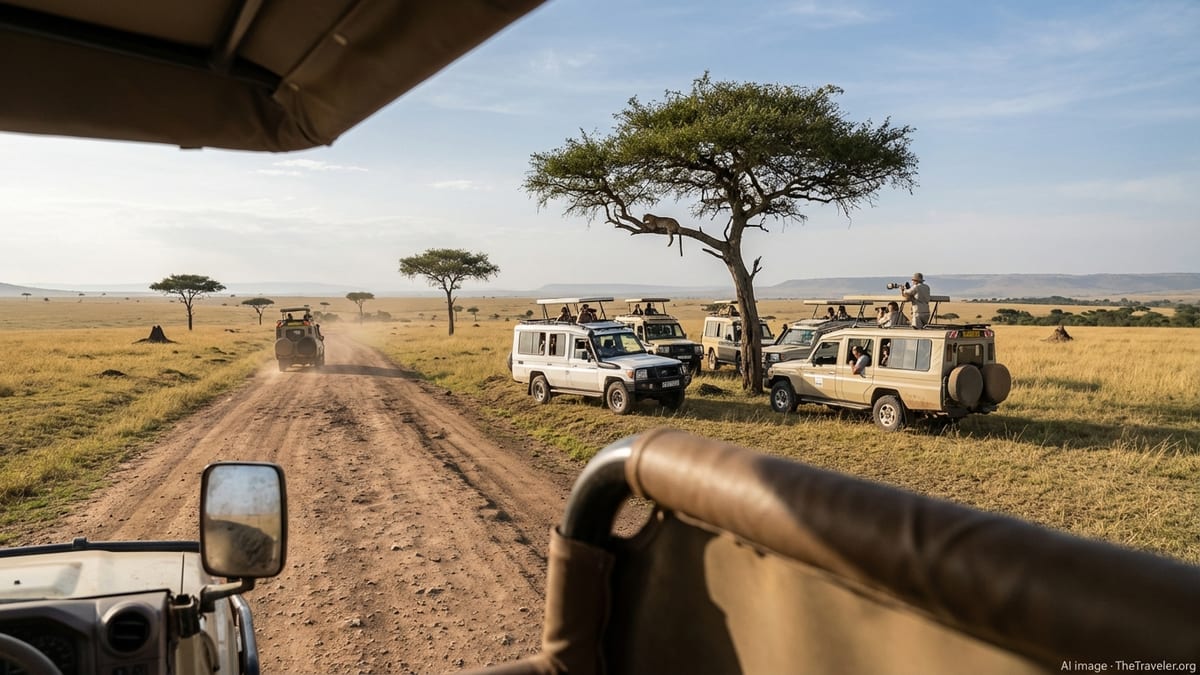
But even on that very first drive, the cracks showed. Every time the radio crackled with a predator sighting, a wave of vehicles would converge. At one lion encounter I counted more than twenty vehicles encircling a single tree where a leopard had hoisted its kill. Engines revved, people leaned out for photos, and some guides edged closer than the informal distance rules suggested. The leopard, which had clearly been feeding earlier, froze and eventually slipped away into thicker cover. The whole thing felt more like a crowded whale-watching trip than a quiet moment in the wild.
Guide quality matters a lot in this context. I was fortunate; my guide was experienced and conservative. He refused to push closer when vehicles began clustering, and more than once he suggested we leave a sighting because he felt the animal was stressed. Not every vehicle around us was as restrained. In the high season, especially around the famous river crossings, that restraint can disappear almost entirely. I went outside the absolute peak months and still saw what I would call borderline mob behavior at a single cheetah sighting. If you picture yourself in a pristine wilderness with just a couple of respectful vehicles quietly observing, be prepared for a different reality in the busier areas.
The Migration Myth Versus Reality
My trip coincided with the tail end of migration activity in the ecosystem, not peak July and August chaos, and that might have been a blessing. I knew before traveling that the idea of the migration as a precise, bookable spectacle is essentially marketing; the animals follow rain and grass, not human calendars. What surprised me was less the unpredictability and more the pressure that unpredictability exerts on tourists and guides.
On one morning at the river, we joined at least fifty other vehicles lined along the bank, all waiting for a crossing that never happened. A huge herd of wildebeest and zebra milled against the cliff, clearly nervous. Every tentative movement toward the water triggered a wave of activity from the vehicle line. Guides inched closer. People stood up to get a better view. Drones, which are officially banned, thankfully did not appear while I was there, but I was told stories of them being used in other seasons. After two tense hours the herd simply turned and drifted away from the river. The collective slump of disappointment was almost comical. I understood it; many people on those vehicles had saved for years, flown halfway around the world, and might never return.
That morning made something clear to me. The migration, when it works, is an incredible natural event. When it does not, the result is not a pleasant backup plan of quiet game viewing; it is a very human spectacle of frustration and crowding. I came away thinking that unless you have several days in the right part of the ecosystem, a healthy budget and a strong tolerance for crowds, chasing a dramatic river crossing as your main goal is a risky bet.
Conservancy Versus Reserve: Two Very Different Experiences
Midway through my trip I moved from a camp near the main reserve to a smaller tented camp inside a community conservancy. This was the single best decision of the whole journey. The conservancy model is simple: local Maasai communities lease land to camps and, in return, receive income and some employment. These areas limit vehicle numbers, allow off-road driving in designated zones, and typically permit night drives and walking safaris, things that are not allowed in the core reserve.
The difference in atmosphere was immediate. Game drives in the conservancy felt slower, quieter and more respectful. When we found a pair of lions on a zebra kill, there were only three vehicles present, and everyone kept a polite distance. The guide switched off the engine and we sat in near silence, hearing the hyenas call in the distance. Later that night, a short drive turned into a magical hour of spotlighting: spring hares, bat-eared foxes, and a pair of serval cats. These were not the headline “Big Five” moments that dominate Instagram, but they were the ones that felt like the wild Africa I had created in my head.
There is a trade-off, of course. Conservancy stays are generally more expensive, and access to the main reserve from some conservancies involves long drives or additional fees. If your dream is specifically the Mara River and the crossing points, you still need time in the main reserve. But if I were planning another trip, I would reverse the proportions: more nights in a conservancy, fewer in the busy core. The best combination, if you can afford it, is to use the conservancy as your base and pop into the reserve for targeted river or migration days rather than the other way around.
Ethics, Overcrowding and the Changing Mara
No honest review of the Maasai Mara can ignore the broader issues of overtourism and development. Before I traveled, I had seen photos of dozens of vehicles stacked at a single crossing point and read about legal battles over new luxury camps allegedly built on traditional migration routes. On the ground, it felt less like sensational news and more like a visible tension running through the whole ecosystem.
I saw newly built or under-construction camps along river lines that felt uncomfortably close to sensitive areas. I listened to guides grumble about “too many vehicles” and “not enough space for the animals.” I spoke to a Maasai staff member who was proud of the income and jobs tourism brings, but also quietly worried that traditional grazing areas were shrinking and that young people were being priced out of the future of their own land. It is complicated, and as a visitor I was conscious that my presence was part of both the problem and the funding for at least some of the solutions.
None of this means the Mara is “ruined,” but it does mean it is a long way from an untouched wilderness. It is a working landscape where wildlife, tourism, livestock and local communities are in constant negotiation. Personally, I found that knowing more about these tensions made the experience richer and more honest, even though it also took some shine off the fantasy. If you arrive expecting pure savannah escapism, the sight of traffic jams around big cats and high-end lodges built on contested sites will feel jarring. If you come prepared for the moral gray areas, you can make more intentional choices about where you stay and whom you support.
Camp Life, Comfort and the Small Disappointments
In terms of comfort, the Mara delivers, sometimes almost too much. My first camp had hot showers, excellent food and a bar that would not have been out of place in a boutique hotel. The tent was more “canvas-walled suite” than camping: proper bed, heavy duvets, and charging points for my camera batteries. If you are worried about roughing it, do not be. Even mid-range camps aim for a version of safari romance that feels very polished.
At the same time, a few small realities chipped away at the dream. Power was provided by a generator and solar system, so charging was limited to certain hours, and Wi-Fi, when it existed at all, was patchy and slow. I actually appreciated the forced digital detox, but it might frustrate anyone hoping to work remotely or post real-time content. The food, while abundant, was clearly designed to please a broad international clientele rather than reflect much local cuisine. After a couple of days, the buffet felt repetitive and oddly disconnected from the Maasai culture just outside the camp gate.
One thing I did not love was the pattern of the daily schedule. Game drives dominate the cool morning and late afternoon, which makes sense, but the long mid-day stretch back at camp felt like limbo. It was too hot to walk much, there was little structured activity, and I sometimes felt trapped in a beautifully appointed bubble. I had naively imagined more meaningful cultural interaction, especially given how visible Maasai communities are around the reserve. In reality, most of what gets offered are short, choreographed “village visits” for an extra fee, with a well-rehearsed dance, a tour of a boma and an inevitable sales pitch. I went to one, and while it was not entirely inauthentic, I left with mixed feelings about how transactional it felt.
Was It Worth It, And Would I Go Again?
So, was the Maasai Mara worth visiting for me? Yes, but not in the simplistic, box-ticking way I had once imagined. It was worth it for the moments of genuine wildness: a lion roaring in darkness close enough that I could feel the sound in my chest, a solitary elephant walking silhouetted against a stormy sky, and the quiet of a pre-dawn drive when the grassland was still wrapped in mist and birdsong. Those experiences are hard to replicate anywhere else.
At the same time, there were aspects that I would not eagerly repeat. I would avoid the crowded central sections of the main reserve in the height of migration season. I would not sign up for a tight two-night package that promises “the migration” as if it were a scheduled show. I would also pay more attention to where my camp sits within the wider ecosystem: which conservancy it partners with, how many vehicles they allow, what their relationship with local Maasai landowners looks like in practice rather than glossy brochures.
If money is tight, if you have a very low tolerance for crowds, or if your idea of a perfect safari is solitude and self-drive freedom, then the Mara might not be the best first choice for you, at least not the main reserve in peak season. Other Kenyan parks and conservancies offer more space, fewer vehicles and lower costs. On the other hand, if your dream is to see big cats against that iconic Mara backdrop and you are willing to accept some over-commercialization and planning constraints as the price of admission, the Mara can still be extraordinary.
The Takeaway
Looking back, I would describe my Maasai Mara safari as powerful but imperfect, and in many ways that is what made it valuable. I went in with a fantasy shaped by nature documentaries and travel marketing. I came back with a more complicated, more human picture: an ecosystem under pressure, a tourism industry walking a tightrope between conservation and consumption, and communities trying to carve out a fair share of a lucrative but volatile trade.
If you are wondering whether it is worth it for you personally, ask yourself a few honest questions. Can you accept that your river crossing might not happen, that your leopard might be surrounded by twenty vehicles, and that your sundown gin and tonic is being poured in a camp whose very existence is part of an ongoing environmental debate? If the answer is yes, and if you are willing to seek out operators and conservancies that are at least trying to do things more responsibly, then the Mara can still give you some of the most memorable wildlife encounters on Earth.
I would go back, but I would do it differently. I would fly instead of drive, travel slightly off-peak, spend more time in a low-density conservancy and fewer days in the busiest parts of the reserve. I would budget for a longer stay to reduce the pressure of ticking off sightings. Most importantly, I would treat the Maasai Mara not as a one-time spectacle to be consumed, but as a place I am briefly borrowing, with a responsibility to leave it a little better than I found it by how and where I choose to spend my money.
FAQ
Q1. Is the Maasai Mara still worth visiting despite the crowds?
For me it was still worth visiting, but with adjusted expectations. The wildlife density is incredible and sightings are almost guaranteed, yet popular areas can feel crowded, especially around big cats and during the migration. If you combine time in a private conservancy with limited vehicles and choose travel dates outside the absolute busiest weeks, the overall experience feels much more balanced.
Q2. When is the best time to visit if I want fewer vehicles but still good game viewing?
I found the shoulder seasons around the main migration months to be a good compromise. Periods like June, early July or late October into November offer excellent game viewing without the peak number of vehicles at river crossings. The dry months outside school holidays generally feel less congested, and predator sightings are still strong.
Q3. Is it better to fly or drive from Nairobi to the Maasai Mara?
After doing the drive, I would fly next time if budget allows. The road, particularly after Narok, is rough and tiring, and you lose most of a day in transit. Flying in on a small bush plane is more expensive and has strict luggage limits, but it saves time, offers great aerial views and gives you a better chance of joining an afternoon game drive on your arrival day.
Q4. How many days should I spend in the Maasai Mara?
In my experience, three nights is an absolute minimum; four to five nights split between a conservancy and the main reserve felt closer to ideal. This gives you enough time to absorb the place without racing from sighting to sighting, and it increases your chances of seeing interesting behavior rather than just ticking off species.
Q5. Is the Maasai Mara too expensive compared to other African parks?
It is certainly not cheap, especially once you factor in increased park fees, conservancy charges and the cost of flights or private vehicles. For what you pay, you do get high wildlife densities and a famous landscape, but value for money depends on your expectations. If you are purely price-sensitive, other Kenyan or regional parks offer more budget-friendly safaris with fewer people.
Q6. Should I stay inside the main reserve or in a private conservancy?
Having tried both, I would prioritize a private conservancy for most nights and use the main reserve more selectively. Conservancies usually limit vehicle numbers, allow off-road and night drives, and offer a calmer, more exclusive feel. The main reserve is still important for the river and some migration routes, but I found it more crowded and regulated.
Q7. Is it possible to do a self-drive safari in the Maasai Mara?
Not in the main reserve under current rules. Private self-drive vehicles are no longer allowed, so you need to be in a licensed safari vehicle with a professional guide. Some surrounding areas and other parks in Kenya still allow self-drive, but the Mara experience is now essentially guided-only, which has implications for cost and flexibility.
Q8. How ethical is tourism in the Maasai Mara?
It depends heavily on where you stay and how your operator behaves. I saw both good practice and concerning behavior. Some camps work closely with Maasai communities, limit guest and vehicle numbers and follow strict wildlife-viewing rules. Others appear more focused on volume and spectacle. Doing a bit of research into ownership, community partnerships and conservation policies makes a real difference.
Q9. Will I definitely see the Great Migration river crossings if I go in peak season?
No, there are no guarantees. Even in high season, crossings depend on weather, river levels and the moods of thousands of skittish animals. You might see multiple dramatic crossings, or you might wait for hours and watch a herd turn back. I went expecting possibility, not certainty, and that mindset helped avoid disappointment when nature did not perform on cue.
Q10. If I only have budget for one big safari trip in my life, should it be the Maasai Mara?
It could be, but only if it aligns with what you value most. If your dream is classic African savannah scenes with big cats and huge herds, and you accept that you will share them with many other vehicles, then the Mara is hard to beat. If you care more about solitude, self-driving and a stronger sense of wilderness, you might be happier choosing a less famous, lower-impact park for your once-in-a-lifetime safari.