

I went to Maputo because I wanted a big African coastal city that still felt raw and unpolished, somewhere less manicured than Cape Town and less touristy than Zanzibar.
What I actually found was a city of juxtapositions: faded boulevards and wide blue bay views, sharp concrete poverty a few streets back from elegant villas, memorable seafood, corrupt police checks, and a general sense that Maputo is still figuring itself out.
It was by no means an easy destination, and I would not recommend it blindly to everyone. But with the right expectations and a bit of patience, it did grow on me.
Arriving in Maputo: First Impressions and Practical Realities
I landed at Maputo International Airport with a mixture of curiosity and low-level anxiety. Southern Mozambique has been dealing with serious flooding since late 2025, and in early 2026 the news from Maputo Province still mentioned displaced families and damaged infrastructure. On the ground, that translated into some chaotic roads, patches of standing water after heavy rains, and occasional detours where bridges or sections of highway were being repaired. It did not make the city inaccessible, but it definitely made everything feel a little more fragile and improvised than I had imagined back home.
Immigration itself was surprisingly straightforward, although the rules around visas and pre-travel registration are more convoluted than they should be. As a citizen of a visa-exempt country, I technically could enter without a traditional visa for up to 30 days. Mozambique had introduced an online Electronic Travel Authorisation system, temporarily suspended it because the platform kept failing, then partially reinstated elements of it. By the time I arrived, the situation was in that ambiguous “check before you travel” phase. In practice, an immigration officer glanced at my approval printout, stamped my passport for 30 days, and waved me through, but it reinforced how important it is to check the latest requirements shortly before flying.
Outside arrivals, the usual scrum of taxi drivers descended immediately, and this was my first little shock. The prices they quoted were high by local standards, often quoted directly in dollars, and bargaining only brought them down so far. There is no formal airport bus into the city center, and the local minibuses, known as chapas, are not set up for clueless new arrivals with luggage. I ended up taking a regular taxi with a driver recommended by my guesthouse. If I went again, I would prearrange an airport transfer in advance and agree on the price in meticais to avoid the first-hit of sticker shock and haggling fatigue after a long flight.
Safety, Floods and the Emotional Weight of the City
Before traveling I had read official advisories suggesting that visitors exercise increased caution in Mozambique due to crime, civil unrest, and sporadic political protests. Street crime in Maputo is a recurring theme in these briefs: muggings, pickpocketing, occasional carjackings, and warnings not to walk around alone at night. On the ground, I never felt actively threatened, but I rarely felt carefree either. I kept my phone mostly hidden, wore a money belt, and avoided wandering after dark unless I was taking a taxi door-to-door. This is not a city where I would feel comfortable strolling alone along the waterfront with headphones in at midnight.
The recent floods added another, more sobering layer to the atmosphere. Walking around some low-lying neighborhoods, I saw walls with high-water marks, temporary shelters in school compounds, and families drying salvaged possessions on pavements. At one point, a taxi detoured around a submerged underpass, and the driver casually mentioned that hundreds of thousands of people across the region had been displaced. That knowledge sits in your mind when you are later sipping a craft beer on a terrace in the Baixa. Maputo is not a carefree city break in the European sense; it is a place where wider national difficulties are very close to the surface.
I also noticed a visible police presence, especially around busy intersections and after dark. Some officers were simply directing traffic, others seemed more interested in stopping cars and checking documents. Travelers often mention police harassment and minor corruption, and I did encounter one roadside check where the officer repeatedly hinted at “a little something” to speed things along. I refused, stayed polite, and eventually he waved us on. It was not terrifying, but it was the kind of interaction that chips away at your sense of ease. Maputo can be navigated safely with common sense, but it is not a place where I ever truly relaxed my guard.
The Cityscape: Beautiful Bay, Faded Grandeur, and Everyday Grit
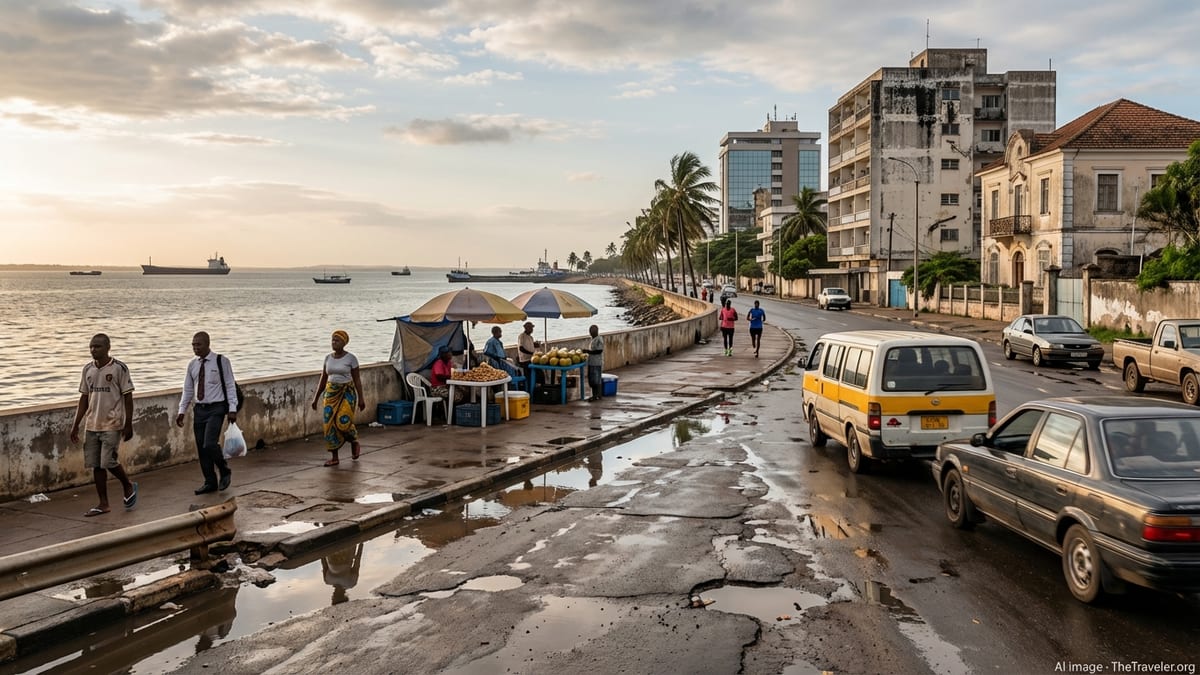
Geographically, Maputo has a lot going for it. It rises on a bluff above a broad, sheltered bay, with long views towards low islands and marshy peninsulas. On a clear afternoon the light is gorgeous, the water a gentle blue, and cargo ships move slowly out towards the Indian Ocean. The famous Marginal, the seaside road, traces this coast, and sections of it are genuinely lovely, with palms, joggers in the early morning, and the sense of a city looking outward. That was one of my favorite impressions of Maputo: when the smog lifts and the sun comes out, the setting is dramatic.
Move inland, though, and the idyll fades into something more complicated. The central Baixa area mixes colonial-era Portuguese buildings, some lovingly restored, others crumbling and stained with mold. There are streets where you can feel the ghost of a grander port city, with arcades and tiled facades, but side by side with concrete office blocks from the socialist period and glassy new towers with security guards and private parking. Just two or three blocks away, narrow lanes go off into informal settlements where drainage is poor and the smell of stagnant water hangs in the air after rains.
This patchwork can be fascinating if you like urban anthropology, but it can also be tiring. The pavements are often broken, traffic is heavy, and there is a persistent low-level hustle: people selling phone credit, cashew nuts, cheap sunglasses, or simply asking for money. I never felt horribly harassed, but I did get tired of repeatedly saying no. The city does not cocoon you the way more touristy destinations do. If you want a neat, aesthetically curated city to wander freely, Maputo will probably disappoint you. If you are drawn to cities that still feel lived in and unpolished, you might find this very real Maputo more compelling.
Sights and Culture: Interesting, but Not a Classic “Must See” City
I went to Maputo knowing it is not overloaded with blockbuster sights, but I still expected a bit more from its core attractions than I actually found. The Fortaleza de Maputo, an old Portuguese fort near the port, is worth a brief visit, with old cannons and some historical displays, but many of the signs are faded and not all areas are well maintained. I enjoyed the sense of history, but I left after about half an hour, feeling that it could easily be more engaging with a bit more investment in curation and basic upkeep.
Nearby, the central market and the FEIMA craft market were more vibrant. The central market sold everything from fish to produce to household items in a noisy, energetic hall. It was atmospheric but a bit intense: narrow aisles, strong smells, and sellers calling out constantly. FEIMA, on the other hand, was more geared towards visitors, with stalls selling wood carvings, fabrics, and paintings under shady trees. Bargaining is expected, and some of the art felt repetitive, but it was one of the more relaxed places to browse and pick up souvenirs.
One of the highlights for me was simply walking through the old leafy neighborhoods, especially around the Polana and Sommerschield areas, to look at the architecture and street life. The famous Iron House and the railway station, often attributed to Gustave Eiffel’s studio, are both photogenic and make for interesting stops, although again, information for visitors is limited. I found myself repeatedly opening my phone to look things up rather than relying on on-site signage. The National Art Museum was a pleasant surprise, small but with some striking works by Mozambican artists. It is not on the scale of major African capitals, but it gave some needed cultural context.
Overall, Maputo is more about mood and everyday experience than about ticking off a long list of iconic monuments. If you like wandering, observing street life, and piecing together a city from small impressions, you will have things to keep you interested for a couple of days. If you need constant “wow” moments and structured sightseeing, you might find yourself wondering what, exactly, you are supposed to be doing after day two.
Food, Nightlife and the Waterfront: Where Maputo Shines
Where Maputo exceeded my expectations was food. The Portuguese influence, combined with abundant seafood from the bay, makes for a genuinely enjoyable culinary scene, at least if you are willing to spend a bit more than rock-bottom local prices. I had excellent grilled prawns, peri-peri chicken, and matapa, a rich dish of cassava leaves cooked in coconut milk and peanuts. Even in fairly simple places, the seafood was often fresh and flavorful. Portions were generous, and eating along the Marginal overlooking the water was one of the few moments when I felt like I was in a classic seaside city-break postcard.
That said, prices at nicer restaurants are not as low as some people might expect for southern Africa. In midrange or expat-oriented places, mains often cost similar to what I might pay in South Africa, and craft beers or cocktails add up quickly. I did eat at a few local joints where grilled fish and rice were much cheaper, but these places required a bit more comfort with basic decor, ad-hoc hygiene, and very limited English. I never got sick, but I was careful about where I ate fresh salads and ice.
Nightlife is one of Maputo’s reputations, and there is some truth to it. On Friday and Saturday nights, bars along the waterfront and in Polana fill up with a mix of locals, expats, and visitors. I heard live music, everything from jazz to local marrabenta. The vibe was welcoming, and I did not feel out of place as a foreigner. Still, I found myself very aware of safety advice: avoid walking between venues late, keep drinks close, and take a taxi directly back to accommodation. The streets outside some clubs felt noticeably sketchy around closing time, and the city’s reputation for late-night muggings did not encourage me to push my luck.
Daytime along the waterfront was calmer. People jogged, families strolled, and there was always someone selling roasted cashews or coconuts. I liked this side of Maputo a lot: a normal city going about its day, with the bay stretching out in front. It did not erase the city’s problems, but it showed another layer beyond the headlines about crime and floods.
Day Trips and Nature: Potential vs Practicality
One of my main reasons for choosing Maputo was the idea of combining city time with nature. Maputo National Park, created by merging old terrestrial and marine reserves, is about 100 kilometers from the city and promises elephants, beaches, wetlands, and birdlife. On paper, it sounds like the perfect escape. In reality, it is not as simple as just hopping on a bus. Access still heavily relies on private vehicles and organized tours, and recent rains had made some dirt roads tricky or impassable.
I joined a day tour in a 4x4, which was not cheap, but self-driving did not seem wise given road conditions and occasional police checkpoints. The park itself was beautiful in a quiet, low-key way, with open landscapes, glimpses of antelope, and long wild beaches. I did not see huge numbers of animals, and anyone expecting a Kruger-style safari will be disappointed, but the feeling of space and the mix of coastal and bush scenery made the trip worthwhile. As a contrast to the city, it was refreshing.
However, the logistics are not trivial. The drive out of Maputo involved slow traffic, potholes, and stretches where flood damage was obvious. Roadside settlements looked precarious, with houses too close to eroded riverbanks. It was a stark reminder of the broader vulnerability of the region. For visitors, it also meant building in more travel time and accepting that plans can change if a bridge washes away or a section of road closes.
There are also beach escapes further south, around Ponta do Ouro and other coastal towns closer to the South African border. These are better choices if you want a classic beach holiday, but they are several hours from Maputo and not ideal as quick day trips. In hindsight, I slightly regret basing myself only in Maputo. If I could redo the trip, I would probably spend just two or three nights in the city and then move on to a beach town or inland reserve, using Maputo purely as a gateway rather than the main event.
Costs, Transport and Everyday Frustrations
One of the most consistent frustrations I had in Maputo was transport. Public transport for locals revolves around chapas, crowded minibuses that follow semi-fixed routes and stop wherever passengers need. As a visitor, it was difficult to figure out where they were going, and language barriers did not help. There is no integrated ticket system, and everything is paid in cash. I tried a chapa once with a local friend and quickly realized this was not going to be my daily mode of transport. For most of my stay, I relied on taxis and ride-hailing apps where available.
Ride-hailing services like Bolt or similar platforms were present in the city, and when they worked they were lifesavers: cheaper than tourist taxis and easier than trying to negotiate prices on the street. But connectivity was not always reliable, and some drivers still tried to circumvent the app by asking for cash or suggesting “off-app” arrangements. During heavy rains, car availability dropped sharply and surge prices kicked in. Traffic itself could be grinding, with long waits at intersections and aggressive lane changes that kept me glued to the window rather than relaxing.
Prices overall were a mixed bag. Street food, local produce and basic services can be cheap, but anything aimed at visitors or the middle class escalates quickly. Decent guesthouses in safe, central neighborhoods cost closer to midrange global prices than budget Africa fantasy. Imported goods in supermarkets are expensive. I would not call Maputo an extreme budget destination for foreign travelers, especially once you factor in taxis, better restaurants, and occasional tours.
On the plus side, I found most ordinary Maputo residents to be patient with my slow Portuguese and generally friendly. When I got stuck in a short power cut at my guesthouse, the staff brought candles and laughed it off as normal. Internet speeds varied, and heavy rains occasionally knocked out connections. None of these issues ruined the trip, but they did require a tolerance for small inconveniences and a willingness to shrug and adapt rather than demand that things work the way they do at home.
Who Will Appreciate Maputo, and Who Might Hate It
By the time I left, I had complicated feelings about Maputo. It is not a city designed around tourists, and that is both its strength and its weakness. If you are the kind of traveler who wants tidy museums, smooth public transport, and clear tourist circuits, Maputo will likely frustrate you. The city is short on polished attractions and long on infrastructural challenges, from patchy sidewalks to power cuts and post-flood disruptions.
On the other hand, if you are interested in Lusophone Africa, post-colonial urban landscapes, and the lived reality of a southern African capital that has not been fully absorbed into the global leisure industry, Maputo is fascinating. It has history, complex politics, a multicultural population, and a visibly struggling but vibrant everyday life. You will not always feel comfortable, but you will rarely be bored. The mix of Indian Ocean light, Portuguese-era architecture, and Mozambican music is distinctive.
I would not recommend Maputo as someone’s very first trip to Africa. The combination of safety concerns, recent natural disasters, and relative lack of tourist infrastructure can be overwhelming if you do not already have some experience navigating big cities in the region. I would also hesitate to recommend it to families with young children, or to travelers who prioritize seamless comfort over curiosity. But for more seasoned travelers, particularly those combining Maputo with other parts of Mozambique or neighboring countries, a short stay can add depth and context to a regional journey.
Most importantly, expectations need to match reality. Go to Maputo expecting a gritty, interesting, challenging city on a troubled but beautiful coastline, not a tropical resort. Go with some Portuguese phrases, a flexible attitude, and an acceptance that plans may change if a road floods or a protest blocks traffic. Under those conditions, Maputo can still be worth your time.
The Takeaway
So, is Maputo worth visiting? For me, the answer is a qualified yes, with several asterisks. I did not fall in love with the city the way I have with other African capitals. The constant background worry about petty crime, the visible impact of recent floods, and the often-frustrating logistics kept me from ever fully relaxing. There were moments when I looked around at the crumbling buildings and chaotic traffic and wondered why I had chosen to spend my vacation here.
And yet, there were also moments that made the trip feel meaningful. Watching the sun set over the bay from the Marginal, eating perfectly grilled prawns while a local band played, or wandering under jacaranda trees in a quiet residential street gave me glimpses of a softer Maputo. Visiting markets and talking to people, however briefly, reminded me that this is a city of more than its problems, even if those problems are impossible to ignore.
If I returned, I would structure the trip differently. I would limit my time in Maputo to two or three full days, focus on a couple of neighborhoods I enjoyed, and then head out to other parts of the country. I would prearrange airport transfers, book accommodation in a safe, well-reviewed area, and plan at least one day in Maputo National Park or a nearby beach to balance the urban intensity. In other words, I would treat Maputo as an engaging but demanding stop, not as a standalone destination for a full week.
In the end, Maputo is worth it if you approach it with eyes open and the right mindset. It is for travelers who value authenticity over comfort, who are willing to deal with uneven infrastructure and a sometimes heavy social atmosphere in exchange for a more unfiltered view of a city in transition. It is less suitable for those seeking easy beach bliss or classic city-break pleasures. If you fit into the first category and adjust your expectations accordingly, Maputo can still reward your curiosity.
FAQ
Q1. Is Maputo safe for tourists right now?
Maputo is not a war zone, but it is not a low-risk destination either. Petty crime and occasional violent incidents do occur, especially after dark. I felt reasonably safe in busy areas during the day, kept valuables out of sight, and used taxis at night instead of walking. The key is to stay alert, avoid flaunting wealth, and pay attention to local advice about which areas to avoid.
Q2. How did recent floods affect your visit?
The floods mostly affected infrastructure and the general mood rather than my daily activities in central neighborhoods. I saw damaged roads, detours, and signs of displaced families in some areas. Travel times were longer than expected, and some routes outside the city were tricky. It added a layer of gravity to the trip and made it clear that conditions can change quickly with heavy rain.
Q3. Do I need a visa to visit Maputo?
Entry rules changed recently, and some nationalities can visit Mozambique for short stays without a traditional visa, sometimes with an online registration requirement. When I traveled, immigration checked my documents and stamped me in for 30 days without fuss. Because the system has been in flux, I strongly recommend checking the current requirements from official sources shortly before you travel.
Q4. How many days do you recommend staying in Maputo?
Personally, I think two to three full days is enough for most people. That gives you time to explore the main neighborhoods, visit a few key sights, enjoy some good meals, and maybe take a day trip. Beyond that, unless you have specific work or personal reasons to stay longer, I would move on to coastal towns or other regions of Mozambique.
Q5. Is Maputo a good base for a beach holiday?
Not really. While Maputo sits on the bay, the best beach destinations are several hours away by road. It works as a gateway city before or after a beach trip, but I would not choose it as my main base if my priority were swimming and sunbathing. For that, I would head to places further south or to the islands and keep my time in Maputo relatively short.
Q6. How easy is it to get around the city without a car?
It is possible, but not always convenient. Local minibuses are cheap but confusing for newcomers. I mainly relied on taxis and ride-hailing apps, which worked but were not always cheap by local standards. Traffic can be slow, and walking long distances is tiring due to heat and broken pavements. If you dislike negotiating fares or dealing with unpredictable traffic, you may find getting around frustrating.
Q7. What was the food like in Maputo?
The food was one of the best parts of the trip. There is excellent seafood, strong Portuguese and local influences, and some very good restaurants. Prices in more polished places are higher than many people expect, closer to big-city levels, but the quality is generally good. If you are willing to eat at simpler local spots, you can find cheaper and still tasty meals, though you need to be a bit more relaxed about surroundings.
Q8. Did you feel comfortable going out at night?
I went out at night a few times and enjoyed live music and bars along the waterfront, but I was always cautious. I avoided walking between venues late, kept my bag close, and used taxis door-to-door. The nightlife can be fun, but I never forgot that late-night muggings are a known issue. It was enjoyable with precautions, not carefree.
Q9. Would you recommend Maputo for first-time visitors to Africa?
Honestly, probably not. For a first African trip, I would choose somewhere with better tourist infrastructure and fewer safety and logistics challenges. Maputo is better suited to travelers who already have some experience in the region, know their own risk tolerance, and are specifically interested in Lusophone Africa or Mozambique.
Q10. Would you go back to Maputo, and what would you do differently?
I would go back, but for a shorter stay and with clearer priorities. I would plan two or three days in the city, stay in a well-located, reputable guesthouse, prebook airport transfers, and line up one or two targeted excursions, such as a day in Maputo National Park. Then I would quickly move on to other parts of the country. Treating Maputo as a challenging but rewarding stop, rather than the main focus, would make the experience feel more balanced.