


I had wanted to visit the Mekong Delta for years, and My Tho kept coming up as the easy gateway from Ho Chi Minh City.
When I finally went, I approached it with cautious optimism. I was curious whether this often-mentioned but rarely raved about riverside city was actually worth a stop in its own right, or if it was just a convenient jump-off point for tour buses shuttling people into a generic version of “the Delta.”
What I found was a mix of peaceful moments, modest charms, and some pretty underwhelming, touristy experiences. My Tho did not blow me away, but under the right conditions it can still be a worthwhile, low-key detour.
Getting to My Tho: Simple, Cheap, and Slightly Chaotic
I started my trip from Ho Chi Minh City, and logistically My Tho is almost too easy. It sits only about 70 kilometers away, and buses from Mien Tay bus station run throughout the day, roughly every 30 minutes in the early morning through late afternoon. Tickets were inexpensive by any standard, and I paid only a few dollars for the one-way ride. The catch was comfort and predictability. The bus itself was functional rather than pleasant, and departure time was interpreted loosely. We left about 25 minutes after the supposed schedule, only once enough passengers had trickled in to make the trip worthwhile for the operator.
Arriving in My Tho, the bus dropped me at the small station on the northwest side of town. From there, I needed a short motorbike taxi ride to reach the riverfront area and main pier. It was not complicated, but it was a reminder that this is still a local hub first and a tourist town second. The infrastructure exists and works, but you should expect some waiting, a bit of haggling with xe om drivers, and a general sense that timetables are more of an aspiration than a contract.
One thing that surprised me was how quickly the scenery changed on the way down. Within an hour or so, the concrete density of Ho Chi Minh City began giving way to wider roads, fields, and the start of the Delta’s water networks. That part I genuinely enjoyed. The bus ride itself felt like a transition from the city’s crush of energy into something looser and slower, which set the tone for what was to come. If your goal is a quick, inexpensive escape from the city, just the journey to My Tho already gets you part of the way there.
First Impressions: A Workaday River City, Not a Polished Resort
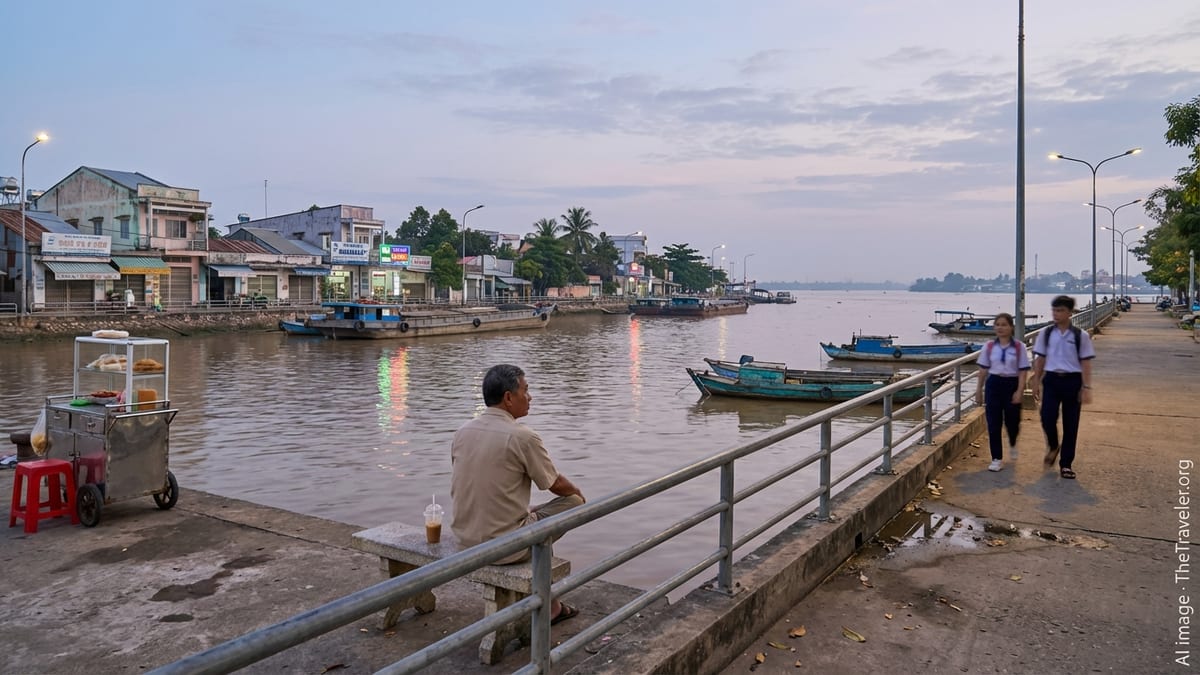
My first steps along the Tiền River embankment made it immediately clear that My Tho is not a manicured tourist showcase. It is a working city that happens to sit along a broad river. Barges pushed along the brown water, local fishermen tended to their boats, and scooters zipped past the riverside promenade that has seen visible upgrades in recent years, such as embankment improvements and lighting systems. Still, it felt more utilitarian than romantic, more about supporting local life than catering to outsiders.
The riverfront path itself was pleasant enough for an evening walk. There were benches, a handful of snack stalls, and families out for a stroll. It was not dramatic or especially scenic by global standards, but I liked that it felt genuine. There was no choreographed light show or forced “Delta cultural performance” here, just people using the riverfront as part of their normal routine. At the same time, I had to temper my expectations. If you are coming straight from glossy photos and dreamy descriptions of “Mekong magic,” the muted reality of My Tho’s waterfront can feel underwhelming.
As I wandered deeper into town, the traffic density thinned, and the city started resembling a mid-size provincial capital with modest shopfronts, cafes, and markets. Tourism certainly plays a role here, especially around the main boat pier and the access point to Thoi Son Island, but it is not the sole reason the city exists. That dual identity is both My Tho’s strength and its shortcoming. It keeps the city grounded and unpretentious, but it also means you will not find the kind of polished, curated experiences some travelers hope for.
Vinh Trang Pagoda: Beautiful, Atmospheric, and Crowded at the Wrong Times
One of the few genuinely standout sights in My Tho is Vinh Trang Pagoda, roughly a 10 to 15 minute drive from the city center. The pagoda is open daily, generally from around 6:30 in the morning to early evening. There is no official entrance fee, which I appreciated, though donation boxes are set up around the grounds. That combination of open hours and free admission makes it a fixture on just about every tour bus itinerary, for better and worse.
I visited mid-morning, which in retrospect was not the best call. Several tour buses had arrived just before I did, and the tranquility of the grounds was pierced by the constant shuffle of large groups being shepherded around, selfie sticks out, guides talking loudly in multiple languages. Underneath the crowd, the site itself is truly impressive. The architecture blends Vietnamese, Chinese, Khmer, and even European influences, and the large Buddha statues in the gardens are dramatic and photogenic. Still, I found it hard to tap into any sense of calm when I had to wait for space to take a simple photo or step around groups blocking doorways.
The pagoda grounds are reasonably well kept, and the gardens and lotus ponds provide welcome shade and pockets of quiet if you are willing to wander away from the main paths. I noticed that by late afternoon, as I passed again by car, the bus crowd had thinned significantly. In hindsight, I would plan my visit for early morning or later in the day, not the midday slot when the bulk of Mekong Delta tours swing through. For me, Vinh Trang Pagoda was absolutely worth seeing, but the timing of my visit blunted some of its charm. It is a place that rewards patience and off-peak hours much more than spontaneity.
Thoi Son Island & the Classic My Tho Boat Tour: Expectations vs Reality
Like most travelers, I signed up for the classic boat tour from My Tho, which usually includes Thoi Son Island, some canals, a fruit garden, a honey tea tasting, and a coconut candy stop. The tours typically depart from the main My Tho pier along the Tiền River and operate throughout the day. Booking is very easy. Tour touts cluster around the waterfront, hotels can arrange trips, and agents in Ho Chi Minh City sell day tours that include transport to and from My Tho plus the boat excursion.
I chose to arrange my tour on the spot in My Tho rather than pre-booking from the city. On the plus side, that gave me some flexibility on departure time and some room to negotiate. On the downside, the experience felt heavily standardized. Regardless of which agent you talk to, the itineraries are almost identical, right down to the same order of stops. My small wooden boat crossed from the city over toward the island, then transferred to a smaller sampan in a side canal, then carried me to the honey farm, then the fruit-tasting spot with traditional music, and finally the coconut candy operation before looping back.
On paper, all of that sounds charming. In reality, much of it felt staged and transactional. The narrow canal ride, the moment I had perhaps anticipated most, did offer a fleeting sense of delta atmosphere, with palm fronds arching overhead and the rhythmic paddling of the boat. But the illusion of discovery vanished quickly when I realized there were multiple other sampans in a loose queue, all following nearly the same path at nearly the same pace. It became less a journey into a hidden world and more a slow-moving ride at a rural amusement park.
The honey tea stop, fruit tasting, and coconut candy visit were interesting up to a point, but they were clearly designed around selling products to a constant stream of visiting groups. I did not mind supporting local businesses, and the honey tea was actually quite pleasant, but I grew weary of the scripted sequence of demonstrations, followed by the subtle pressure to buy something. None of it felt exploitative, but it did feel repetitive and tightly choreographed. If you are hoping for a spontaneous wander through village life, this is not it.
Tourist Crowds, Overtourism, and the Sense of Sameness
One of my biggest personal frustrations with My Tho was the sameness of the experiences offered. Almost every traveler I met who had done a My Tho tour described it with the same set of words: short boat ride, honey, fruit, music, coconut candy, sampan ride. That uniformity has a cost. It keeps things efficient and digestible for mass tourism, but it also flattens the nuances of the region. I left with the sense that I had scratched the surface in exactly the same way thousands of visitors do, without ever really getting beneath the script.
The crowds themselves were not unbearable when I visited, but they were very noticeable. Tour boats lined up to dock at the same small piers, and at a couple of points I had to wait for another group to finish their tasting or music session before mine could begin. It did not ruin the experience outright, but it certainly diluted the charm. There were a couple of quiet, unscripted moments that I cherished, such as watching local kids fishing in the canal from a wooden bridge between stops, or catching a glimpse of an elderly woman quietly tending her garden away from the main tourist path. Those moments felt real, and they made me wish the standard itineraries allowed more room to simply wander.
I noticed that operators have become highly practiced at cycling visitors through this narrow circuit. From a logistical standpoint, that is admirable. From a traveler’s perspective, it can feel like being moved along a conveyor belt of “local experiences.” If you are the sort of traveler who values originality and the feeling that you are discovering something on your own, My Tho’s mainstream tour formula may leave you disappointed. To truly break out of that mold, you need either time, a private arrangement, or a willingness to venture deeper into the broader Tien Giang countryside rather than just looping the classic route.
Staying in My Tho vs Doing a Day Trip
I chose to stay overnight in My Tho rather than doing the very common day trip from Ho Chi Minh City. That decision gave me a bit more space to observe the city outside tour hours, and it did change my impression. By late afternoon and into the evening, as the tour buses withdrew, the city relaxed. Locals filled in the gaps along the riverside, street food stalls appeared, and the energy shifted from “destination for outsiders” back to “small Mekong city doing its thing.” I sat by the river with a simple coffee and watched the twilight settle over the water, and in that quiet, I was glad I stayed.
Accommodation options in My Tho are functional but fairly basic. There are a few hotels and guesthouses scattered near the center, but this is not a town of boutique riverfront resorts. My room was clean, with functioning air conditioning and decent Wi-Fi, but the building itself was tired and unremarkable. In high season, it is wise to book ahead, yet in general, you should temper expectations. If you are used to the breadth of choices in Ho Chi Minh City or even in more established Mekong destinations like Can Tho, My Tho’s hotel scene will feel limited.
Reflecting on it, I think staying overnight makes sense if you are the sort of traveler who prefers slower rhythms, or if you want to continue deeper into the Delta the next day without rushing back to Ho Chi Minh City. However, if your time is short and you just want a snapshot of the Mekong, a day trip will probably give you most of what My Tho’s mainstream tourism offers. In my case, I appreciated the extra time but could also see why many travelers choose to visit once and move on.
Food, Atmosphere, and Everyday Life
Food in My Tho was a subtle highlight for me, though nothing I ate would warrant a pilgrimage on its own. The city has its share of pho and com tam spots, small rice eateries, and street vendors selling grilled meats, fresh spring rolls, and sweet snacks. I found it fairly easy to get good, inexpensive meals simply by walking a few streets back from the river and choosing the places that were busy with locals. Menus were often in Vietnamese only, but pointing and basic translation apps went a long way.
What I appreciated most was the lack of a heavy tourist markup outside the main pier area. Once I stepped away from the boat-tour cluster, prices dropped to everyday levels. At a small family-run place near my guesthouse, I had a generous bowl of hu tieu noodles, local to the region, for a fraction of what I would pay in the city. The owner seemed slightly surprised to see a foreign visitor but quickly warmed up, asking where I was from and insisting I try a homemade chili sauce that nearly blew my head off but tasted fantastic.
The overall atmosphere in My Tho is low-key and practical. It is not a nightlife city. After about 9 or 10 in the evening, the streets grew quiet and shutters went down on many shops. That suited me fine. I enjoyed walking through the local markets in the late afternoon, where stalls were piled high with fruit, fish, and vegetables, and where the pace of life seemed dictated by the river and the heat more than any tourist calendar. The experience felt modest but honest, and I rarely felt like I was in a place performing itself for outsiders.
Is My Tho Worth Visiting? Who It Suits and Who It Does Not
By the end of my short stay, I found myself wrestling with the core question I had started with: is My Tho worth visiting? For me, the answer is a qualified yes, with clear caveats. The city itself is not especially beautiful, nor is it packed with a wide range of attractions. Its main draw lies in its function as an accessible introduction to the Mekong Delta and in a handful of specific experiences, such as Vinh Trang Pagoda and the short boat journeys among the islands.
If you are looking for a deeper, more varied exploration of the Mekong Delta, I would not stop at My Tho alone. Other areas, like the floating market cities further downriver, tend to offer more distinctive experiences and a stronger sense of place. My Tho, by comparison, feels like the starting chapter of a much longer story. Useful, illustrative, occasionally charming, but not the most compelling part of the book.
On the other hand, if you have limited time in southern Vietnam and want a simple, low-commitment way to get a feel for the waterways, fruit orchards, and rural scenes of the Delta, My Tho does serve that purpose. It is close to Ho Chi Minh City, transportation is straightforward and cheap, and the tourism infrastructure, for all its formulaic tendencies, is developed enough that you will not have to struggle much with logistics. Just go in understanding that you are signing up for a polished, repeatable, and somewhat commercial version of the Mekong rather than something raw or untouched.
The Takeaway
Looking back, I am glad I went to My Tho, but I would not describe the experience as essential. It was a gentle, modest introduction to the Mekong Delta rather than a transformative journey. The highlights for me were the brief but memorable quiet moments: the evening walk along the river once the tour buses had left, the glimpses of daily life on the canal away from the standard stops, and the architectural details of Vinh Trang Pagoda when I could momentarily stand apart from the crowd. Those moments gave weight to a trip that otherwise might have felt entirely cookie-cutter.
Would I do it the same way again? Probably not. If I returned, I would aim for an earlier or later visit to Vinh Trang Pagoda to avoid peak tour hours. I would strongly consider arranging a private or semi-private boat tour that allows more flexibility, even if it costs more, and I would try to build in at least one day traveling further into the Delta afterward rather than stopping at the first major gateway. I would also research specific homestays or community-based tourism options outside the core My Tho orbit to escape the standard honey-fruit-candy circuit.
My Tho is worth visiting if your expectations are aligned. It suits travelers who are curious, patient, and content with low-key experiences: people who want a simple day or overnight escape from Ho Chi Minh City, who do not mind a bit of touristy packaging, and who can enjoy small, authentic moments that appear in between the more rehearsed parts of the tour. It is less ideal for those chasing dramatic landscapes, deep immersion, or truly off-the-beaten-path exploration. Under the right conditions, though, My Tho can still earn its place as a gentle first step into the wider labyrinth of the Mekong Delta.
FAQ
Q1. Is My Tho worth visiting if I only have one day in southern Vietnam?
If you have just one free day and want a quick taste of the Mekong Delta without long travel times, My Tho is a practical choice. You will get a snapshot of river life, orchards, and canals, but it will be a fairly standard, tourist-oriented experience rather than a deep dive into the region.
Q2. How long should I stay in My Tho?
Most visitors come on a day trip, and that is usually enough to see Vinh Trang Pagoda and do a classic boat tour. If you prefer slower travel or want to connect onward to other parts of the Delta, an overnight stay can be worthwhile, but there is not a huge amount to justify a longer stay within the city itself.
Q3. What are the current opening hours for Vinh Trang Pagoda?
Vinh Trang Pagoda generally opens daily from early morning to early evening, with public sources consistently listing hours roughly around 6:30 in the morning until about 7 in the evening. There is no formal ticket office, so you can simply walk in during those daylight hours.
Q4. Do I need to book a Mekong boat tour in My Tho in advance?
You do not have to book in advance. Tour operators and boat owners are easy to find along the riverfront, and most hotels can arrange a tour on short notice. However, if you want a more customized, less crowded trip, arranging a private or small-group tour ahead of time can help you avoid being slotted into the most generic itineraries.
Q5. Is My Tho very touristy compared to other Delta towns?
Yes and no. The standard boat tour circuit with honey tastings, fruit, and coconut candy is heavily touristic and quite choreographed. Outside that circuit, however, My Tho feels more like an ordinary Mekong city. It is not as tourism-saturated as some coastal resort areas, but the main attractions are firmly on the tourist trail.
Q6. What should I wear when visiting Vinh Trang Pagoda and the boat tours?
For the pagoda, modest clothing that covers shoulders and knees is appropriate, and you will need to remove shoes before entering certain halls. For the boat tours, light, breathable clothing, a hat, and sunscreen are advisable, as it can be very hot and sunny on the water.
Q7. Is it better to visit My Tho independently or on a tour from Ho Chi Minh City?
Traveling independently gives you more flexibility and often a quieter experience, especially if you stay overnight and time your visits to avoid peak tour crowds. Joining a day tour from Ho Chi Minh City is easier and fully packaged, but you will have less control over timing and will likely follow the same fixed itinerary as everyone else.
Q8. Are there good accommodation options in My Tho?
Accommodation in My Tho is adequate but not particularly memorable. You will find a handful of mid-range hotels and basic guesthouses that are clean and functional, but do not expect luxury riverside resorts. Booking ahead in peak periods is wise, as the overall supply is limited compared with larger tourist cities.
Q9. Can I use My Tho as a base to explore more of the Mekong Delta?
You can, but it is more commonly used as a first stepping stone. There are onward buses to other Delta towns, and you can arrange private transfers, but many travelers choose to move on to cities deeper in the region for a richer experience. My Tho works as a convenient starting point rather than a long-term base.
Q10. Who is My Tho best suited for as a destination?
My Tho is best suited for travelers who want an easy, low-effort introduction to the Mekong Delta, especially those based in Ho Chi Minh City with only a day or two to spare. It will appeal more to people who enjoy quiet provincial cities and do not mind some touristy packaging, and less to those seeking dramatic scenery, extensive activities, or a strong sense of discovery.