

Nanaimo is one of those places travelers think they know before they ever arrive. Its name appears on ferry schedules, road-trip itineraries and transit boards as the place you pass through on the way to somewhere else on Vancouver Island.
Yet when you step off the boat or the plane and actually wander its waterfront, parks and historic streets, a more complex picture comes into focus.
Is Nanaimo simply a convenient transport hub, or is it a coastal city worth building a trip around in its own right?
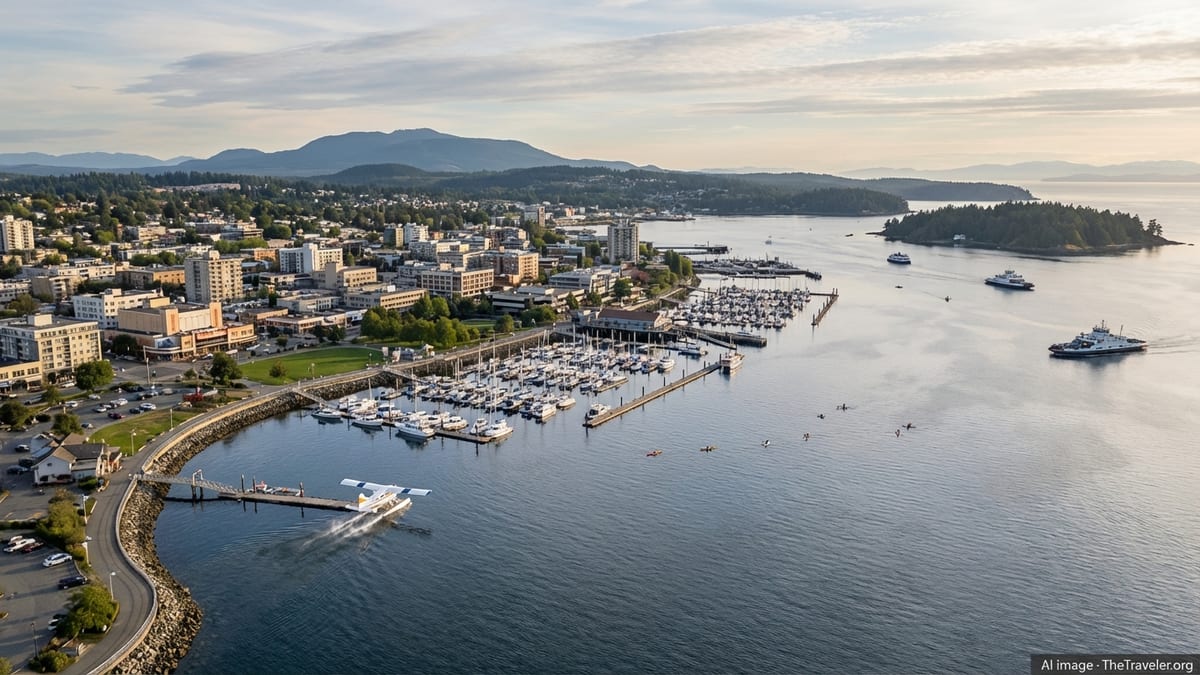
Nanaimo at a Glance: A Harbour City With a Hub Reputation
Nanaimo sits on the sheltered east coast of Vancouver Island, looking across the Strait of Georgia toward Vancouver’s skyline. Long known as “The Harbour City,” it has also carried the nickname “Hub City,” thanks both to its central position on the island and its original wagon-wheel street layout that once radiated out from the waterfront. Today, ferries, floatplanes and highways converge here, making Nanaimo the main gateway to central and northern Vancouver Island.
The question for travelers is whether that centrality translates into reasons to stay. The city itself is mid-sized by Canadian standards, with a population just under 100,000, but it serves a much wider region of smaller coastal communities and island destinations. That regional role has shaped its character: part working harbour, part commercial center and part recreation base. Unlike the polished, historic downtown of Victoria or the resort strip of nearby Parksville, Nanaimo feels more lived-in and layered, with industrial remnants, new condos and heritage buildings all pressed close to the shoreline.
Climate is one of Nanaimo’s quiet advantages. Like much of coastal British Columbia, it enjoys mild, wet winters and warm, relatively dry summers. Spring and autumn can linger, with shoulder-season days that are still comfortable for walking the seawall or hopping over to a nearby island. For visitors, that translates into a long viable season where outdoor plans are rarely derailed by extreme weather, even if you do need to pack a rain jacket for the cooler months.
Underlying all of this is a deep Indigenous presence. The lands around Nanaimo are the traditional territory of the Snuneymuxw First Nation, whose name and stories are interwoven with local place names and coastal sites. Increasingly, visitors encounter that history in interpretive signs, art and community-led experiences, giving the city a cultural context that goes far beyond its role as a transport node.
The Waterfront: Seawall Strolls, Working Harbour and Island Hopping
If you only experience one part of Nanaimo beyond the ferry terminal, make it the waterfront. The downtown harbourfront follows a sweeping curve, with a paved seawall linking marinas, boardwalks, pocket parks and viewpoints. On a clear day you can see across the water to the coastal mountains on the mainland, while small fishing boats, recreational craft and seaplanes are constantly in motion in front of you.
The heart of the waterfront is the area around Swy-a-Lana Lagoon and Maffeo Sutton Park. Here, lawns slope down to the water, playgrounds and public art installations break up the shoreline, and it often feels as if half the city is out walking dogs or grabbing an ice cream. This is where Nanaimo’s dual personality is most obvious: the scenery is undeniably scenic, but the backdrop includes working docks and ferry ramps as well as new residential towers. For many visitors, that blend of practical harbour life and seaside leisure is part of the appeal.
From this same stretch of shoreline, you can board small passenger ferries to Protection Island and Saysutshun, also known as Newcastle Island Marine Park. These short hops are one of the clearest arguments for lingering in Nanaimo. Protection Island feels like a quiet, car-light cottage community, with forested lanes and rocky beaches a brief boat ride from downtown. Saysutshun, designated as a provincial marine park and co-managed with Snuneymuxw First Nation, offers looping forest and shoreline trails, picnic areas and views back toward the city’s skyline, giving you a sense of just how closely wilderness and urban life sit side by side.
For those arriving by seaplane, the experience is visceral: flights touch down in the inner harbour itself, with passengers stepping straight into downtown. Even if you are not flying, the regular take-offs and landings add a dynamic layer to the scenery. The constant movement on the water, from tugboats nudging barges to kayakers slipping along the shore, keeps the waterfront from feeling like a static postcard.
Beyond a Stopover: Culture, History and Everyday City Life
Travelers who treat Nanaimo purely as a waypoint often miss the more subtle texture of the city’s streets. A few blocks back from the water, the Old City Quarter preserves clusters of historic buildings from Nanaimo’s coal-mining and trading past. Today, these brick and wooden storefronts house boutiques, cafes and small restaurants that give the neighborhood an almost village-like feel within the broader city. For visitors interested in the evolution of coastal communities, this contrast between old and new neighbourhoods is part of Nanaimo’s story.
History is also visible in individual landmarks. The Bastion, a white, tower-like former Hudson’s Bay Company fortification built in the 1850s, still stands above the harbour as a rare remnant of that colonial era. Petroglyph Provincial Park, on the southern edge of the city, protects rock carvings attributed to Indigenous artists, offering another lens onto the area’s much older human presence. Taken together, these sites hint at the layered, sometimes difficult histories that underlie what now looks like a straightforward modern port.
Cultural life in Nanaimo has grown steadily in recent years. The Port Theatre, a purpose-built performing arts venue on the waterfront, anchors the city’s arts scene, hosting everything from symphony performances to touring musicians and dance companies. Smaller galleries and studios are dispersed through downtown, and Vancouver Island University’s presence on the hillside above contributes both student energy and public programming, from lectures to exhibitions.
What may surprise first-time visitors is that much of Nanaimo’s appeal lies in its everyday rhythm rather than in marquee attractions. You are less likely to find headline-grabbing museums or iconic landmarks than you are to stumble into a busy farmers’ market, an experimental music night or a new craft brewery tasting room. For some travelers, that ordinariness is exactly the draw: it feels like a real coastal city, not a curated resort town, with enough going on that you can plausibly imagine living there, even during a short stay.
Outdoor Access: Trails, Coastline and Adventure Within Easy Reach
From an outdoor perspective, Nanaimo is almost purpose-built as a base. Within minutes of downtown, forested parks, coastal trails and viewpoints unfurl in every direction. Buttertubs Marsh, a protected wetland and bird sanctuary set surprisingly close to the city center, provides a level walking loop popular with birdwatchers and families. In contrast, Neck Point Park and Pipers Lagoon on the north side of town showcase the rocky, driftwood-strewn coastline many visitors associate with the Pacific Northwest, complete with tidal pools and arbutus trees clinging to the cliffs.
For hikers, the choice ranges from short, accessible loops to more strenuous half-day outings. Mount Benson, rising behind Nanaimo, offers a challenging climb rewarded with wide views over the city, Strait of Georgia and Gulf Islands. Other nearby trails wind through second-growth forest, follow creeks, or wrap around small lakes that are popular with local swimmers in summer. The relative compactness of the city means that even without a car, many trailheads can be reached via a short taxi ride or a combination of public transit and walking.
Nanaimo’s adventure pedigree is more established than some visitors realize. The city is home to a long-running bungee jumping site that claims pioneering status in North America, and local outfitters arrange kayaking, diving and boat tours along the surrounding coastline. While Nanaimo’s dive sites may not be as famous as those elsewhere in British Columbia, the cold, clear waters attract enthusiasts interested in wrecks and marine life. The sheltered nature of the nearby channels also makes them suitable for beginners trying sea kayaking for the first time.
Most importantly for the stopover debate, the spectrum of these outdoor options makes Nanaimo a strong candidate for at least one full day on any Vancouver Island itinerary, even if you are primarily en route to more remote destinations. With a bit of planning, you can arrive on a morning ferry, hike or paddle for several hours, then enjoy the waterfront into the evening before carrying on the next day.
Food, Drink and the Famous Nanaimo Bar
Nanaimo’s culinary reputation is anchored by one delightfully nostalgic dessert: the Nanaimo bar. This layered, no-bake square, with its crumbly base, custard-flavored middle and chocolate top, is a Canadian classic that takes its name from the city. Visitors can sample versions in bakeries and cafes across town, and tourism promoters have at times mapped out bar “trails” highlighting establishments that put their own spin on the recipe. While the dessert alone will not justify a detour for every traveler, it is a small but memorable way the city has lodged itself in the national imagination.
Beyond its signature sweet, Nanaimo’s food and drink scene reflects both its coastal setting and its workaday roots. You will find casual seafood spots serving local salmon and shellfish, dockside patios with views over the harbour, and a scattering of more contemporary restaurants that draw on Pacific Northwest ingredients with a modern sensibility. Food trucks make appearances at events and around popular parks during the warmer months, adding to the informal options.
Coffee culture and craft beer are both well established. Independent cafes line parts of downtown and the Old City Quarter, often doubling as creative hubs with rotating art on the walls. Several small breweries operate tasting rooms where visitors can sample island-produced ales and lagers, frequently in refurbished industrial spaces that nod to Nanaimo’s working past. In the evening, live music is common in bars and pubs, particularly on weekends, contributing to a nightlife that is low-key but far from dormant.
For travelers deciding whether to stay overnight, the city’s dining and social options are a practical consideration. While Nanaimo does not rival larger cities for sheer variety, it offers enough choice to fill a couple of evenings comfortably, especially if you are content with honest, unfussy venues rather than high-end fine dining.
Using Nanaimo as a Base for Wider Vancouver Island Exploration
Where Nanaimo undeniably excels is as a launchpad. Its ferry terminals, highway connections and central location on Vancouver Island make it a logical place to pivot between coastal and inland destinations. To the north and west lie surf towns, alpine parks and small harbor communities; to the south, the provincial capital of Victoria and the more populated Saanich Peninsula. Offshore, the necklace of smaller Gulf Islands is never far away.
From Nanaimo, driving times to popular spots are manageable for day trips or short overnights. Coastal resort communities such as Parksville and Qualicum Beach are roughly a short drive to the northwest, with sandy shorelines contrasting with Nanaimo’s rockier waterfront. Inland, the road to Port Alberni opens the way toward the wild west coast and the Pacific Rim region. While many visitors prefer to stay in those end-of-the-road destinations, using Nanaimo as the inbound or outbound anchor helps break up long travel days.
For travelers relying on public transportation, Nanaimo is also a practical hub. Regional buses link the city with other Vancouver Island communities, and island-hopping ferries connect to Gabriola Island and beyond. Seaplanes and small commercial flights from Nanaimo Airport provide quick links to Vancouver and other mainland points, which can save significant time compared with longer ferry and driving combinations. This connectivity is one of the main reasons Nanaimo appears on so many itineraries, whether or not travelers intend to linger.
The key consideration is whether you want your base to feel more urban or more resort-like. Nanaimo leans toward the former: its accommodations range from chain hotels and motels to smaller inns and vacation rentals spread through residential neighbourhoods. For visitors who appreciate having supermarkets, gear shops and services close at hand, that can be a distinct advantage, especially before or after more remote parts of a trip.
Who Should Linger in Nanaimo, and Who Might Just Pass Through
Whether Nanaimo is worth extended time depends largely on what you look for in a destination. Travelers who gravitate toward refined, historic centers with a dense concentration of marquee sights may find the city underwhelming compared with Victoria or with beloved west coast spots such as Tofino. The waterfront is appealing, but there are few traditional “must-see” attractions that demand a multi-day stay on that basis alone.
On the other hand, slow travelers, repeat visitors to Vancouver Island, and those who prefer real, lived-in cities to polished tourist enclaves often find themselves pleasantly surprised. Nanaimo offers a chance to engage with Vancouver Island life at a more everyday level, whether that means chatting with locals on the seawall, exploring the Old City Quarter’s independent shops, or joining residents on favorite trails and beaches. It is a place where you can ease into the island’s rhythm without feeling like you are in a holiday bubble.
Families may appreciate the mix of amenities and nature. Playgrounds and parks along the waterfront, calm swimming areas in local lakes, and straightforward hiking trails give children room to roam, while the city’s size keeps driving times relatively short. Budget-conscious travelers also benefit from generally lower accommodation rates than in some of the island’s marquee resort communities, especially in shoulder seasons.
For tight itineraries focused on specific highlights, Nanaimo can perform well as a one-night stop that breaks up journeys between ferry terminals and further-flung regions. Arriving in the afternoon, stretching your legs on the waterfront, enjoying a relaxed dinner and perhaps a short island hop the next morning gives you a tangible taste of the place without requiring a wholesale reshuffle of your plans.
The Takeaway
Nanaimo’s reputation as a stopover is both accurate and incomplete. It is undeniably a major junction, the point where highways, ferries and flight paths cross on Vancouver Island. Many visitors will always experience it in passing, as a line item on a ticket or a brief pause between more iconic destinations. Yet look beyond that functional role and a more nuanced city emerges, one with a lived-in urban core, a strongly used waterfront, and quick access to forests, rocky coves and offshore islands.
If your only goal is to check off the province’s most celebrated highlights in the shortest time possible, a brief overnight in Nanaimo may be all you allocate, and that can still be worthwhile. But if you value seeing how coastal British Columbia works away from the postcard viewpoints, or if you have the flexibility to add a day or two to your schedule, the city rewards those who slow down. Stroll the seawall, ride the little ferries out to nearby islands, climb a local hill, and taste the dessert that bears its name, and Nanaimo begins to feel less like a junction and more like a place.
In the end, whether Nanaimo is “worth it” is less a question of the city’s inherent qualities than of your own travel style. As a destination, it offers understated, authentic appeal rather than instant spectacle. As a stopover, it offers far more than a place to refuel and sleep. The decision is not whether to visit at all, but how long you can afford to stay.
FAQ
Q1. Is Nanaimo worth visiting on its own, or only as a stopover?
Nanaimo is worth visiting in its own right if you enjoy coastal scenery, everyday city life, and easy access to trails and nearby islands, even without major headline attractions.
Q2. How many days should I spend in Nanaimo?
Many travelers find one to two full days enough to explore the waterfront, visit nearby parks and islands, and get a feel for the city’s character.
Q3. Is Nanaimo a good base for exploring Vancouver Island?
Yes. With ferry terminals, floatplanes, highways and regional buses, Nanaimo works well as a central base for trips to Parksville, Qualicum Beach, Port Alberni and the Gulf Islands.
Q4. What is there to do in Nanaimo without a car?
Without a car you can walk the harbourfront, explore downtown and the Old City Quarter, ride small ferries to Protection Island and Saysutshun, and access several parks by transit or taxi.
Q5. Is Nanaimo family friendly?
Nanaimo is generally very family friendly, with waterfront playgrounds, calm swimming spots at local lakes, easy walking trails and plenty of casual dining options.
Q6. When is the best time of year to visit Nanaimo?
Late spring through early autumn usually offers the most pleasant weather for outdoor activities, though the city’s mild climate makes it visitable year-round with rain gear.
Q7. How does Nanaimo compare with Victoria for visitors?
Victoria has a denser concentration of historic sights and curated attractions, while Nanaimo feels more like a working coastal city with understated charm and fewer crowds.
Q8. Can I see Nanaimo on a day trip from Vancouver?
Yes. With ferries and floatplanes, a long day trip from Vancouver is possible, though staying overnight allows a more relaxed pace and time to explore local parks and islands.
Q9. Is Nanaimo expensive compared with other Vancouver Island destinations?
Accommodation and dining in Nanaimo are often moderate compared with some resort areas, making it a relatively budget-friendly base, especially outside peak summer.
Q10. Do I need to book activities in Nanaimo in advance?
For popular summer activities such as guided tours, bungee jumping or seaplane flights, advance booking is advisable, while simple hikes and waterfront walks require no reservations.