


I had been hearing about the Oceanário de Lisboa for years, always introduced with some variation of “one of the best aquariums in Europe.” On my latest visit to Lisbon, I finally decided I needed to see it for myself and answer a question I am often asked as a travel writer: is it actually worth going, or is it just another overhyped, crowded attraction?
I booked my ticket, joined the inevitable lines, wandered the dim corridors, and came away with mixed feelings. There were some unforgettable moments, but also frustrations and compromises that are worth knowing about before you go.
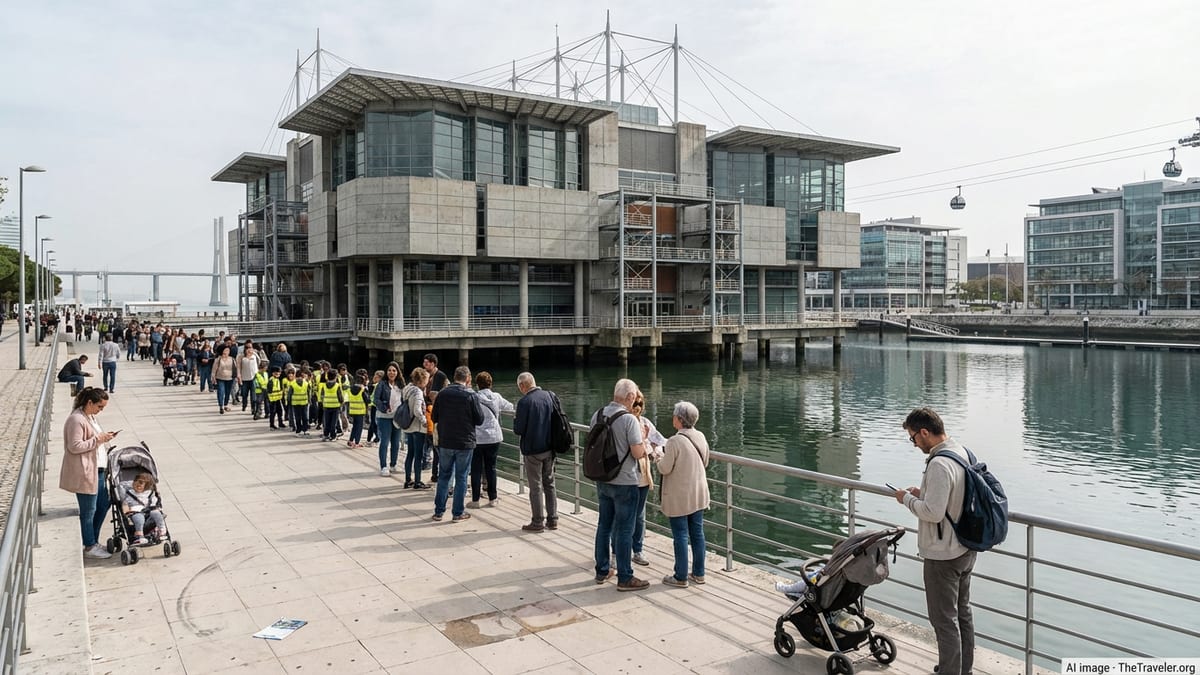
Planning, Tickets, and First Impressions
The first thing I learned is that Oceanário de Lisboa does not reward spontaneity. It opens daily from 10:00 to 20:00, with last entry at 19:00, and it really pays to plan around those hours. I visited on a weekday in shoulder season, bought my ticket online in advance, and still found myself in a slow-moving entrance queue at around 10:30. Buying online did help a little with the ticket counter line, but it did not magically make the security and turnstile crowd vanish. If you are expecting a seamless “skip the line” experience, that is not the reality on a normal busy day.
Ticket prices struck me as high but not outrageous for a flagship European attraction. Adults were 25 euros at the time of my visit, children 3 to 12 were 15 euros, and visitors 65 and over paid 17 euros, with kids under 3 free. For a family of four, though, this quickly becomes a significant outlay before you have even stepped inside. There are combo and third-party tickets that bundle the Oceanário with other attractions or a cable car ride, but those can make planning more complex and do not change the fact that this is a relatively expensive half-day out.
Reaching the Oceanário itself is one of the easiest parts. It is in Parque das Nações, near the Oriente transport hub on Lisbon’s red metro line. I took the metro to Oriente and walked about 10 minutes through a modern, somewhat anonymous stretch of glassy buildings and wide pavements. It felt safe and straightforward, if not particularly charming compared to central Lisbon’s older neighborhoods. For anyone staying in Baixa, Chiado, or Alfama, the metro plus short walk is the most sensible route; driving and parking in the area is possible but, in my view, unnecessary stress.
My first visual impression of the building was slightly underwhelming. From the outside, the Oceanário has the look of a late-1990s Expo pavilion, which makes sense given its origins. It is functional, a bit boxy, and set on the water with some industrial flourishes. It does not scream “world-class aquarium” as much as “serious institution,” and that tone carried through to much of what I experienced inside.
Crowds, Layout, and the Emotional Tone of the Visit
Inside, any lingering fantasy I had of wandering in peaceful semi-darkness vanished quickly. Even though I visited well outside peak summer holidays, the Oceanário was busy. School groups, families with strollers, couples, and a steady stream of independent travelers like me all funnel into the same circulation path that winds around the central tank and through side exhibits. At times I found myself doing that awkward shuffle you do in museums when you are trying not to block people while still catching information panels.
The layout is both a strength and a weakness. The design centers on a huge main ocean tank that you keep encountering from different angles and levels, with side habitats branching off. Conceptually, it is clever and immersive. In practice, it creates several choke points where visitors naturally slow down, which means traffic jams in front of the best viewing windows. I often had to wait several minutes to get close enough to the glass to properly appreciate the scene, and if you are someone who dislikes crowds pressed up against large tanks, this will test your patience.
Emotionally, I found the atmosphere more contemplative than “family fun” oriented, which I mostly appreciated. Lighting is low, the sound of water and muffled voices dominates, and there is a seriousness in the way the exhibits are presented. That said, the constant background noise of children and loud conversations snapped me out of the meditative mood more than once. The Oceanário clearly tries to serve both as an educational conservation center and a family attraction, and at times it felt caught between those identities.
One aspect that affected my enjoyment was the temperature. The building is climate controlled to keep the tanks stable and comfortable for animals, not for visitors who have just rushed in from a warm Lisbon day. I was glad I had a light layer with me. It was not freezing, but after an hour of slow walking and standing still, the chill crept in. If you are sensitive to cool environments, bring something extra to wear.
The Star of the Show: The Central Tank and Its Residents
The main ocean tank is where the Oceanário truly justifies its reputation. It holds millions of liters of seawater and feels genuinely vast, with different viewing panels at multiple levels giving you the sense of circling a living, breathing slice of the open ocean. When I finally squeezed into a good spot at one of the large windows, I stopped thinking about the crowd and simply watched.
Massive sunfish, graceful rays, and various species of sharks patrol the space, weaving around schools of smaller fish that move like synchronized clouds. It is mesmerising. I found myself returning to the central tank several times, sometimes by design, sometimes just because the route brings you back to it. Each angle gave me a slightly different perspective on the same underwater world. When the crowd noise dipped, it was almost meditative, and these moments were the clear highlight of my visit.
However, the central tank also highlighted a tension for me. There is an undeniable thrill in seeing these animals so close, but I could not entirely shake the question of how well they are doing in captivity. The Oceanário positions itself strongly as a conservation and research center, and there is information about its partnerships and projects, but some exhibits did not provide as much detail as I would have liked about the welfare standards and enrichment the animals receive. I am not accusing the institution of negligence; it is clearly regarded as a serious and respected aquarium. Still, as someone who has become more cautious about wildlife attractions, I would have appreciated more visible, specific information about how they ensure the animals thrive, not just survive.
Another minor disappointment is that, while the central tank is spectacular, it is also somewhat static. The longer I watched, the more I noticed the same animals repeating similar patterns. That is part of the point: you are watching an ecosystem in balance, not a staged show. But if you go in expecting continuous high drama, you may need to adjust your expectations to quieter appreciation of slow movement and subtle interactions.
Side Exhibits, Penguins, and Temporary Installations
Beyond the central tank, the Oceanário offers a range of side habitats representing different marine and coastal environments. I found these more uneven in impact. Some are beautiful and thoughtfully designed, others felt slightly dated or crowded to the point of distraction. At times the theming is rich, with carefully constructed rockwork, plant life, and lighting. In other spots, the illusion breaks and you are clearly standing in front of a large, high-tech fish tank, nothing more.
The penguin area was one of the better known sections I was keen to see, especially as there had recently been news of structural works and then the penguins returning to the exhibit. When I visited, the birds were active and engaging, diving into the water and waddling across rocks. Children around me were delighted, and I have to admit I was too. Still, I was left with mixed feelings about the space itself. It seemed relatively compact for such energetic animals, and the artificial snow and rock surfaces had that slightly stage-like quality that reminded me I was looking at a set. Again, I do not doubt that experts are involved in the design and care, but as a visitor with growing sensitivity about captive wildlife, I found myself questioning whether the educational value fully justifies their confinement.
Another element during my visit was a temporary, immersive exhibition themed around the connection between the ocean and the universe. It used projections, sound, and mirrored surfaces to create the feeling of floating between stars and bioluminescent creatures. I appreciated the creativity and the attempt to reach visitors beyond traditional tanks and labels, but after a few minutes the experience felt more like an Instagram-friendly art installation than a deeply informative exhibit. It was visually impressive and kids seemed to love it, but the educational content was thinner than what I had expected from the marketing description.
Not every side exhibit hit the mark. Some tanks were so crowded with fish that it was hard to appreciate individual species, and a couple of areas had minor glare or reflection issues that made photography frustrating. Information panels varied in quality; some were insightful and well translated, others read like fairly generic fact sheets. I caught myself skimming more than I wanted to, which is never a great sign in a place that aims to educate.
Practicalities: Food, Facilities, and Comfort
After about an hour and a half of slow wandering and repeated returns to the central tank, I needed a break. The Oceanário has a café on site, and I decided to test it rather than heading back out into the neighborhood. This turned out to be one of the more disappointing aspects of my visit. The food options were what I would call basic attraction fare: sandwiches, pastries, some hot items, and drinks. Prices were predictably inflated, portions modest, and the overall vibe felt more like a functional cafeteria than a place you would choose to eat if you were not already trapped inside a major attraction with limited options.
If I went again, I would plan to eat either before or after my visit in one of the many restaurants along the riverfront or inside the shopping and dining complexes at Parque das Nações. The surrounding area is not short on food choices, and you can get far better value and atmosphere within a short walk. My recommendation is to treat the on-site café as an emergency coffee or snack stop rather than part of the experience to look forward to.
In terms of facilities, the Oceanário is generally well equipped. There are multiple restrooms, an accessible layout with elevators, and wide corridors designed to accommodate strollers and wheelchairs. Still, at peak times the comfort level drops. Stroller parking areas overflow, restroom lines build up, and the constant shuffle of bodies becomes tiring. I noticed that staff were present and trying to keep things organized without being intrusive, which I appreciated, but there is only so much they can do in a building heavily constrained by its original Expo-era design.
The gift shop is large and well stocked with the usual array of plush animals, children’s books, branded items, and a sprinkling of more thoughtful, sustainability-themed products. I found a couple of small, well produced ocean-related books that I thought were worth the price, but much of the merchandise felt generic. As is common in big attractions, you pass through or by the shop as part of the exit route, so if you are visiting with children, be prepared for some negotiation.
Time, Value, and How It Fits into a Lisbon Itinerary
In total, I spent just under three hours inside the Oceanário, including a short break at the café. I could have rushed through in about ninety minutes, but that would have undermined what the place does best, which is reward unhurried observation. That said, three hours is a significant chunk of a day in a city as rich as Lisbon, and I found myself weighing what I might have done instead with those hours and that ticket cost.
From a pure value-for-money standpoint, I would call the experience fair but not exceptional. The central tank and some of the side exhibits are genuinely world class. The educational mission is serious, and there is real substance behind the marketing language about conservation. However, the crowding, the slightly dated feel of some areas, and the mediocre food dragged the overall impression down a notch. I did not come away feeling cheated, but I did not walk out thinking, “That was an absolute bargain and a must-do for everyone,” either.
Where the Oceanário shines is for certain types of visitors. If you are traveling with children, especially those with a fascination for marine life, this can be a highlight of their trip. For a rainy or very hot day when outdoor sightseeing is less appealing, it offers a structured, weather-proof activity in a comfortable environment. If you are already staying or spending time in Parque das Nações, it fits naturally into your day, perhaps combined with a walk along the river or a ride on the cable car.
On the other hand, if your time in Lisbon is short and you are looking for experiences that feel uniquely local and rooted in the city’s history and culture, the Oceanário is easier to skip. It is impressive, but it could almost be anywhere. Compared to wandering labyrinthine streets in Alfama, tasting pasteis in Belém, or riding the tram through old neighborhoods, this is a polished, international-style attraction with only a shallow connection to the Lisbon outside its doors.
What I Would Do Differently Next Time
Reflecting on my visit, there are several things I would change if I went again, and they are worth sharing because they could easily improve your experience too. For starters, I would make a more deliberate choice about timing. Arriving just after opening was better than the midday crush, but it still put me in the middle of a wave of school groups and early-bird visitors. If I could redo it, I would either be at the door right at 10:00, ready to walk in with the first group, or I would come later in the day, perhaps around 17:30 or 18:00, when many families are heading out.
I would also skip the on-site café and plan a proper meal in the surrounding area. There are more scenic and higher quality options within a short walk, especially along the waterfront. Eating before going in would mean I could focus fully on the exhibits without hitting the mid-visit energy crash that led me to accept a subpar lunch.
Another change would be to approach the exhibits more selectively. On my first visit, I tried to see everything in order, worried that I might miss something important. In practice, this meant I burned energy on a few less compelling side rooms that did not add much to my understanding or enjoyment. Next time, I would give myself permission to linger longer at the central tank and one or two side habitats that genuinely captivated me, and walk more briskly through areas that felt repetitive.
Finally, I would go in with clearer expectations about what kind of experience this is. It is not a quiet, meditative temple to the ocean where you can commune in solitude with marine life. It is a large, popular, family-friendly aquarium in a busy modern district of Lisbon. Accepting that reality upfront makes the crowds and noise easier to tolerate. Within that framework, you can still find pockets of wonder and reflection, but they require a bit of patience and strategic positioning.
The Takeaway
So is Oceanário de Lisboa worth visiting? For me, the answer is a qualified yes, with several important conditions. I am glad I went. The main tank alone offered some of the most compelling underwater viewing I have experienced in an aquarium, and the overall institution clearly takes its conservation role seriously. There were moments when I simply stood and watched a ray glide past a shark against a backdrop of shimmering fish and felt my shoulders drop and my mind quiet. Those are the moments that justify the ticket price.
At the same time, I do not think this is an essential stop for every traveler. If your time in Lisbon is limited to two or three days and you care more about historic neighborhoods, local food, and traditional culture, I would not prioritize the Oceanário over those. It is a high-quality modern attraction, but not uniquely “Lisbon” in the way a walk through Alfama at dusk or a ferry ride across the Tagus feels.
If you are traveling with children, have a particular interest in marine life, or are looking for a weather-proof activity that can fill a half-day in a comfortable environment, the Oceanário can be a great choice, provided you manage your expectations. Book your tickets in advance, plan your visit for first thing in the morning or later in the afternoon to avoid the worst of the crowds, bring an extra layer for the cool interior, and eat before or after your visit outside the building.
For me personally, if I were to return, it would be because I wanted to see a specific new exhibition or because I was in Lisbon with friends or family who had never been and were keen to go. I would not repeat the experience exactly as I had it, but I would refine it with what I have learned. Approached with realistic expectations and a bit of planning, Oceanário de Lisboa can offer an engaging, thought-provoking window into the ocean. It is not perfect, and it is not for everyone, but under the right conditions it is still worth making time for.
FAQ
Q1. How long should I plan to spend at Oceanário de Lisboa?
Most visitors, including me, find that two to three hours is enough to see the main tank, explore side exhibits at a comfortable pace, and take a short break. You can rush through in about ninety minutes, but that feels too hurried for what the aquarium does best, which is reward slow observation.
Q2. What are the current opening hours and last entry times?
At the time of my visit, the Oceanário was open daily from 10:00 to 20:00, with last entry at 19:00. On December 24 and 31 it closed an hour earlier, and on December 25 and January 1 it opened an hour later than usual. It is always wise to recheck the official site before you go in case hours change.
Q3. Is it necessary to buy tickets in advance?
I would strongly recommend buying tickets online in advance, especially during weekends, holidays, or school vacation periods. It does not eliminate all waiting, because you still pass through security and entrance gates, but it can significantly shorten the queue compared with buying tickets on the spot.
Q4. What is the best time of day to visit to avoid crowds?
In my experience and based on staff advice, the best strategy is to either arrive right at opening time at 10:00 or go later in the day, around two hours before closing. Midday and early afternoon tend to be the busiest, especially with school groups and families. Even at quieter times you should expect some crowds around the most popular viewing windows.
Q5. How easy is it to get there using public transport?
Getting there by public transport is straightforward. I took the red metro line to Oriente station and walked about 10 minutes through Parque das Nações to reach the entrance. Several bus lines also serve Oriente, and from central Lisbon the journey typically takes around 20 to 30 minutes. I did not feel any need to drive or take a taxi.
Q6. Is Oceanário de Lisboa suitable for very young children?
Yes, it is generally suitable for young children, and I saw many families with strollers and toddlers. The dark lighting and crowd levels might be overwhelming for some kids, and stroller parking areas can get congested, but the wide corridors and elevators make it manageable. If you have very young children, going at opening time can make the environment less intense.
Q7. How did the food and café options compare to eating nearby?
I found the on-site café to be one of the weaker parts of the experience, with fairly standard, overpriced attraction food and a functional rather than pleasant atmosphere. Given how many better dining options exist nearby in Parque das Nações, I would plan to eat before or after the visit elsewhere and use the café only for a quick coffee or emergency snack.
Q8. Are there any ethical concerns about animal welfare I should be aware of?
The Oceanário presents itself as a serious conservation and research institution, and it collaborates with various scientific and environmental organizations. Still, like any large aquarium, it raises questions about keeping large marine animals, including sharks and sunfish, in captivity. I would have appreciated more detailed, visible information about welfare standards and enrichment, but I did not see any obvious signs of neglect. If you are particularly sensitive about captive wildlife, you may want to reflect on your comfort level before visiting.
Q9. Is the Oceanário a must-do if I only have a couple of days in Lisbon?
In my view, no. If you only have two or three days in Lisbon and want to focus on experiences that feel uniquely local, I would prioritise historic neighborhoods, viewpoints, traditional food, and the riverfront over the Oceanário. It is a high-quality, enjoyable attraction, but it has a more international, less specifically Lisbon character compared with other parts of the city.
Q10. Who is the Oceanário best suited for, based on your experience?
Based on my visit, the Oceanário is best suited for families with children, travelers with a strong interest in marine life, and anyone looking for a weather-proof, structured activity that fills a half-day comfortably. It also works well if you are already planning to spend time in Parque das Nações. For travelers short on time or primarily interested in historic and cultural immersion, it is more of a nice-to-have than an essential stop.