

Thailand has evolved into one of the world’s most visible hubs for location‑independent professionals. For 2026 relocation planning, the central question is whether the country’s digital infrastructure, work environment and operating conditions are robust enough for long term remote work, not just short stays. This briefing evaluates Thailand’s suitability as a base for expats and remote workers, focusing on connectivity, workspace availability, reliability, and structural risks that directly affect the ability to work online.
Digital Connectivity and Network Quality in 2026
For remote workers, stable and fast internet connectivity is the primary threshold issue. Thailand performs strongly by global standards on fixed broadband. Recent international rankings using 2024 and 2025 Speedtest data place Thailand within roughly the global top 10 to 15 countries for median fixed broadband speeds, with typical national medians in the 230 to 270 Mbps range. This places Thailand ahead of many Western countries and most regional peers, and indicates a solid foundation for bandwidth‑intensive work such as video calls, cloud computing and large file transfers.
Fixed fiber broadband is widely deployed in major cities including Bangkok, Chiang Mai, Phuket, Pattaya and other secondary hubs. Commercial packages of 300 to 1000 Mbps are commonly marketed to households and small offices, and user reports indicate that measured speeds often reach several hundred Mbps on wired connections. Independent barometer studies of Thai fixed internet performance through 2024 and into early 2025 further confirm consistent improvements in throughput and latency, particularly on fiber‑to‑the‑home lines.
Mobile connectivity is more mixed. Thailand has 4G coverage in almost all populated areas and expanding 5G coverage in dense urban corridors and selected provincial centers. Field studies of Thai 5G networks in Bangkok and other cities in 2023 and 2024 show urban download speeds that are competitive within the Asia–Pacific region, but mobile median speeds nationally are still well below fixed fiber performance. Remote workers relying primarily on mobile hotspots in rural or island areas should therefore expect more variable performance and occasional congestion at peak times.
Overall, for professionals who can secure a fixed fiber line in a city or established town, Thailand’s connectivity is more than adequate for modern remote work. The country’s global ranking on fixed speeds and ongoing fiber rollout support the conclusion that internet capacity is a clear strength rather than a constraint, provided the worker chooses an area with good last‑mile infrastructure.
Availability and Quality of Workspaces
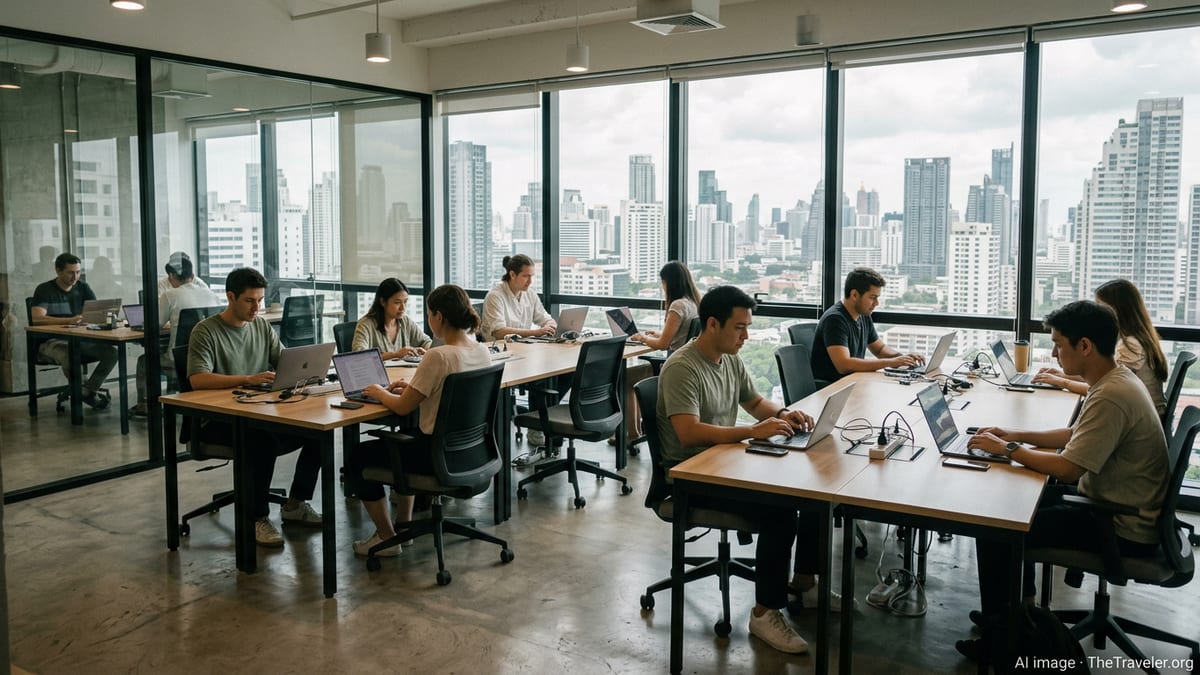
Thailand offers a diversified ecosystem of work environments suited to different remote work styles. Bangkok has a dense network of coworking spaces, serviced offices and corporate‑grade business centers in central districts such as Sathorn, Silom, Asok and along the new mixed‑use developments coming online in 2024 and 2025. Many of these facilities provide redundant high‑speed connections, meeting rooms, phone booths and business support services, which can be critical for client‑facing or team‑management roles.
Outside the capital, Chiang Mai remains a well‑known hub for long‑stay digital workers, with multiple coworking spaces and laptop‑friendly cafes in the old city and Nimmanhaemin areas. Secondary cities such as Phuket Town, Pattaya and Hua Hin, and some islands including Koh Phangan and Koh Lanta, now support smaller but growing coworking and remote‑friendly cafe ecosystems. Community discussions among digital workers through late 2024 and early 2026 frequently reference reliable Wi‑Fi in many of these locations, though dedicated office‑style environments are still concentrated in larger urban centers.
Work‑from‑home setups are also feasible for most apartments and houses in urban Thailand. Fiber installation is routinely available in modern condominiums and housing developments; many landlords either include a line in the lease or allow tenants to contract directly with providers. Speeds of 300 Mbps or higher are typical on entry‑level packages, with higher tiers available at moderate incremental cost. For expats intending to work from home rather than coworking offices, this makes it relatively straightforward to create a stable, professional‑grade workspace.
The main gap emerges in more remote rural areas and smaller islands, where coworking options are limited or absent and infrastructure depends heavily on individual providers. Although anecdotal reports describe fiber or high‑speed links reaching surprising locations, availability is inconsistent and outages can be harder to resolve. Remote workers selecting these areas for lifestyle reasons should be prepared with contingencies such as secondary SIM cards, backup work locations on the mainland, or flexibility in work hours.
Reliability, Outages and Redundancy Risk
Beyond nominal speeds, remote workers must consider reliability. In practice, Thailand’s power and internet infrastructure is relatively stable in cities, but outages do occur. The power grid in Bangkok and major provincial centers is generally dependable, with brief interruptions occurring a few times per year in many neighborhoods. Outside large cities, short power cuts are more frequent, particularly during storms or maintenance periods.
On the connectivity side, user experience data and consumer forums indicate that fixed broadband outages tend to be localized and are usually restored within hours, but service quality can vary by provider and neighborhood. Some operators have been rated more highly in independent 2024 and 2025 performance barometers for consistency and uptime, while others attract more complaints regarding routing issues or evening slowdowns. For remote workers with mission‑critical responsibilities, provider selection and building infrastructure can therefore be as important as the national indicators.
Prudent redundancy planning is advisable. Many remote workers in Thailand adopt a two‑layer approach: a wired home or office fiber line paired with at least one 4G or 5G mobile data plan capable of supporting temporary tethering. This combination significantly reduces the risk that a single infrastructure failure will disrupt work. In practice, carrying SIM cards from two different operators and knowing the location of nearby coworking spaces or cafes with alternative connections can provide an additional safeguard.
Natural hazard risk is another reliability consideration. Large areas of Thailand are exposed to seasonal heavy rains and occasional flooding, particularly in certain low‑lying parts of Bangkok and southern provinces. While moderate seasonal flooding does not necessarily interrupt service, severe events can affect both power and last‑mile connectivity. For professionals whose work cannot tolerate extended disruption, choosing accommodation in less flood‑prone districts and high‑rise buildings with backup power systems can mitigate this risk.
Remote Work Policy, Time Zones and Business Alignment
Thailand is in the UTC+7 time zone, which creates different levels of alignment with global clients and employers. For teams based in Europe, Thailand is typically 5 to 6 hours ahead of Central European Time for much of the year, enabling overlapping working hours through the European morning and Thai afternoon. For East Asia and Australia, overlap is generally strong, making Thailand a practical base for regional roles.
By contrast, alignment with North American working hours is challenging. Thailand is typically 11 to 12 hours ahead of Eastern Time, which often requires remote workers serving US or Canadian clients to work late evenings or nights to attend real‑time meetings. While this offset can be manageable for asynchronous roles, it is less suitable for positions that require continuous overlap during standard North American office hours. Remote workers should evaluate their employer’s expectations for live collaboration before committing to Thailand as a permanent base.
Remote work norms are also evolving. Thailand has seen increasing numbers of foreign remote workers and digital nomads since the late 2010s, with a noticeable acceleration after global acceptance of distributed work practices. Dedicated remote work and long‑stay visas are being progressively updated, and public discourse in 2024 and 2025 reflects a growing policy interest in attracting skilled foreign remote professionals. Although this briefing does not analyze visa specifics, the overall policy direction indicates that Thailand sees remote workers as an economic opportunity rather than a marginal phenomenon.
For expats employed by foreign companies, employer compliance and internal policy will remain decisive. Many organizations now maintain standardized frameworks for “work from anywhere,” including approved jurisdictions, security requirements and tax residency considerations. Thailand’s role in these frameworks is increasingly positive, especially for companies with Asia–Pacific operations, but individuals considering relocation should confirm their employer’s stance on long‑term work from Thailand before making firm commitments.
Urban vs Secondary Locations for Remote Work
Remote work feasibility varies significantly between different types of Thai locations. Large metropolitan areas such as Bangkok and its surrounding provinces offer the highest infrastructure quality, greatest choice of providers and strongest coworking ecosystem. They also provide more stable power, better public transport and ready access to service technicians, which reduces downtime when technical issues arise.
Mid‑sized cities and established tourist centers like Chiang Mai, Phuket, Pattaya and Hua Hin offer a compromise between urban infrastructure and a less intense environment. These areas generally have fiber connectivity, multiple workspace options and active expat communities, making them realistic choices for long‑term remote work. Many remote workers report stable connections and sufficient amenities in these cities, particularly in central neighborhoods and newer residential developments.
Smaller towns, rural settings and less developed islands present a more nuanced picture. While fiber is increasingly present even in provincial areas, coverage is patchier and heavily dependent on local rollout decisions. In some locations, high‑speed fiber may be available along main roads but not in more isolated properties. Weather‑related disruptions may also be more noticeable where infrastructure is less robust. For remote workers whose livelihoods depend on uninterrupted connectivity, these areas should be approached only after on‑the‑ground verification of speeds, outage history and backup options.
A structured way to approach location choice is to separate “core work base” and “short‑term retreat” functions. Thailand is well suited to a model where the primary work base is in a connectivity‑strong city or town, while more remote or island destinations are used for limited periods when work intensity is lower or when the worker can accept higher outage risk. This approach allows individuals to benefit from Thailand’s geographic variety without compromising business reliability.
The Takeaway
Viewed strictly through the lens of remote work practicality, Thailand in 2026 stands out as a comparatively strong option for expats and remote workers, particularly when measured against other middle‑income countries. High median fixed broadband speeds, wide fiber penetration in cities, and a mature coworking ecosystem create favorable conditions for knowledge work that depends on stable, high‑bandwidth connectivity.
Key advantages include globally competitive fixed internet performance, relatively straightforward access to high‑speed home connections in urban areas, and a spectrum of coworking and serviced office options in major hubs. Thailand’s UTC+7 time zone works well for collaboration with Europe, East Asia and Australia, and increasingly accepted global norms around location‑independent work reinforce the country’s position as a practical base for distributed teams.
The main constraints lie in uneven infrastructure quality outside major centers, variable reliability of mobile connectivity in more remote or island locations, exposure to weather‑related disruption in some regions, and significant time‑zone misalignment with North America. These factors do not negate Thailand’s suitability, but they require deliberate planning, particularly for professionals whose roles are time‑sensitive or heavily dependent on synchronous communication.
Overall, for remote workers and expats willing to base themselves in cities or well‑serviced towns, invest in redundant connections and carefully match their time zone obligations, Thailand can be considered a good to very good country to move to in 2026 from a remote work infrastructure and environment perspective. Those prioritizing highly rural or isolated settings, or close alignment with North American work hours, may find the structural constraints more limiting and should evaluate alternatives or adapt their working patterns accordingly.
FAQ
Q1. Is Thailand’s internet fast enough for full‑time remote work in 2026?
Yes, in major cities Thailand’s fixed broadband speeds are among the higher national medians globally, typically sufficient for video conferencing, cloud tools and large file transfers.
Q2. How reliable is home internet for expats working from apartments or condos?
In urban areas reliability is generally good, especially in modern buildings with fiber, although occasional localized outages mean many remote workers maintain a mobile backup.
Q3. Can remote workers depend on mobile data and hotspots alone?
Mobile networks and 5G coverage are adequate in cities, but performance is more variable than fixed fiber, so relying solely on hotspots is not ideal for mission‑critical work.
Q4. Are Thailand’s islands suitable for long‑term remote work?
Some islands have good connections and a modest coworking presence, but coverage is inconsistent and outages can be harder to resolve, so risk‑tolerant or short‑term stays are more realistic.
Q5. Is there good coworking space availability in Thailand?
Yes, Bangkok and Chiang Mai have extensive coworking ecosystems, with additional though more limited options in cities like Phuket, Pattaya and some island locations.
Q6. How does Thailand’s time zone affect collaboration with employers abroad?
UTC+7 provides good overlap with Europe and Asia–Pacific but requires evening or night work for real‑time collaboration with North American teams.
Q7. Do frequent power cuts disrupt remote work in Thailand?
Short power interruptions occur but are relatively infrequent in major cities; using surge protection, laptop battery buffers and mobile hotspots reduces their impact.
Q8. Is it easy to get high‑speed home internet installed as a new arrival?
In urban areas it is usually straightforward, either through landlords who already have service in place or by arranging installation directly with an ISP for the rented unit.
Q9. Are rural areas in Thailand viable bases for remote workers?
Some rural and small‑town areas have fiber, but coverage is patchy and support limited, so they are generally suitable only after verifying local service quality in person.
Q10. Overall, is Thailand recommended as a remote work base in 2026?
For expats in cities or well‑connected towns who plan for redundancy and time‑zone issues, Thailand is broadly a strong choice; for very remote or North America‑aligned roles, constraints are greater.