

The Canadian Museum for Human Rights in Winnipeg is one of Canada’s most distinctive cultural institutions, drawing visitors from around the world with its striking architecture and powerful storytelling. For many travelers, however, an equally important question arises long before they step inside: is the museum safe and genuinely accessible for all visitors, including those with mobility, sensory, or cognitive disabilities, families with children, and solo travelers? This guide takes a close look at current safety practices, accessibility features, and real-world considerations so you can plan a confident and comfortable visit.
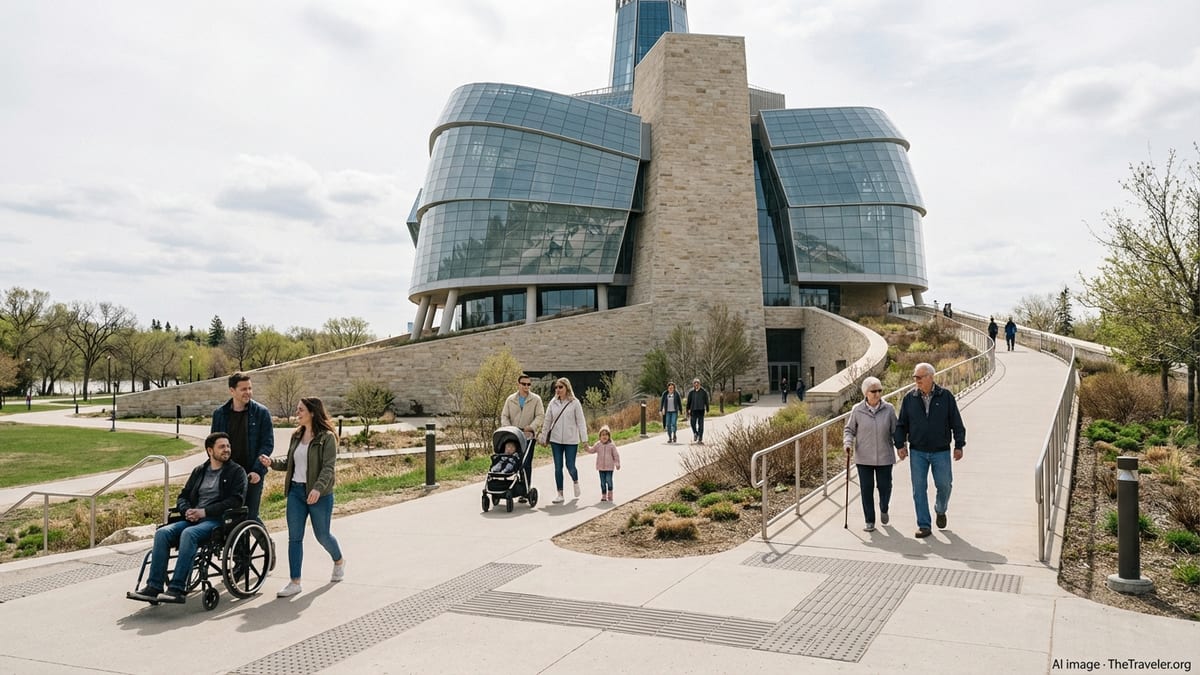
Setting the Scene: Location, Design and Visitor Profile
The Canadian Museum for Human Rights (CMHR) is located at The Forks in downtown Winnipeg, a long-time gathering place at the confluence of the Red and Assiniboine rivers. The area is a major civic and tourism hub, typically busy during the day and early evening with visitors, workers, and locals using nearby restaurants, markets, and riverfront paths. This steady presence of people, combined with on-site security and active city patrols around The Forks, supports a feeling of general safety for most visitors during typical opening hours.
The museum’s architecture is dramatic and symbolic, with a glass “cloud” exterior and a central tower rising above the city skyline. Inside, visitors move along a sequence of illuminated alabaster ramps that connect the galleries. While the design is visually striking, it was also created with inclusive design principles in mind. Circulation paths are wide, elevators are positioned to serve all levels, and wayfinding cues help orient visitors as they move through the building.
The CMHR attracts a diverse cross-section of visitors: local school groups, international tourists, human rights advocates, and families exploring Winnipeg’s cultural attractions. The themes explored inside can be emotionally intense, touching on genocide, discrimination, and other harms, so the museum is intentional about creating calm, physically safe spaces where people can pause, reflect, and, if needed, step away from the heavier content for a time.
Although any urban destination requires basic travel precautions, there is no pattern of violent crime or major safety incidents associated with visiting the museum itself. Travelers who are familiar with standard urban awareness practices typically find the environment comfortable and well managed.
Physical Safety, Security Measures and Visitor Support
From the moment you approach the CMHR, visible security and safety measures are in place. Entrances are monitored by staff, and visitors pass through a controlled entry sequence where tickets are checked and large items can be inspected at the discretion of security. Inside, security personnel and visitor services staff are present throughout the building, both in uniform and at service points such as the admissions desk and coat check.
The museum publishes and maintains a formal accessibility and safety framework under Canada’s Accessible Canada Act, and its current multi-year accessibility plan emphasizes the prevention and removal of barriers for disabled visitors while integrating safety considerations into building operations and programming. This forward-looking approach underlines that safety is not treated as a one-time compliance issue but as an ongoing process involving staff training, community consultation, and periodic review.
Emergency preparedness is woven into the building’s design and operations. Stairwells, ramps, and exits are marked; staff are trained to guide visitors during evacuations; and accessible routes are built into emergency planning so that people using wheelchairs or other mobility devices are not left out of safety procedures. While specific protocols are not disclosed in detail for security reasons, the museum is aligned with national museum standards on fire safety, crowd management, and emergency response.
In day-to-day practice, visitors report a calm and orderly environment, with crowding most likely during peak field-trip seasons or special events. Even at busy times, galleries tend to absorb visitors across multiple levels, reducing the sense of congestion and potential safety stress that can appear in more compact museums.
Mobility Access: Getting In, Getting Around, and Resting
The CMHR positions itself as a global example of inclusive design, with mobility access built into both the building and its operations. All public entrances are accessible to people using wheelchairs, scooters, walkers, and strollers, and there is a dedicated accessible drop-off entrance located very close to the main doors. This is especially valuable in Winnipeg’s winter conditions, reducing exposure to snow, ice, and cold.
Once inside, visitors will find barrier-free paths throughout the galleries. The museum uses a system of gently sloped ramps, with resting spots at regular intervals, to connect levels. Elevators are available for those who prefer or need them, and they are clearly integrated into the circulation pattern rather than hidden away in staff-only corners. While the ramps create a striking visual experience, visitors using manual wheelchairs or pushing strollers may wish to pace themselves and take advantage of rest areas, particularly if they plan to see the museum in a single, extended visit.
To support visitors who require mobility aids, the museum maintains a small fleet of scooters, power mobility devices, and manual wheelchairs. These can be pre-booked or accessed on a first-come, first-served basis, and cane-seats are also available at coat check. This significantly reduces barriers for travelers who may not be able to transport their own equipment by air or long-distance ground travel. It is sensible, however, to reserve equipment in advance when possible, particularly during weekends, holidays, and school-break periods when demand may rise.
Washrooms are uniformly gender-inclusive, with large, accessible, single-user washrooms located across multiple levels. At least one washroom includes an adult-sized change table and a motorized transfer lift, a feature that can be critical for visitors who require assistance with personal care. This attention to detailed physical access signals that the museum’s commitment to accessibility extends beyond broad statements to the realities of everyday needs.
Visual, Auditory and Sensory Accessibility
Accessibility at the CMHR extends well beyond ramps and elevators. The museum has invested heavily in multi-sensory access to content, so that visitors who are blind, have low vision, are Deaf or hard of hearing, or have sensory processing differences can engage with the exhibits in meaningful ways. This is particularly important at a human rights museum, where exclusion from the stories being told would undermine the very principles it seeks to uphold.
For visitors who are blind or have low vision, the museum makes extensive use of tactile markers called Universal Access Points. These markers, positioned near exhibits, allow visitors to access audio description, transcripts, and additional information through devices or the museum’s mobile app. Tactile flooring strips guide users toward access points, and many exhibits include tactile components and large-print materials to support non-visual exploration.
For Deaf visitors and those who are hard of hearing, videos with spoken content are interpreted into American Sign Language and Langue des signes québécoise on-screen, and captioning is widely used. Assistive listening technologies and audio jacks at certain exhibits allow visitors using hearing aids or headphones to control volume and listen in a way that suits their needs. The museum’s mobile app, offered in English, French, ASL, and LSQ, provides another layer of accessible guidance, and the use of members of the Deaf community on-screen reinforces representation as well as communication access.
The museum has also started to focus more intentionally on sensory accessibility. Feedback gathered through its accessibility planning process has emphasized the need for sensory-friendly spaces and programming, as some visitors may find the combination of crowds, soundscapes, and emotional content overwhelming. In response, the museum has committed to developing sensory-friendly offerings and clearer information on quiet spaces, and it continues to adapt based on community input. Travelers with autism, anxiety, or sensory processing differences may wish to contact the museum ahead of time to ask about upcoming sensory-friendly hours or low-sensory times of day.
Digital Tools, Wayfinding and Communication Support
Digital and communication tools play an important role in keeping the CMHR both safe and accessible. The museum’s free mobile app offers a self-guided tour that includes audio description, sign language content, and additional background on exhibits. For visitors who prefer to pace themselves, avoid larger guided groups, or reduce close contact, the app supports an independent style of exploration while still offering structured information.
The CMHR also supports the Aira app, which connects people who are blind or have low vision with a live visual interpreter via their smartphone. Within the museum, Aira can assist with navigation, reading text panels, or describing visual elements of exhibits. The service is provided at no cost on-site, effectively adding a remote human guide to the museum’s physical and digital accessibility toolkit.
Wayfinding has been approached with inclusive design principles. Signage is provided in high-contrast formats, multiple languages, and with clear pictograms. Maps and visitor guides, including accessible print formats, help visitors orient themselves before moving between levels. Staff receive dedicated training on inclusive communication, so that interactions with visitors who use AAC devices, interpreters, or other supports are handled respectfully and efficiently.
Communication supports extend to ticketing and visitor inquiries. Multiple contact methods are provided, including telephone, toll-free numbers, email, and TTY options, so that visitors can clarify expectations, request accommodations, or ask detailed questions about accessibility and safety protocols before arriving. This proactive communication reduces uncertainty and helps visitors plan strategies that meet their needs.
Health Measures, Crowd Management and Emotional Safety
Like most major Canadian museums, the CMHR has adjusted its health and safety approach over the last several years, particularly in light of respiratory illness concerns. While specific mask or vaccination rules may evolve based on public health guidance, the museum emphasizes regular cleaning, hand-sanitizer availability, and encouragement of responsible visitor behavior, such as staying home when unwell. Health-related procedures are periodically reviewed and updated in line with federal and provincial recommendations.
Crowd management also plays a part in visitor safety. Timed tickets or capacity limits for certain events may be used to avoid overcrowding, and staff can redirect visitor flows when particular galleries become busy. Elevators, in particular, can see higher demand at peak times, and visitors who can comfortably use ramps or stairs are often encouraged to do so, leaving elevator capacity for those who depend on it. This cooperative approach helps maintain safety while preserving accessibility.
Emotional safety is another important consideration. The museum’s subject matter can be challenging, covering events such as the Holocaust, residential schools, and other human rights abuses. The CMHR addresses this by designing galleries with quieter reflection zones, seating areas, and routes that allow visitors to step away if they feel overwhelmed. Facilitators and guides are trained to respond sensitively to emotional reactions, including those of children and teenagers, and to suggest breaks or alternate routes when appropriate.
For families, the museum’s exhibits combine difficult themes with age-appropriate interpretation and spaces that allow children to process information with the support of caregivers. Parents and guardians may wish to review exhibit descriptions ahead of time to decide which areas are suitable based on the age and temperament of their children, and to plan breaks in calmer areas of the building or at The Forks outside.
Accountability, Inclusion and Past Concerns
No major cultural institution is free from scrutiny, and in recent years the Canadian Museum for Human Rights has faced internal criticism and public investigation over issues including systemic racism, workplace discrimination, and the treatment of staff, particularly Indigenous and Black employees and LGBTQ2S+ communities. These concerns led to external reviews, leadership changes, and new equity and anti-racism commitments.
For visitors, these developments matter less in terms of immediate physical safety and more in terms of trust and institutional culture. A museum dedicated to human rights is expected to model the values it promotes, and failures in that area can raise doubts about whose stories are told and whose comfort and safety are prioritized. The CMHR has responded by expanding anti-racism training, Indigenous engagement, and equity-focused initiatives, as well as making its accessibility and inclusion planning more transparent and consultative.
From a traveler’s perspective, the key takeaway is that the museum is actively engaged in a process of accountability and improvement. Policies on accessibility, employment equity, and community consultation are now more visible, and the institution has committed to regular public reporting on progress. While individual experiences may still vary, especially for visitors from historically marginalized groups, the current direction is toward greater inclusion, responsiveness, and openness to feedback.
Visitors who encounter barriers or concerns related to accessibility, discrimination, or safety are encouraged by the museum to report them directly through designated feedback channels or in person. This feedback is formally recognized as part of the institution’s continuous-improvement framework, which can offer some reassurance that concerns are not simply dismissed.
The Takeaway
For most travelers, the Canadian Museum for Human Rights offers a visit that is both physically safe and notably accessible. Its setting at The Forks, visible security presence, and compliant emergency planning provide a solid foundation of basic safety that aligns with what seasoned travelers expect from a national museum in a Canadian city.
Where the CMHR truly distinguishes itself is in accessibility. From accessible entrances and ramps to free mobility aids, gender-inclusive and fully accessible washrooms, sign language interpretation, audio description, tactile markers, and digital tools such as Aira and the museum app, it demonstrates a far-reaching commitment to ensuring that visitors with diverse disabilities can not only enter the building but fully experience its content. This aligns closely with its mission as a human rights institution and is continually reinforced through updated accessibility plans.
The museum’s acknowledgement of past internal problems and its ongoing efforts toward equity and inclusion show that it treats human rights as a living practice rather than a static exhibition topic. Travelers who prioritize ethical tourism may appreciate this willingness to confront shortcomings, even as they hold the museum to its promises.
In practical terms, visitors can enhance their own sense of safety and comfort by planning ahead: checking the latest health and accessibility information, reserving mobility devices when needed, scheduling visits during quieter times if they are sensitive to crowds or sensory input, and preparing emotionally for challenging content. With these basic steps, the Canadian Museum for Human Rights can be an enriching, accessible, and safe highlight of a trip to Winnipeg.
FAQ
Q1. Is the Canadian Museum for Human Rights generally safe for visitors?
The museum is considered a safe environment, with monitored entrances, on-site security staff, and standard emergency procedures consistent with national museum practices.
Q2. Is the museum wheelchair accessible on all levels?
Yes. All public levels are accessible by a combination of ramps and elevators, and circulation paths have been designed to accommodate wheelchairs, scooters, and strollers.
Q3. Can I borrow a wheelchair or scooter at the museum?
The museum maintains a small fleet of manual wheelchairs, scooters, and other mobility devices that visitors can borrow, with pre-booking or first-come, first-served access.
Q4. Are there accessible and gender-inclusive washrooms?
Washrooms throughout the museum are gender-inclusive, and multiple single-user accessible washrooms are available, including at least one with an adult-sized change table and transfer lift.
Q5. What support is available for visitors who are blind or have low vision?
The museum uses tactile markers, audio description, large-print materials, and support through the Aira app to provide detailed, navigable access for visitors with low or no vision.
Q6. How does the museum support Deaf and hard-of-hearing visitors?
Most videos with spoken content include sign language interpretation and captioning, and assistive listening options and audio jacks are available in many areas.
Q7. Are there sensory-friendly options for visitors sensitive to noise or crowds?
The museum is working on sensory-friendly programming and encourages visitors to contact staff about quieter times, reflection spaces, and strategies for avoiding peak crowd periods.
Q8. Is it safe to visit with children, given the difficult subject matter?
Yes, but parents should be prepared for emotionally challenging exhibits. Staff can recommend age-appropriate galleries, and there are quiet zones for breaks and conversation.
Q9. Can a support person or attendant enter the museum for free?
Yes. A support person accompanying a visitor who requires assistance is typically admitted at no cost, reflecting the museum’s commitment to accessibility.
Q10. What should I do if I encounter an accessibility or safety issue during my visit?
Report concerns immediately to museum staff or security, or share feedback through the museum’s official channels so issues can be documented and addressed.