

I had dreamed about the Okavango Delta for years. A shimmering green fan in the middle of the Kalahari, often described as one of the last true wildernesses on earth. When I finally made it there, I found moments of real magic: elephants pushing through papyrus channels at sunset, the hollow knock of a mokoro pole, stars so bright they almost felt artificial.
But in between those high points were long, hot, expensive and occasionally frustrating realities that most glossy brochures skip. If you are weighing whether the Okavango Delta is actually worth visiting, this is the candid review I wish I had read before I booked.
First Impressions: Expectations vs Reality
My expectations were sky high. Every article I had ever seen described the Delta as untouched, exclusive and life changing. Landing in Maun, the dusty gateway town, was my first hint that reality would be more work than the marketing implied. Immigration lines were slow, the small airport was chaotic around midday flight rushes, and it felt very much like a logistics hub rather than a romantic safari frontier. It was a necessary staging post, not a destination, and that was a mental adjustment right away.
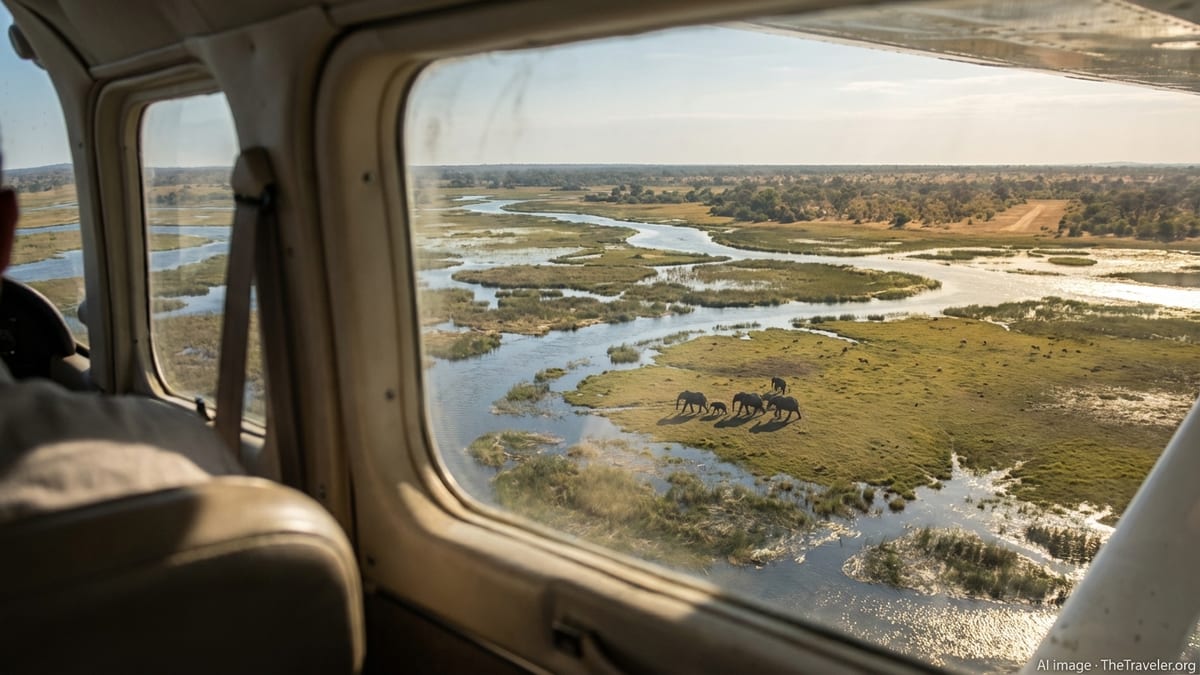
The scenic flight from Maun into the Delta itself was where the dream started to feel real. From above, the landscape is stunning, a patchwork of water channels, palm islands and herds of elephant that look like pepper grains against the floodplains. But that short flight, usually 20 to 40 minutes, was also my first real encounter with the price of the Okavango. Those charter transfers are not optional for most camps and they add several hundred dollars per person to the bill, even when bundled into packages. I knew this in theory before I went, but seeing how short the flight was compared to the cost gave me a small jolt.
Arriving in camp, I was met with warm towels, drinks and the polished choreography of high-end safari hospitality. The setting was beautiful, with canvas tents raised on wooden decks, open lounge areas, and staff who knew my name within minutes. It felt intimate and remote. Still, I also immediately noticed the hum of generators in the background, the strict briefing on water usage and safety rules, and the fact that this “wilderness” comes with a lot of structure. If you are picturing yourself freely wandering around a pristine swamp, that is not how the Delta works.
The Money Question: How Much the Okavango Really Costs
Let me be blunt: the Okavango Delta is one of the most expensive safari destinations on earth, and you feel that from the moment you start planning. When I priced options for 2025 and 2026, typical lodge packages for what I would call “normal” mid to upper range camps were running from roughly 400 to well over 1,500 US dollars per person per night depending on season and standard, with some concessions crossing the 2,000 dollar mark. That usually included accommodation, meals, game drives and activities, and often the charter flights from Maun, but not international flights or tips.
Even more budget conscious packages that bundle charter flights and a basic camp can still easily exceed 1,000 dollars per person for just two nights, again depending on season and inclusions. When I tried to shave costs, I found that truly cheap options are limited. Self drive and camping in the public reserves is possible and dramatically more affordable on paper, but vehicle rental, park fees, fuel and the risk of getting stuck in sand or flooded tracks mean it is not the bargain some people imagine. The Delta is logistically complicated and that complexity is baked into the price.
I knew it would be expensive before I booked, yet I was still surprised by how fast the numbers climbed when I added everything up: charter flights, pre and post nights in Maun, travel insurance, tips, extra drinks, and sometimes private vehicle surcharges if you do not want to share a game drive with strangers. By the time I left, I had spent more per night than any other trip in my life. Whether that felt justified is a question I kept asking myself the entire time I was there.
Wildlife Encounters: Spectacular, Subtle and Sometimes Slow
The wildlife was ultimately why I came, and on my best days the Okavango delivered beautifully. I watched a herd of elephants cross a channel, tiny calves almost completely submerged except for their trunks. I saw a pack of wild dogs on the move at first light, trotting purposefully across open ground while the sky turned from purple to gold. I drifted past a malachite kingfisher so close I could see every feather. These were the moments when the high cost suddenly became easier to rationalize.
However, game viewing in the Okavango is not always the nonstop drama that promotional videos suggest. Depending on the flood cycle, the time of year and whether you are in a water heavy area or a more mixed habitat, sightings can be spaced out and subtle. In some areas I spent long stretches driving through thick mopane or dense reeds with very little to see beyond impala and the odd giraffe. Predators like lions and leopards do exist in good numbers, but locating them is not guaranteed on a short stay. On one three night stretch, we only saw lions once, and then briefly in tall grass far from the vehicle.
I also discovered that water based activities, which are central to the Delta’s appeal, come with trade offs. Gliding in a mokoro at sunset is romantic and peaceful, but you are generally not seeing big cats or large concentrations of mammals while you do it. You are looking at frogs, waterlilies, birds and the architecture of the reeds. I enjoyed that slower, more intimate style of safari, yet I met other guests who were disappointed because it did not match their mental image of dramatic riverbank hunting scenes. If your heart is set purely on big game drama, some other African parks will give you a higher hit rate for less money.
Logistics, Seasons and the Frustration of Planning
One of the most important things I learned is that the Okavango Delta is highly seasonal and the details are confusing if you do not already know the region. Water levels do not always line up neatly with the calendar. The peak flood, which brings that iconic flooded landscape, typically arrives between about May and July, but timing shifts year to year. The dry season months of June to October often offer the best balance of firm roads and concentrated wildlife, and also the highest prices and fullest camps. In the green season from November to March, afternoon storms, lush vegetation and dispersed animals make the experience very different.
When I was researching, I struggled to match marketing language like “secret season” and “green season value” with actual conditions on the ground. Some camps promote lower rates early in the year, but those months can mean extreme heat, humidity and thick vegetation that makes spotting predators harder. At the same time, you might get beautiful skies, baby animals and far fewer vehicles around sightings. I chose a shoulder period, hoping for a mix of reasonable prices and decent game viewing, and I would say that trade off mostly worked, but I did feel moments of FOMO hearing staff talk about how much more intense the wildlife viewing can be in peak dry season.
The daily logistics are also quite rigid. Game drives have fixed departure times, usually very early in the morning and again in the afternoon, with the hottest midday hours spent back in camp. There are strict curfews on vehicle movement in the public reserves, so you cannot just stay out indefinitely. Boat and mokoro activities depend on water levels and sometimes wind. On one windy afternoon, our planned boat trip had to be abandoned and there was no backup activity available besides staying in camp. This is part of remote travel, but it did underline how much your experience is shaped by factors you cannot control.
The Camps: Comfort, Character and a Few Annoyances
Staying in Delta camps is a large part of the experience. Mine were comfortable and thoughtfully designed, with big beds, proper bathrooms and hot showers. At night I lay under a mosquito net listening to hippos grunting nearby and branches cracking as elephants moved through the bush. That sense of closeness to nature is real, and it was a highlight for me. I never felt unsafe, partly because camps brief you clearly on how to move between tents and the main area after dark.
Still, even in high end camps, this is not a polished city hotel. Power usually comes from solar panels and generators, so you may have limited plug points and set hours when electricity is available. Wi fi ranged from patchy to nonexistent. Hot water sometimes took a while to arrive. Air conditioning, if it exists at all, does not always keep up with midday heat that can be intense, especially around October. I personally accepted these limitations as part of being in a remote environment, but I also watched other guests grumble about slow fans and tepid drinks.
Service was overwhelmingly friendly and often excellent. Guides in particular were a standout, combining deep bush knowledge with humor and patience. But the “all inclusive” label can be a little misleading. Some camps charge extra for premium drinks, scenic helicopter flights, or private vehicles. Laundry might be included, but only on certain days. Park fees and conservation levies are sometimes bundled into your nightly rate, sometimes not. I had to read the fine print very carefully, and in one case I discovered an unexpected conservation levy per night that had barely been mentioned in initial quotes. It was not a huge sum in the context of the total, but the lack of transparency annoyed me.
Maun, Transfers and the Hidden Time Costs
I underestimated how much of my trip would be eaten up by transfers and dead time. You almost always need at least one night in Maun at the start or end, depending on your international flights. Maun itself has a few perfectly pleasant guesthouses and restaurants, but it is not a destination in the way that safari marketing might make you imagine. I spent part of a day hunting for an ATM that would work with my card, another chunk of time sorting luggage weight limits for the light aircraft, and more time just waiting around the small, crowded terminal for flights to and from the Delta.
The charter flights are visually stunning but not always smooth administratively. Schedules can shift based on demand and weather, and you do not get much say in exact departure times. On my way out of the Delta, I had to leave camp right after breakfast and ended up with a four hour wait in Maun before my onward connection. After such an intense nature experience, my last memory of the trip was sitting in a noisy waiting area watching the departures board cycle through the same few flights.
Even within the Delta, you may spend more time in transit than you expect. Boat transfers between camps can be slow if water channels are shallow and meandering. Vehicle transfers that look short on a map can take much longer because of deep sand or detours around waterlogged sections. I accepted this as part of the adventure, but if you only have three or four nights, every hour spent in transfer rather than on an activity or just sitting quietly by the water feels more expensive.
Environmental Realities and Ethical Questions
The Okavango Delta is often portrayed as timeless, but it is not immune to environmental pressure. Conversations with guides and staff made it clear that climate change is altering rainfall patterns upstream, affecting the timing and volume of the annual flood. Some seasons the water spreads less widely or arrives later than expected. That, in turn, influences vegetation, wildlife movements and the types of activities each camp can offer in certain months. When you are spending thousands of dollars on the idea of a classic Okavango flood, this unpredictability matters.
There are also ongoing concerns about potential water extraction for agriculture or mining projects upstream. These are complex political and economic issues well beyond the scope of a single tourist, but they did add a layer of tension to my visit. I could not entirely shake the sense that I was enjoying something whose long term stability is not guaranteed. It made the conservation levies and park fees feel more meaningful, but also made me question the sustainability of flying people in and out of such a fragile system in small planes every day.
On the positive side, Botswana’s overall conservation model, with low volume and high cost tourism, has clearly helped preserve large tracts of wilderness that might otherwise be fragmented or converted. Many camps support local communities through jobs and development projects, and guiding is a respected career path. I met staff who had worked their way up from entry level positions to senior roles over many years. If I am going to spend money on travel, supporting that kind of structure feels better than pumping the same amount into anonymous city hotels.
Would I Do It Again, and What Would I Change?
So, was the Okavango Delta worth it for me personally? Yes, but with important qualifiers. The best moments of the trip genuinely felt unforgettable, and the combination of water, light, animals and silence is unlike anywhere else I have been. Yet I walked away with a clear sense that not every traveler will find the equation of cost, effort and reward worthwhile, especially on a tight budget or a rushed schedule.
If I were to do it again, I would probably stay slightly longer in one or two carefully chosen camps rather than trying to sample several areas in a short time. Constant transfers, even if they are scenic, eat into your energy and your wildlife time. I would also prioritize camps in private concessions where off road driving and night drives are allowed, because that can significantly deepen your wildlife experience compared to strictly regulated public areas. Finally, I would be even more transparent with myself about total costs from the start, building in tips, pre and post nights, and incidentals rather than hoping they would somehow be minor.
Crucially, I would not recommend the Okavango as someone’s very first safari if they are on a tight budget or hungry for fast paced, high density game viewing. Parks like Kruger or the Serengeti can offer more predictably busy sightings for a fraction of the price. For a second or third safari, when you are ready to slow down and appreciate the subtlety of a wetland ecosystem, the Okavango makes more sense. Matching your expectations to what the Delta actually offers is the key to coming away satisfied rather than quietly resentful of your credit card bill.
The Takeaway
In the end, I came to see the Okavango Delta as a place of trade offs. The wilderness is genuine, but you pay heavily for that sense of remoteness. Wildlife encounters can be extraordinary, but they are not guaranteed to be constant or cinematic. Camps are comfortable and often beautiful, but they exist within the very real constraints of a fragile, flood dependent ecosystem and a small, remote town acting as the only gateway. Planning is more complex than for many other destinations, and you need to accept a higher level of uncertainty about conditions and logistics.
For travelers with a deep interest in nature, a tolerance for heat, bugs and rigid schedules, and a budget that can absorb multi thousand dollar outlays without regret, the Okavango Delta is still a remarkable, possibly once in a lifetime destination. It rewards patience, curiosity and a willingness to shift your focus from ticking off species to noticing the way light filters through papyrus or how the call of a distant fish eagle can define an entire morning. If that sounds like your version of a perfect trip, the Delta is worth it.
If you are more interested in big cats on demand, poolside bars and guaranteed daily drama, or if every dollar of your travel budget needs to stretch as far as possible, you might be happier starting somewhere else and saving the Okavango for a future journey. I am glad I went, even with the frustrations and the sticker shock. I would go again under the right circumstances. The key is to walk in with clear eyes, realistic expectations and a firm understanding that this is not a bargain, but an investment in one of the most singular landscapes left on the continent.
FAQ
Q1: How many nights do I really need in the Okavango Delta?
For a first visit, I found that four to six nights split between one or two camps was a good balance. Less than three nights felt too rushed given the transfer times and the unpredictability of wildlife sightings.
Q2: Is it possible to do the Okavango Delta on a tight budget?
It is possible but challenging. Self drive camping in public areas lowers costs significantly, yet vehicle rental, park fees and the need for solid 4x4 experience mean it is not a casual budget option. Fly in lodges, even at the lower end of the range, remain expensive compared to many other destinations.
Q3: Which season is best for visiting the Delta?
The classic dry season from June to October usually offers the best combination of firm roads and concentrated wildlife, but it is also the most expensive and busiest. Shoulder seasons can provide better value with more greenery and fewer vehicles, though wildlife can be more dispersed.
Q4: Will I definitely see the Big Five in the Okavango Delta?
No. While elephants and buffalo are common in many areas, rhinos are limited and not present everywhere, and lion and leopard sightings depend on luck, guide skill and habitat. The Delta is excellent for a wide range of species, but it is not a guaranteed Big Five checklist.
Q5: How physically demanding is a trip to the Delta?
The trip is not strenuous in the traditional sense, but heat, bumpy game drives, early mornings and insect exposure can be tiring. Walking safaris and mokoro trips are generally gentle, though you should be comfortable getting in and out of small boats and vehicles.
Q6: Do I need travel insurance for an Okavango safari?
Yes. Given the cost of the trip, the remoteness of the camps and the reliance on small aircraft, comprehensive travel insurance that includes medical evacuation is, in my view, essential rather than optional.
Q7: How reliable is internet access in the Delta?
In my experience, internet access ranged from slow and intermittent to entirely absent. If you need strong, consistent connectivity for work, the Okavango Delta is not an ideal destination. It is better to plan as if you will be largely offline.
Q8: Are mokoro trips safe with hippos and crocodiles around?
Mokoro excursions are run by experienced polers who know the channels and animal behavior, and accidents are rare. That said, you are in a wild environment, so I treated safety briefings and guide instructions very seriously and felt comfortable doing so.
Q9: Can I bring children to the Okavango Delta?
Some camps accept children and even offer family tents, while others have strict minimum age limits. The environment involves wildlife, deep water and heat, so I would only bring children who can follow instructions carefully and who are genuinely interested in nature.
Q10: If I have already done a safari elsewhere, is the Okavango still special?
Yes, if you are looking for a different kind of safari. The combination of water based activities, small intimate camps and the feeling of being in a flooded oasis in the desert makes the Okavango distinct from savanna only parks. For me, it felt less about chasing constant action and more about sinking into a very particular, atmospheric landscape.