

More news on this day
Passengers traveling via Islamabad International Airport around March 16 are being urged to check their itineraries closely, as Pakistan’s aviation authorities prepare a temporary suspension of selected flight operations and warn of schedule disruptions linked to airspace restrictions and military activity in the capital region.
Get the latest news straight to your inbox!
Targeted Suspension of Flights Around March 16
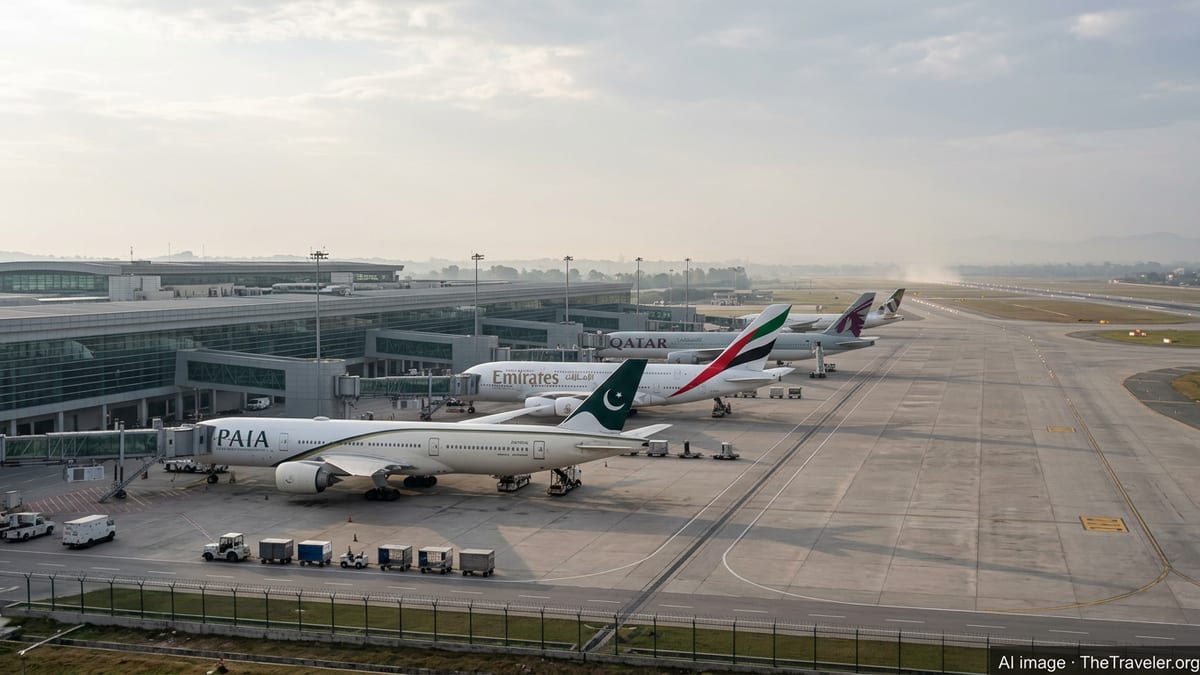
Publicly available notices and regional media coverage indicate that Islamabad International Airport is preparing for short, targeted suspensions of flight movements around Monday, March 16, rather than a full, daylong shutdown. The measures are tied to wider airspace controls currently affecting several routes into and out of Pakistan and to anticipated military flight activity near the capital.
The Pakistan Airports Authority (PAA), which oversees operations at major airports in the country, has in recent months repeatedly used time-limited flight pauses at Islamabad to accommodate security-related activity and aerial rehearsals. Past advisories have emphasized that such pauses are typically structured in narrow windows of one to two hours, with operations resuming between closures.
In the latest advisory for mid-March travel, the PAA is cautioning passengers that similar patterns are expected on March 16. While precise time bands may vary and are subject to change at short notice, travelers are being told to anticipate rolling disruptions to both departures and arrivals at Islamabad, with potential knock-on delays across domestic and international networks.
Available information suggests the suspension is part of a broader cycle of intermittent airspace restrictions that began in early March, as air traffic flows across Pakistan have been repeatedly re-routed, slowed, or held due to shifting security dynamics and temporary closures affecting multiple corridors.
Impact on International and Domestic Connections
The planned March 16 suspensions are expected to affect a mix of domestic services to and from northern Pakistan and key international connections linking Islamabad with Gulf hubs, Europe, and other Asian destinations. Earlier in the month, commercial travelers reported cancellations and extended diversions on flights bound for major Pakistani gateways, including Islamabad, as carriers adjusted to evolving airspace constraints.
Disruptions have already been visible in the run-up to March 16. Travelers using connecting itineraries through Doha, Dubai, Abu Dhabi, and other regional hubs have described late-notice changes, prolonged layovers, and altered routings on flights scheduled to land at or depart from Islamabad. In some cases, online flight trackers have shown aircraft holding or diverting when airspace around the capital temporarily closes.
Domestic connectivity is also vulnerable. In previous episodes of restricted operations, airlines serving northern cities such as Gilgit and Skardu have been forced to cancel or consolidate flights from Islamabad, leaving passengers to rebook on limited alternatives. Aviation observers note that any time-specific pause on March 16 could once again compress the operating window for these short-haul sectors, increasing the likelihood of schedule changes.
Given the cascading nature of such disruptions, even flights not directly scheduled within a pause window on March 16 may experience secondary delays if aircraft and crews are repositioned late or if earlier segments in a rotation are held on the ground.
PAA Urges Early Check-in and Direct Airline Contact
The PAA’s latest advisory strongly encourages passengers traveling on or around March 16 to adopt a cautious approach in planning their airport journeys. Public guidance emphasizes the importance of monitoring airline communications, booking platforms, and airport information channels closely in the 24 to 48 hours before departure.
Passengers are being advised to arrive at Islamabad International Airport earlier than usual, particularly for international departures that may be rescheduled to operate just before or after any announced closure windows. For those connecting onward via Islamabad to other domestic destinations, officials recommend confirming that both segments remain viable under the revised operating plan.
Travel industry analysts suggest that flexible ticket conditions and a willingness to accept re-routing may be crucial for minimizing disruption. For some travelers, airlines may offer alternative dates, nearby gateway options such as Lahore or Karachi, or connections through different hubs to bypass peak congestion around March 16.
Given the dynamic situation, publicly available commentary from frequent travelers and aviation watchers also underscores the value of checking for last-minute changes on the day of travel, as formal notices to airmen and operational decisions can shift with evolving security and weather conditions.
Security Context and Recent Airspace Restrictions
The mid-March flight suspensions at Islamabad are unfolding against a backdrop of heightened security sensitivity and recent episodes of airspace disruption across Pakistan. Open-source reporting over the past year has documented several cycles of temporary airspace closures, ranging from narrow time-bound restrictions to broader pauses affecting multiple major airports simultaneously.
In earlier incidents, air traffic around Islamabad has been curtailed to accommodate military exercises, overflight restrictions, and weather-related safety measures. In one recent case, intermittent closures aligned with preparation for national events and aerial displays, with aviation authorities clarifying that only short, scheduled pauses would occur at the capital’s airport.
More recently, online accounts from Islamabad residents and travelers have described increased military jet activity in the skies near the city and periods during which commercial aircraft approaching the airport appeared to enter holding patterns or divert to alternate fields. These observations are consistent with temporary closures of specific approach routes and air corridors, which can ripple through airline schedules hours after restrictions are lifted.
The March 16 suspension must therefore be seen as part of a wider pattern of agile airspace management intended to balance security priorities with the need to keep essential passenger and cargo services operating whenever possible.
Guidance for Travelers Holding March 16 Bookings
For travelers already ticketed to fly into or out of Islamabad on March 16, aviation and travel industry guidance converges on a few practical steps. First, passengers are urged to verify their flight status directly with their airline, using official apps or customer service channels, rather than relying solely on third-party booking sites or static schedule data.
Second, those with onward international connections on tight layovers may wish to consider voluntary rebooking to reduce stress and avoid missed connections if Islamabad departures are pushed back. Where fare rules allow, moving travel by a day on either side of March 16 could significantly improve the chances of an uninterrupted journey.
Third, travelers should prepare for a lengthier airport experience than usual. This includes allowing extra time to reach the terminal if road traffic is affected, bringing essentials such as snacks, medications, and device chargers, and planning for the possibility of spending several additional hours airside if flights are delayed but not cancelled.
Finally, passengers who do not have urgent travel needs may find it prudent to delay nonessential trips until after the current cycle of restrictions eases. Travel planners focusing on Pakistan suggest that schedules typically stabilize once major security operations conclude and airspace managers can revert to more predictable patterns of flight coordination.