

More news on this day
Island journeys across the Isle of Wight are set for weeks of disruption this spring, with major road closures, embankment repairs and diversions affecting routes through Wroxall, Newport, Shanklin and key access roads to Ryde and Cowes.
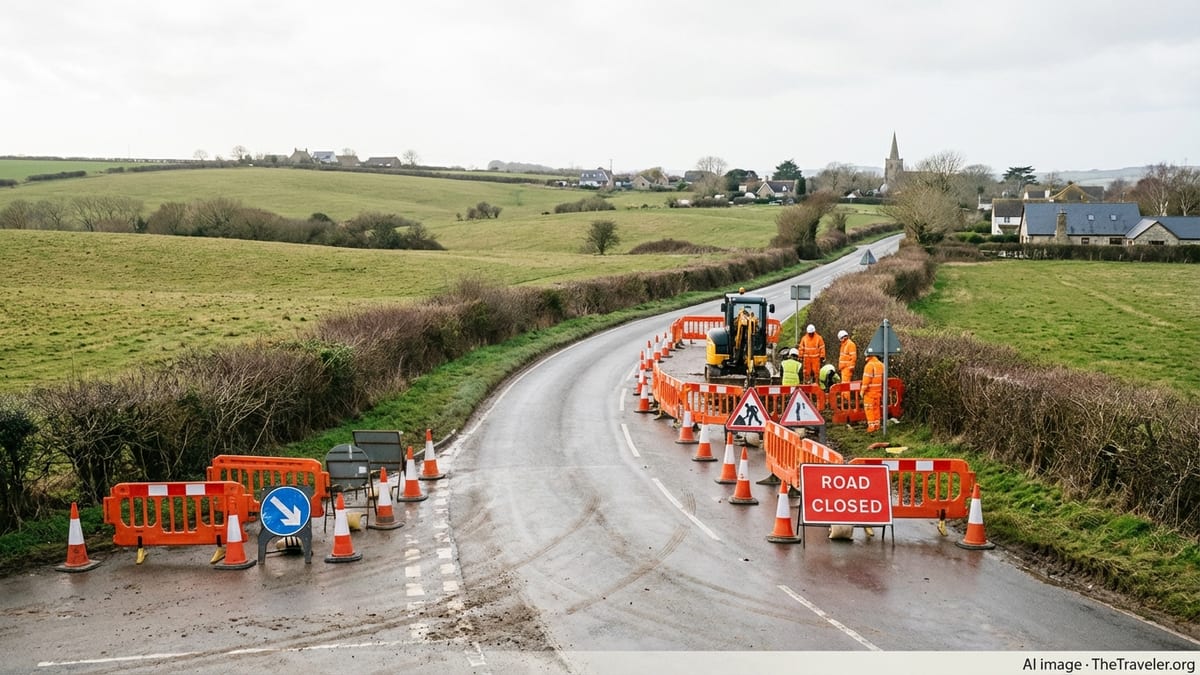
Wroxall Braced for Eight-Week Closure on St John’s Road
Fresh disruption is looming for Wroxall as engineers prepare for a full eight-week closure of St John’s Road to tackle a collapsed embankment on one of the village’s main approaches. The stabilisation project, commissioned by Isle of Wight Council and carried out by Island Roads, is due to start on 2 March and will see a 24-hour closure between Appuldurcombe Road and Whiteley Bank for the duration of the works.
The scheme will involve removing large amounts of unstable earth and building a new retaining wall designed to improve long-term safety. The new structure will be reprofiled to enhance visibility for drivers and for passengers using the nearby bus stop, in a bid to address long-standing concerns about the narrow, twisting stretch. Redhill Lane will also remain closed throughout the project, further limiting local access.
Island Roads and Southern Vectis have already adjusted bus services around the wider Wroxall works, with shuttle services and diversions via Whiteley Bank and Shanklin used during earlier phases. Operators say the resumption of closures in March will again require passengers to check altered timetables and, in some cases, walk to alternative stops at Whiteley Bank or Upper Ventnor when shuttle buses are not running.
St John’s Road itself only reopened briefly in February after several months of deep reconstruction, with Island Roads lifting traffic controls ahead of schedule. While that work has largely finished, road markings and lining remain weather dependent and will be completed when conditions allow, meaning some short-term overnight restrictions are still possible.
Newport High Street Restrictions to Affect Central Access
In Newport, drivers are being warned to expect disruption around the town centre as improvement works continue along the High Street and Upper High Street this spring. Island Roads has confirmed that sections of the historic commercial spine are subject to full closures and parking restrictions while crews carry out deep carriageway reconstruction.
Public notices issued on behalf of Isle of Wight Council indicate that the High Street may be closed for extended periods between mid-January and mid-April, with no waiting allowed on the affected stretches or within 50 metres of adjoining side roads where signs are displayed. Officials say the works programme is being phased, and that exact timings will be communicated to nearby businesses and residents via advance warning signs and letters.
The closures are designed to address underlying structural issues with the road surface, including drainage, reflective studs and lining that cannot be repaired under simple temporary traffic lights. Traders have been encouraged to plan deliveries outside of working areas and to advise customers of alternative parking and walking routes into the town centre.
Island Roads stresses that the programme is weather dependent, with periods of heavy rain or frost likely to lead to changes at short notice. Motorists are being urged to allow additional time when heading into Newport, particularly during peak commuting and school run periods.
Shanklin and South Wight Routes Hit by Diversions
The impact of the Wroxall works is being felt across the south of the Island, with knock-on effects for journeys between Newport, Shanklin, Ventnor and Ryde. When the closure of St John’s Road is in force, Southern Vectis route 3 is diverted to maintain connectivity between key resorts and employment centres while avoiding the shut section through Wroxall.
Buses from Newport will run via Whiteley Bank and Shanklin into Ventnor before climbing St Boniface Road and Spring Hill, then continuing on to Ryde. In the opposite direction, services from Ryde will operate through Shanklin and Upper Bonchurch, using Spring Hill and St Boniface Road to reach Ventnor and then Whiteley Bank on the way back to Newport.
At certain times of day, a dedicated shuttle bus is scheduled to connect Wroxall Church with Whiteley Bank and Upper Ventnor, giving residents a link to the main route 3 service. Passengers travelling outside shuttle hours are being advised that their nearest stops may be some distance away, making journey planning and checking the latest operator updates essential.
Local tourism businesses in Shanklin and Ventnor are monitoring the situation closely ahead of the main holiday season. While the bulk of the most disruptive engineering has been scheduled outside the busiest summer months, hoteliers and guesthouse owners remain keen to reassure visitors that resorts are open and accessible, albeit with longer journey times on some inland routes.
Ryde and Cowes Connections Affected by Wider Island Works
Beyond the south of the Island, ongoing projects around Ryde and the Newport to Cowes corridor are also expected to shape travel patterns this spring. On the approach to Ryde, carriageway reconstruction on Binstead Road is continuing in phases, with full 24-hour closures in place between key junctions as Island Roads carries out deep excavations to repair deteriorated sections.
Ferry operator Wightlink has warned that these closures and associated utility works at Elenors Grove could lengthen journey times to and from Fishbourne for both residents and visiting motorists. Diversions have been signposted via Newport, with light vehicles sent towards Ryde along The Downs Road and Ashey Road, and heavy goods vehicles routed along the A3056 and A3055. Drivers heading for sailings have been told to allow extra time to reach the port for check-in.
On the northbound route between Newport and Cowes, the council’s wider programme of improvements at Horsebridge Hill continues to influence local traffic. Although a major one-way diversion between May and July last year was timed to keep the road fully open during the Isle of Wight Festival, works to support new housing and ease future congestion are still reshaping the layout, with intermittent restrictions likely as finishing touches are completed.
Transport planners say these projects, combined with the Wroxall embankment repair and town centre schemes, reflect an effort to push ahead with long-delayed upgrades before the Island’s peak tourism period. Even so, they acknowledge that for regular commuters and service vehicles, the cumulative effect amounts to one of the most challenging spring seasons on the roads in recent years.
What Drivers and Passengers Need to Do Now
Island Roads is urging motorists to check the latest closure information before travelling, noting that its schedule of works is updated frequently and that some schemes may start or finish earlier than advertised if conditions allow. On-street signs remain the definitive guide to which stretches are closed on any given day, and drivers are being asked to obey temporary speed limits and no-waiting orders on diversion routes.
Bus users are being encouraged to plan ahead by consulting revised timetables and allowing extra time for connections, particularly where shuttle services or walking links between stops are required in and around Wroxall, Shanklin and Ventnor. Operators say they will continue to adjust services where possible to maintain school and commuter journeys, but warn that congestion on narrow rural roads can quickly build when traffic is displaced from main routes.
Local authorities are recommending that, where feasible, residents consider flexing work hours, sharing lifts or working from home on the most heavily affected days to reduce peak congestion. For visitors, the message is to treat the roadworks as part of the journey, factoring in scenic alternatives across the Downs and coastal routes rather than relying on usual shortcuts through the Island’s inland villages.
With key links through Wroxall, Newport and the approaches to Ryde all scheduled for intensive maintenance in the coming weeks, officials are clear that short-term inconvenience is the trade-off for longer-term resilience. For those planning trips on or off the Isle of Wight this spring, checking for updates before setting off will be as important as booking a ferry ticket.