

More news on this day
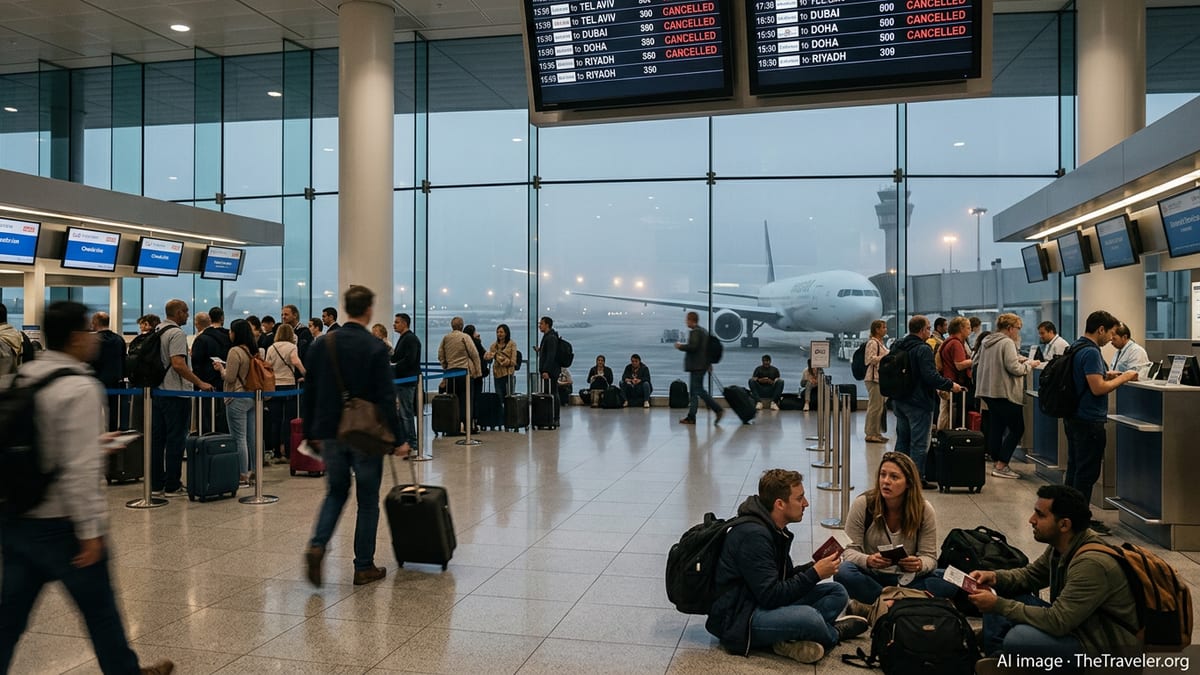
Escalating conflict involving Israel, Iran, the United States and regional actors has plunged Middle East travel into chaos, prompting urgent government advisories, mass flight cancellations and sweeping airspace closures that are rippling through global aviation networks.
Governments Urge Citizens to Leave as Advisories Intensify
Travel warnings across the Middle East have hardened in recent days, with multiple governments urging their citizens to leave the region as soon as commercial options allow. The United States has called on Americans to depart more than a dozen countries, including Israel, Saudi Arabia, Qatar, the United Arab Emirates, Egypt, Iraq and Lebanon, citing a rapidly deteriorating security environment and the risk of further missile and drone attacks.
British authorities have gone further in some cases. The UK Foreign, Commonwealth and Development Office now advises against all travel to Israel and Palestine following the closure of Israeli airspace and the possibility that borders could shut at short notice. Similar alerts have been issued for several Gulf states, and nationals have been urged to register their presence so they can receive direct updates and assistance if conditions worsen.
On the ground, embassies are shifting into crisis mode. The US Embassy in Jerusalem issued a new security alert on March 2 warning of heightened threats across Israel, the West Bank and Gaza and urging individuals to maintain a high level of situational awareness. Other diplomatic missions in the region have scaled back staffing or temporarily relocated personnel as the risk to official and civilian targets grows.
Officials stress that the situation remains fluid and that advice may change with little notice. Travelers are being told to monitor their government’s travel pages multiple times a day, stay in close contact with airlines and travel providers, and be prepared for sudden curfews, airport closures or communications disruptions that could complicate evacuation efforts.
Airspace Closures and Flight Chaos Across Key Hubs
The most immediate impact for travelers has been in the skies. Large swathes of Middle East airspace are now closed or heavily restricted, including over Iran, Iraq, Israel, Qatar, Bahrain, Kuwait and Syria, with partial limitations in parts of Saudi Arabia and the United Arab Emirates. Aviation authorities in Europe have labeled the entire region a high risk to civil aviation and extended conflict-zone bulletins warning airlines to avoid affected flight information regions.
Several of the world’s busiest connecting hubs have been effectively knocked offline. Airports in Dubai, Abu Dhabi and Doha have seen broad suspensions of commercial operations, with carriers such as Emirates, Etihad and Qatar Airways cancelling or pausing most scheduled flights as they await clarity from national regulators and military authorities. In Israel, national carrier El Al has cancelled services through at least early March after the closure of national airspace.
The knock-on effects stretch far beyond the region. Thousands of flights have been cancelled in recent days and many more rerouted, as airlines from Europe and Asia are forced to detour around the traditional “Silk Road” corridor over Iran and Iraq. Long-haul journeys between Europe and Asia are taking longer, burning more fuel and straining airline schedules. Travelers with no intention of entering the Middle East are nonetheless encountering missed connections, last-minute aircraft changes and significantly longer flight times.
With the outlook uncertain, airline schedules are now being updated in rolling waves of short-term decisions. Some carriers have suspended flights into Tel Aviv, Beirut, Amman, Riyadh, Dubai and Doha for days or weeks, while others are operating only limited repatriation and cargo services. Industry analysts warn that even if fighting subsides, it could take weeks for normal capacity and routing patterns to return.
How Travelers’ Rights and Insurance Are Being Tested
The sudden wave of cancellations and reroutes is also testing the limits of consumer protections and travel insurance policies. In many jurisdictions, passengers on cancelled flights are entitled to refunds or rebooking at no additional cost, but not necessarily to compensation when disruptions stem from security threats, conflict or airspace closures considered beyond an airline’s control. That distinction is creating confusion for travelers as they try to recoup costs.
Insurance coverage is even more complex. Standard policies often exclude losses linked to war or armed conflict, especially in countries that appear on official “do not travel” lists. Travelers who purchased specialist policies or add-ons that cover political unrest may have broader protection, but many will discover that claims for abandoned trips, missed tours or nonrefundable hotel nights fall into gray areas once a destination is under formal government warning.
Travel lawyers say documenting every change is crucial. Passengers are advised to keep written evidence of cancellations, rerouting notices and any government advisories that directly affect their itinerary. In some cases, tour operators may be required to offer alternative arrangements or partial refunds when a trip can no longer proceed safely, but policies vary widely by country and by contract.
Industry groups are already calling for clearer, more harmonized rules that address large-scale conflict-related disruption. For now, however, individual travelers must navigate a patchwork of airline policies, local consumer law and insurance fine print, making early, informed decisions more important than ever.
Protecting Upcoming Trips: Practical Steps for Travelers
For travelers with pending plans to Israel or neighboring Middle East destinations, experts agree on one immediate step: do not assume your trip will proceed as booked. With government advisories against travel in place and extensive flight suspensions through early and mid March, many itineraries are already effectively impossible, even if formal cancellations have yet to appear in booking systems.
Travelers are being urged to contact airlines and tour operators proactively rather than waiting for automated notifications. Many carriers are offering fee-free rebooking or credits, but only within set windows and under specific conditions. Those with complex routings through hubs such as Dubai or Doha may be able to rebook using alternate European or Asian hubs, though availability is tight and fares have climbed as demand concentrates on a smaller number of viable routes.
Officials recommend that anyone currently in the region, or planning essential travel there, maintain a low profile, avoid demonstrations and crowded public areas, and have a contingency plan if commercial flights stop altogether. That includes confirming passport validity, carrying physical copies of key documents, registering contact details with their embassy and identifying nearby land borders that remain open if air routes close.
Travel advisors emphasize that flexibility will be crucial in the coming weeks. Nonessential trips should be postponed or re-routed, and essential travel should be planned with multiple backup options, including separate tickets on different carriers and flexible accommodation arrangements that can absorb last-minute changes.
Global Travel Outlook as the Crisis Deepens
Beyond immediate disruptions, the crisis is reshaping expectations for global travel in the months ahead. Airlines are reassessing exposure to conflict zones and critical chokepoints, from Middle East air corridors to key energy and shipping routes that underpin tourism economies. Even destinations far from the epicenter may feel the impact through higher fuel costs, stretched aircraft capacity and nervousness among travelers about transiting volatile regions.
Tour operators report a surge in inquiries about alternative winter sun and pilgrimage destinations as holidaymakers and religious travelers reconsider trips to Israel, the Gulf and wider Middle East. Some are pivoting to southern Europe, East Africa or Southeast Asia, though availability in the peak Easter period is already constrained and prices are rising accordingly.
For Middle Eastern tourism boards and airlines, the setback is particularly sharp after years of investment turning cities like Dubai and Doha into global hubs. With key airports operating at a fraction of normal capacity and images of missile strikes dominating news coverage, rebuilding traveler confidence is likely to be a long process, even once security conditions stabilize and airspace gradually reopens.
For now, officials and industry leaders agree that the priority is safely moving people out of harm’s way and keeping essential air links open where possible. Travelers with any exposure to the region are being told to stay informed by the hour, not by the day, and to treat official advisories and airline alerts as the primary guides to what is, and is not, realistically possible.