

More news on this day
Nonstop air links between Israel and New York are rebuilding at pace as El Al and Arkia restore and expand services, testing how far transatlantic demand can rebound while regional security tensions remain in focus.
Get the latest news straight to your inbox!
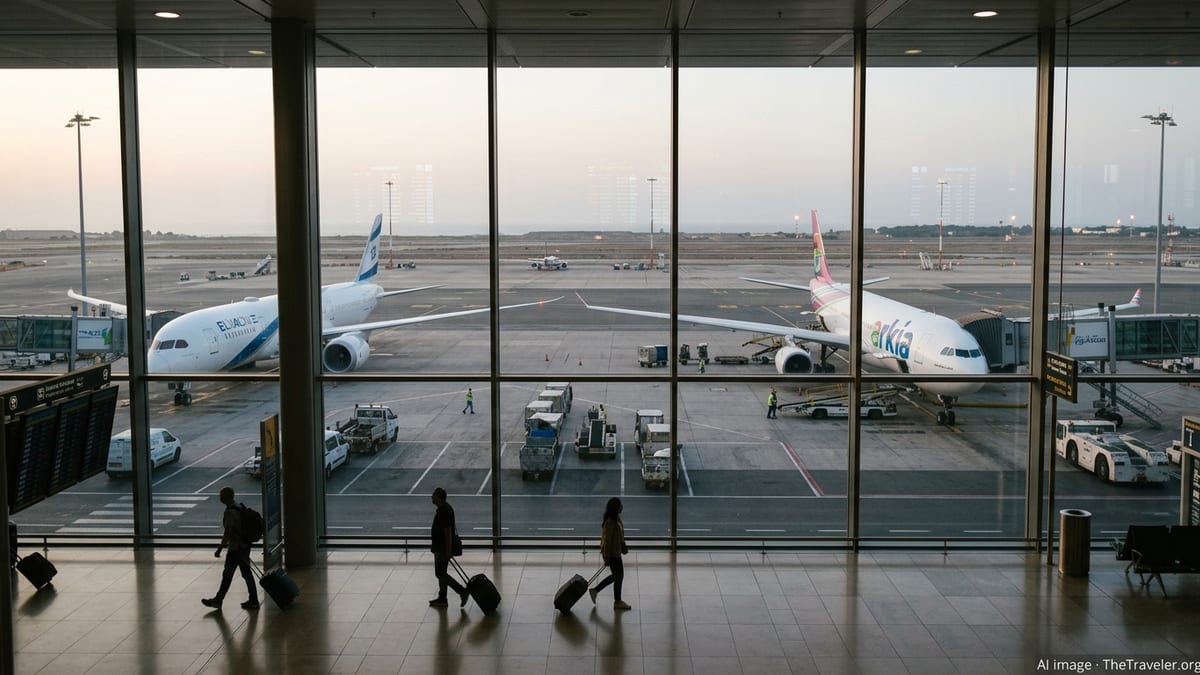
El Al Restores Core Transatlantic Links Amid Ongoing Volatility
El Al has reestablished its New York routes as a backbone of Israel’s long-haul connectivity, with regular services from Tel Aviv’s Ben Gurion Airport to both New York JFK and Newark. Publicly available airport schedules show El Al once again listed among the primary long-haul operators at Ben Gurion, with New York remaining one of its key destinations despite periodic disruptions to regional air traffic.
Industry and financial disclosures indicate that El Al has benefited from phases in which it temporarily held an effective monopoly on Israel–New York nonstop capacity after some foreign carriers suspended operations during escalations in the Gaza conflict and wider Middle East tensions. That unique position, although gradually eroded as U.S. and European airlines resumed flying, has highlighted the strategic importance of the New York corridor for Israel’s flag carrier.
Scheduling data suggests that capacity rebuild has taken place in waves, with El Al adding frequencies as security conditions and airport constraints allowed. The carrier’s focus on New York has remained consistent throughout, even as it adjusted other parts of its network. Recent months have also seen special flights added on short notice to help clear backlogs when other services were disrupted, underscoring how central the route has become for both routine travel and crisis response.
At the same time, El Al’s return to more normalized operations has been shaped by infrastructure and security limits at Ben Gurion Airport. Public reports describe temporary caps on total departures following missile incidents and airspace alerts, conditions that forced airlines to prioritize certain routes. In that environment, maintaining New York frequencies has signaled the route’s commercial and diplomatic weight.
Arkia’s New York Push Adds Competition and Capacity
Alongside El Al’s reinstated schedules, Arkia has emerged as a high-profile challenger on the Israel–New York corridor. After a long hiatus from the transatlantic market, Arkia resumed Tel Aviv–New York flights in mid-2025, initially relying on chartered widebody aircraft to bridge the capacity gap while demand for North America travel returned. Travel industry coverage describes early services that sometimes included short technical stops for crew changes before settling into a more stable nonstop pattern.
Arkia’s New York route, served via JFK, was launched in partnership with TechAir, a consortium backed by Israel’s tech sector with the stated aim of improving connectivity between Tel Aviv and New York and lowering fares on a route dominated for long periods by El Al. Regulatory filings and aviation data show Arkia operating the service using wet-leased Airbus A330-200 aircraft, configured for both economy and business class, in order to compete more directly with established transatlantic products.
As consumer interest strengthened, Arkia extended its New York schedule multiple times, opening bookings well into the 2025 and 2026 northern summer seasons. Aviation analysts interpret those extensions as a clear vote of confidence in the durability of demand, even as security alerts and intermittent missile threats occasionally disrupted operations at Ben Gurion.
Arkia’s decision to grow on the New York route has also been framed as a strategic diversification move. Historically focused on short- and medium-haul leisure markets, the airline is now using its transatlantic presence to build brand recognition, attract higher-yield passengers, and win market share from both El Al and returning U.S. carriers.
Security Tensions Shape Schedules and Traveler Behavior
The rebuilding of Israel–New York air links has unfolded against a backdrop of persistent regional tensions. Missile attacks, airspace restrictions, and geopolitical flare-ups since late 2023 have periodically forced flight suspensions, diversions, and last-minute timetable changes on routes into and out of Tel Aviv. Public reporting on incidents around Ben Gurion, including damage in the vicinity of the airport, illustrates the fragile environment in which airlines are operating.
These tensions have had a direct impact on scheduling strategies. When threats spike, foreign carriers have tended to pull back more quickly, trimming or suspending Tel Aviv services while they reassess security assessments and insurance conditions. In several phases, that has left Israeli airlines such as El Al and Arkia carrying the majority of nonstop traffic between Israel and New York, sometimes with sharply higher fares as limited capacity met strong demand from family visits, business travel, and diaspora communities.
Travelers, in turn, have adapted by favoring operators perceived as more likely to maintain service during crises. Booking data and anecdotal reports suggest that for many passengers with urgent reasons to travel, the reliability of El Al and Arkia during volatile periods has outweighed concerns about pricing or onboard amenities. This has reinforced the commercial logic for both carriers to prioritize New York frequencies even when adjusting wider networks.
At the same time, both airlines have had to navigate operational constraints beyond their control. Temporary shutdowns of Ben Gurion, airspace reroutings to avoid conflict zones, and stricter security procedures have all added complexity and cost. The result is a network environment in which schedules are rebuilt carefully and often conservatively, with room for rapid adjustment if the security picture changes.
Rising Competition from U.S. and Israeli Rivals
While El Al and Arkia are central to the current reconstruction of the Israel–New York corridor, they no longer operate in isolation. United Airlines has resumed Newark–Tel Aviv flights, and Delta Air Lines has worked to restore its New York JFK service, gradually reintroducing U.S. carrier presence after extended suspensions. Industry coverage portrays United’s restart as a particularly significant milestone, signaling renewed confidence from U.S. airlines in the safety and commercial viability of the route.
Looking ahead, Israir is preparing to join the transatlantic market as a third Israeli airline on the New York route. Regulatory approvals from U.S. authorities and Israeli ministries, granted in 2025, clear the way for up to six weekly Tel Aviv–New York flights from around Passover 2026. Israir has described the move as a low-cost alternative aimed at price-sensitive travelers, adding another layer of competition for El Al and Arkia as they try to protect yields.
Additional competition may also come indirectly through connecting services. As more foreign carriers return to Ben Gurion, passengers gain alternative one-stop options via European and Middle Eastern hubs, putting pressure on nonstop operators to differentiate through schedule convenience, onboard product, or loyalty partnerships. El Al’s deepening cooperation with U.S. domestic airlines and Arkia’s partnerships with leasing and tech-sector backers both reflect efforts to stay competitive in that environment.
For now, however, nonstop Israel–New York capacity remains more constrained and more fragile than before the recent conflicts. Each new schedule extension or route announcement is being closely watched by the travel trade as a gauge of confidence in the stability of the corridor.
Balancing Demand, Pricing and Public Perception
The gradual resumption and expansion of Israel–New York flights has been accompanied by intense scrutiny of fares and perceived profiteering during emergencies. Consumer advocates and local media have highlighted cases in which prices surged when capacity was scarce, particularly during periods when El Al was one of the only carriers still operating long-haul departures from Tel Aviv. Similar criticism has periodically surfaced around Arkia and other airlines serving regional routes.
In response, airlines have emphasized the high fixed and variable costs associated with flying into a conflict-adjacent airspace, including security, insurance, and operational contingencies. Public communications from carriers and regulators have stressed that some special flights were sold at capped or regulated fares designed to help stranded travelers, even as market-driven pricing remained in effect on other departures.
For passengers, the result is a complex trade-off between cost, reliability, and perceived safety. Many travelers booking Israel–New York flights today are doing so with an awareness that schedules can change on short notice and that travel insurance, flexible tickets, and direct communication with airlines are more important than in more stable markets. Travel agents and online booking platforms have responded by flagging advisories and pushing flexible products more prominently on Tel Aviv routes.
As of March 2026, the trend line on the corridor points toward gradual normalization: more carriers in the market, more frequencies, and a broader spread of price points. Yet the experience of the past two years means every new El Al or Arkia flight between Israel and New York carries a significance that goes beyond tourism and business travel, functioning as a visible indicator of confidence in the region’s ability to keep its vital air bridge open.