

More news on this day
A sweeping wave of coordinated United States and Israeli strikes on Iran, followed by Iranian missile retaliation, has triggered widespread airspace closures across the Middle East, severing vital flight corridors and unleashing cascading disruption for travelers from Europe to Asia and North America.
Coordinated Strikes Ignite a New Phase in the Iran-US Standoff
Explosions rocked Tehran and other Iranian cities on Saturday as the United States and Israel launched what officials described as a broad campaign of strikes targeting Iran’s military and leadership infrastructure. The operation, which began in the early hours of February 28, marked the most dramatic escalation yet in the long-simmering confrontation between Washington, Tel Aviv and Tehran.
Reports from Tehran, Isfahan, Qom and Karaj described multiple impact sites and plumes of smoke rising over urban districts, as Iranian air defenses attempted to respond. U.S. leaders framed the strikes as a move to neutralize what they called imminent threats and to degrade Iran’s missile capabilities, while Israeli officials cast the attack as a preemptive effort to prevent future assaults on their territory.
Iran’s Revolutionary Guard Corps swiftly answered with salvos of ballistic missiles and drones aimed at Israel and at U.S. assets across the Gulf, including bases in Bahrain, Kuwait, Qatar and the United Arab Emirates. Air raid sirens sounded over Jerusalem, Tel Aviv and Haifa, with Ben Gurion International Airport coming under particular threat and halting all operations.
The exchange shattered the fragile equilibrium that had held despite months of tension and sporadic incidents at sea and along proxy front lines. Within hours, the conflict’s impact rippled far beyond the battlefields, reshaping flight paths and stranding passengers across continents.
Middle Eastern Skies Slam Shut
As missiles flew, civil aviation authorities across the region moved quickly to close or sharply restrict their airspace. Iran, whose skies form a key east-west transit corridor, issued a blanket suspension to civilian traffic, with its civil aviation organization declaring the country’s airspace shut until further notice. Live flight-tracking data showed a sudden void over Iran during peak travel hours.
Israel also ordered its airspace closed to all civilian flights as part of a nationwide state of emergency. Air traffic at Ben Gurion, normally one of the region’s busiest hubs, stopped abruptly as incoming flights diverted away and outbound departures were canceled. Nearby states followed suit: Iraq shuttered its skies, while Jordan, Qatar, Bahrain, Kuwait and the United Arab Emirates imposed full or partial closures in response to the evolving security threat.
Syria’s civil aviation authority announced a 12-hour closure of southern air corridors along the Israeli border, further tightening the ring of no-fly zones. By mid-afternoon local time, a broad swath of West Asian airspace had effectively gone dark to commercial aviation, forcing airlines to race to replot their routes around an expanding conflict zone.
For pilots and controllers, the sudden shift meant managing complex diversions in already congested skies above Turkey, the eastern Mediterranean and the Arabian Sea. For passengers, it meant diversions to unfamiliar airports, hours-long delays and, in many cases, outright cancellations.
Global Carriers Scramble as Key Routes Collapse
The closure of Iranian and Israeli airspace, layered over existing bans on Russian and Ukrainian routes, has left airlines with few viable options between Europe and Asia. Carriers that previously threaded narrow corridors through the Middle East now face much longer detours over Central Asia, the Caucasus or Africa, increasing flight times, fuel consumption and costs.
Major Gulf and regional airlines, including Emirates, Etihad, Qatar Airways and carriers based in Israel and Turkey, announced rapid suspensions or rerouting of services. Turkish Airlines canceled flights to Lebanon, Syria, Iraq, Iran and Jordan through at least March 2, while curbing operations to Gulf states for the remainder of February 28 as conditions evolve.
Indian carriers Air India and IndiGo temporarily halted services into the Middle East, with an Air India Delhi–Tel Aviv flight forced to turn back after the Tehran flight information region was closed. European operators such as Air France, Lufthansa, Iberia Express and low-cost carrier Wizz Air suspended flights to Tel Aviv and other regional destinations, citing security concerns and airspace uncertainty.
Long-haul routes connecting India and Southeast Asia with the United Kingdom, mainland Europe and North America are among the hardest hit. Airlines have warned travelers of extended flight times, technical stops for refueling and last-minute diversions as they are forced to skirt a widening area of potential risk in West Asia.
Travelers Face Cancellations, Confusion and Crowded Hubs
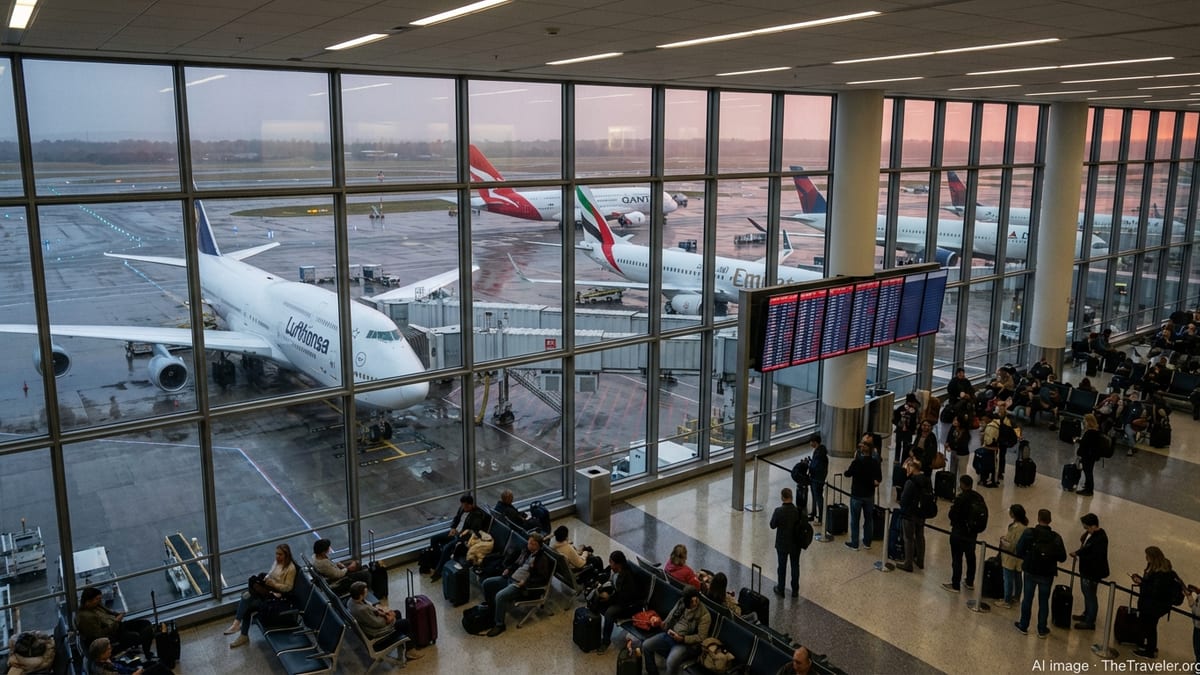
At airports from Tel Aviv and Doha to Istanbul, Delhi and major European hubs, travelers awoke to departure boards filled with delays and cancellations. In Israel, passengers who had already cleared security at Ben Gurion were instructed to leave the terminal after civilian flights were suspended, while incoming aircraft were redirected to alternate airports in Cyprus, Greece and beyond.
In South and East Asia, passengers bound for Europe or North America via Gulf hubs found themselves stranded as onward connections evaporated. Airlines’ customer service desks and call centers struggled to keep pace with rebooking requests, while many travelers reported waiting in long lines for updated itineraries or hotel vouchers.
With airlines revising schedules in real time, some passengers experienced multiple last-minute gate changes or reroutings, such as being sent via more northerly paths through Central Asia or via longer southern arcs over the Arabian Sea and East Africa. Aviation analysts cautioned that the operational shock would likely reverberate for days, if not weeks, as carriers adjusted crew rotations and aircraft positioning to the new constraints.
Insurance providers and travel agents reported surging inquiries as holidaymakers and business travelers sought clarity on coverage for war-related disruptions. Many standard policies exclude armed conflict, prompting questions about out-of-pocket costs for those now stuck far from home.
What Travelers Should Expect in the Coming Days
Industry experts say the immediate focus for airlines will be safety and compliance with rapidly changing airspace notices, even if that means significant inconvenience for passengers. Until there is greater clarity on the trajectory of the conflict and the duration of airspace closures, schedules are likely to remain volatile.
Travelers with itineraries that cross the Middle East in the coming days are being urged to monitor airline communications closely and to check flight status frequently rather than relying solely on original booking confirmations. Many carriers are issuing flexible rebooking and cancellation waivers, allowing customers to postpone or reroute trips without standard penalties.
Alternative routings through East Africa, Central Asia or transatlantic connections via North America may help some long-haul travelers bypass the chokepoint, but those options come at the cost of longer journey times and often higher fares. Capacity constraints on unaffected corridors mean that popular alternatives will fill quickly, particularly for peak business and holiday periods.
For now, the joint Israel-US strikes on Iran and the subsequent missile exchanges have transformed the Middle East from a vital aviation crossroads into a sprawling no-fly zone. Unless diplomatic efforts swiftly rein in the confrontation, the region’s skies are likely to remain turbulent, with global travelers bearing much of the fallout.