

More news on this day
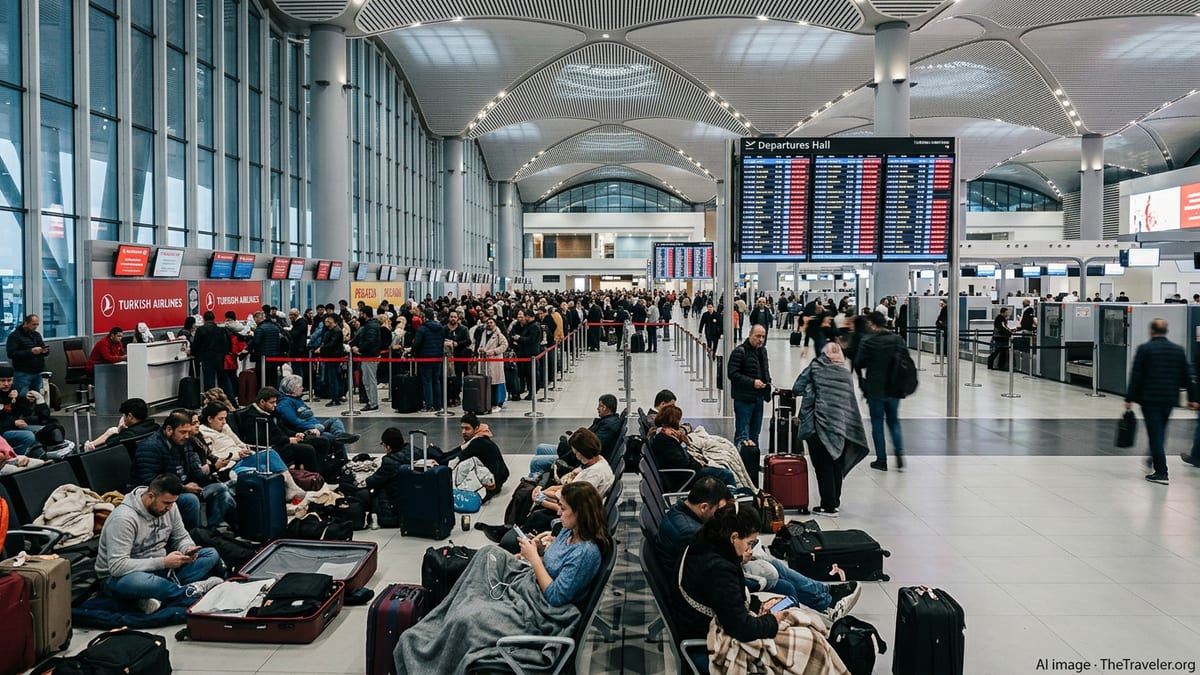
Hundreds of travelers were left sleeping on terminal floors and queuing for hours at Istanbul Airport on March 3 as at least 85 flights were delayed and 14 canceled, with Turkish Airlines, Pegasus Airlines and other carriers scrambling to adjust to rapidly tightening Middle East airspace restrictions.
Knock-on Turmoil at a Key Global Hub
The disruption hit Istanbul just as the wider Middle East aviation network entered its third consecutive day of severe upheaval following US and Israeli strikes on Iran and subsequent retaliatory attacks. With swathes of airspace over Iran, Iraq, Israel, Syria, Kuwait, Bahrain and Qatar closed or heavily restricted, routes linking Europe and North America with Asia and the Gulf have been forced into lengthy detours or cut altogether.
Turkey’s main gateway, which routinely ranks among the world’s busiest international hubs, sits at the crossroads of those east–west corridors. On Tuesday, departure boards at Istanbul Airport and the city’s secondary Sabiha Gökçen hub filled with red as delays stacked up across short-haul links to the Middle East and Eastern Europe, as well as long-haul services to Southeast and East Asia that would normally overfly now-closed corridors.
Operational data from airport and airline sources indicated that, over the course of the morning and early afternoon, 85 flights involving Istanbul’s two airports were delayed beyond schedule minimums, while 14 were canceled outright. Aviation analysts caution that those figures could rise through the day as carriers continue to rework timetables around evolving NOTAMs and military risk assessments.
Passengers transiting via Istanbul on multi-leg itineraries have been particularly hard hit, with missed connections rippling through the network. Many travelers heading to or from Dubai, Doha and Abu Dhabi now find themselves stranded in Türkiye with little clarity on when their onward segments will resume.
Turkish Airlines, Pegasus and Foreign Carriers Forced to Reroute
Flag carrier Turkish Airlines, one of the world’s largest network airlines by destinations served, has borne the brunt of the disruption. The airline has already suspended direct services to several conflict-adjacent countries and is now reconfiguring long-haul routes to avoid closed Middle Eastern skies, adding hours to some journeys and creating knock-on delays for aircraft and crew rotations.
Budget carrier Pegasus Airlines, based at Sabiha Gökçen, has also seen its schedule heavily affected. While many of its core domestic flights continue to operate, services to Gulf gateways and to destinations that would normally route through affected airspace have been delayed, consolidated or temporarily pulled from the schedule. Ground staff at both airlines spent much of Tuesday rebooking passengers, issuing meal vouchers and arranging overnight accommodation for those unable to travel the same day.
Foreign airlines operating through Istanbul are dealing with similar headaches. European and Asian carriers that rely on the city as a convenient refuelling and connection point have had to suspend certain rotations or send aircraft on longer northern tracks over the Black Sea and Caucasus. Those detours not only consume additional fuel but also compress already tight turnaround times, leaving little margin for weather or technical delays elsewhere in the network.
Airlines are publicly emphasizing that safety considerations remain paramount. Routes that would normally cross Iran or Iraq are being evaluated flight by flight, and some carriers are choosing to avoid even technically open corridors if they pass near active military zones or missile trajectories being monitored by civil aviation authorities.
Stranded Passengers Face Long Queues and Limited Information
Inside Istanbul Airport’s vast departure hall, the human impact of the crisis has been unmistakable. Lines for ticketing desks and transfer counters snaked deep into the concourses on Tuesday as travelers tried to secure new itineraries or understand whether their flights would operate at all. Many passengers reported waiting several hours to speak with an agent as airlines prioritized those with imminent departures.
Families returning from holidays in Southeast Asia, workers commuting between Europe and Gulf construction projects, and pilgrims traveling to and from Islamic holy sites all found themselves suddenly stuck. Some had their boarding passes scanned and bags checked before being told their flights were subject to indefinite delay, forcing them back through crowded public areas to retrieve luggage and seek accommodation.
Airport operators deployed additional staff and opened overflow seating areas, but space quickly became scarce, with many travelers resorting to makeshift beds on the floor near power outlets. Food courts and airport hotels reported surging demand, while long lines formed at currency exchanges and SIM card kiosks as passengers prepared for an unscheduled stay in Türkiye.
Communication has remained a major pain point. With call centers overwhelmed and mobile apps struggling to keep pace with rolling schedule changes, many travelers said they were relying on departure boards and word of mouth. Staff on the ground have urged passengers to stay close to their gates, as some flights may be cleared to depart at short notice if alternative routings are approved.
Middle East Airspace Restrictions Reshape Global Routes
The chaos unfolding in Istanbul is part of a much broader shock to international aviation as Middle Eastern airspace closures force airlines to redraw some of the world’s busiest flight paths. With Iran, Iraq and large portions of the Gulf region effectively off-limits to commercial traffic, traditional great-circle routes between Europe and Asia have been severed, echoing earlier disruptions seen during conflicts in Ukraine and over the Red Sea.
Carriers are increasingly funnelling long-haul services along more northerly or southerly arcs, flying over the Caucasus, Central Asia or North Africa where possible. Those deviations can add anywhere from 45 minutes to several hours to flight times, increasing fuel burn and crew duty hours and tightening the availability of aircraft for subsequent rotations. The result is a cascading pattern of delays and equipment shortages that shows up at hubs far from the immediate conflict zone, from Istanbul and Frankfurt to Delhi and Singapore.
Industry analysts note that Turkey’s role as a bridge between Europe and Asia makes its aviation sector especially exposed to such shocks. Even flights that do not touch the Middle East directly often depend on shared airspace corridors, common overflight permissions and coordinated air traffic control arrangements that have now been thrown into disarray. Until clarity emerges on when key Gulf hubs and regional airspaces will reopen, Istanbul’s hubs are likely to remain under acute operational pressure.
Freight operations are also being squeezed. Cargo carriers and combination airlines using bellyhold capacity are re-routing freighters around closed zones, contributing to longer transit times for shipments between Asia, Europe and Africa. Logistics providers warn that if the closures persist, downstream effects could be felt in supply chains reliant on just-in-time deliveries, including automotive components, electronics and pharmaceutical products that often move through Turkish and Gulf gateways.
Officials Urge Patience as Outlook Remains Uncertain
Turkish aviation and transport officials have urged passengers to remain patient as they work with airlines to manage the disruption. Authorities in Ankara have already imposed their own suspensions on flights to several countries directly affected by the conflict and signaled that additional measures are possible if security conditions deteriorate further.
At Istanbul Airport, managers say priority is being given to safety-critical movements and to flights that can operate along established alternative corridors with minimal risk. Ground operations teams are coordinating closely with airlines to match limited gate and stand capacity to the constantly shifting schedule, while security and passenger services personnel have been reinforced to help manage crowding in the terminals.
For travelers, however, the near-term outlook remains uncertain. With no firm timeline for the reopening of several key Middle Eastern airspaces and major hubs such as Dubai, Doha and Abu Dhabi operating only limited or special services, airlines are planning schedules conservatively, canceling or consolidating flights rather than risking last-minute diversions. Many carriers are offering free rebooking and, in some cases, refunds, but available seats on alternative routings are scarce during peak travel periods.
Travel advisers recommend that anyone due to transit through Istanbul or the wider region in the coming days closely monitor airline communications and consider flexible options, including postponing non-essential trips. Until the geopolitical situation stabilizes and airspace restrictions ease, Istanbul’s role as a global crossroads will remain heavily constrained, and scenes of stranded travelers at its terminals are likely to persist.