

More news on this day
Istanbul Airport has overtaken London Heathrow as Europe’s busiest airport in January, handling an estimated 6.9 million passengers as the UK’s main hub reaches capacity and renews its drive for a long-debated third runway.
Get the latest news straight to your inbox!
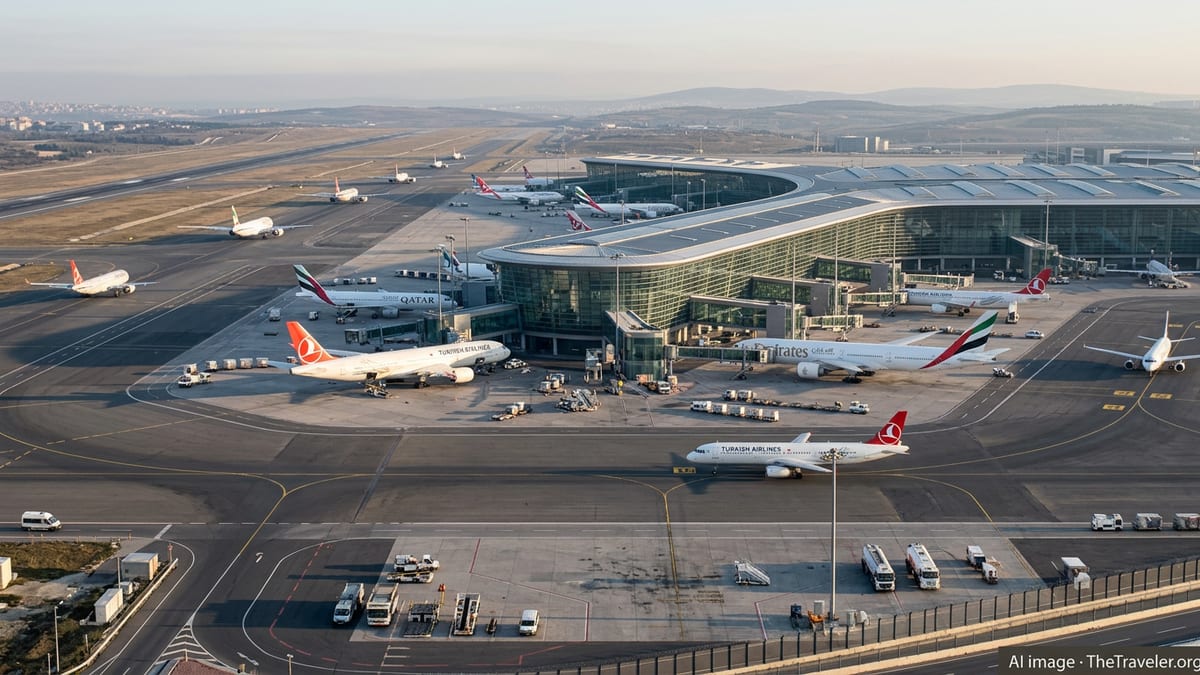
Istanbul’s Strong Start to 2026 Reshapes Europe’s Aviation League Table
Fresh traffic data for January 2026 shows Istanbul Airport edging ahead of London Heathrow, with around 6.9 million passengers passing through the Turkish mega-hub, narrowly eclipsing Heathrow’s just-over 6.3 million travellers. The shift underscores how Istanbul’s geographic position and aggressive route growth strategy are reshaping the balance of power in European aviation.
Officials in Türkiye highlight that Istanbul Airport and the wider Istanbul airport system have seen sustained year-on-year growth, building on record figures in 2025. Robust demand on Europe–Asia and Europe–Middle East corridors, plus strong transfer traffic, have helped Istanbul convert its geographic advantage at the crossroads of continents into concrete passenger volumes.
By contrast, Heathrow remains heavily constrained by its current two-runway layout. While overall annual numbers at the London hub reached record highs in 2025, month-by-month growth has started to trail the European average as other airports with available capacity, notably Istanbul, continue to add flights and frequencies.
The January milestone is symbolically important. Heathrow has long been regarded as Europe’s premier hub, but Istanbul’s continued expansion suggests that competition for that crown will intensify through 2026, especially as airlines chase fast-growing markets in the Gulf, South Asia and Africa via Türkiye.
Why Istanbul Is Pulling Ahead
Istanbul Airport’s ascent is rooted in more than a single strong month. The new airport has been designed from the outset as a mega-hub, with multiple parallel runways, large-scale terminal capacity and room for further expansion. That infrastructure allows airlines to schedule dense banks of connecting flights, funnelling passengers between Europe, the Middle East, Africa and Asia with minimal backtracking.
National flag carrier Turkish Airlines, supported by a growing roster of partner and low-cost airlines, has been pivotal in this strategy. Its network strategy blends high-frequency European services with extensive coverage of secondary cities in Central Asia, the Caucasus and Africa, routes that often do not sustain point-to-point long-haul from Western Europe but work well over a central hub.
Pricing dynamics and currency effects are also playing a role. For many travellers, particularly from emerging markets and price-sensitive leisure segments, itineraries routing via Istanbul can be cheaper than those via Heathrow or continental hubs, even when journey times are similar. This is encouraging a higher share of transfer traffic to pass through Türkiye rather than the UK.
The result is a virtuous circle for Istanbul: rising passenger numbers increase the airport’s attractiveness to airlines, which in turn add more destinations and frequencies. As long as physical capacity at the airport stays ahead of demand, Istanbul is well positioned to maintain its lead in monthly European traffic tables, especially in off-peak winter periods when Heathrow’s slot constraints are most acute.
Heathrow at Capacity and the Renewed Third Runway Push
Heathrow’s response to Istanbul’s surge is to double down on expansion. The airport’s management, buoyed by record annual passenger figures in 2025 and supportive signals from the UK government, has stepped up its campaign for a third runway and associated terminal infrastructure. Executives argue that without additional capacity, the UK risks ceding long-haul connectivity and trade opportunities to rival hubs.
Official investor presentations and government statements in recent months outline a plan to submit a detailed development consent application for a northwest third runway, with the aim of securing approval within the current parliamentary term. The proposed project, costed in the tens of billions of pounds, would require extensive civil works, including rerouting sections of the M25 motorway and significant land acquisition to the north-west of the existing airfield.
Heathrow insists that the runway would be funded privately through airport revenues and capital markets rather than the taxpayer, although the scheme’s economic and environmental assumptions are already under intense scrutiny. Regulators are examining how early-stage expansion costs would be recovered and how they might affect airport charges paid by airlines and ultimately by passengers.
For now, the physical limits of Heathrow’s two-runway operation are clear. The airport continues to handle near-maximum daily movements, sometimes with little headroom to recover from disruptions. While operational performance has improved compared with the upheaval seen during the pandemic recovery, airport leaders warn that without additional capacity, growth will increasingly be constrained to upgauging aircraft rather than adding new routes or frequencies.
Environmental, Political and Community Hurdles in the UK
Even as Heathrow moves to capitalise on its political momentum, the third runway plan faces a familiar wall of opposition. Environmental organisations, local councils and resident groups around west London are mobilising once again, citing concerns over noise, air quality and the climate impact of additional flights. Legal challenges are widely expected once a formal planning application is lodged.
The UK’s climate commitments add another layer of complexity. Campaigners argue that a major increase in capacity at Heathrow is incompatible with net-zero targets, even if airlines invest heavily in more efficient aircraft and sustainable aviation fuels. Supporters of expansion counter that demand will not disappear but instead shift to other hubs such as Istanbul, Paris or Dubai, potentially undermining the UK’s aviation sector without delivering a meaningful cut in global emissions.
Politically, the project remains sensitive. While recent government decisions, including the selection of Heathrow’s own northwest runway design as the preferred scheme, signal support at the national level, local representatives and some members of Parliament remain deeply sceptical. With a lengthy policy review and public consultations still ahead, the timeline to secure a final planning green light remains uncertain.
Financial markets are also watching closely. Ratings agencies have previously warned that expansion could stretch Heathrow’s balance sheet, particularly if construction risks and regulatory limits on charges squeeze returns. Any significant deterioration in the funding environment could slow progress, even if political hurdles are cleared.
What This Shift Means for Travellers and Airlines
For travellers, Istanbul’s emergence as Europe’s busiest airport in January translates into more choice, especially on itineraries between Europe and emerging markets. Passengers originating in the United States, the UK and continental Europe are finding an expanded menu of one-stop options via Istanbul to destinations that were previously harder to reach, often at competitive fares.
Airlines, meanwhile, are recalibrating their network strategies. Some carriers are adding capacity into Istanbul to feed long-haul connections, while others are strengthening partnerships with Turkish Airlines and regional operators. At the same time, premium-focused airlines remain committed to Heathrow’s lucrative origin-and-destination market, which continues to command strong yields even as volume growth slows.
From a broader industry perspective, the January figures highlight a gradual decoupling between traditional perceptions of Europe’s leading hub and the realities on the ground. Istanbul’s success demonstrates how new infrastructure, supportive aviation policy and an ambitious home carrier can quickly elevate an airport from newcomer to market leader.
In the years ahead, the contest between Istanbul and Heathrow will likely hinge on two parallel races: Istanbul’s ability to maintain rapid yet orderly growth, and Heathrow’s capacity to navigate the political, environmental and financial gauntlet required to secure and build a third runway. Until the UK hub can break free of its capacity ceiling, Europe’s busiest-airport title may increasingly migrate east.