

More news on this day
Travellers across Turkey faced a day of mounting disruption as Pegasus Airlines and Gulf Air registered nine flight cancellations and more than 200 delays, snarling key domestic and international routes through Istanbul’s busy airports and compounding wider instability in regional air travel.
Get the latest news straight to your inbox!
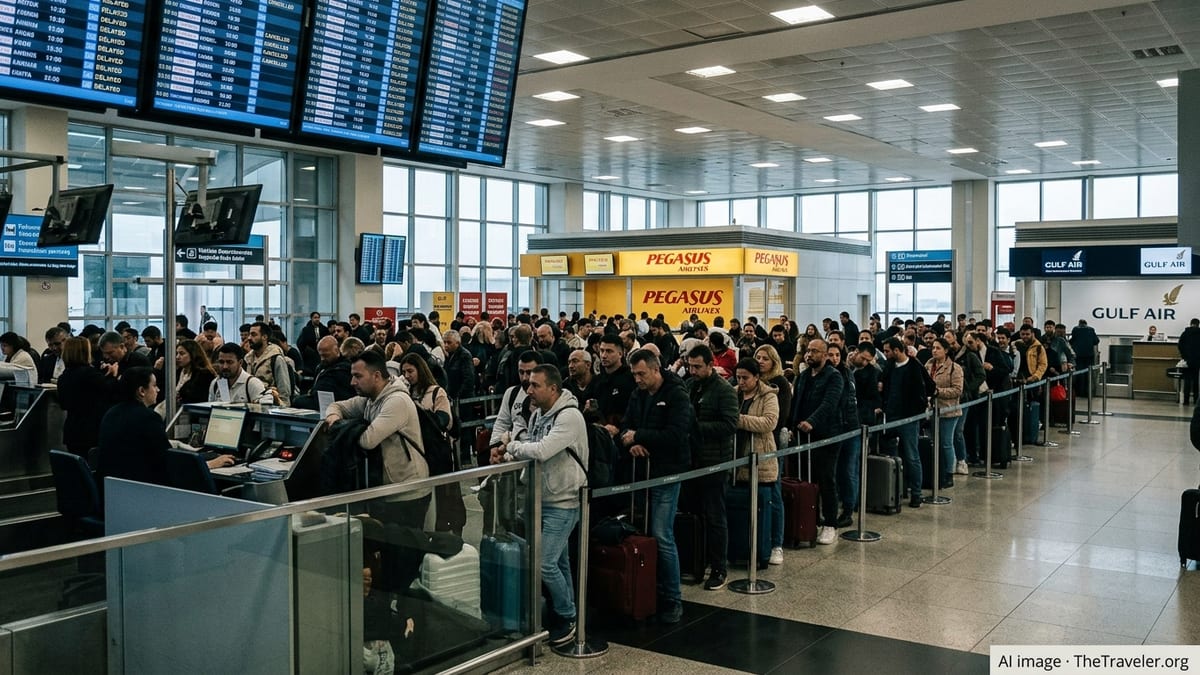
Disruptions Hit Istanbul’s Key Hubs
The latest operational snags have rippled through both Istanbul Airport on the European side and Sabiha Gökçen Airport on the Asian side, where Pegasus Airlines maintains a major base. Flight-tracking data and airport information screens on Saturday showed a cluster of late departures and arrivals on Pegasus services linking Istanbul with cities across Turkey, Europe and the Middle East.
Gulf Air’s schedules into and out of Istanbul have also been affected, with cancellations focused on services connecting Bahrain and other Gulf points to Turkey. The nine confirmed cancellations, alongside a much larger number of delayed departures and arrivals, have tightened capacity on already stretched corridors as airlines navigate a narrower band of usable airspace across the region.
Passenger accounts shared publicly from Istanbul terminals described extended waits at gates and crowded departure halls as rolling delay estimates were repeatedly updated. While some flights eventually departed hours behind schedule, others were removed from departure boards altogether as ground operations adjusted to shifting time slots and crew availability.
Regional Tensions and Congested Skies
The timing of the Pegasus Airlines and Gulf Air disruption coincides with broader volatility in Middle East airspace, which has forced many carriers to reroute around closed or restricted corridors. Commercial aircraft crossing between Europe and Asia are now frequently funneled through narrower lanes, raising workloads for air traffic controllers and leaving limited flexibility when schedules slip.
Analysts note that Turkey’s location as a bridge between continents makes Istanbul particularly sensitive to such regional shocks. When neighboring hubs in the Gulf experience operational stress, Istanbul often absorbs diverted flights and additional traffic, putting pressure on airport infrastructure and local carriers. This dynamic can amplify even modest timetable changes into days of lagging rotations for aircraft and crews.
For Gulf Air, the challenges are compounded by its reliance on Bahrain as a connecting node for routes to Europe and Asia. Any disturbance to flows through that hub has an immediate knock-on effect for passengers using Istanbul as either an origin, destination or transfer point, and can cascade into cancellations when aircraft and crews are out of position.
Passengers Face Missed Connections and Overnight Stays
The combination of nine flight cancellations and more than 200 delays has translated into real-world headaches for travellers attempting to reach or leave Turkey. Publicly shared itineraries show that even short initial delays on Pegasus flights have caused passengers to miss onward connections from Istanbul, sometimes resulting in forced overnight stays and rebooking onto later services.
Similar patterns are emerging on disrupted Gulf Air journeys, where altered timetables in the Gulf region have led some Istanbul-bound passengers to lose their planned links onward to Europe or Asia. With seat availability constrained across multiple carriers, last-minute alternatives have often come with higher fares and multi-stop routings.
Accommodation and meal arrangements have varied depending on ticket type, route and the nature of the delay. Some passengers reported securing hotel vouchers or meal support, while others indicated that they were left to cover out-of-pocket costs while waiting for new flight options. The patchwork of experiences reflects the complex web of passenger rights rules that apply differently on domestic Turkish routes, intra-European services and longer international sectors.
Airlines Balance Safety, Regulations and Customer Care
Pegasus Airlines and Gulf Air are operating within a regulatory environment that prioritises safety and compliance when airspace or operational conditions deteriorate. Publicly available passenger rights documents for Pegasus, for example, emphasise that compensation may not apply when disruptions stem from extraordinary circumstances, including wider airspace closures or security-related events, even as carriers remain responsible for basic care obligations.
Industry observers note that airlines are now walking a tightrope between adhering to evolving safety advisories and maintaining commercially viable schedules. Longer routings to avoid sensitive areas increase fuel burn and crew hours, while slot constraints at heavily used airports such as Istanbul limit the scope for simply adding extra flights once conditions improve.
Gulf Air’s recent advisories have highlighted flexible options such as refunds or rebooking windows for affected tickets over a defined period, signalling an effort to absorb some of the disruption’s impact on passengers. However, the practical process of securing those changes has not always been smooth, with customer-service channels facing high volumes and limited response capacity.
What Travellers Through Istanbul Should Expect Next
With schedules still in flux, travel experts are advising anyone booked on Pegasus Airlines or Gulf Air services touching Turkey to anticipate further last-minute changes. Even flights that operate broadly on time may face slightly extended journey durations as they follow more circuitous paths across congested skies, particularly on routes bridging Europe and the Gulf.
Passengers are being urged, in public advisories and travel commentary, to monitor their flight status frequently on the day of departure and to allow extra time for connections through Istanbul. Those holding separate tickets for onward legs are considered especially vulnerable to missed connections, as protection and automatic rebooking typically apply only to journeys issued under a single booking reference.
Looking ahead, the extent to which disruptions ease will depend on how quickly regional airspace stabilises and how fast airlines can restore aircraft and crew rotations to normal patterns. For now, Istanbul’s role as a vital crossroads between continents remains intact, but travellers moving through Turkey over the coming days should be prepared for an experience marked by longer queues, shifting departure times and a premium on flexibility.