

More news on this day
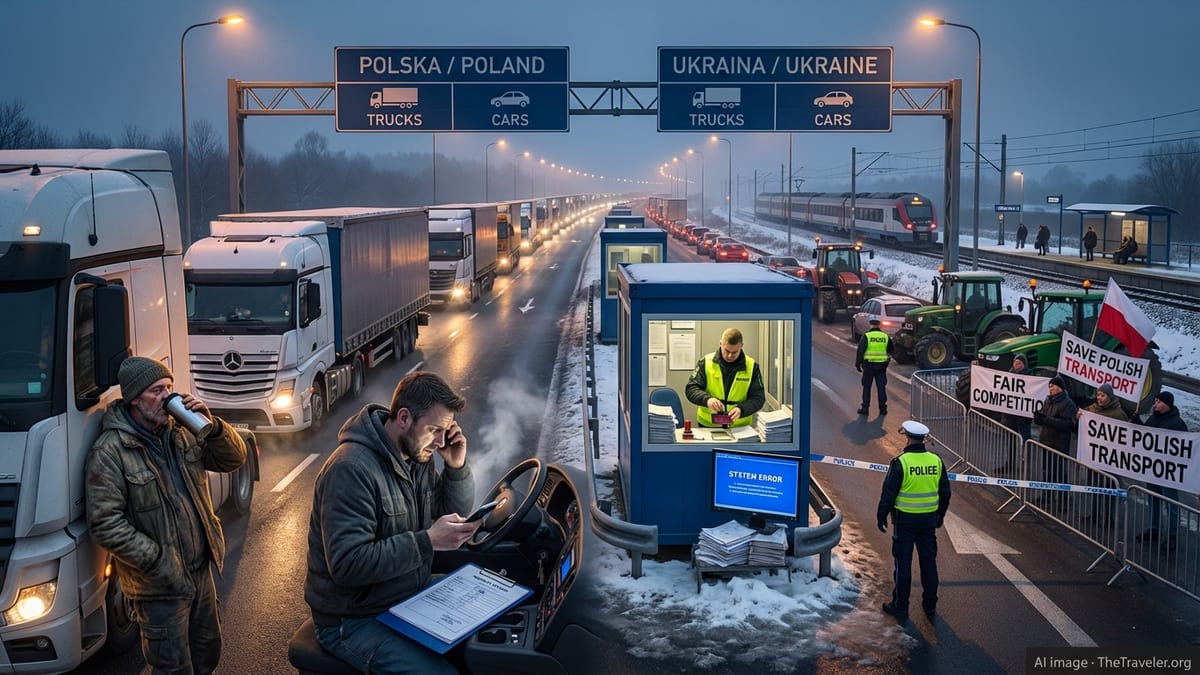
A fresh wave of disruption has hit the Poland Ukraine frontier after a failure in Poland’s border IT systems compounded ongoing protests by Polish haulage and farming groups, creating an unpredictable environment for travelers using key checkpoints in the Lviv and Volyn regions.
While officials in Kyiv stress that queues on the Ukrainian side remain comparatively short for now, intermittent database outages, slower train processing and sporadic road blockades are combining to stretch journey times and unsettle those moving between the two countries.
More News
- TSA Rolls Out $45 ConfirmID Fee for Travelers Without REAL ID at Security
- Flying Blue Launches February 25% Promo Rewards on Transatlantic and Regional Routes
- United Fast-Tracks Starlink Wi‑Fi Across Fleet, Free for MileagePlus Members
Technical Glitch Cripples Polish Border Systems
The latest turbulence began on January 26 when the Polish Border Guard’s primary passport control and data system suffered a major outage, temporarily paralysing all Poland Ukraine road and rail crossings along the Lviv and Volyn corridors. According to regional briefings, the malfunction hit the core database that underpins passport checks and the automatic upload of movements into the European Union’s Entry Exit System, which went live across the bloc in late 2025.
Faced with frozen terminals and inoperable passport readers, Polish officers reverted to manual checks and hand stamping of documents. That emergency workaround kept the crossings open but slashed processing capacity from dozens of vehicles per hour to fewer than a dozen, triggering fast growing queues on the Polish side and uncertainty for passengers heading toward Ukrainian checkpoints. Officials insisted that personal data remained secure and that the glitch was linked to a corrupted server cluster in Warsaw, yet the disruption exposed how reliant the border has become on complex digital infrastructure.
By the following day, technical teams had restored partial functionality, but border authorities acknowledged that the system remained fragile, with further short, unannounced interruptions possible. For travelers, that has translated into a new kind of risk: even when roads are clear and protests have ebbed, a sudden IT failure can now slow or halt processing with little warning, especially at smaller crossings that lack robust backup procedures.
Ukrainian Checkpoints Feel the Ripple Effects
On the Ukrainian side of the frontier, the immediate picture has been less dramatic but still uneasy. The State Border Guard Service of Ukraine reported that queues at major checkpoints such as Yahodyn, Ustyluh and Shehyni were “light to moderate” in mid January, with only a handful of cars and coaches waiting at peak times. At first glance, that suggested a welcome respite after previous years of chronic congestion and multi day truck lines.
Behind the numbers, however, officials cautioned that intermittent failures in Polish and Ukrainian customs IT links were quietly undermining that apparent normality. Even in the absence of a visible backlog, a brief interruption in the electronic manifest or permit systems can extend clearance times from a matter of minutes to close to an hour, particularly for freight vehicles that rely on digital documentation. Travelers and transport managers have been urged to carry printed copies of key paperwork and ensure drivers have reliable power for phones and handheld scanners in case systems fail mid processing.
Rail traffic has been particularly vulnerable. Ukrainian officials say that while car and bus movements remain relatively fluid, cross border trains have encountered slower handling as Polish systems intermittently struggle to verify passenger data and record movements in the EU wide database. For rail passengers, that can mean extended stops at border stations, delayed arrivals and missed onward connections, even when no formal blockade or strike is in place.
Protests and Blockades Add to the Uncertainty
The technical difficulties are unfolding against a backdrop of renewed, rolling protests by Polish truckers and farmers who argue that liberalised rules for Ukrainian hauliers and agricultural imports are undercutting their livelihoods. Since late 2025 and into early 2026, demonstrations have periodically escalated into blockades at several road crossings, most notably Dorohusk Yahodyn, Rava Ruska Hrebenne, Shehyni Medyka and Krakivets Korczowa.
At times, protest organisers have limited the flow of trucks to as little as one vehicle every three hours, creating queues that stretch for tens of kilometres along approach roads in eastern Poland. In early January, estimates from regional customs offices suggested that well over 4,000 lorries were waiting across multiple crossings, with delays at Dorohusk measured in weeks rather than days for some freight operators. Passenger cars, buses and humanitarian convoys have usually been spared the strictest controls, but even those categories often face slower passage due to congestion and frequent police traffic interventions around protest sites.
For Ukrainian travelers and drivers, the picture can be confusing. A checkpoint that appears open on official maps may in practice be subject to “filtering” by protesters who inspect cargoes, select which trucks can pass and at what interval, turning what should be a predictable border crossing into a negotiation. Organisers of the protests insist that their actions are lawful and targeted, but for those caught in the queues the effect is one of arbitrary delay and mounting fatigue.
Travelers Confront Longer Journeys and New Risks
For tourism and general travel between Poland and Ukraine, the immediate impact of the system failure and protests has been uneven yet significant. Independent travelers in cars report that, on many days, they can still cross within one to two hours at quieter checkpoints, particularly in the Lviv region. However, the margin for error has narrowed. A misjudged departure time, an unannounced protest escalation or a short lived customs IT failure can suddenly turn a routine crossing into a half day ordeal.
International bus companies and rail operators are feeling the strain as they try to maintain timetables in a highly unstable operating environment. Some coach firms have quietly added buffer time to their published schedules or built in planned rest breaks close to the frontier, anticipating potential holdups at passport control. Rail operators, meanwhile, have had to warn passengers that arrival times may vary, especially on services that connect Ukraine with major Polish hubs such as Przemysl, Lublin and Warsaw, where onward links to the wider Schengen area are time sensitive.
For leisure travelers planning city breaks in Lviv or weekend visits to Krakow and Warsaw from western Ukraine, the disruptions present a difficult calculation. Official advisories stress that the border remains open and that most crossings continue to process passengers each day. Yet many travelers now budget several extra hours on either side of the frontier, adjust hotel check in times and reconsider tight connections with flights or long distance trains further into the European Union.
Human Cost for Drivers and Local Communities
While the border system failure has attracted attention for its technical and political implications, much of the real impact is being felt in the cabs of stranded trucks and in villages along Poland’s eastern highways. Long lines of lorries idling for days have become an unwelcome but familiar sight on national roads leading to Dorohusk, Hrebenne and other crossings, stretching through small communities where infrastructure is ill equipped to handle such volumes.
For drivers, the combination of protests and system glitches means more time spent eating and sleeping in their vehicles, heightened stress and mounting operational costs. Fuel consumption rises as engines run to provide heating in winter conditions, while access to showers, toilets and medical care remains limited along crowded roadside verges. Volunteer groups and local charities on both sides of the border have stepped in periodically to distribute hot meals, blankets and basic medical supplies, but their resources are finite.
Residents in border villages are also bearing the brunt. With national roads choked by stationary freight, locals report difficulty reaching schools, workplaces and health services. Small businesses that depend on cross border shopping and tourism face fluctuating custom as travelers divert to alternative routes or postpone trips altogether. At the same time, some shops and cafes have seen a short term uptick in sales to waiting drivers, creating a complex, often uneasy dependence on the very queues that many residents wish would disappear.
Policy Debate Over Digital Borders and Fair Competition
The cascading problems at the Poland Ukraine border are feeding into a wider European debate over how to balance digital security, efficient mobility and economic fairness. The introduction of the EU’s Entry Exit System, designed to modernise external border control and track non EU nationals’ stays, has brought new technical demands on frontline border posts. The recent Polish database failure underscores that even a short disruption can have disproportionate consequences when so many processes rely on continuous connectivity.
At the same time, the protests by Polish hauliers highlight unresolved tensions around trade liberalisation policies adopted after Russia’s full scale invasion of Ukraine. Temporary measures that allowed Ukrainian carriers easier access to the EU road freight market were intended to keep trade flowing and support Kyiv’s economy in wartime. Polish and other EU transport companies now argue that these steps have gone too far or lasted too long, putting them at a competitive disadvantage and pushing some smaller firms toward closure.
Negotiations between Warsaw, Kyiv and Brussels continue, but the border itself has become a stage where technical vulnerabilities and policy grievances intersect. Calls are growing for more resilient backup systems at checkpoints, clearer communication of disruptions to travelers and a structured timetable for reviewing transport and customs arrangements so that protests are not seen as the only way for industry groups to make their voices heard.
Advice for Travelers Planning Crossings
For those who need to travel between Poland and Ukraine in the coming weeks, careful planning and flexibility are more important than ever. Travel and mobility specialists recommend checking multiple, up to date sources on border conditions before departure, including official statements from border guards on both sides and real time traffic or queue monitoring services provided by regional authorities. Because situations can change hourly, especially where protests are involved, travelers are urged to verify conditions again shortly before reaching the frontier.
Car and bus passengers should allow generous time buffers, avoid scheduling same day onward flights or high speed train departures from Polish hubs, and carry essential supplies such as water, snacks, warm clothing and phone chargers in case of unexpected delays. Those using trains should pay close attention to operator alerts and consider booking flexible tickets where possible, particularly for legs beyond the immediate border region.
Business travelers and logistics planners moving critical cargo or humanitarian shipments are advised to prepare contingency routes, including crossings via Slovakia, Hungary or Romania, even though such diversions can add days and additional costs to a journey. Where travel cannot be postponed, carrying printed copies of key documents, ensuring that all permits and manifests are also stored offline, and maintaining clear communication lines between drivers, dispatchers and clients can mitigate some of the risk created by IT outages and protest related slowdowns.
FAQ
Q1. What exactly caused the recent disruptions at the Poland Ukraine border?
They were triggered by a significant failure in Poland’s Border Guard database on January 26, 2026, which disrupted automated passport and data processing, and were aggravated by ongoing protests and partial blockades by Polish hauliers and farmers at several key crossings.
Q2. Are Ukrainian checkpoints themselves closed or overwhelmed?
No, Ukrainian checkpoints in the Lviv and Volyn regions remain open, and officials report relatively short queues for most passenger traffic, but processing can slow without warning when customs and data exchange systems experience glitches or when protests restrict the flow of vehicles from the Polish side.
Q3. Which crossings are most affected right now?
Dorohusk Yahodyn, Rava Ruska Hrebenne, Shehyni Medyka and Krakivets Korczowa have seen some of the most serious freight delays due to protests and intermittent technical issues, although the severity can change from day to day depending on the level of blockade and system stability.
Q4. How are passenger cars and buses being impacted compared with trucks?
Passenger cars and buses generally fare better, often being allowed to pass even during intensified protests, but they still face secondary effects such as congestion on approach roads, slower passport checks during IT interruptions and occasional rerouting around blocked lanes for heavy vehicles.
Q5. Is it still safe to travel between Poland and Ukraine for tourism?
Yes, the border remains open to legitimate travelers and there are no specific security warnings linked to the technical failure, but visitors should be prepared for delays, monitor official updates closely and avoid tight same day connections that depend on exact border crossing times.
Q6. How have rail services been affected by the technical problems?
Cross border trains have experienced slower handling at control points, with longer stops for document checks and data entry when systems are unstable, which can in turn delay arrivals in hub cities and cause some passengers to miss onward domestic or international connections.
Q7. What are the main demands of the protesters on the Polish side?
Polish transport and farming groups are pressing for the reintroduction of permit quotas for Ukrainian hauliers, additional financial support to offset rising operating costs, and tighter controls on what they view as unfair competition created by post invasion liberalisation of trade and transport rules.
Q8. How long might these disruptions last?
The duration is uncertain, as it depends both on the technical stabilisation of border IT systems and on political negotiations between Poland, Ukraine and European Union institutions over transport and trade regulations; protest organisers have suggested that actions could continue or recur if they feel their concerns are not addressed.
Q9. What practical steps can individual travelers take to reduce their risk of long delays?
Travelers can build in extra time, carry paper copies of passports and key bookings, keep essential supplies at hand in their vehicle or hand luggage, choose less congested crossings where feasible and stay flexible with departure and arrival plans in case they need to adjust on short notice.
Q10. Are there viable alternative routes that avoid the most affected crossings?
Yes, some travelers and freight operators are rerouting via Slovakia, Hungary or Romania to bypass the most heavily disrupted Poland Ukraine checkpoints, but these alternatives usually involve longer distances, higher costs and their own potential bottlenecks, so they are best reserved for journeys where timing is critical.