

More news on this day
Thousands of air travellers across Germany faced extensive disruption after a widespread IT failure triggered 249 flight cancellations and numerous delays on key routes through Berlin, Munich and Frankfurt, affecting services operated by Ryanair, easyJet, Lufthansa, British Airways, Austrian Airlines and other carriers.
Get the latest news straight to your inbox!
Berlin, Munich and Frankfurt Hubs Struggle With Knock-On Disruptions
Published reports indicate that the disruption cascaded across Germany’s three main aviation hubs, with Berlin Brandenburg, Munich and Frankfurt airports all reporting significant schedule changes. Data compiled by aviation tracking and industry outlets points to a combined 249 cancellations nationwide over the course of the disruption, alongside a far larger number of late departures and arrivals.
Berlin Brandenburg Airport emerged as one of the most heavily affected German gateways, with publicly available figures from earlier major IT outages showing that the capital’s airport can lose around a quarter of its daily schedule when systems fail. During previous technology incidents, such as the global IT failure in July 2024, Berlin recorded more than 150 cancellations in a single day, underlining how quickly operations can unravel when check-in and boarding systems are impaired.
Frankfurt and Munich, the principal hubs for Lufthansa and major transit points for British Airways, Austrian Airlines, Ryanair and easyJet services, also reported widespread disruption. Industry summaries of the latest incident describe rolling delays, aircraft held on the ground awaiting revised slots and crews, and a wave of missed connections as the morning’s problems rippled into the afternoon and evening schedules.
Analysts note that Germany’s central role in Europe’s air traffic network magnifies the impact of any operational shock. Even a few hours of IT instability can disrupt carefully choreographed rotations, leading to cancellations not only on domestic sectors, but also on high-demand routes linking Germany with other European capitals.
Ryanair, easyJet and Lufthansa Among Most Exposed Carriers
Low cost giants Ryanair and easyJet, along with Germany’s flag carrier Lufthansa, were among the airlines most exposed to the disruption, according to aviation intelligence and schedule data. All three operate dense networks into Berlin, Munich and Frankfurt, with multiple daily rotations that depend on tight turnaround times and stable ground systems.
Ryanair and easyJet, which both focus heavily on high-frequency intra-European routes, tend to operate with shorter ground times and high aircraft utilization. When an IT failure interrupts boarding or check-in processes, even briefly, these models leave little room to absorb delays. As a result, airlines often respond by cancelling rotations entirely to prevent further knock-on effects later in the day.
Lufthansa, meanwhile, relies on its hub-and-spoke system through Frankfurt and Munich, where disruption on a single bank of flights can quickly cascade across its long haul and European networks. Previous IT-related events in Europe have shown that hub carriers sometimes trim schedules and proactively cancel services to maintain control of aircraft positioning, crew hours and available slots.
Industry coverage indicates that British Airways and Austrian Airlines, while generally operating fewer daily services to German hubs than Lufthansa or the major low cost carriers, also suffered notable delays and selected cancellations. Their reliance on shared check-in, baggage and boarding platforms at German airports left them similarly vulnerable to the underlying systems failure.
IT System Failures Again Highlight Aviation’s Digital Weak Spots
According to aviation and technology reporting, the latest wave of cancellations occurred in the context of a series of high profile technology failures that have affected airlines and airports since 2024. Previous incidents linked to faulty software updates or cyberattacks on aviation service providers have already exposed how dependent modern air travel is on a relatively small number of critical IT systems.
Global coverage of those earlier events documented how a single flawed software release or compromised system at a third party provider could trigger thousands of cancellations worldwide. In Europe, check-in and boarding platforms operated by specialist technology firms are deeply embedded in day to day operations at major hubs, including Berlin, Munich and Frankfurt.
Analysts point out that, while airlines and airports maintain their own resilience plans, many frontline processes still converge on shared infrastructure. When that infrastructure fails, carriers often revert to manual procedures, resulting in slower passenger processing, longer queues and a higher risk of missed departures.
Recent industry briefings have urged operators to expand backup capabilities, strengthen contractual requirements around uptime, and rehearse contingency plans for rapid recovery. However, the fresh wave of cancellations in Germany illustrates that significant vulnerabilities remain, particularly during peak travel periods when schedules are already operating at close to full capacity.
Travellers Face Long Queues, Missed Connections and Limited Options
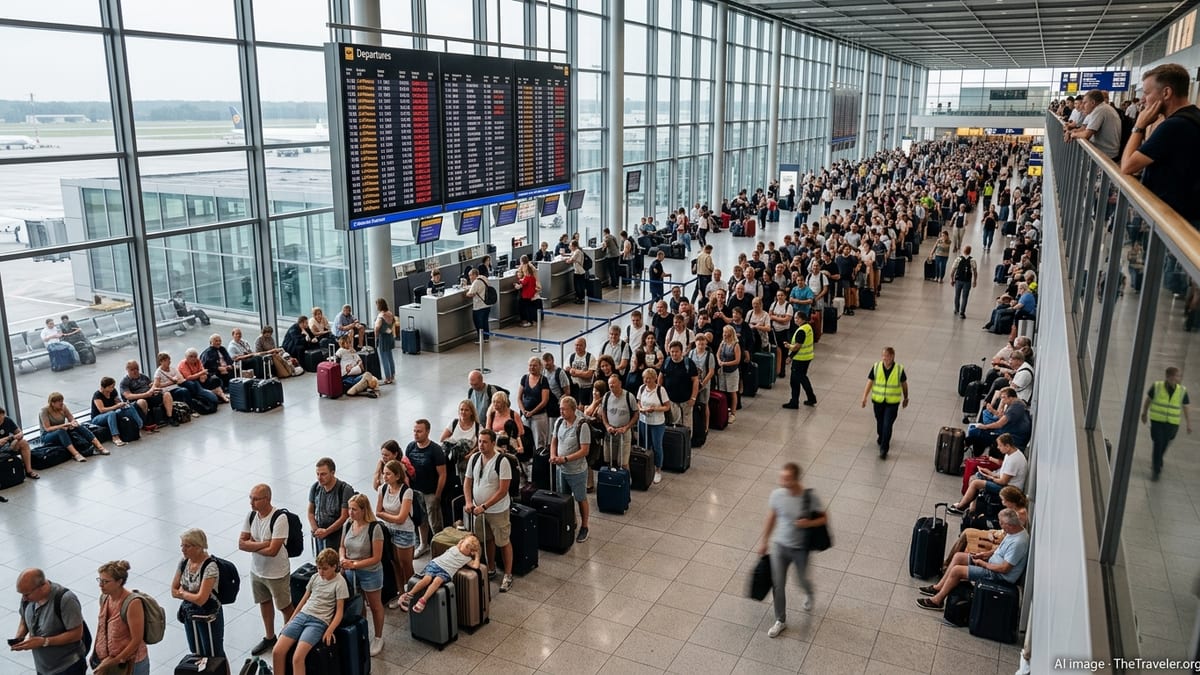
Passenger accounts shared across social and traditional media describe scenes of crowded departure halls, long check-in lines and repeated boarding delays at the affected German airports. With aircraft and crews out of position, many travellers encountered last minute cancellations or significant rebooking challenges, especially on popular city pairs where remaining seats were limited.
Publicly available information on recent European IT disruptions shows that travellers often bear the brunt of the operational complexity. Even when airlines quickly resume partial service, the backlog of stranded passengers can take many hours, or even days, to clear. In Germany, the concentration of disrupted flights at Berlin, Munich and Frankfurt meant that connecting passengers were particularly vulnerable to missed onward sectors.
Consumer rights groups typically remind passengers that, under European air passenger regulations, travellers are entitled to rerouting or refunds in cases of cancellation, and in some circumstances compensation, depending on whether the root cause is considered within the airline’s control. However, the classification of large scale IT failures involving external providers has been the subject of debate in previous cases.
Travel industry observers note that the incident has reinforced calls for clearer guidance on passenger rights in the event of technology-related disruptions. With aviation systems becoming more interconnected and digitally driven, questions are increasingly being raised about how responsibility is assigned when multiple airlines and service providers are affected simultaneously.
Operational Recovery Underway but Residual Delays Persist
By the time German airports began stabilising schedules, a substantial portion of the daily programme had already been lost, leaving airlines to focus on repositioning aircraft and crews. Industry updates suggested that, while the immediate IT issues were contained, residual delays continued to affect evening and next day departures as operations gradually returned to normal patterns.
Experience from previous large scale IT incidents indicates that the recovery phase can be complex. Aircraft may be stranded away from their usual bases, crews may reach regulatory duty limits, and maintenance checks can be pushed out of sequence. All of these factors can contribute to additional, unplanned cancellations even after the initial technical problem has been resolved.
For Germany’s key aviation hubs, the incident serves as another stress test of contingency planning and communication strategies. Observers underline that clear, timely information for passengers, both online and at the airport, remains critical to managing expectations when schedules are changing rapidly.
Sector analysts suggest that the German disruptions will likely feed into broader European discussions on digital resilience in aviation. As airlines including Ryanair, easyJet, Lufthansa, British Airways and Austrian Airlines review the latest event, attention is expected to focus on strengthening backup systems, diversifying critical suppliers and improving transparency around the risks inherent in shared IT infrastructure.