

More news on this day
ITA Airways has unveiled a major expansion of its Germany–Italy schedule for the Summer 2026 season, announcing 47 new weekly flights at ITB Berlin and underscoring the airline’s ambition to turn Rome Fiumicino into a leading European hub.
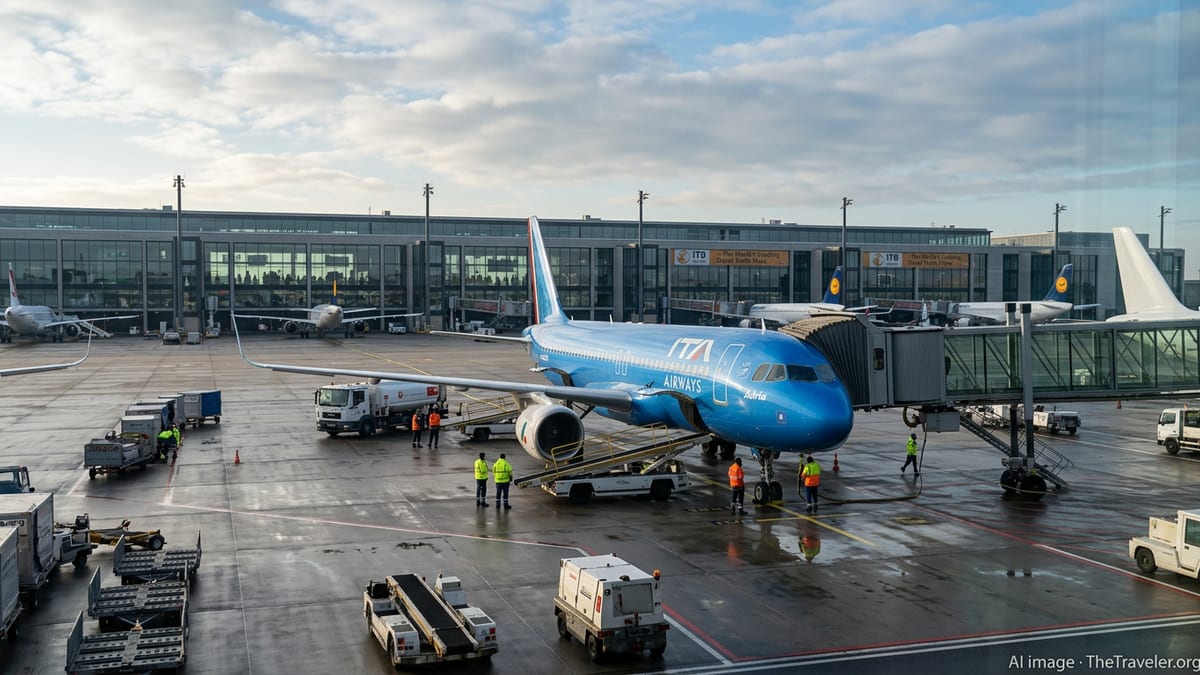
New Frequencies Link German Cities to Italian Hubs
Speaking at ITB Berlin 2026 in early March, ITA Airways confirmed it will operate up to 106 weekly frequencies between Germany and Italy during the peak summer timetable, 47 more than in the previous season. The uplift focuses on strengthening links from key German gateways to Rome Fiumicino and Milan Linate, improving both point-to-point options and onward connectivity across the carrier’s network.
Additional daily and near-daily flights are being deployed on routes from Frankfurt, Munich, Düsseldorf, Hamburg and Berlin to Rome and Milan. The move is designed to capture resilient leisure demand between the two countries while also offering more choice to business travelers who value multiple daily departures and tighter connection windows. ITA Airways management described Germany as one of the airline’s most strategic European markets.
The added capacity will be phased in from late March 2026, aligning with the start of the IATA summer season, and ramped up further for July and August when holiday travel from Germany to Italian coastal and cultural destinations typically peaks. Seats are being sold across a range of fare families, including the carrier’s premium cabin on select frequencies, as ITA aims to appeal to higher-yield customers as well as price-sensitive travelers.
By nearly doubling its weekly Germany–Italy frequencies compared with 2025 levels, the airline is positioning itself as a more visible alternative to traditional incumbents on this corridor. The expansion also brings more competition to a market long dominated by larger European groups and low-cost operators that have aggressively grown capacity on tourist-heavy city pairs.
Rome Fiumicino at the Heart of a Hub-and-Spoke Strategy
The increased Germany–Italy flying is central to ITA Airways’ strategy to consolidate Rome Fiumicino as its primary international hub. Most of the new frequencies are timed to connect efficiently into long-haul departures from Rome to North America, South America, Africa and parts of Asia, as well as to high-demand domestic routes serving Italian islands and secondary cities.
Under the revised schedule, morning and late-afternoon waves from German cities will feed Rome-bound flights, allowing travelers from Germany to connect with minimal layovers to destinations such as New York, Boston, São Paulo and Buenos Aires, along with Mediterranean hotspots including Catania, Palermo and Cagliari. Evening returns back to Germany are structured to cater to both weekend holidaymakers and corporate travelers completing same-day meetings.
The carrier has emphasized that the new services will be operated predominantly with its latest-generation Airbus narrowbody aircraft, part of a fleet renewal plan that aims to significantly reduce fuel burn and emissions per seat. This is expected to improve operating economics on the relatively short Germany–Italy sectors while supporting the airline’s stated sustainability goals.
Operationally, the expanded schedule requires tighter coordination between ITA’s Rome hub team and its ground operations in Germany, particularly at slot-constrained airports like Frankfurt and Munich. The airline is working with local airport operators and air traffic authorities to secure and retain peak-time slots that are critical for maintaining robust banked connections at Fiumicino.
Germany Remains a Powerhouse Source Market for Italy
ITA Airways’ decision to add 47 weekly flights underscores the enduring importance of Germany as a source market for Italian tourism. German travelers have long ranked among the top international visitors to Italy by volume, drawn by its coastal resorts, cultural cities and culinary experiences. Industry forecasts presented at ITB Berlin 2026 point to continued growth in intra-European leisure demand, with Germany–Italy flows expected to perform particularly strongly.
Summer 2026 capacity growth by ITA comes amid solid booking trends reported by Italian tourism boards and hotel operators, who are seeing robust advance reservations from German tour operators and online travel agencies. Additional nonstop options from regional German airports are likely to benefit not only major Italian cities but also secondary destinations accessible via short domestic connections from Rome and Milan.
The added flights are also intended to support business and trade ties between the two countries. Germany is one of Italy’s largest economic partners, and frequent air links facilitate corporate travel, trade fair attendance and cross-border investment. More early-morning and late-evening rotations are being tailored to corporate schedules, particularly on routes serving major industrial and financial centers.
For Germany-based travelers, the expansion offers a greater choice of departure times and the possibility of avoiding long road or rail transfers to reach an airport with direct Italy service. ITA Airways expects this to stimulate new demand, especially from smaller cities feeding into its German gateways, as well as to claw back some market share from carriers that have been operating on these routes for longer.
Competitive Pressure and Network Synergies
The Germany–Italy corridor is among Europe’s most hotly contested, served by full-service groups, regional airlines and low-cost carriers. ITA Airways’ expanded schedule will pit it more directly against both German network airlines and budget operators that have grown aggressively at airports such as Berlin Brandenburg and Hamburg. In this context, ITA is betting that a coordinated schedule, strong Rome hub connectivity and an improving onboard product can differentiate it in the eyes of travelers.
The carrier’s planned integration into the Star Alliance ecosystem during 2026 adds another layer of strategic significance. Closer cooperation with alliance partners that already have a strong presence in Germany could unlock additional feeder traffic and joint corporate contracts, further supporting the viability of the new flights. Expanded codeshare agreements and aligned frequent flyer benefits are expected to make connecting itineraries smoother for passengers.
Analysts note that the move also signals ITA Airways’ intention to be a meaningful player in north–south European traffic flows, rather than limiting itself to operating as a niche point-to-point airline. By building scale in a single, high-value market like Germany, the airline can test its ability to manage complexity across scheduling, pricing and revenue management, lessons that could later be applied to other strategic markets.
At the same time, ramping up capacity at a rapid pace carries execution risks, from aircraft availability to crew planning and potential congestion at busy airports during peak summer months. ITA Airways executives at ITB Berlin indicated the airline has built in operational buffers and is closely monitoring early booking patterns so that it can fine-tune frequencies and aircraft deployment as necessary ahead of the main holiday period.
What Travelers Can Expect in Summer 2026
For passengers, the most visible impact of ITA Airways’ announcement will be a broader menu of flight options and potentially sharper pricing on popular Germany–Italy routes. With multiple daily services on several city pairs, travelers will have greater flexibility to choose departure and arrival times that fit their plans, whether they are heading to Italy for a long weekend or connecting onward to long-haul destinations.
The airline is highlighting a refreshed in-flight experience, with cabins featuring updated interiors, Italian-inspired catering and free basic connectivity on select aircraft. While service levels will vary by route and time of day, the carrier is aiming for a consistent product that emphasizes its national branding and hospitality, a message it has reinforced with a prominent presence at ITB Berlin.
Travel agents and tour operators attending the fair reported strong interest in the expanded schedule, particularly from those packaging coastal and island itineraries that rely on smooth connections via Rome. The additional flights are expected to give them more flexibility in designing trips that start and end in different Italian regions while keeping transit via Germany convenient for their clients.
With Europe’s summer booking window already well underway, ITA Airways’ Germany–Italy expansion positions the airline to capture a greater share of peak-season travel demand. If the additional 47 weekly flights perform as expected, industry observers believe the carrier will be well-placed to consider further growth in other key European markets in subsequent seasons.