

More news on this day
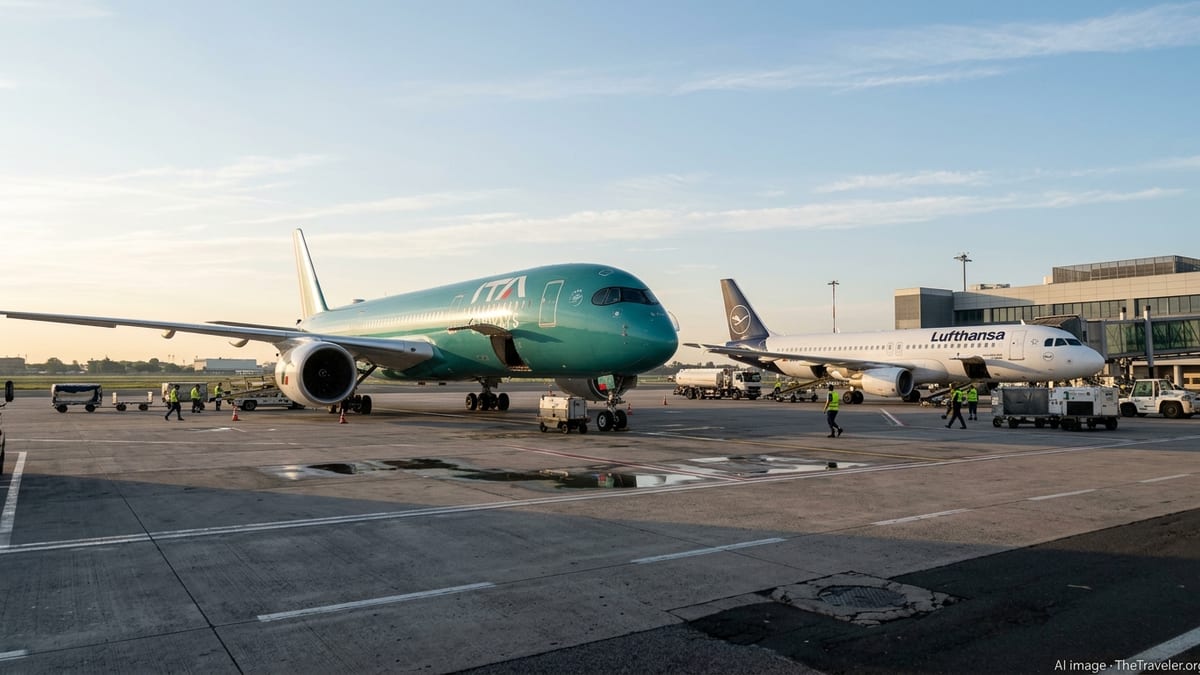
ITA Airways has reported a net profit of €209 million, marking a decisive break from years of red ink and highlighting how its deepening partnership with Lufthansa is reshaping the competitive landscape in European aviation.
Get the latest news straight to your inbox!
From Alitalia’s Legacy to ITA’s Turnaround
The Italian flag carrier, created from the remnants of Alitalia in 2021, has spent its first years battling high costs, intense low-cost competition and lingering skepticism about the viability of a state-backed national airline. Publicly available financial data show that as recently as 2023 ITA Airways was still posting a small net loss, though revenues were growing and core earnings had turned positive.
The swing to a €209 million profit underscores how quickly the balance sheet has shifted. According to financial statements and independent industry analysis, 2024 marked ITA’s first year with a clearly positive bottom line, driven by rising passenger numbers, fuller planes and tighter cost control. The result represents a marked improvement on the modest loss recorded in 2023 and the far deeper deficits associated with its Alitalia predecessor.
Analysts note that the restructuring of routes, a simplified fleet and more disciplined capacity planning have all contributed to the turnaround. The airline has focused on high-yield business and long-haul leisure markets while trimming marginal services, a strategy more closely aligned with the network-focused model of its new German partner.
Equally important has been a stronger commercial focus. Published accounts and sector commentary indicate that ITA has benefited from improved revenue management, higher ancillary income and more efficient use of its slots at Rome Fiumicino and Milan Linate, two of Italy’s most strategically important airports.
Lufthansa Partnership Solidifies With 41 Percent Stake
The financial upswing comes as ITA Airways’ long-planned tie-up with Lufthansa moves from theory to reality. Following European Commission clearance in July 2024 for Lufthansa to acquire a 41 percent stake in the Italian carrier, conditions tied to competition and slot access were gradually implemented, paving the way for the transaction to close.
According to company disclosures and regulatory documents, Lufthansa completed its minority investment through a €325 million capital increase, alongside continued ownership by Italy’s Ministry of Economy and Finance. The deal gives the German group joint control and sets out a roadmap for potentially raising its stake in stages in the coming years, subject to further approvals.
Industry observers say the partnership is already shaping ITA’s strategy. The airline is aligning schedules and fares with Lufthansa Group carriers, particularly on key flows between Italy, Germany, Austria and Switzerland. The prospect of full membership in the Star Alliance ecosystem is also expected to deepen cooperation on frequent-flyer programs and corporate travel contracts, areas where ITA has historically been weaker than larger European rivals.
The Lufthansa link is widely seen as a decisive break with Alitalia’s past, when repeated restructurings failed to produce durable profitability. By anchoring ITA within a broader multi-hub group, the partnership gives the Italian carrier access to long-haul feed, joint procurement and common digital tools that would be difficult to build alone.
Network Expansion and Coordination Across Europe and Beyond
Operationally, the new strategic alignment is most visible in ITA’s network. Publicly available route data show that the carrier has been adding capacity on core business corridors from Rome and Milan into Lufthansa’s main hubs, facilitating one-stop connections to North America, Asia and Africa via Frankfurt, Munich, Zurich and Vienna.
On the long-haul side, ITA has been expanding its presence in North and South America, traditionally strong markets for Italian outbound demand and inbound tourism. The improved profitability in 2024 is closely tied to higher load factors and stronger yields on these intercontinental routes, where cooperation with Lufthansa Group airlines helps fill premium cabins and stabilize demand across seasons.
The Lufthansa partnership also influences ITA’s position at Milan Linate, one of Europe’s most constrained airports. Under remedies agreed with competition authorities, rivals have been granted access to some slots, but reports indicate ITA remains a dominant presence. Coordinated scheduling with Lufthansa-branded carriers is expected to support shuttle-style frequencies on key business routes while maintaining a competitive offering for Italian travelers.
Beyond Europe, codeshare agreements and future alliance integration are poised to extend ITA’s reach far beyond its own metal. This broader virtual network is seen by analysts as crucial to sustaining the airline’s new profit trajectory, allowing it to compete more evenly with Air France-KLM and IAG, whose Italian operations rely heavily on connecting traffic through Paris, Amsterdam, London and Madrid.
Financial Metrics Signal a More Sustainable Business Model
The €209 million profit is only one element of a broader improvement in ITA’s financial profile. Recent financial statements point to revenue growth outpacing capacity increases, a sign that demand and pricing power are strengthening. Estimates compiled from official documents and sector research put 2024 revenues at more than €3 billion, significantly ahead of 2023 and well above the airline’s early projections.
Operating profit margins remain modest by global standards, but their direction is encouraging. The company has reported positive operating earnings, with EBITDA and EBIT improving as fuel, maintenance and staffing costs are brought under tighter control. The 2024 results are described in public filings as ahead of the business plan, even before the airline can fully tap expected cost and revenue synergies from its integration into the Lufthansa Group.
Debt metrics also show signs of stabilization. While ITA continues to rely on state shareholder support and committed funding linked to the Lufthansa deal, the shift to profitability eases pressure on public finances and helps address longstanding concerns in Brussels about state aid and market distortion in the Italian aviation sector.
For travelers, the financial turnaround has practical implications. A more stable balance sheet gives ITA greater scope to invest in fleet renewal, cabin upgrades and digital services, areas where the carrier has already begun rolling out enhancements. If current trends continue, passengers on key domestic and international routes could see a more consistent product and greater schedule reliability.
What ITA’s Profit Means for Italy’s Travel Market
ITA’s return to the black carries significance beyond corporate finance. For Italy’s tourism and business travel sectors, a healthier national carrier promises more direct connectivity to major global markets and greater resilience during demand shocks. Tourism bodies have long argued that a strong home airline is vital for sustaining year-round links between Italian destinations and key long-haul source markets.
The Lufthansa partnership also alters the competitive landscape in Italy, which has become one of Europe’s most hotly contested markets. Low-cost operators dominate many domestic and short-haul leisure routes, while foreign network carriers funnel Italian passengers through their own hubs. A stronger ITA within the Lufthansa Group raises the prospect of more balance between low-cost and full-service options, particularly on routes linking regional Italian cities with the rest of Europe.
At the same time, regulators and consumer groups are expected to scrutinize how the consolidation affects fares and choice. The remedies attached to the Lufthansa deal, including slot concessions and commitments to facilitate rival operations on certain routes, are intended to preserve competition, but their real-world impact will be monitored closely over the coming seasons.
For now, ITA’s €209 million profit stands as a symbolic milestone: evidence that the latest attempt to create a viable Italian flag carrier may finally be gaining altitude. Whether the turnaround will endure will depend on how effectively the airline leverages its new partnership, navigates competitive pressures and delivers on the promise of a more sustainable, traveler-focused business model.