

More news on this day
ITA Airways is sharpening its focus on international growth in 2025, using Rome Fiumicino as a global hub as it adds long-haul routes, renews its fleet and deepens partnerships ahead of joining Star Alliance in 2026.
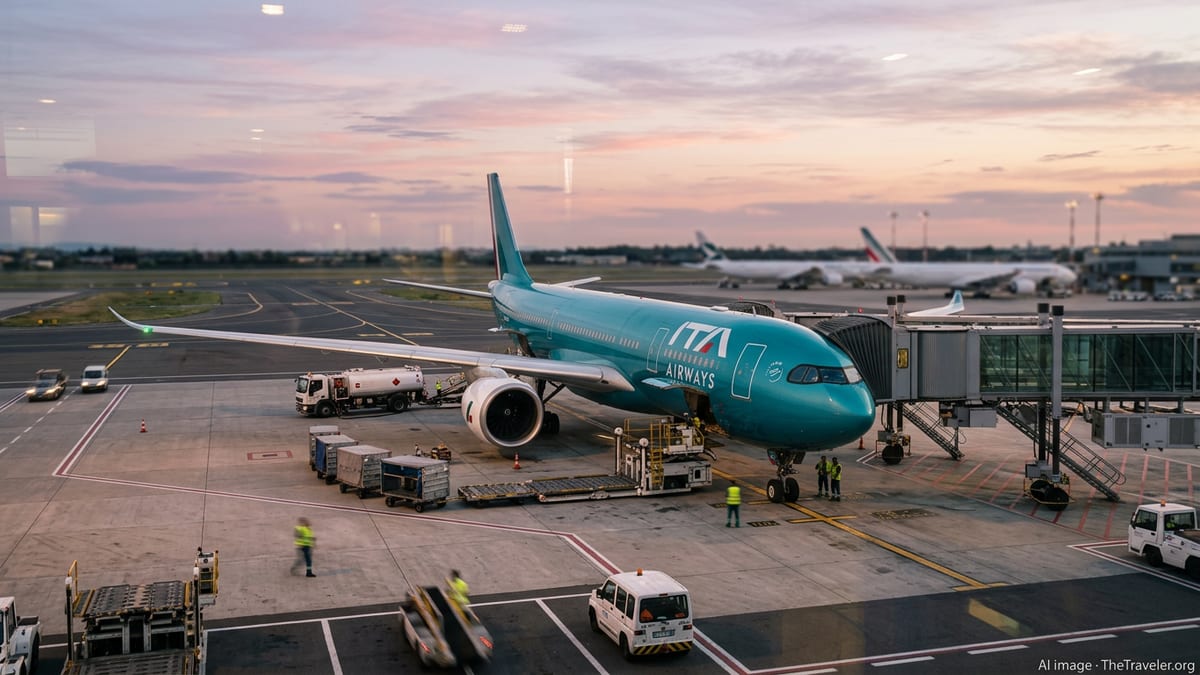
Rome Fiumicino at the Heart of ITA’s Global Strategy
ITA Airways is positioning Rome Fiumicino more firmly as its long-haul gateway as it enters its fourth year of operations. After consolidating intercontinental services at the capital’s main airport and dropping Milan Malpensa long-haul flying, the carrier is now pivoting from restructuring to measured expansion, with 2025 framed as a turning point from survival towards growth.
The airline, now part of Lufthansa Group’s network carriers following the acquisition of a 41 percent stake in January 2025, is expected to benefit from coordinated scheduling, feeder traffic and joint sales initiatives. Management has repeatedly underlined that Italy’s strong outbound demand, combined with Rome’s geographic position between Europe, the Americas, Africa and Asia, gives ITA a platform to scale up intercontinental operations.
At trade events and investor briefings, executives have highlighted improving load factors and rising long-haul traffic as proof that the carrier’s Rome-centric model is gaining traction. In the first nine months of 2025, ITA carried 12.6 million passengers, including around 2 million on long-haul routes, with average load factors on intercontinental services exceeding 80 percent for the first time.
With Lufthansa integration now under way and Star Alliance membership targeted for early 2026, the 2025 network plan is designed to plug gaps in ITA’s global map, particularly in North and South America, while also reinforcing tourism-driven links to the Indian Ocean and Southeast Asia.
New Long-Haul Routes Extend Reach Across Four Continents
The most visible sign of ITA Airways’ international push is a wave of new long-haul routes slated for the winter 2025 to 2026 season and beyond. The carrier has already confirmed new nonstop services from Rome to Mauritius, Bangkok and Buenos Aires, adding to an intercontinental portfolio that includes destinations in North America, South America, Africa and Asia.
In the United States, historically ITA’s most important long-haul market, the airline is preparing to add Houston to its network with a Rome service operated by Airbus A330-900neo aircraft from May 2026. The route will strengthen connectivity into the energy sector and tap corporate demand in Texas while leveraging a growing codeshare relationship with United Airlines, which has major operations at Houston’s George Bush Intercontinental Airport.
South America is another pillar of the expansion plan. A partnership with Spain’s Plus Ultra Líneas Aéreas, announced in mid-2025, allows passengers to combine ITA flights between Italy and Madrid with Plus Ultra’s services onward to South American cities. This arrangement effectively broadens ITA’s reach in markets such as Peru and Ecuador, while new nonstop ITA services to Buenos Aires aim to capture strong point-to-point traffic between Italy and Argentina’s large Italian diaspora.
Leisure-focused links to the Indian Ocean and Southeast Asia complement the carrier’s business-heavy transatlantic strategy. Rome to Mauritius and Rome to Bangkok have been positioned as premium holiday routes, operated with widebody jets offering upgraded cabins. The airline is also reinstating seasonal services to the Maldives and increasing capacity to popular tourist destinations in the Middle East, betting on Italy’s role as both a source and transit market for long-haul vacation travel.
Fleet Renewal Brings Next-Generation Long-Haul Capacity
ITA Airways’ long-haul push is underpinned by rapid fleet renewal that is phasing out older widebodies in favor of more efficient new-generation aircraft. By the end of 2025, the airline will have retired its last Airbus A330-200, with the final flight scheduled on a Rome to Boston rotation at the turn of the year. The type is being replaced by the Airbus A330-900neo, which offers lower fuel burn, longer range and an updated onboard product.
The A330-900neo now sits alongside the Airbus A350-900 as the backbone of ITA’s intercontinental fleet. These aircraft support both dense transatlantic routes and longer missions to South America, Asia and the Indian Ocean. Cabin layouts emphasize a larger share of premium seating, reflecting a strategy to grow higher-yield corporate and luxury leisure traffic, particularly on routes to North America and Asia.
On the edge of long-haul, ITA is also deploying the Airbus A321neo on medium and longer missions to the Middle East and parts of Africa, including destinations such as Dubai, Riyadh, Jeddah, Dakar and Accra. The narrowbody’s range and lower operating costs allow the airline to test new markets or increase frequencies without the risk profile of additional widebody flying, while still offering lie-flat or recliner-style business class on many sectors.
The broader fleet plan, aligned with Lufthansa Group’s sustainability targets, calls for a progressively higher share of new-generation jets across both short and long haul. As additional A330-900neo, A350-900 and A220 family aircraft arrive through the decade, ITA expects to reduce unit costs, cut emissions per seat and support network growth without a corresponding surge in fuel and maintenance expenses.
Partnerships and Alliances Amplify International Growth
Beyond aircraft orders and route announcements, partnerships are a central pillar of ITA Airways’ international growth in 2025. Following the exit from the SkyTeam alliance in April 2025, the airline is in a transition period ahead of its planned Star Alliance entry in early 2026, already receiving clearance from the alliance’s chief executive board to begin integration.
The closer relationship with Lufthansa Group is already reshaping ITA’s long-haul proposition. Network planners are coordinating schedules and connections through hubs such as Frankfurt and Munich, while loyalty program ties between ITA’s Volare scheme and Lufthansa’s Miles & More are being strengthened. The goal is to present passengers with a unified set of benefits and seamless connections, particularly for corporate customers and frequent flyers.
Codeshare deals are also expanding ITA’s virtual network. A deepened agreement with United Airlines, announced in 2025, extends ITA’s reach into secondary U.S. cities beyond its own gateways like New York, Boston and Miami, while feeding more American passengers into the Rome hub for onward travel to Europe, the Middle East and Africa. The collaboration is expected to become even more comprehensive once ITA formally joins Star Alliance, of which United is a founding member.
In Latin America, the interline and partnership deal with Plus Ultra enhances ITA’s ability to serve smaller markets without deploying its own aircraft, while in Asia the carrier is exploring closer cooperation with regional partners to support planned growth in India and Southeast Asia. These commercial links, combined with alliance membership, are intended to offset the limitations of ITA’s still-modest standalone fleet by giving customers access to a much wider global network.
Balancing Ambition With Competition and Operational Challenges
ITA Airways’ international ambitions unfold in an intensely competitive landscape. On transatlantic routes, the carrier faces strong rivals from both European and U.S. airlines, many of which are also rolling out new-generation aircraft and premium cabin upgrades. Gulf and Turkish carriers continue to offer one-stop alternatives between Italy and Asia or Africa, often with aggressive pricing and dense frequencies.
Operational reliability and customer experience will be critical differentiators as ITA scales up. The airline has invested in a new flagship lounge at Rome Fiumicino and is refining its onboard service to position itself as a premium yet contemporary Italian brand. Maintaining punctuality and minimizing disruption across a more complex long-haul network will be equally important, especially as the airline leans more heavily on connecting traffic.
Regulatory scrutiny surrounding state aid and the Lufthansa transaction remains a background factor, even after Brussels approved the stake sale with conditions. Any future increase in Lufthansa ownership will be closely watched by competitors and regulators, potentially influencing how closely ITA can coordinate pricing and capacity with its sister carriers on certain routes.
For now, the focus in 2025 is on turning a clearer strategic vision into tangible growth: adding long-haul seats where demand is strongest, modernizing the fleet to improve economics, and slotting ITA into the global fabric of Star Alliance. If the airline can execute that plan while preserving service quality, Rome’s blue-and-green jets are likely to become a more visible presence on long-haul tarmacs worldwide over the next few years.