

More news on this day
Italian high-speed rail operator Italo is moving beyond its home market by integrating with AccesRail’s global distribution platform, a strategic step designed to make its high-speed services bookable worldwide alongside major airlines and long-haul itineraries.
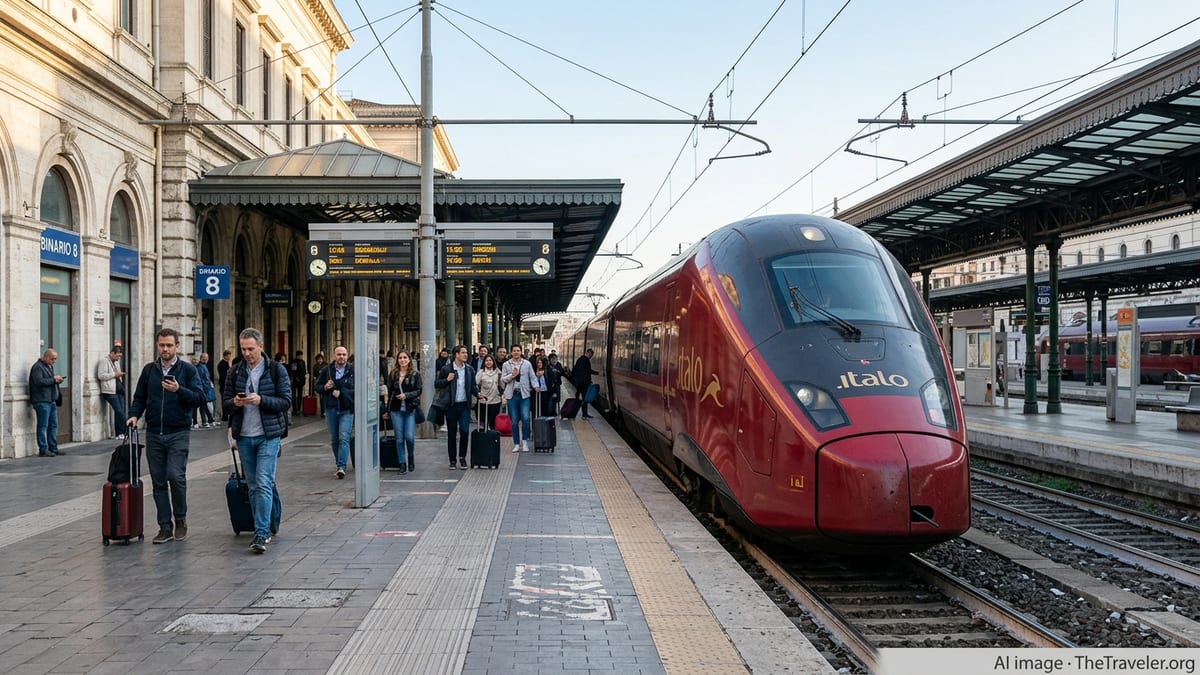
Bringing Italian High-Speed Rail to the Airline Shelf
The tie-up connects Italo to AccesRail’s IATA-accredited system, which uses virtual airline code 9B to display rail segments in the same primary screens travel agents use to sell flights. For Italo, a private open-access operator that has built a strong position on core Italian corridors such as Milan–Rome, the integration is intended to shift the brand from a largely domestic player into a rail option visible to global aviation customers.
AccesRail’s model allows railway inventory to appear in global distribution systems as if it were another airline, while ticketing, settlement and after-sales processes follow familiar airline workflows. That structure is attractive for high-speed operators looking to capture passengers who today default to short-haul flights, especially on dense European city pairs where rail already rivals air in journey time.
Although neither company has disclosed commercial terms, people close to similar rail integrations say the focus is less on headline volumes and more on plugging rail into existing air networks. For Italo, this means its seats can now be packaged with international flights sold by partner carriers and intermediaries, expanding reach without the cost of building new sales channels.
Air–Rail Intermodality Targets Short-Haul Flights
The backdrop to Italo’s distribution play is a broader European policy push to shift passengers from planes to trains on routes where high-speed rail offers competitive travel times. Studies of the high-speed segment point to rising demand and growing operator diversity, with private players like Italo increasingly seen as critical to unlocking modal shift on busy intercity corridors.
By using AccesRail’s infrastructure, airlines and tour operators can now issue combined tickets that stitch together long-haul flights and Italo’s domestic segments in a single passenger name record. For travelers, that translates into simplified booking and protected connections; for carriers, it offers a way to extend their virtual networks beyond airports into central business districts served by Italo’s stations.
The move also comes as European regulators scrutinize short-haul flights on routes well served by rail. Combined air–rail products let airlines continue to sell access to city pairs while reducing the number of feeder flights to major hubs. Italo’s presence on these intermodal itineraries positions the operator to benefit directly from any policy tilt away from domestic or near-border flights.
Tech-Driven Rail Product Meets Airline-Grade Distribution
Italo has been upgrading its onboard technology and digital infrastructure, from 5G connectivity projects on its AGV and EVO fleets to a renewed partnership with reservations specialist Navitaire. Those investments are aimed squarely at making its rail product resemble the best of low-cost and hybrid airlines in terms of booking flow, ancillary sales and data-driven revenue management.
AccesRail’s platform is built around similar principles. It standardizes how rail itineraries are displayed, priced and ticketed, ensuring they slot seamlessly into the search and booking logic of global distribution systems used by airlines and travel management companies. For Italo, which competes head-to-head with state operator Trenitalia on Italy’s main high-speed axes, aligning its digital backbone with airline standards is increasingly a commercial necessity.
Industry analysts say that with this integration, Italo is effectively positioning itself as an airline-like carrier on steel rails: dynamically priced, tech-enabled and accessible through the same channels corporate buyers and tour operators already rely on. The AccesRail connection provides the missing distribution layer needed to monetise those investments at a global scale.
New Flows for Italy’s Tourism and Business Hubs
Tourism boards and airport stakeholders are watching the development closely, as greater visibility for Italo’s network could reshape how visitors stitch together multi-stop Italian itineraries. High-speed trains already link major gateways such as Rome, Milan, Venice, Florence and Naples in under four hours, but many inbound travelers still default to low-cost flights or standalone rail tickets bought last minute.
With Italo segments now able to be booked alongside long-haul flights, a traveler from North America or Asia can, in principle, secure a through journey that ends not at an airport on the urban fringe but in a central station connected to local transit and walkable neighborhoods. That shift could distribute visitor spending more evenly across cities and regions served by Italo, while easing pressure on congested airports and domestic air routes.
Corporate travel managers are also likely beneficiaries. Having Italo appear in standard global distribution workflows allows them to compare rail and air options on cost, journey time and emissions, and to enforce policy that nudges travelers toward high-speed rail on appropriate routes. For Italy’s business hubs, particularly along the Milan–Rome–Naples axis, this could further entrench high-speed rail as the default choice for intercity mobility.
Positioning for a More Competitive European High-Speed Market
The integration with AccesRail comes as Italo weighs expansion beyond Italy’s borders and as private operators across Europe prepare to challenge incumbent state railways on more international routes. Reports in recent months have suggested that Italo is studying entries into neighboring high-speed markets, part of a wider trend of cross-border competition fueled by liberalization and strong demand.
Global distribution visibility is a prerequisite for such a strategy. If Italo launches services into markets like Germany or further into central Europe, the ability to sell those seats through airline and agency channels from day one will be crucial. AccesRail offers a ready-made bridge to that ecosystem, connecting Italo not just to European airlines but to long-haul carriers seeking reliable rail partners.
For travelers, the result is a step toward a more integrated European mobility network in which high-speed trains are no longer a separate, locally-booked component but an embedded part of the global travel retail environment. For Italo, the AccesRail deal is not just a distribution upgrade; it signals an intent to compete for passengers far beyond Italy’s borders, using technology and intermodality as its principal levers.