

More news on this day
Travellers moving through Italy’s key gateways of Milan, Florence and Rome faced a new round of air travel disruption this week, as easyJet, Iberia, CityJet, Air France, KLM and several other carriers suspended fourteen flights and reported widespread delays linked to severe weather, staffing shortages and knock-on effects from chaos elsewhere in Europe.
Fourteen Flights Scrapped as Pressure Mounts on Italian Hubs
According to preliminary tallies from airport operations teams and flight-tracking data reviewed on Wednesday, a total of fourteen short-haul and regional flights operated by easyJet, Iberia, CityJet, Air France, KLM and a handful of codeshare partners were cancelled on routes touching Milan, Florence and Rome. The suspensions were concentrated in the busy morning and early evening banks, when Italian business travellers and Olympics visitors have been crowding key corridors between northern and central Italy.
While Italy’s aviation network has been under strain for much of February, with hundreds of flights delayed or cancelled on peak days, this latest wave of targeted suspensions added fresh pressure on already stretched ground operations in Milan and Rome. Earlier in the month, disruptions across major Italian airports produced nearly 400 affected flights in a single day, underscoring the fragility of schedules during the Winter Olympics period and the height of Carnival-season travel.
Airport managers in Milan and Rome framed Wednesday’s cancellations as a tactical move to stabilise operations rather than a full-blown collapse of service. By trimming frequencies and consolidating lightly booked services, airlines aimed to free up aircraft and crews to protect core routes and reduce the risk of rolling delays spreading into Thursday and the weekend.
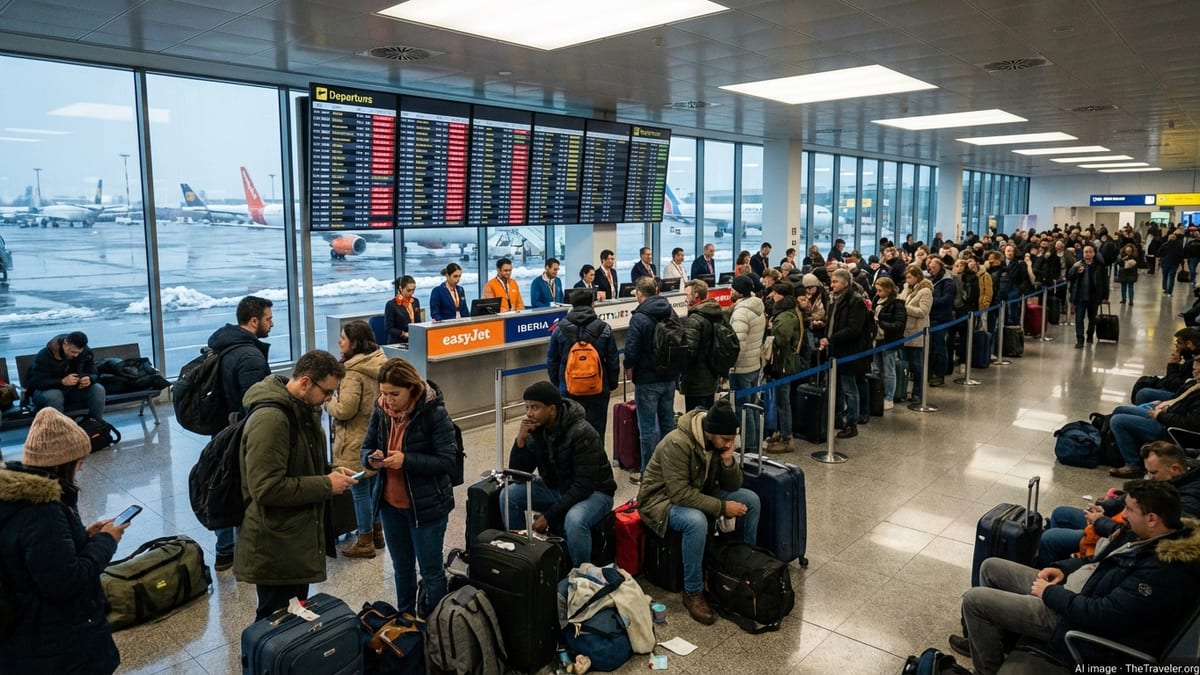
Nonetheless, passengers booked on the fourteen cancelled flights faced last-minute rebookings, longer connections and overnight stays as carriers worked through backlogs. At both Milan Linate and Rome Fiumicino, long lines formed at airline desks as travellers sought clarification on revised itineraries, while departure boards flickered with new times and gate changes.
Milan Hit Hard as Weather and Staffing Collide
Milan’s airport system, split mainly between Linate and Malpensa, has been one of the hardest-hit nodes in this latest round of disruption. In the past ten days, wintry weather and low visibility have repeatedly forced ground stops and de-icing procedures at Malpensa, sharply reducing capacity and triggering waves of delays, particularly during the morning rush. On some days, the cancellation rate at Malpensa has climbed to roughly three times its typical winter average, according to industry data.
On Wednesday, several of the fourteen cancelled flights were Milan rotations operated by easyJet and KLM, with aircraft scheduled to connect through northern European hubs. Snow showers and gusty winds returning over the Lombardy plain prompted renewed concerns over runway conditions and turnaround times, while staffing shortages in ground handling limited the number of departures that could be processed safely in tight windows.
Airport operator SEA Group has previously acknowledged that absenteeism among de-icing crews and ramp staff during recent cold snaps has slowed operations in Milan, forcing airlines to pad schedules and, at times, proactively scrap services. Those constraints remained visible this week, with tugs and de-icing rigs in constant use and aircraft queued on taxiways as pilots awaited clearance.
Adding complexity is the evolving route strategy of some legacy carriers in Milan. KLM, for example, is in the process of consolidating its Milan operations at centrally located Linate, reducing its dependence on more weather-exposed Malpensa. While that shift is meant to improve reliability for passengers over the long term, the current transition period has left the Dutch airline juggling aircraft rotations across two airports just as weather and staffing issues are biting hardest.
Florence’s Fragile Operations Buckle Under Regional Weather
Florence’s Amerigo Vespucci Airport, which handles a mix of business and leisure traffic to Italy’s central heartland, also saw cancellations and heavy delays as the weather system sweeping northern Italy pushed south. The airport’s relatively short runway and challenging approach paths leave it particularly vulnerable to crosswinds, low cloud and poor visibility, conditions that have been common across Tuscany during the latest European storm sequence.
Several of the fourteen suspended flights involved regional services linking Florence with other European hubs under the banners of CityJet and Iberia’s regional partners. Pilots facing shifting wind conditions and capacity restrictions opted to divert, delay or cancel rotations rather than risk protracted holding patterns or multiple approach attempts at an already saturated airfield.
Beyond pure weather, Florence has been affected by the same structural issues straining operations elsewhere in Italy. Ground handling providers have struggled to source seasonal staff fast enough to cope with the surge in Winter Olympics and Carnival-related travel, while airlines have been running tight rosters across their European networks. When crews arrive late from disrupted sectors in France, Germany or the Netherlands, even a single delayed inbound can cascade into missed departure slots in Florence.
For travellers, the result has been an increasingly unpredictable experience. On Wednesday, passengers arriving into Florence reported waiting extended periods for baggage as handlers tried to juggle late inbound flights with outbound operations. Others described check-in queues snaking through the compact terminal as departure times slipped in twenty- or thirty-minute increments, with limited seating available in the public areas.
Rome Fiumicino Strains to Absorb Knock-On Disruptions
Rome Fiumicino, Italy’s largest international gateway, again found itself absorbing a share of the disruption even when local weather conditions were relatively benign. Several of the cancelled flights involved Rome-based segments that would normally feed into or out of services operated by Air France, KLM and easyJet, linking the capital with northern Italy and key European hubs.
Earlier in February, Fiumicino recorded a spike in disruptions as heavy rain and congestion across Italian airspace forced airlines to slow operations and, in some cases, cancel departures outright. The airport is also contending with heightened traffic flows related to the Winter Olympics and increased tourism tied to events in Rome and the wider Lazio region. Hotels in the capital have been running at very high occupancy levels, leaving fewer options for passengers forced to stay overnight after missed connections.
On Wednesday, the cancellations and delays tied to the fourteen suspended flights had visible ripple effects in Rome’s terminals. Departure boards alternated between “delayed” and “boarding” tags as ground crews worked to turn aircraft quickly, while perimeter security queues at peak times stretched toward the main entrances. Although core long-haul services largely operated as scheduled, short-haul and regional links bore the brunt of schedule reshaping, with some passengers re-protected via alternative routings through other European hubs.
Airport authorities at Fiumicino reiterated that they are coordinating closely with the Italian Civil Aviation Authority and Eurocontrol to manage flows during this volatile period. However, they warned that as long as storms and labour tension continue to affect neighbouring countries, Rome flights will remain vulnerable to last-minute changes driven by events elsewhere in the network.
European Storms and Network Strain Drive Wider Chaos
The immediate trigger for many of the latest disruptions in Italy lies beyond its borders. A series of strong Atlantic storms sweeping across western and central Europe this month has hammered airports in France, Germany, the Netherlands and Scandinavia, prompting thousands of delays and dozens of cancellations at major hubs. When airlines such as Air France, KLM and easyJet cut or retime services in response to weather at their bases, Italian destinations often feel the downstream impact hours later.
In recent days, flight data has shown hundreds of delays and cancellations across a group of fourteen major European airports, including Amsterdam Schiphol, Paris Charles de Gaulle and various German and Nordic hubs. Those disruptions have affected a broad cross-section of airlines, from low-cost carriers to full-service flag airlines, leaving fleets and crews out of position and eroding schedule resilience.
Italy’s own weather has compounded the problem. Snow, freezing rain and low clouds over the Alps and northern plains have forced capacity cuts and increased spacing between takeoffs and landings at Milan and Florence, while heavy rainfall and landslides in parts of central Italy have added new safety concerns. Network planners now face a juggling act: adjusting timetables in real time as fresh meteorological data comes in, while grappling with aircraft that are late or stuck at foreign airports.
For passengers in Milan, Florence and Rome, the end result has been disruption that can appear random or opaque. Flights to one destination may continue almost unaffected while another, seemingly similar route is suddenly cancelled. Industry analysts note that such inconsistencies reflect the underlying complexity of European airline networks, where a single grounded aircraft in Amsterdam or Paris can create a domino effect that is only felt in Italy several rotations later.
Labour Tensions and Upcoming Strikes Cast a Longer Shadow
While Wednesday’s fourteen flight suspensions were officially attributed to operational and weather-related factors, they are unfolding against a backdrop of rising labour tension in Italy’s transport sector. Unions representing airline employees, ground handlers, air traffic controllers and local transport workers have announced a series of strikes and assemblies stretching from late February into March, warning of more “significant inconvenience” for travellers.
Among the most consequential actions is a nationwide air transport strike scheduled for February 26, involving staff at ITA Airways and workers tied to other carriers such as easyJet. Government intervention has pushed some stoppages to dates after the Winter Olympics in an effort to protect Games traffic, but national and regional walkouts are still expected to cause hundreds of cancellations and schedule changes across Italian airports once they begin.
Ground staff at Milan’s airports and other northern hubs have also been locked in disputes over pay and working conditions, with unions complaining of increased workloads and staff shortages during peak periods. Similar frustrations are evident among air traffic controllers, some of whom are planning targeted strikes at Rome’s area control centre in early March that could restrict access to major sections of Italian airspace.
Given this context, airlines are under pressure to keep current disruptions under tight control to avoid entering a prolonged period of instability. Yet the structural issues fuelling labour unrest, including inflation, high living costs in major cities and lingering post-pandemic staffing gaps, suggest that Italy’s air travel reliability may remain fragile well beyond this week’s fourteen cancelled flights.
Impact on Travellers and What Airlines Are Offering
For individual travellers caught in the latest wave of cancellations and delays, the immediate concern is often simply reaching their destination. Airlines including easyJet, Iberia, Air France and KLM have reiterated standard pledges to notify affected passengers by text or email, automatically rebook them where possible and provide options for refunds or vouchers when journeys are no longer viable.
Under European consumer protection rules, passengers whose flights are cancelled or arrive with long delays may be entitled to reimbursement or compensation, though carriers can invoke exemptions when severe weather or other extraordinary circumstances are to blame. Several airlines operating in and out of Milan have already signalled that they will apply such exemptions for portions of February, citing official weather alerts and capacity restrictions issued by aviation authorities.
In practical terms, many travellers have turned to self-service tools such as airline apps and websites to manage their disrupted itineraries. Carriers urge passengers to check flight status before leaving for the airport, as gate agents and call centres are often overwhelmed during peak disruption periods. Hotels near Milan Malpensa, Milan Linate and Rome Fiumicino reported brisk last-minute bookings on Wednesday evening, with some properties indicating that they were nearly full from passengers requiring an unplanned overnight stay.
For those able to adjust their plans, travel advisers suggest building in extra buffers between connections, especially when itineraries involve multiple European hubs, and considering rail alternatives on core domestic corridors such as Milan–Florence–Rome where trains remain available. However, with Italy’s railway network itself facing sporadic disruption from sabotage and upcoming labour actions, even this fallback option is not guaranteed to be smooth.
Authorities Urge Patience as Italy Navigates a Volatile Winter
Italian transport officials and airport operators have urged passengers to brace for a period of continued volatility, noting that February’s converging pressures of winter storms, Olympics traffic and labour disputes are unlikely to abate overnight. They emphasise that the fourteen suspended flights reported on Wednesday represent a fraction of the total movements across Milan, Florence and Rome, where the vast majority of services are still operating, albeit sometimes with delays.
Nevertheless, the pattern of recurring disruption has raised questions about the resilience of Italy’s aviation system and the adequacy of contingency planning at both airline and institutional levels. Consumer groups have called for clearer, faster communication from carriers when schedules begin to unravel, arguing that many passengers only find out about cancellations once they have already arrived at the airport.
In response, some airlines are reviewing their notification thresholds and exploring more proactive use of messaging tools to alert customers to potential issues before they become acute. Airport authorities, for their part, are refining snow-clearing and de-icing protocols, reinforcing staffing pools for critical winter operations and coordinating closely with Eurocontrol to manage airspace capacity around storm fronts.
For now, travellers planning to pass through Milan, Florence or Rome in the coming days are advised to closely monitor their bookings, allow extra time for transfers between city centres and airports, and remain flexible as conditions evolve. With more volatile weather systems on the horizon and a calendar of strikes approaching, Italy’s skies look set to remain unsettled long after this week’s fourteen cancelled flights fade from the departure boards.