

More news on this day
Europe’s border experience is undergoing its biggest shake-up in decades as Italy accelerates biometric passport controls and e-visa style authorizations while Norway presses ahead with tougher regulations, signaling a continent-wide move toward fully digital border management.
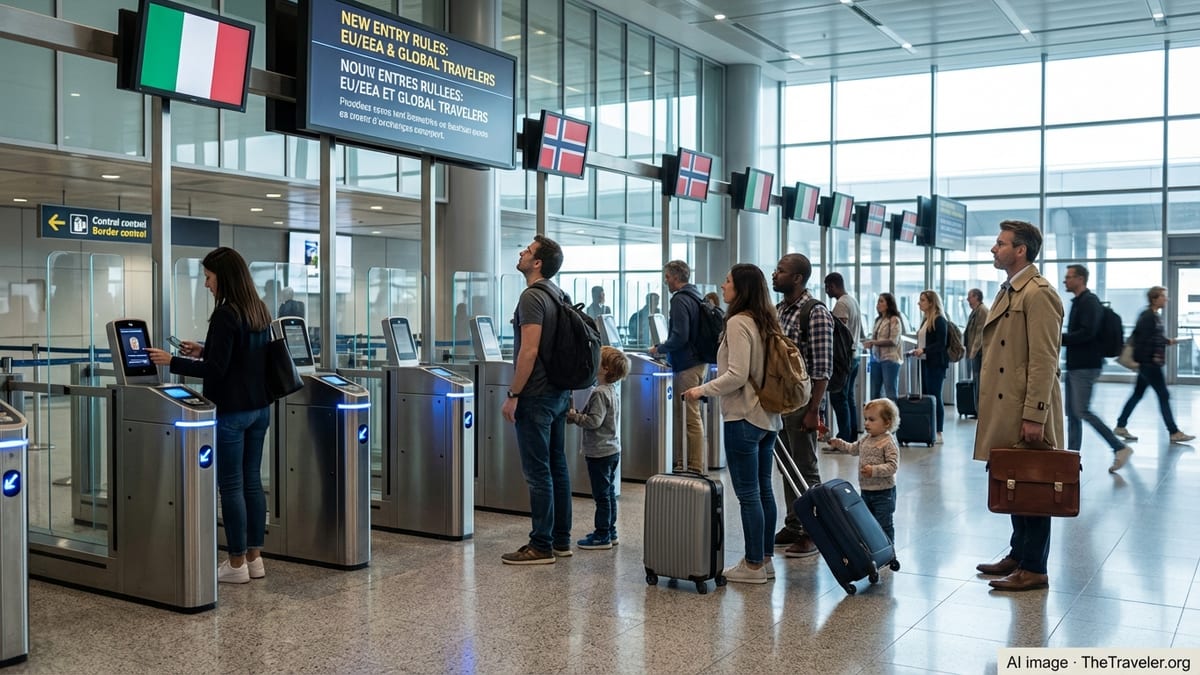
Italy Steps Up Biometric Controls Under the New Entry/Exit System
Italy has moved firmly into the digital border era as the European Union’s Entry/Exit System, or EES, transitions from rollout to routine at airports and major land crossings. The system, which began operating on 12 October 2025 and is due to be fully in place across all external Schengen borders by 10 April 2026, replaces the familiar passport stamp with biometric registration for most non-EU visitors. Italy is among the high‑traffic countries that have prioritized deployment at major hubs, including Rome Fiumicino, Milan Malpensa and Venice, where self‑service kiosks and automated e‑gates are rapidly becoming the default.
For travelers, the change means presenting a passport alongside a facial image and, for most visa‑exempt visitors, four fingerprints, captured electronically during the first entry after the system goes live. Subsequent trips should be quicker as biometric data is verified rather than captured from scratch. Italian authorities have framed the push as both a security and efficiency upgrade, with automated checks intended to identify overstays and identity fraud while eventually shortening queues once the initial registration wave has passed.
Tourism operators in Italy report a mixed start. While some long‑haul arrivals have encountered extended waits at peak periods, particularly where kiosks are still being added or staff are adapting to new procedures, others are already seeing faster clearance at upgraded e‑gates. With EES data automatically calculating days spent in the Schengen area, Italy’s border officers say they can focus more attention on complex cases and less on manual arithmetic at busy desks.
Italian officials have also highlighted privacy safeguards to reassure visitors uneasy about handing over fingerprints and facial biometrics. The data is held for a limited period, in line with EU rules, and access is strictly regulated. Nonetheless, the end of passport stamping has a symbolic resonance for many travelers heading to Italy, where entry stamps were once a cherished memento of a long‑planned European trip.
Poland, Germany, Switzerland, Hungary and Others Deepen E‑Gate Use
Italy’s shift is mirrored across much of continental Europe, where countries such as Poland, Germany, Switzerland and Hungary have been racing to ensure their border infrastructure is compatible with the new biometric systems. In practice that has meant more automated e‑gates, expanded banks of self‑service kiosks, and dedicated EES registration areas at large airports and busy road crossings. The goal is to channel the bulk of short‑stay, non‑EU travel through digital lanes that can verify identity, check visa conditions and log arrivals and departures in seconds once travelers are fully enrolled.
Germany has leaned heavily on its existing experience with automated passport control to integrate the EES tools, especially at Frankfurt and Munich. Poland, which currently holds a key role in shepherding border legislation through EU institutions, has publicly backed the technology as a needed modernization at external Schengen crossings, including its busy eastern land borders. Switzerland, though not an EU member, participates fully in the Schengen zone and is rolling out similar biometric checkpoints at Zurich and Geneva airports, branding the upgrades as both a security measure and a service enhancement for frequent flyers.
In Hungary and other Central and Eastern European states, investment has focused not only on airports but also on road and rail crossings used by tourists and cross‑border workers. Local authorities have warned that the system’s first months are a learning period, with processing times still variable from one border post to another. However, officials insist that once the majority of regular travelers have completed their initial biometric registration, throughput should improve and manual inspection lanes will gradually become the exception rather than the rule.
For the broader Schengen area, the shared database at the heart of the EES is seen as a crucial tool in clamping down on overstays and improving information‑sharing between police and immigration services. Border agencies in Germany, Poland and Switzerland say that real‑time access to accurate entry and exit records helps them distinguish between visitors who respect the 90‑days‑in‑180 rule and those whose status may require closer scrutiny.
Norway Enforces New Rules to Bolster Border Security
While most of Europe is focused on the technical rollout of EES terminals and e‑gates, Norway is pairing that shift with a set of tougher regulatory measures aimed squarely at security. As a Schengen‑associated state outside the EU, Norway must adhere to common border rules but has room to shape how it enforces them. Over recent months, Oslo has tightened risk‑based screening criteria, expanded the use of biometric checks at key ferry ports and land crossings, and updated legislation to allow more systematic use of EES data for law‑enforcement purposes within strict privacy limits.
Norwegian authorities say the reforms are designed to address a more complex risk environment, from irregular migration routes in the High North to concerns about organized crime using the freedom of movement within the wider Schengen space. The new rules make it easier for border guards to consult EES records alongside existing security databases when they suspect identity fraud or document manipulation, and to respond quickly if a traveler has already overstayed or violated conditions elsewhere in Europe.
Travelers arriving in Norway by air are already noticing a more structured process at international terminals such as Oslo Gardermoen and Bergen, where border police direct non‑EU visitors toward the new biometric kiosks before they proceed to inspection points. Cruise and ferry arrivals, long a feature of Norway’s tourism economy, are also being drawn into the system, with operators required to share passenger data earlier and more consistently as part of a push for advanced risk assessment.
Officials in Oslo stress that the objective is not to discourage tourism but to ensure that Norway’s borders remain among the most secure and predictable in Europe. The country has invested in public information campaigns to prepare visitors for the change, emphasizing that the new rules simply align practice with the shared direction of travel across Europe: more digital screening, fewer manual checks, and a heavier reliance on biometrics.
Ireland’s Separate Path: E‑Travel Authorization and Manual Stamps
Ireland offers a notable contrast in this new landscape. Although it is an EU member state, it is not part of the Schengen Area and is therefore not implementing the EES at its external borders. Instead, Dublin is developing its own electronic travel authorization program, often described as functioning much like an online pre‑clearance or e‑visa light for visa‑exempt visitors. Under plans announced by the Irish government, most non‑visa nationals who currently arrive with just a passport will in future be required to complete a short application and receive digital approval before boarding.
The move places Ireland in a growing group of countries that, while not requiring a traditional visa for short stays, increasingly ask travelers to obtain an online authorization in advance. The system is intended to give Irish authorities earlier visibility of inbound passenger flows and to screen applications against watchlists before the traveler is physically at the border. Once they arrive, however, visitors will continue to receive manual passport stamps, since Ireland has opted out of the shared Schengen biometric border framework.
Tourism and aviation stakeholders in Ireland are watching developments closely in the rest of Europe, especially as EES and, later, the EU’s separate ETIAS travel authorization are set to reshape how global visitors move around the continent. For now, passengers connecting between Ireland and Schengen destinations will encounter two distinct regimes: digital, biometric checks within the Schengen zone and more traditional, officer‑led controls when entering Irish territory.
Irish officials point out that this dual approach reflects the country’s unique position, including its Common Travel Area arrangements with the United Kingdom and its geographic reliance on air and sea links. For travelers, it means planning ahead for different sets of rules, even on short multi‑stop itineraries that combine Dublin with cities such as Rome, Berlin or Zurich.
E‑Visa Style Authorizations Expand Across Europe
Beyond the shared border database, Europe is also moving toward e‑visa and e‑authorization schemes that resemble those used in other major travel markets. The EU’s forthcoming European Travel Information and Authorization System, or ETIAS, is now scheduled to start in the final quarter of 2026. Once live, it will require citizens of around 60 visa‑exempt countries, including the United States, Canada and much of Latin America and Asia‑Pacific, to apply online and receive approval before traveling to most European destinations.
While ETIAS is not a visa in the traditional sense, it functions much like one from a traveler’s perspective: applicants submit passport details, personal information and travel plans digitally, pay a modest fee, and receive an authorization that is electronically linked to their passport. Border officers will check the authorization on arrival, and airlines and cruise lines will be obliged to verify it at check‑in, creating an additional layer of pre‑departure screening designed to keep inadmissible passengers from ever reaching the border.
In the meantime, several European states have introduced or expanded their own national e‑visa platforms for visitors who do require visas, particularly for long‑stay categories or in cases where Schengen‑wide procedures allow for digital submission. Consulates in countries such as Poland, Hungary and Germany are increasingly steering applicants to online portals where forms, supporting documents and biometric appointments can be managed electronically. The shift is intended to reduce paperwork, shorten queues at consular windows and make it easier to re‑use existing data securely for repeat travelers.
For frequent visitors from outside Europe, the cumulative effect is a layered digital ecosystem: pre‑travel authorizations like ETIAS or Ireland’s planned scheme, national e‑visa portals for those who need full visas, and biometric checks at the physical border itself. Together, these systems reflect a broader move away from paper forms and inked stamps to a model where a traveler’s journey is tracked and verified at multiple points in an almost entirely electronic chain.
How New Rules Will Change the Traveler Experience
For many travelers, the most practical question is what all these changes mean at the airport or ferry terminal. In the near term, the answer is that trips to Europe may require both more preparation and more time at the border. First‑time EES registrations can take several minutes per person, especially for families traveling with older children who must provide fingerprints. Transport operators and tourism boards across Italy, Norway, Germany and other participating countries are advising visitors to arrive earlier than usual for international departures during the initial rollout period.
Once the technology beds in, however, officials expect the process for most short‑stay visitors to be significantly faster and more predictable than under the traditional manual system. Automated kiosks can operate around the clock, queues can be dynamically managed between staffed and self‑service lanes, and biometric verification should allow border guards to focus their efforts on travellers who actually raise red flags rather than those simply waiting for a stamp. For travelers enrolled in trusted‑traveler or fast‑track programs, biometric data captured under EES may eventually be used to enable smoother passage through other airport checkpoints.
The flip side is that the room for error is shrinking. Because the EES automatically calculates how long non‑EU visitors have spent inside the Schengen area, there is far less leeway for misunderstandings over the 90‑days‑in‑180 rule. Travelers who overstay, even inadvertently, risk being flagged at exit and may face fines, entry bans or other penalties. Border authorities in Italy, Poland and elsewhere have urged visitors to keep close track of their trips and to understand that past leniency on short overstays may be less common once the system is fully operational.
Norway’s new rules illustrate another dimension of the traveler experience: more sophisticated risk profiling. While most passengers will still pass smoothly, those whose patterns match certain risk indicators may face more questions or secondary screening. Officials insist that decisions will be based on behavior and data, not nationality alone, but human‑rights advocates are already calling for transparent oversight and clear channels for complaint if travelers feel unfairly targeted.
Balancing Security, Privacy and Tourism Competitiveness
The rise of biometric border controls and e‑visa style authorizations poses a delicate balancing act for European governments. On one side is the clear desire to strengthen security, improve migration management and modernize outdated systems that rely heavily on manual inspections and paper stamps. On the other is the need to remain an attractive, accessible destination for tourists and business travelers who have plenty of other options if journeys to Europe become too complicated or intrusive.
Italy and Norway, though different in size and legal status within the European system, exemplify the effort to strike that balance. Both are investing in modern hardware and software while emphasizing communication campaigns designed to prepare visitors and avoid confusion. Both are aligning with a broader European trend in which biometric data has become central to travel, from airport check‑in through immigration to hotel registration in some countries.
Privacy advocates argue that the collection and storage of fingerprints and facial images on a mass scale carries inherent risks of misuse or data breaches. Policymakers in Brussels, Rome, Oslo and other capitals counter that strict data‑protection laws, limited retention periods and strong technical safeguards offer robust protection, and that the security benefits outweigh the risks. The debate is likely to intensify as ETIAS comes online in 2026, bringing hundreds of millions of individual application records into the mix.
What is clear is that the age of the inked passport stamp is drawing to a close across much of Europe. For travelers heading to Italy, crossing through Poland or Germany, skiing in Switzerland, touring Hungary or sailing into Norway’s fjords, the new normal will be a journey shaped by biometrics, databases and digital authorizations. How smoothly that transformation proceeds will be closely watched by the global travel industry, and by millions of visitors planning their next trip to Europe’s borders that are, increasingly, controlled by algorithms as well as officers.