

Planning a trip to Italy in 2026 means navigating not just Italian rules, but also wider Schengen regulations that govern how long you can stay and what you need to enter. From passport validity and visas to the 90/180-day rule, the new biometric Entry/Exit System and the upcoming ETIAS travel authorisation, understanding the framework in advance will help you avoid surprises at the border and enjoy a smooth arrival in Italy.
Italy’s Place Inside the Schengen Area
Italy is a full member of the Schengen Area, a bloc of European countries that have removed internal border checks and apply a common set of rules at their external borders. For travellers, this means that once you enter any Schengen country, such as Italy, France, or Spain, you can usually move between them without additional passport control. However, the shared border regime also means that your time in Italy counts as time in the wider Schengen Area for the purposes of stay limits and overstay calculations.
As of early 2026, Schengen rules apply at all of Italy’s external borders, including major airports like Rome Fiumicino and Milan Malpensa, seaports that receive international ferries and cruise ships, and land crossings from non-Schengen neighbours. Checks there are conducted under the EU’s Schengen Borders Code, which sets common requirements for passports, visas and security screening. Once you are admitted, you can generally travel onward to other Schengen states without further checks, although temporary internal controls may be reintroduced in response to security or migration concerns.
Because Schengen law governs short-stay entry conditions, the distinction between “Italian rules” and “Schengen rules” is often less important than many travellers expect. Italian authorities implement EU regulations on short stays, visa waivers and border procedures, while also applying national rules on long stays, residence permits and some categories of work and study. Understanding this dual layer helps clarify why some things, like the 90/180-day limit, are identical across most of continental Europe, while others, such as long-stay permits, differ from country to country.
For travellers whose main destination is Italy, this means that checking both official Italian government information and general Schengen guidance is wise. Italy’s Ministry of Foreign Affairs maintains country-specific visa guidance, while the European Commission publishes tools for calculating short stays and explaining upcoming systems such as the Entry/Exit System and ETIAS. Using both perspectives will give you the clearest overall picture of what applies to your particular nationality and travel purpose.
Passport Validity, Visas and Who Needs What
The first step in determining your entry requirements for Italy is your passport. For short stays, Schengen rules require that non-EU travellers hold a passport issued within the last ten years and valid for at least three months beyond the date you plan to leave the Schengen Area. In practice, many airlines and border officials prefer more generous margins, so travelling with at least six months of remaining validity is a commonly recommended safety buffer. Your passport also needs at least one blank page for entry and exit stamps, even as new digital systems begin to replace stamping.
Whether you need a visa to visit Italy depends on your nationality and the length and purpose of your stay. Citizens of many countries, including the United States, Canada, Australia, Japan and the United Kingdom, can currently visit Italy without a visa for short stays of up to 90 days in any 180-day period for tourism or business. As of February 2026, these visa-exempt travellers still do not need a traditional visa for such visits, though they remain subject to standard border checks and must meet general conditions such as having sufficient funds, proof of onward travel and accommodation plans.
Nationals of countries that are not on the Schengen visa-exempt list must obtain a short-stay Schengen visa (often called a type C visa) before travelling to Italy. This visa, issued by an Italian consulate or by another Schengen state representing Italy in some locations, normally allows stays of up to 90 days in any 180-day period across the entire Schengen Area. Long-stay visas, such as those for work, study or family reunification that exceed 90 days, fall under national Italian law and are known as national or type D visas. Holders of long-stay visas or residence permits are usually exempt from the standard 90/180 limit while their permit is valid but must respect the conditions attached to it.
It is important not to confuse visa exemption with a right to enter. Even if you are from a visa-exempt country, Italian border police can still refuse entry if you do not meet conditions such as explaining your travel purpose, showing proof of return or onward travel, or demonstrating that you have enough money for your stay. While systematic financial checks are not always conducted, you should be prepared to produce documentation such as hotel reservations, invitation letters, travel insurance and evidence of funds if asked. These requirements are not unique to Italy; they reflect Schengen-wide standards that all member states enforce.
Understanding the Schengen 90/180-Day Rule
One of the most important Schengen regulations for visitors to Italy is the 90/180-day rule. This rule limits visa-exempt travellers and holders of short-stay Schengen visas to a maximum of 90 days of stay within any rolling 180-day period across the entire Schengen Area. In simple terms, you can think of having a flexible allowance of 90 days that moves with you, while the 180-day reference window slides forward one day at a time. Every day you spend in any Schengen country, including Italy, counts against this allowance.
To apply the rule correctly, you always look back 180 days from the date you plan to enter or remain in the Schengen Area and count how many days you have already spent there. If the total is less than 90, you may still have days available. If it is 90 or more, you must wait until enough days have fallen outside the 180-day window before returning. This calculation can become complex for frequent travellers who make multiple short trips each year, especially when visiting several Schengen countries in succession. The European Commission provides an official online calculator to help travellers verify their compliance with the rule before booking new trips.
Staying even one day beyond your permitted 90/180 allowance is considered an overstay, which Italy and other Schengen states treat seriously. Consequences can range from fines and a note in your record to formal removal and a ban on re-entering Schengen for a defined period, depending on the length of the overstay and individual circumstances. Because the rule is shared among all Schengen members, you cannot “reset” your days by crossing from Italy into a neighbouring Schengen country. Only time spent outside the Schengen Area allows your used days to gradually drop out of the 180-day window.
Some travellers are exempt from the standard 90/180 rule because they hold a long-stay visa or residence permit issued by Italy or another Schengen state. In those cases, the terms of the permit supersede the short-stay limit within the country of issuance, though movement to other Schengen states may still be subject to separate conditions. For most casual visitors, however, the 90/180 rule is the central framework governing how long you can stay in Italy and the wider Schengen Area without a long-stay status. Planning your itinerary with this in mind, and keeping careful track of your days, is essential.
What to Expect at the Border: Checks, Questions and EES Biometrics
Arriving in Italy in late 2025 and 2026 looks different from previous years because of the gradual rollout of the European Union’s new Entry/Exit System, known as EES. This large-scale biometric system is designed to register the entry and exit of non-EU nationals at Schengen external borders, replacing manual passport stamping with electronic records. The system began phased implementation at selected airports, including major Italian hubs, in October 2025 and is expected to be fully operational at all external border crossings by around April 2026.
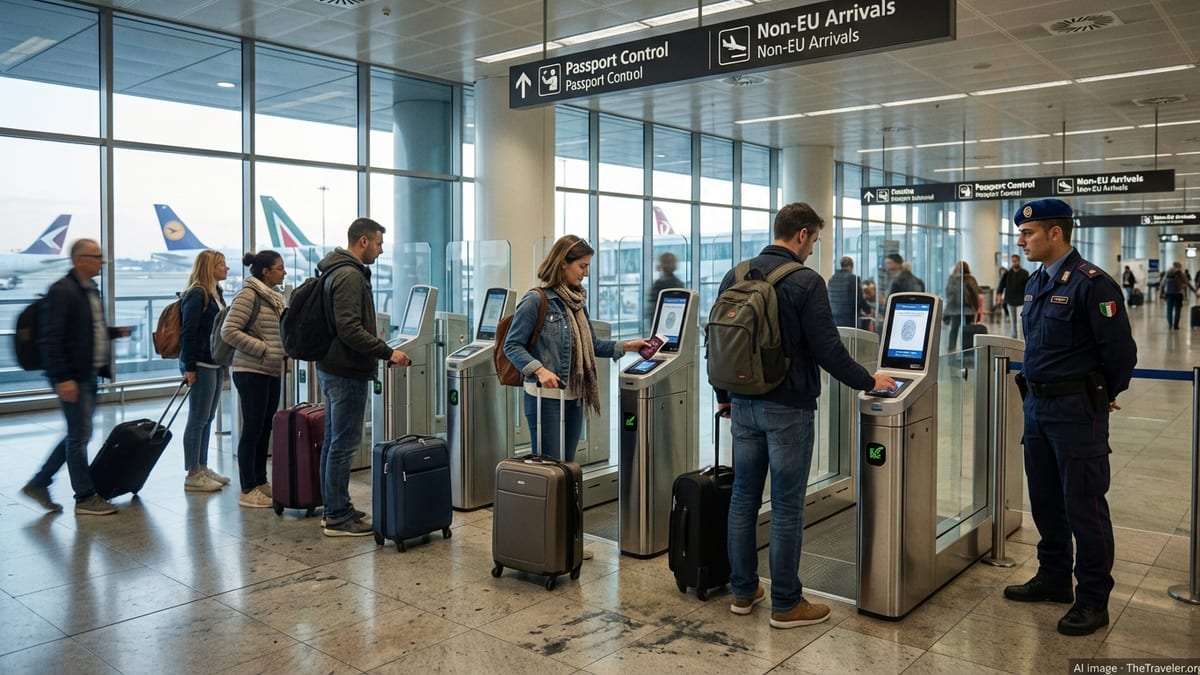
For most travellers, the biggest visible change will be the use of automated kiosks or gates that capture biometric data such as facial images and, in many cases, fingerprints on the first entry after EES goes live. At a typical Italian airport, you can expect to scan your passport, have your face photographed and, unless you are a young child, provide fingerprints. This initial enrolment can take a couple of minutes per person, and authorities have warned that queues may be longer during the transition period as both travellers and staff adapt. On later trips, once your data is in the system, crossings should be faster because the gate will simply verify your biometrics and match them with your digital record.
Alongside biometric capture, standard border checks continue to apply. Italian border police may ask about your travel purpose, length of stay, accommodation and financial means. It is wise to have documentation ready, such as hotel bookings, a return ticket, travel insurance and, if applicable, an invitation letter from a host in Italy. If you hold a visa, you should be prepared to explain how your plans fit the category of visa you received. Even with automation, decisions about admission are still made by officers who can refer you to secondary inspection if anything is unclear or inconsistent.
The EES gives Italian and other Schengen authorities a more precise tool for enforcing stay limits, especially the 90/180 rule. Instead of relying on manual stamps, the system automatically records each entry and exit and calculates time spent in the Schengen Area. This makes inadvertent overstays more visible and reduces the chance that they will be overlooked. As a result, travellers who have previously taken a relaxed approach to counting their days in Europe should be more cautious. Keeping your own records and understanding how digital tracking works will help ensure your Italian holiday does not turn into a border compliance problem on a future trip.
ETIAS: Upcoming Travel Authorisation for Visa-Exempt Visitors
Beyond passports, visas and EES, visa-exempt travellers to Italy need to be aware of ETIAS, the European Travel Information and Authorisation System. ETIAS is a forthcoming online travel authorisation that will be required for citizens of many countries who currently visit the Schengen Area, including Italy, without a visa for short stays. It is similar in concept to systems such as the United States ESTA. Travellers will complete an online application providing personal details, travel plans and security-related information, and most applications are expected to be processed quickly and automatically.
As of February 2026, ETIAS is not yet in force. Official EU timelines indicate that the system is expected to start operating in the last quarter of 2026, once the Entry/Exit System is fully implemented and stable. When ETIAS launches, there will be a transition period during which travellers can apply for authorisation but are not yet refused boarding solely for not having it, provided they meet other entry conditions. Current planning suggests that ETIAS will become mandatory some months after launch, likely in 2027, but exact enforcement dates and grace-period details can still change. Travellers considering trips from late 2026 onward should monitor official announcements as their departure date approaches.
Once ETIAS becomes mandatory, eligible travellers will need to apply online, pay a modest fee and receive digital approval linked to their passport before boarding a flight, ship or coach to Italy or any other participating country. The authorisation is expected to be valid for several years, as long as the associated passport remains valid, and to allow multiple short stays of up to 90 days in any 180-day period. Importantly, ETIAS is not a visa and does not change the underlying stay limits or permitted activities. It is an additional pre-screening requirement layered on top of existing rules for visa-exempt visitors.
Because implementation details can evolve, especially around precise launch and enforcement dates, travellers should treat all ETIAS information as subject to update. Unofficial websites that claim to already process ETIAS applications should be approached with caution, particularly if they charge high service fees or request unusual personal data. For the most accurate and current information, it is advisable to consult official EU and national government sources close to your travel date to Italy. Building some lead time into your planning will allow you to complete any required authorisations without disrupting your trip.
Health Measures and Travel Insurance Considerations
Italy, like other Schengen states, no longer maintains the emergency-style Covid-19 entry restrictions that characterised international travel in earlier years of the decade. As of early 2026, visitors are generally not required to present vaccination certificates, negative tests or proof of recovery specifically for Covid-19 to enter Italy, although these policies can change if public health conditions warrant. Health questions remain a normal part of broader immigration and carrier screening, and airlines or cruise operators can sometimes impose their own conditions of carriage that go beyond minimum government requirements.
Even without specific health certificates, travellers to Italy should pay attention to recommended vaccinations and routine health precautions issued by their home country’s health authorities. Italy’s healthcare system is modern and widely accessible, but non-residents can face significant costs for treatment, especially in private facilities or for emergency care. For this reason, Schengen guidance and many consulates strongly encourage visitors to hold comprehensive travel medical insurance covering the entire duration of their stay, with sufficient limits to cover hospital care, repatriation and unexpected delays.
For those applying for a short-stay Schengen visa to visit Italy, travel medical insurance that meets defined minimum standards is usually mandatory. The policy must cover at least the full planned period in the Schengen Area and provide coverage for emergency medical expenses and repatriation. Consulates frequently request proof of such insurance as part of the visa application file, and applicants should ensure that their policy documents clearly state the coverage area and dates. Visa-exempt travellers are not typically asked to present insurance at the border, but Italian authorities still recommend it as a prudent safeguard.
In addition to medical coverage, broader travel insurance can help manage common risks such as trip cancellation, baggage loss or travel disruptions linked to strikes, weather events or technical issues. Although not an entry requirement, these protections can make a meaningful difference if your Italian itinerary is affected by factors beyond your control. Reading policy terms carefully, paying attention to exclusions and documenting bookings and expenses will make it easier to claim benefits if something goes wrong during your journey.
Practical Tips to Stay Compliant With Italian and Schengen Rules
Navigating Italy’s entry requirements and Schengen regulations becomes much easier if you adopt a few practical habits. Start by confirming your personal situation well before travel: check whether your passport meets validity requirements, whether your nationality is visa-exempt for short stays, and whether your planned activities fit within what is allowed for a tourist or business visitor. If you need a visa or long-stay permit, begin the application process early, as appointments and processing can take weeks or even months during busy seasons.
Once you are in Italy, keep careful track of your days in the Schengen Area, especially if you plan multiple trips in a year or intend to combine Italy with other European destinations. Use the official Schengen short-stay calculator or a similar tool to model your dates and ensure you remain within the 90/180-day limit. Remember that days are counted by calendar days, not nights, and that every day you are physically present in any Schengen country counts toward your total, including the day of arrival and day of departure.
At the border, having your documentation organised and easily accessible will speed up checks. Keep your passport, boarding pass, accommodation confirmations, return or onward ticket, evidence of funds and travel insurance details together in a single folder or digital wallet. Answer questions from Italian border officers clearly and honestly, and be prepared for additional screening if your travel pattern or documentation raises questions. With the rollout of EES, allow extra time at arrival in Italy, particularly if you are a first-time visitor after the system becomes fully operational.
Finally, stay informed. Entry rules can evolve, especially around implementation of ETIAS and any future changes to health measures. Before each trip to Italy, even if you visit frequently, take a moment to consult up-to-date information from official Italian and EU sources relevant to your nationality. Doing so will reduce uncertainty, minimise the risk of unpleasant surprises and allow you to focus on the real purpose of your journey, whether that is admiring Renaissance art, exploring coastal villages or meeting business partners in Italy’s major cities.
The Takeaway
Travel to Italy in 2026 sits at a crossroads between familiar Schengen rules and a new era of digital border management. Core principles such as the 90/180-day rule, passport validity requirements and the distinction between short-stay visits and long-term residence remain firmly in place. At the same time, systems such as the Entry/Exit System and the forthcoming ETIAS authorisation are reshaping how those rules are applied in practice, adding layers of automation and pre-screening that affect the traveller’s experience long before setting foot on Italian soil.
For most visitors, especially those coming for a classic holiday or short business trip, complying with Italy’s entry requirements still comes down to a few fundamentals: a valid passport, clarity about whether you need a visa, respect for time limits and honest, well-documented answers at the border. Digital tools will increasingly do the counting and verification in the background, but personal responsibility remains central. By approaching your trip with awareness rather than anxiety, you can navigate these evolving systems confidently.
Looking ahead, the most significant near-term change for many travellers will be the introduction of ETIAS. While not yet required as of early 2026, it is on the horizon and will eventually become an essential step for visa-exempt visitors heading to Italy and other Schengen countries. Planning for that shift now, and building flexibility into your travel preparations, will put you in a stronger position when new rules finally take effect.
In the meantime, Italy remains as accessible and rewarding as ever for those who take the time to understand the framework that governs entry. With a bit of preparation and attention to detail, Schengen rules need not be an obstacle. Instead, they can become a quietly efficient backdrop to your Italian journey, allowing you to move smoothly from airport arrivals to the experiences that truly matter.
FAQ
Q1. Do I need a visa to visit Italy for a short holiday?
For many nationalities, including citizens of countries such as the United States, Canada, Australia, Japan and the United Kingdom, a visa is not required for short tourist or business visits to Italy of up to 90 days in any 180-day period. However, travellers from countries that are not visa-exempt must obtain a short-stay Schengen visa before departure.
Q2. How does the 90/180-day Schengen rule work for stays in Italy?
The 90/180-day rule means you can spend a total of up to 90 days in the entire Schengen Area, including Italy, during any rolling 180-day period. To check compliance, you look back 180 days from each day of your planned stay and count all the days you have already spent in Schengen. If that total is under 90, you still have days available.
Q3. What passport validity do I need to enter Italy?
Your passport must have been issued within the last ten years and be valid for at least three months beyond the date you plan to leave the Schengen Area. In practice, travelling with at least six months of remaining validity is widely recommended to avoid issues with carriers or border officials.
Q4. What is the Entry/Exit System and how will it affect my arrival in Italy?
The Entry/Exit System is a new EU-wide digital border system that records the entry and exit of non-EU travellers and replaces manual passport stamping. On your first entry after it becomes fully operational, you can expect to provide biometric data, such as facial images and fingerprints, at a kiosk or automated gate in addition to standard document checks.
Q5. Is ETIAS already required to travel to Italy?
No. As of February 2026, ETIAS is not yet required for travel to Italy or other Schengen countries. The system is expected to launch in the last quarter of 2026, with a transition period before it becomes mandatory. Travellers should follow official updates as their trip date approaches.
Q6. Will ETIAS replace a visa for travel to Italy?
No. ETIAS is not a visa and will not replace visas. It will be an additional travel authorisation for citizens of visa-exempt countries who make short visits to Italy and other participating states. Travellers who already need a Schengen visa will continue to apply for visas through consulates.
Q7. Do I still need travel insurance to enter Italy?
Travel insurance is strongly recommended for all visitors and is mandatory for most travellers who require a short-stay Schengen visa. While visa-exempt travellers are not usually asked for insurance at the border, having coverage for medical emergencies, hospitalisation and repatriation is considered prudent.
Q8. What happens if I overstay in Italy or the Schengen Area?
Overstaying even by a short period can lead to consequences such as fines, formal records of infringement, difficulties at future border crossings and, in more serious cases, bans on returning to the Schengen Area for a specified period. With the Entry/Exit System, such overstays are more likely to be detected.
Q9. Can I work or study in Italy on a short tourist stay?
Short-stay rules and visa waivers are primarily designed for tourism and limited business activities. Paid work or longer-term study in Italy normally requires an appropriate national visa or residence permit issued by Italian authorities. Engaging in activities beyond what your status allows can create legal and immigration problems.
Q10. Where should I check for the latest entry rules before my trip?
The most reliable information comes from official Italian government sources, such as the Ministry of Foreign Affairs and Italian embassies or consulates, along with official European Union guidance on Schengen rules, the Entry/Exit System and ETIAS. Because regulations and timelines can change, you should always verify details close to your departure date.