

More news on this day
Italy’s two busiest air hubs, Rome Fiumicino and Milan Malpensa, were hit by significant disruption as 271 flight delays and 15 cancellations created fresh chaos for holidaymakers and business travelers across Europe.
Get the latest news straight to your inbox!
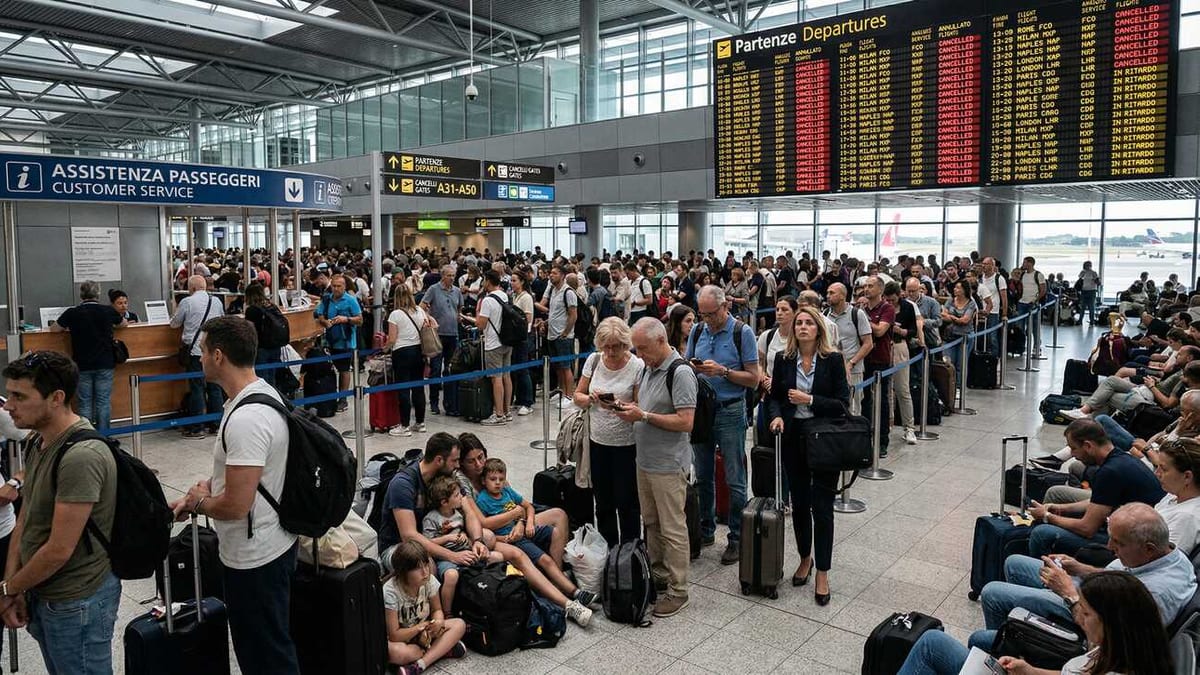
Rome and Milan Face Heavy Operational Disruption
Published data from aviation monitoring services and industry-focused outlets shows that Rome Fiumicino and Milan Malpensa have emerged as some of the most heavily disrupted airports in Europe, with a combined 271 delayed flights and 15 cancellations over a short operational window. The figures highlight how even a limited number of outright cancellations can translate into far wider disruption once knock-on delays and missed connections are taken into account.
Reports indicate that the worst of the problems have centered on key departure and arrival banks at both airports, when dense clusters of flights are scheduled within tight time frames. As aircraft and crews circulate between Rome, Milan and other major European hubs such as London, Paris, Amsterdam and Madrid, delays in Italy have fed directly into congestion elsewhere, compounding the overall impact.
The disruption has affected a mix of domestic and international services. Short-haul routes linking Rome and Milan with other Italian cities and nearby European destinations were particularly exposed to schedule slippage, while long-haul connections to North America and Asia have faced pressure from missed inbound connections and late-arriving aircraft.
Travel-focused coverage indicates that some airlines adjusted their schedules in real time, holding departures to wait for connecting passengers and crews where possible. While such measures help limit the number of travelers stranded overnight, they also add to departure backlogs and contribute to the elevated delay count observed at both airports.
Airlines and Routes Most Affected
Publicly available disruption tallies suggest that the impact has been spread across both national and foreign carriers operating at Rome Fiumicino and Milan Malpensa. Italy’s flag carrier ITA Airways features prominently in the schedules at both hubs, meaning its network has been especially exposed to cascading delays when aircraft and crew rotations are interrupted.
Major European and transatlantic airlines operating into the Italian hubs, including large network carriers and low cost operators, have also faced timetable pressure. Reports indicate that flights linking Rome and Milan to London and Paris have seen heavier-than-usual delays as those routes sit at the heart of dense European connection flows. Services to and from other major hubs, such as Amsterdam and Madrid, have likewise been affected when aircraft arriving late from Italy force airlines to reshuffle subsequent rotations.
For passengers, the disruption has been felt in missed onward connections, rebookings onto later flights and, in some cases, involuntary overnight stays near the airports. Travel industry sources note that congestion at customer service desks and slow re-accommodation processes can amplify frustration, particularly when multiple airlines experience issues at once and compete for remaining seats on later departures.
Industry analysts point out that Rome and Milan already handle substantial volumes of connecting traffic, not only within Italy but also between Europe and long-haul destinations. The combination of tight aircraft utilization, high load factors and limited slack in schedules means that even modest irregularities can cascade into larger operational challenges, as seen in the latest wave of delays.
Structural Strains on Italy’s Major Hubs
Beyond the immediate disruption, recent punctuality reports and academic analysis highlight longer-running structural pressure on Italy’s major airports. Studies tracking average delay minutes at Rome Fiumicino and Milan Malpensa over recent years show a gradual upward trend, reflecting both growth in demand and constraints in airspace and ground infrastructure.
European punctuality assessments for 2024 and 2025 point to a decline in on-time performance at several large airports, including Rome and Milan, as traffic has rebounded and in some cases exceeded pre-pandemic levels. Weather events, capacity limits, and en route air traffic management restrictions across central European airspace all contribute to periodic bottlenecks that have a direct knock-on effect on Italian hubs.
Operational specialists note that high-density morning and evening banks at hub airports are inherently vulnerable. When thunderstorm cells, low visibility or upstream airspace restrictions arise during these peaks, airport flow rates must be reduced and departure slots spread out, which in turn pushes back arrival times for later waves of flights. Once rotations are disrupted, airlines can take several cycles to restore balance to their fleets.
Rome and Milan have also been affected by broader European challenges, including staff shortages in certain ground-handling and air traffic control functions in recent seasons. While recent hiring has eased some pressure, the margin for absorbing unexpected events remains narrow, raising the likelihood that localized incidents will prompt disproportionate disruption.
Knock-on Effects Across Europe’s Flight Network
The latest disruption in Italy has not occurred in isolation. Travel monitoring services and consumer-rights organizations have documented a series of high-impact days across Europe in recent months, with several thousand delays and hundreds of cancellations recorded on individual days when multiple hubs were affected at once. In that context, Rome and Milan have acted both as sources and recipients of network strain.
When flights from Italy depart late for major European hubs, the problems can quickly spread as arriving aircraft are used to operate onward legs. A delayed Rome or Milan departure arriving into London, Amsterdam or Copenhagen in the late afternoon, for example, may compress turnaround times and lead to delays on evening departures that return to Italy or continue onward to other destinations.
Conversely, disruptions that begin elsewhere in Europe can reverberate into Italian airports as late inbound flights force last-minute gate changes, rapid turnarounds or even rotation swaps at Fiumicino and Malpensa. Published disruption maps for recent days show simultaneous pressure points across Scandinavia, the United Kingdom, the Netherlands and southern Europe, creating a web of interrelated schedule issues.
For airline planners, this environment has renewed debate about how much slack to build into schedules and how to balance high aircraft utilization with improved resilience. While adding buffer time can reduce the risk of cascading delays, it also carries cost implications and may limit capacity at already busy airports.
What Passengers Should Expect and How to Prepare
Consumer advocacy groups and travel advisories responding to the latest wave of Italian disruption emphasize that passengers should anticipate further periods of irregular operations at Rome and Milan, particularly on busy travel days and during peak holiday periods. Even if no single cause such as a strike or severe storm is present, the combination of high demand and tight scheduling can produce clusters of delays similar to the 271-flight backlog recently observed.
Guidance circulating in the travel sector encourages passengers to monitor flight status closely from 24 hours before departure, check in early and consider the risks of tight connections, especially when itineraries pass through multiple congested hubs. Building in longer layovers and avoiding last departures of the day where possible can provide a margin of safety if earlier flights slip behind schedule.
Travel information services also underscore the importance of understanding passenger rights under European rules. For flights departing from Italy or operated by European carriers, long delays and cancellations may entitle travelers to assistance, rerouting and, in some circumstances, financial compensation, depending on the cause of the disruption and the length of the delay.
For now, the latest figures from Rome and Milan serve as another reminder of how quickly operational challenges can escalate in Europe’s crowded skies. With schedules already tightly packed and demand for Italy remaining strong, both airports are likely to stay under scrutiny from passengers watching for any renewed signs of flight chaos.