

Renewing a residence permit in Italy is not a routine administrative formality. For foreign residents, the renewal phase is often the riskiest point in their legal stay, with potential consequences that range from temporary travel restrictions to loss of residency status. Anyone evaluating a move to Italy should understand how renewal works in practice, which situations commonly lead to problems, and what structural risks exist in the Italian system.
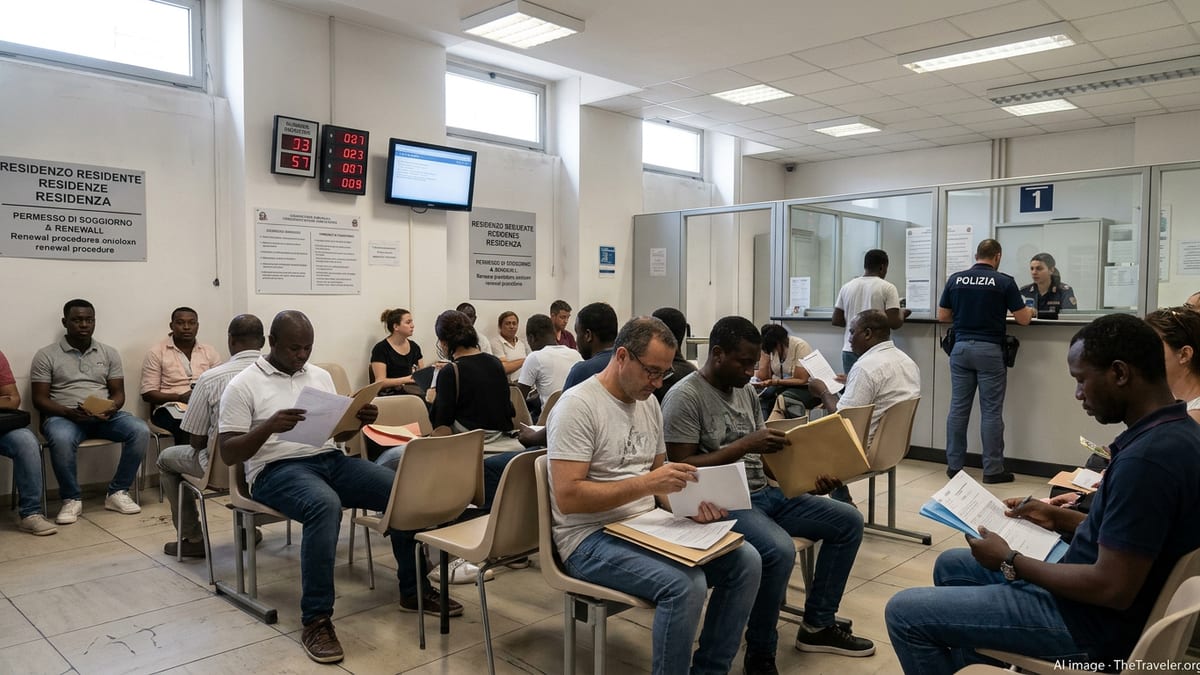
Overview of Italy’s Residence Permit Renewal Framework
Italian law requires most non-EU foreign residents to hold a valid residence permit (permesso di soggiorno) and to renew it periodically if they wish to remain in the country. The legal basis sits primarily in Legislative Decree 286/1998 (the Consolidated Immigration Act) and its implementing regulations, which establish that renewal must be requested before expiry and that a permit can be refused if the underlying conditions for residence are no longer met.
In practice, renewal is handled by the local police headquarters (Questura), often preceded by an application submitted through designated post offices. Different permit types (work, family, study, elective residence, etc.) carry different validity periods, but the renewal risk patterns are broadly similar. Key risk factors include missed deadlines, incomplete documentation, income or employment changes, long absences from Italy, and administrative delays at the Questura.
Italy’s system gives local immigration offices considerable discretion in assessing whether the conditions for residence continue to exist. This discretion, combined with uneven processing capacity across provinces, means experiences can vary considerably between cities. For relocation planning, it is therefore important to evaluate not only the formal rules but also the operational realities of renewal.
While many renewals are approved without incident, the potential downside of errors or adverse decisions is significant: an applicant may fall into irregular status, lose the path to long-term residency, or face difficulties re-entering Italy or moving within the Schengen Area. Understanding these risks is central to any decision about establishing long-term residence in Italy.
Deadlines, Grace Periods, and the Risk of Irregular Status
One of the most critical renewal risks is timing. Official guidance generally indicates that renewal should be requested before the permit expires, often between 60 and 90 days before the expiry date, depending on permit duration. For many categories, renewal is recommended at least 60 days prior to expiry; some guidance suggests up to 90 days before expiry for longer permits. Applying late can significantly increase risk.
Italian practice recognizes a limited grace period. If a permit has expired for more than approximately 60 days and no renewal request has been filed, the foreign national is typically considered an irregular migrant. At that point, the individual may face difficulties renewing the permit from within Italy and may instead be directed to leave and apply for a new visa from abroad. This threshold is not only a legal cutoff but also a practical tipping point at which it becomes harder to regularize status.
Short delays within the general renewal window do not always result in automatic refusal, particularly if there are documented reasons, but they can trigger closer scrutiny. Applicants who routinely leave renewal to the last weeks before expiry increase their exposure to errors, postal delays, or appointment backlogs that can push submission beyond acceptable time limits.
For relocation planning, this means that living in Italy requires sustained administrative discipline. Individuals who travel frequently, have complex personal circumstances, or are likely to be outside Italy for extended periods around the time of renewal face a higher risk of inadvertently falling outside the permitted time frame.
Documentation, Economic Requirements, and Substantive Refusal Risks
Another major risk category concerns the substantive conditions that must continue to be met at renewal. Italian immigration rules require that the same basic requirements that justified the original permit still exist at the time of renewal, unless the law explicitly allows a change of status. If these conditions lapse, the Questura can refuse renewal.
Common risk areas include income and employment for work-based permits, sufficient resources and health coverage for elective residence, and continued enrolment and academic progress for student permits. Where minimum income thresholds or contract types are prescribed, even relatively small changes in working hours, contract renewals, or employer changes can raise questions about eligibility. Applicants may be required to demonstrate stable, lawful income at or above certain indicative thresholds, along with compliant tax and social security records.
Family-based permits carry different risks. For example, separation, divorce, or the breakdown of cohabitation that originally justified family reunification may prompt the authorities to re-evaluate the right to stay, although in some cases continued independent residence is possible under alternative provisions. For long-term planning, households built on a single sponsoring resident should be aware that changes in family structure can affect dependent family members’ right to renew.
Incomplete or inconsistent documentation also carries risk. Missing employment records, unclear proof of accommodation, gaps in health insurance, or discrepancies between residence registration and actual living arrangements can delay or undermine a renewal application. For those considering relocation, it is important to recognize that renewal decisions are evidence-based, and maintaining orderly documentation over the full permit period is essential to reduce the chance of refusal.
Absences from Italy, Travel Constraints, and Mobility Risks
Italian rules limit how long a resident can be absent from the country without jeopardizing renewal prospects. As a general guide, a residence permit may not be renewed if the holder’s stay in Italy has been interrupted by a continuous absence of more than six months, or for a period exceeding half the validity of the permit, except for specific reasons such as military service or serious documented circumstances. For shorter permits, this “half of validity” rule can translate into relatively short permissible periods abroad.
These limitations create particular risk for mobile professionals, digital nomads, or retirees who intend to divide their time between Italy and other countries. If the authorities determine that Italy is no longer the applicant’s primary place of residence, renewal may be questioned, especially for categories such as elective residence that explicitly require the holder to live in Italy most of the time.
Travel during the renewal process introduces additional practical risks. Once a renewal application is filed, the applicant normally stays legally in Italy on the basis of a receipt (cedolino or receipt from the post office or Questura) until the new card is issued. However, this receipt is not always accepted as a valid travel document by foreign border authorities. In many cases, travel is effectively limited to direct journeys between Italy and the holder’s country of nationality, carrying the expired permit and the renewal receipt together with a valid passport.
For those who expect frequent travel within the Schengen Area or beyond, this restriction can significantly affect professional and personal mobility. Long processing times, described below, can extend this constrained travel period from a few months to more than a year in some jurisdictions, which is a non-trivial relocation risk for frequent travelers.
Processing Times, Local Backlogs, and Uncertainty
Although national legislation sets indicative deadlines for the issue, renewal, and conversion of residence permits, practical experience shows that processing times can be highly variable. Some guidance references a target of around 60 days for issuing or renewing a permit after submission. In reality, local Questura offices in larger cities frequently exceed these targets, leading to months-long or even year-long wait times, particularly during periods of high application volume.
Recent anecdotal reports from various Italian cities suggest that it is not unusual for residents to wait six to twelve months between filing a renewal application and receiving the new electronic card. In some reported cases, the interval has extended beyond a year, with applicants remaining in a prolonged “in process” status. Delays can occur both before the fingerprinting (biometric) appointment and after biometrics are taken.
These extended processing times introduce several risks. First, applicants must rely on the renewal receipt for daily life, which can complicate interactions with employers, landlords, banks, and service providers unfamiliar with the receipt’s legal value. Second, long periods in pending status can create uncertainty about long-term plans, such as job changes, property purchases, or family reunification. Third, if the Questura ultimately identifies a problem late in the process, the individual may have invested significant time and resources in Italy before discovering that renewal will be refused.
For prospective movers, the key implication is that Italy’s residency framework may offer less procedural predictability than some other European jurisdictions. Those whose professional or personal plans cannot accommodate long periods of administrative uncertainty should factor this element heavily into their relocation decision.
Impacts on Work, Services, and Long-Term Status
Renewal risks extend beyond simple legality of stay. They also affect employment continuity, access to services, and progression to more secure residency statuses. Typically, a foreign resident who has filed a timely renewal application can continue working while waiting for the new card, provided the employer accepts the renewal receipt as proof that the right to work continues. However, not all employers are familiar with this practice, and human resources departments may be cautious when documentation appears irregular or expired.
There is also an impact on access to public and private services. Banks, mobile phone operators, leasing companies, and public offices often request a valid residence permit card for transactions or contract renewals. While some accept the renewal receipt combined with the expired permit, others may delay or refuse services, citing internal compliance requirements. This can create practical obstacles in everyday life that are not immediately visible when first securing a visa or initial permit.
From a long-term perspective, renewal issues can jeopardize the path to an EU long-term residence permit, which typically requires about five years of continuous legal residence with stable income, adequate accommodation, and integration measures. Interruptions in legal status, long absences from Italy, or repeated short-term permits with gaps between them can delay or block eligibility. For individuals whose relocation strategy is built around eventually achieving a more secure or long-term status in the European Union, renewal-related breaks in continuity are a critical risk.
In addition, certain permit categories are assessed more strictly for long-term conversion. For example, residents on student permits may have their years counted only partially toward long-term status, while periods on short-term or precarious permits may not count at all. Any refusal or revocation for non-compliance at renewal can reset the clock, forcing the resident to restart the qualifying period from zero.
Risk Management Considerations for Prospective Relocators
Although Italian residence permit renewal carries clear structural risks, these can be partially mitigated with forward planning and realistic expectations. From a risk management standpoint, prospective residents should consider several practical strategies at the evaluation stage rather than after arrival.
First, any long-term relocation plan to Italy should include a calendar-based compliance strategy. This typically means planning to start the renewal process two to three months before the earliest allowed date, maintaining updated documentation in a dedicated file, and avoiding extended absences from Italy during the months surrounding renewal. Those who anticipate heavy travel or temporary relocation elsewhere may need to adjust timelines or reconsider whether Italy is the right primary residence base.
Second, prospective movers should assess their tolerance for administrative uncertainty. In regions with known backlogs, residents may spend significant portions of their time in “pending renewal” status. Individuals with sensitive professional roles, strict employer documentation requirements, or frequent cross-border mobility needs may find this environment challenging compared to countries with more predictable processing times.
Third, foreign residents should be aware that many disputes and complex scenarios are ultimately resolved through legal assistance or detailed engagement with the Questura. While specialist support can often rescue difficult situations, it carries its own costs and time implications. For some household profiles, these latent costs and risks meaningfully change the overall attractiveness of Italy as a relocation destination.
The Takeaway
Italy offers diverse residence options, but the renewal phase is structurally one of the most fragile points in a foreign resident’s lifecycle. The key risks arise from strict timing requirements, substantive reassessment of income and other eligibility criteria, limits on time spent outside Italy, lengthy and unpredictable processing times, and knock-on effects on employment, services, and long-term status.
For individuals evaluating whether to move to Italy, these renewal dynamics should be treated as core decision factors rather than administrative details. Prospective residents who can maintain stable documentation, plan travel around renewal windows, and tolerate periods of procedural uncertainty may find the risks manageable. Those whose work or personal circumstances require high mobility, predictable timelines, and minimal bureaucratic friction should carefully weigh whether Italy’s residency renewal environment aligns with their risk profile and long-term objectives.
FAQ
Q1. How early should a residence permit renewal be submitted in Italy?
For many permits, renewal is generally recommended 60 days before expiry, and some guidance allows up to about 90 days in advance for longer permits. Submitting within this window reduces the risk of timing-related complications.
Q2. What happens if a residence permit expires and renewal is not requested within 60 days?
If more than roughly 60 days pass after expiry without a renewal request, the foreign resident is usually treated as irregular, which can make it much harder to recover status and may require leaving Italy to start a new visa process.
Q3. Can someone keep working in Italy while their residence permit renewal is pending?
In many cases, if renewal was requested on time, the combination of the expired permit and the official renewal receipt allows the person to continue working, although recognition of this right can vary by employer and local practice.
Q4. Are long absences from Italy a risk for residence permit renewal?
Yes. As a general rule, continuous absences longer than about six months, or more than half the permit’s validity period, can jeopardize renewal unless there are specific justified reasons, such as military service or serious documented circumstances.
Q5. How long does it typically take to receive a renewed residence permit card?
Officially, issuance within roughly 60 days is a reference target, but in practice waiting times of several months are common in many cities, and in some reported cases the process has taken close to or more than one year.
Q6. Can a foreign resident travel within the Schengen Area while their permit renewal is in progress?
Travel during renewal is risky. The renewal receipt is primarily recognized in Italy, and some guidance suggests limiting travel to direct trips between Italy and the person’s home country while the new permit is pending.
Q7. What are common reasons for refusal of a residence permit renewal?
Frequent reasons include insufficient or unstable income, loss of the job or family relationship that justified the permit, excessive time spent outside Italy, missed renewal deadlines, or incomplete or inconsistent documentation.
Q8. How do renewal problems affect the path to long-term EU residency?
Interruptions in legal status, lengthy absences from Italy, or refusals at renewal can break the continuity of residence required for long-term EU permits, potentially resetting the qualifying period and delaying more secure status.
Q9. Do renewal risks differ between large cities and smaller towns?
Yes. While the legal framework is national, processing times and administrative practices vary by Questura. Larger cities often report heavier backlogs, which can increase uncertainty and extend waiting periods for renewed permits.
Q10. Should renewal risks influence a decision to relocate to Italy?
Renewal risks should be a significant consideration. Individuals who can manage strict timelines, maintain strong documentation, and tolerate administrative uncertainty may accept these risks, while others may find them a decisive factor against choosing Italy as a primary base.