

More news on this day
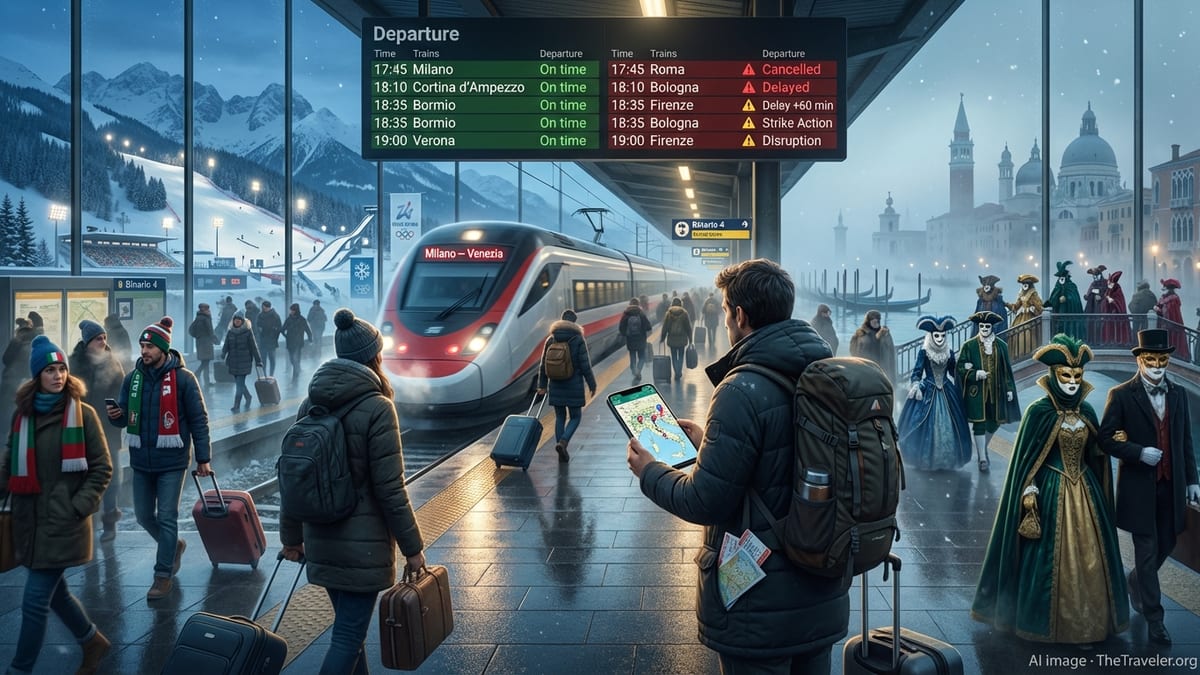
Italy in February 2026 will be one of the most closely watched destinations on the planet, as the Venice Carnival, the Milan Cortina Winter Olympics and a rolling calendar of transport strikes all converge on the same short winter window.
For travelers, it means extraordinary cultural and sporting experiences, but also the need to navigate disruptions on the ground.
More News
- TSA Rolls Out $45 ConfirmID Fee for Travelers Without REAL ID at Security
- Flying Blue Launches February 25% Promo Rewards on Transatlantic and Regional Routes
- United Fast-Tracks Starlink Wi‑Fi Across Fleet, Free for MileagePlus Members
February 2026: A High-Stakes Month for Travel to Italy
February is traditionally a quieter month for Italian tourism outside ski resorts and Venice Carnival, but 2026 is a major exception. The Winter Olympic Games will run from February 6 to 22 across Milan, Cortina d’Ampezzo and several alpine venues, drawing tens of thousands of athletes, staff, media and spectators. This extra pressure comes on top of Carnival visitors in Venice and the usual domestic travel flows around school breaks and winter holidays.
Italy’s transport sector has also been marked by periodic strikes in recent years, often announced with limited notice and sometimes scheduled on Fridays or Mondays to maximize impact. Rail workers, airport ground staff, air traffic controllers and local public transport employees have all staged industrial action over pay, staffing and safety conditions. While exact dates in February 2026 can shift as unions and authorities negotiate, the underlying pattern means visitors should expect at least some risk of disruption during the month.
As a result, travelers heading to Italy in February 2026 will be moving through an unusually crowded and sometimes unpredictable landscape. Planning buffer time, booking key connections early and keeping flexible back-up plans will be as important as reserving hotel rooms and event tickets.
Winter Olympics 2026: What Visitors Need to Know
The Milan Cortina 2026 Winter Olympics will officially take place from February 6 to 22, turning northern Italy into a global sports stage. The Games will feature 116 medal events across 16 disciplines, including alpine skiing, snowboarding, ice hockey, figure skating, speed skating, biathlon and the Olympic debut of ski mountaineering. Around 2,900 athletes from more than 90 countries are expected to compete, supported by thousands of officials, volunteers and media crews.
The competition is distributed across four main clusters. Milan hosts figure skating, short-track speed skating and some ice hockey games at large arenas in and around the city, while the venerable San Siro stadium is being transformed to serve as the Olympic Opening Ceremony venue. In the Valtellina area, Bormio will stage men’s alpine skiing, and Livigno will welcome snowboarding and freestyle skiing. Cortina d’Ampezzo, which last hosted the Winter Olympics in 1956, will see women’s alpine skiing on the famed Tofane slopes, curling at the Cortina Curling Olympic Stadium and sliding events at a rebuilt track. In Trentino’s Val di Fiemme, Predazzo and Tesero will host ski jumping, Nordic combined and cross-country skiing, with the closing ceremony for the Games scheduled in the historic Verona arena.
For visitors, this decentralized layout means that not all Olympic traffic is concentrated in one city. However, Milan and Venice will serve as key arrival gateways, and alpine roads and rail lines into the mountain clusters will be under intense pressure on peak days. Tickets for competition events and ceremonies are being sold through official channels with tiered pricing, and many of the most coveted finals are expected to sell out well in advance.
Getting Around: Transport Strikes and Infrastructure Pressure
Italy’s history of transport strikes adds a layer of uncertainty for February 2026 travelers. Trade unions representing rail workers, air traffic controllers, ground handling staff and local transit employees regularly call nationwide or sector-specific walkouts over pay conditions and staffing levels. In some instances, so-called “minimum services” are guaranteed by law at peak commuting times, but intercity and regional services can still be severely reduced or canceled. Aviation strikes can affect both departing and arriving flights, especially on short-haul European routes.
The approach of the Winter Olympics has prompted the government and transport authorities to emphasize continuity of service, with political pressure likely to mount against large-scale disruptions in early and mid-February. However, past experience suggests that even when major walkouts are scaled back or postponed, travelers may still face partial strikes affecting specific operators, short time windows or particular airports. Seasonal weather risks such as snow and strong winds in the Alps can compound these challenges, leading to cascading delays on busy travel days.
Rail travelers heading toward Milan and the alpine clusters should anticipate crowded trains, especially on weekends and around key competition dates. Advance reservations on high-speed services will be essential, and regional trains into smaller mountain towns will be in high demand. Buses laid on by Olympic organizers are expected to supplement local transport in some areas, but capacities are finite, and delays are likely if road conditions deteriorate. In cities, urban public transport networks may experience overload at peak times as fans, workers and residents all converge on central stations and venues.
Venice Carnival 2026: Celebrations amid Crowds and Controls
The Venice Carnival is one of Italy’s most iconic winter events, traditionally unfolding over roughly two weeks leading up to Shrove Tuesday. In 2026, Carnival celebrations are expected to peak in mid-February, overlapping almost exactly with the Winter Olympics. Visitors can expect the usual elaborate masks, costumed parades, canal-side performances and nighttime events in historic palaces and squares.
In recent years Venice has introduced a series of crowd-control measures to manage overtourism. Authorities have experimented with entrance fees for day-trippers, booking systems and limits on organized groups in the historic center. While final rules for February 2026 will likely be confirmed closer to the date, travelers should be prepared for some form of access management for the busiest days, particularly weekends and headline Carnival events like the opening parade and the traditional “Flight of the Angel” performance from the bell tower in St. Mark’s Square.
The city’s fragile lagoon environment and narrow streets mean that any interruption to waterbuses or regional rail services can quickly lead to bottlenecks. If transport strikes coincide with Carnival peaks, day visitors from mainland hubs such as Mestre and Padua could face long waits or reduced services. Overnight stays in Venice will remain expensive during Carnival, and many hotels and guesthouses will impose minimum-stay requirements. Those combining Venice with Olympic events in Milan or the Dolomites should factor in longer transfer times and potential disruptions on the corridor between the Veneto plains and Lombardy.
Balancing Venice Carnival and the Winter Games in One Trip
Despite the logistical complexity, February 2026 offers a rare chance to experience both Venice Carnival and the Winter Olympics on a single trip. The two hubs are separated by several hours of rail travel, with high-speed trains linking Venice and Milan and regional or long-distance services continuing onward toward the alpine clusters. For many travelers, the most practical pattern will be to anchor their stay in one area and make a shorter side trip to the other.
One likely strategy is to begin in Venice in the early phase of Carnival, then move west to Milan before the Opening Ceremony on February 6, using the city as a base for selected Olympic events. Another approach reverses the sequence, focusing first on key competitions in the Alps and Milan and then traveling to Venice for the final Carnival weekend and Shrove Tuesday in the second half of the month. In both cases, securing accommodation and major transport legs well in advance will be essential, as demand will spike in both destinations around the same dates.
Travelers should also consider the different atmospheres and weather conditions across the two experiences. Venice in February is often damp, chilly and foggy, with short days but an intense indoor cultural life of masked balls and performances. The alpine venues deliver classic winter conditions, with heavy snow possible and temperatures in the mountains well below freezing. Packing appropriately, allowing flexibility in day-by-day plans and building in rest days between high-intensity events can make the combined itinerary more enjoyable and less stressful.
Practical Travel Advice for February 2026 Visitors
Given the convergence of events, practical preparation will matter more than ever. For flights, travelers are advised to book into major hubs like Milan Malpensa, Milan Linate and Venice Marco Polo as early as possible and consider flexible or refundable fares where budgets allow. If potential strikes are announced for specific days, adjusting arrival or departure by 24 hours can sharply reduce the risk of missed connections. Allowing generous layover times for any onward rail journeys from the airport is equally important, particularly when heading to smaller mountain towns.
On the rail side, reservations on high-speed routes linking cities such as Rome, Milan, Venice and Turin will be a key safeguard. Travelers should register with their operators’ alert services or maintain access to up-to-date timetables through apps and station information boards. In the event of a strike or severe weather disruption, alternative plans might include long-distance buses, private transfers shared with other spectators, or reshuffling event days where tickets permit. In cities, walking or cycling short distances rather than relying entirely on public transport could help avoid congestion around major hubs.
Insurance policies that cover strike-related delays and cancellations, as well as winter weather disruptions, may prove worthwhile for many visitors. Accommodation near main transport nodes or within easy reach of competition venues can reduce the impact of last-minute schedule changes and lessen time spent in transit. With higher-than-usual crowds, travelers should also expect tighter security screenings and longer lines at major stations, arenas and public squares, adding another incentive to reach sites well ahead of scheduled start times.
Impact on Local Communities and Visitor Experience
For Italians living in the affected regions, February 2026 will bring both opportunity and strain. The influx of visitors for the Olympics and Carnival promises a boost for hotels, restaurants, bars, cultural institutions and small businesses, at a traditionally slow point in the tourism calendar. Many local workers are being recruited as volunteers or staff for the Games, and infrastructure investments around venues and transport nodes are expected to leave a long-term legacy.
At the same time, residents in Milan, Cortina, Venice and the surrounding areas will face higher living pressures during the month. Rising short-term rental prices, crowded public transport and more congested streets are likely to test patience. The strain may also feed into existing tensions around working conditions in the transport and hospitality sectors, indirectly influencing the likelihood and shape of further strike actions. Visitors who remain conscious of these local pressures and patient in dealing with crowds and service limitations may find a warmer welcome and smoother daily experience.
For many travelers, the memory of February 2026 in Italy is likely to be defined as much by the human atmosphere as by the spectacle itself. Packed trains full of fans in national colors, late-night celebrations in alpine villages, masked revelers crossing misty Venetian bridges and spontaneous moments of shared frustration or solidarity during delays will all contribute to a unique travel narrative. Those who arrive with realistic expectations and a measure of flexibility are best placed to enjoy the spectacle without being overwhelmed by its logistical side effects.
FAQ
Q1. When exactly are the Milan Cortina 2026 Winter Olympics taking place?
The Winter Olympics are scheduled from February 6 to February 22, 2026, with some training sessions and preliminary events beginning shortly before the official Opening Ceremony.
Q2. How will the Olympics affect travel to and within Italy in February 2026?
The Games will significantly increase demand for flights, trains, accommodation and local transport, particularly in northern Italy. Travelers should expect busier airports, crowded rail services and heavier traffic on alpine roads throughout the month.
Q3. Are transport strikes already scheduled in Italy for February 2026?
Specific strike dates typically become clear only closer to the time, as unions and authorities negotiate. However, given Italy’s pattern of periodic transport strikes, travelers should assume some risk of disruption and monitor official announcements as their travel dates approach.
Q4. When will Venice Carnival 2026 take place, and will it overlap with the Olympics?
While exact dates will be confirmed by local authorities, Venice Carnival traditionally runs over the two weeks leading up to Shrove Tuesday. In 2026, that period is expected to overlap closely with the February 6 to 22 Olympic window, creating an exceptionally busy time for travel.
Q5. Is it realistic to visit both Venice Carnival and the Winter Olympics on one trip?
Yes, it is realistic but requires careful planning. High-speed trains link Venice and Milan, and additional services connect Milan with the alpine venues. Travelers should build in extra time for transfers, secure key tickets well in advance and remain flexible in case of delays or strikes.
Q6. Will there be crowd-control measures or entrance limits in Venice during Carnival?
Venice has already experimented with day-tripper fees and access controls to manage overtourism. It is likely that some form of crowd management will be in place during Carnival 2026, especially on peak days, so visitors should be prepared to follow booking or reservation systems for entry to the historic center.
Q7. How should I plan my rail travel in Italy during February 2026?
Book high-speed and long-distance tickets as early as possible, choose reserved seats where available and register for operator alerts. Allow generous transfer times, especially when connecting from flights to trains, and have alternative routes or modes in mind in case of service disruptions.
Q8. What kind of weather can travelers expect at the Olympic venues and in Venice?
In the alpine areas, February usually brings full winter conditions with snow, ice and sub-zero temperatures, particularly at higher elevations. Venice and Milan tend to be cold and damp, with occasional fog and rain, so layered clothing, waterproof gear and sturdy footwear are advisable.
Q9. Will prices for accommodation and services be higher than usual?
Yes. The combination of the Olympics and Carnival during a single month is expected to push up prices, especially in and around Milan, Cortina and Venice. Early booking and flexibility in location, such as staying in nearby towns and commuting, can help contain costs.
Q10. What are the most important steps to reduce the impact of possible strikes on my trip?
Key steps include monitoring news from airlines and rail operators, choosing flexible or refundable tickets where budgets allow, avoiding tight same-day connections, and arranging travel insurance that covers strike-related delays or cancellations. Keeping an extra day in hand before time-critical events can be a valuable safeguard.