

More news on this day
Hundreds of travelers at Jacksonville International Airport (JAX) are facing mounting disruption today as 41 flights are delayed and 9 canceled, snarling connections on DD Airlines, Delta Air Lines, American Airlines, Southwest Airlines and other carriers and rippling across major domestic and international routes to cities including New York, Miami and London.
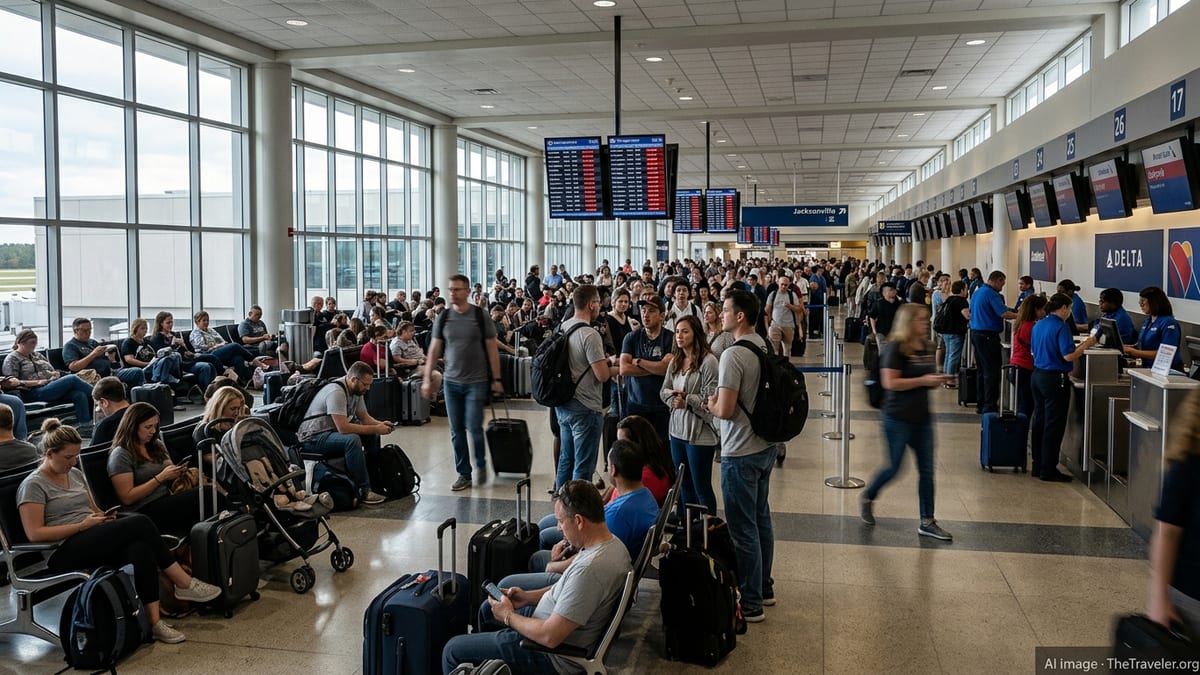
Operational Turmoil at Jacksonville International
Jacksonville International Airport, a key gateway for northeast Florida, has seen its departures and arrivals boards fill with yellow and red status alerts as delays stack up across the day. Airport monitors show rolling pushback times and gate changes, with some departures held for incoming aircraft and others slowed by ground congestion as carriers work through a compressed operating window.
Flight data indicate that 41 services into and out of JAX are currently delayed, with 9 canceled outright, affecting a mix of regional and mainline operations. While the numbers are modest compared with the largest US hubs, the concentration of disruption at a medium-sized airport means a significant share of passengers have limited rerouting options, increasing the likelihood of missed connections and extended layovers.
Airport staff report that many affected flights are operating with average delays of around an hour, though individual services have slipped by considerably more as congestion builds across the broader network. Travelers are being advised to remain near their gates, monitor airline apps closely and expect further schedule adjustments as the day progresses.
Carriers are adding customer service agents at key counters and deploying additional staff in the terminal to manage queues, but long lines are common around check-in, rebooking desks and baggage service offices as passengers seek alternatives.
Major US Airlines and Routes Hit Hard
The disruption is touching most of the major US carriers serving Jacksonville. Delta, American and Southwest are among the hardest hit, alongside DD Airlines, a growing presence in the regional market whose schedules rely heavily on tight turnarounds and onward connections through larger hubs.
Many of the delayed flights are those linking Jacksonville with major domestic connecting points such as Atlanta, Charlotte, Dallas Fort Worth and New York area airports. These routes typically act as the first leg for onward travel across the United States and to long haul destinations in Europe and Latin America, magnifying the impact of even relatively short delays at JAX.
American and Delta are using spare aircraft and crew where available to protect peak-time departures, but ongoing disruption at their hub airports is limiting flexibility. Southwest, which operates a point-to-point model, is contending with aircraft and crews arriving late from earlier segments in the network, forcing back-to-back delays at Jacksonville.
DD Airlines, which relies on a smaller fleet, has fewer options to swap equipment and has instead focused on consolidating lightly booked services and rebooking passengers on partner carriers where possible. That approach can reduce the number of outright cancellations but often leads to longer connection times and overnight stays for some travelers.
Ripple Effects to New York, Miami, London and Beyond
Although Jacksonville itself does not host the volume of long haul flying seen at the largest coastal gateways, today’s disruption is radiating across the broader network to high profile destinations. Passengers booked to New York are reporting missed connections at LaGuardia and John F. Kennedy airports, with some evening departures now oversold as airlines attempt to accommodate travelers from earlier canceled or heavily delayed flights.
Southbound traffic to Miami is also feeling the strain, particularly for travelers connecting onward to the Caribbean, Central America and South America. Late-arriving Jacksonville flights are colliding with already busy afternoon and evening departure banks, forcing Miami-based carriers to rework loads and, in some cases, leave travelers behind to avoid further knock-on delays downroute.
Further afield, passengers traveling to London and other European cities on one-stop itineraries via major US and Canadian hubs are increasingly at risk of misconnecting. With transatlantic departures often concentrated in narrow time bands around the early evening, a delay of even an hour or two on a Jacksonville feeder flight can mean a full day’s delay in reaching the final destination if later connections are unavailable.
Travel agents and airline call centers report elevated call volumes from customers concerned about making cruise departures, business meetings and time-sensitive events overseas. Many are being advised to accept immediate rebooking options, even if they involve additional stops or longer travel times, rather than waiting in the hope that original itineraries can be salvaged.
Weather, Congested Hubs and Tight Crews Fuel Disruption
The situation at Jacksonville is being compounded by broader strains across the US aviation system. Recent bouts of severe weather in key regions, along with persistent crew and aircraft positioning challenges at major hubs, have left airlines with limited spare capacity to absorb localized disruption. When even a handful of flights depart late from a hub, subsequent segments can cascade into delay chains that extend into smaller spokes such as JAX.
Industry analysts note that today’s issues come on the heels of an already difficult late winter and early spring period in which storms and high winds have repeatedly forced ground stops, diversions and schedule thinning at airports including New York, Chicago, Boston and Atlanta. Each such event leaves airlines working through residual imbalances in aircraft and crew allocation, making the system more fragile when fresh disruptions arise.
At Jacksonville, several flights are operating with inbound crews who have already approached or reached limits under federal duty time regulations. When these limits are reached, flights cannot operate until a rested crew becomes available, sometimes turning what begins as a short delay into an extended hold or cancellation, particularly late in the operating day.
Airlines say they are working in close coordination with air traffic control to manage flow into and out of constrained hubs and to prioritize flights that carry the largest numbers of onward connecting passengers. However, with busy weekend demand and high load factors, even modest schedule changes can leave some travelers without same day alternatives.
What Affected Travelers Can Do Now
For those currently stuck at Jacksonville International Airport or facing disruption on inbound flights, the most effective step is to engage with airlines across multiple channels simultaneously. Using airline mobile apps and websites to request alternative options while also joining customer service queues in the terminal can increase the odds of securing scarce seats on remaining flights.
Passengers are being advised to keep boarding passes, bag tags and receipts readily available, as these are often required for rebooking, baggage tracing and potential reimbursement of eligible expenses. Travelers who booked through online travel agencies or corporate travel programs may need to coordinate with both their airline and their booking platform to finalize changes.
Experts also recommend that travelers review airline policies on delays and cancellations, particularly around hotel vouchers, meal credits and complimentary changes. While obligations vary depending on the cause of the disruption and the carrier involved, many airlines will offer same day rebooking at no additional cost when flights are significantly delayed or canceled for reasons within their control.
Looking ahead, frequent flyers suggest building additional connection time into itineraries that route through busy hubs, especially during storm-prone seasons or holiday peaks. For those departing Jacksonville over the next 24 hours, checking flight status repeatedly before leaving for the airport, traveling with essential medications and a change of clothes in carry-on luggage, and maintaining flexible expectations may help ease the stress of what is shaping up to be another challenging day for air travel across the United States.