

More news on this day
The Sri Lankan government’s decision to accelerate the expansion of Jaffna International Airport is emerging as one of the most consequential infrastructure moves for the country’s Northern Province since the end of the civil conflict, promising to unlock new tourism flows, deepen economic ties with India and reposition Jaffna as a regional gateway rather than a remote frontier.
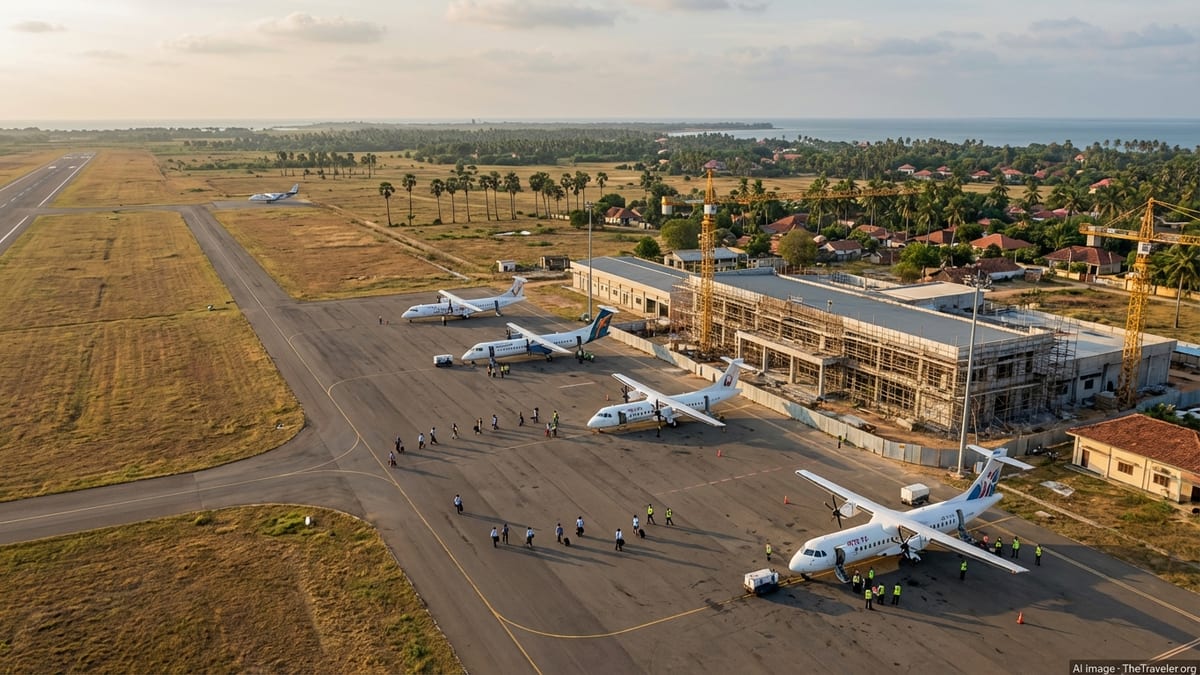
From Wartime Airfield to Emerging Regional Gateway
Located at Palaly, just north of Jaffna town, Jaffna International Airport has undergone a dramatic reinvention in recent years. Once a tightly controlled military air base at the heart of Sri Lanka’s civil war, the site was officially reopened for civilian international operations in October 2019, following a first round of runway extensions and terminal upgrades supported in part by India.
The initial phase enabled the airport to handle turboprop aircraft such as ATR 72s, restoring long-lost air links between Jaffna and cities in southern India. For local residents, many of whom have family, cultural and commercial ties across the Palk Strait, the reopening marked a profound psychological turning point, signalling that the region was finally reconnecting with the outside world on its own terms.
Since then, traffic through Jaffna International Airport has risen steadily. Airport and Aviation Services (Sri Lanka) Ltd reported that Jaffna recorded its strongest year yet in 2025, handling more than 53,000 international passenger movements and over 1,100 international aircraft movements as new scheduled and charter services came online.
This momentum has emboldened policymakers in Colombo to move ahead with an ambitious second phase of expansion, intended to transform the modest regional facility into a full-fledged international gateway capable of handling larger narrow-body jets and far greater passenger volumes.
New Terminal and Runway Works Signal Second Phase of Growth
In recent months, the government has begun to translate its plans for Jaffna into concrete infrastructure commitments. The foundation stone for a new passenger terminal building was laid in December 2025, in what officials described as a major milestone in a two-phase expansion programme valued at around 700 million Sri Lankan rupees.
The new terminal, expected to be completed within roughly two years, will significantly expand the airport’s passenger handling capacity and bring facilities closer to the standards seen at other international gateways in the country. Designs focus on streamlined check-in, improved security and baggage systems, and more comfortable waiting areas to support regular international services and growing charter traffic.
Alongside the terminal works, authorities are advancing plans to further extend and strengthen the runway. The current strip, which was lengthened during the 2019 reopening, is being evaluated for upgrades that would allow operations by larger narrow-body aircraft such as Airbus A320s. Civil aviation officials have stressed that these works will proceed on the basis of detailed feasibility studies and a phased business plan, mindful of past experience with underutilised infrastructure elsewhere.
While major wide-body operations are not on the immediate agenda, the ability to safely accommodate single-aisle jets is seen as crucial to attracting more regional carriers, opening new city pairs and ensuring that Jaffna can integrate seamlessly into South Asia’s dense network of short and medium haul routes.
Strengthening Air and Sea Links with India
The airport’s expansion cannot be viewed in isolation from a wider push to weave northern Sri Lanka more tightly into regional transport and trade corridors, particularly with India. Jaffna’s closest major markets and cultural counterparts lie just across the narrow Palk Strait, and India has emerged as Sri Lanka’s largest source of inbound tourists in recent years.
Air connectivity between Jaffna and southern India has grown steadily since 2019. Alliance Air, a subsidiary of Air India, pioneered scheduled flights between Chennai and Jaffna, later increasing frequencies in response to strong demand from pilgrims, business travellers and diaspora visitors. IndiGo, India’s largest low-cost carrier, has since joined the route, operating ATR 72-600 turboprop services and adding new links such as a direct Jaffna–Tiruchirappalli route.
These flights are being complemented by revived maritime connections. The Nagapattinam to Kankesanthurai ferry service, operating under an India–Sri Lanka maritime connectivity initiative, now provides an alternative route for tourists, traders and families moving between Tamil Nadu and the Northern Province. Officials on both sides see the air and sea connections as mutually reinforcing, deepening people-to-people ties as well as commercial exchanges.
For Jaffna International Airport, the growth in Indian traffic validates the logic of expansion. With improved terminal facilities and runway capacity, the airport will be better positioned to support additional Indian cities, seasonal charters and potential transit flows, creating a virtuous circle of connectivity and demand.
Tourism Boom Beckons for Northern Sri Lanka
The airport upgrades come at a time when Jaffna itself is gaining unprecedented international attention as a destination. In a symbolic boost, the region was recently highlighted by global travel media as one of the world’s top places to visit in 2026, praised for its distinctive Tamil culture, historic temples, colonial-era architecture and emerging food scene.
Industry stakeholders argue that easier access is the missing link needed to translate this rising profile into sustained visitor numbers. Currently, many foreign tourists reach Jaffna only after first flying into Colombo and undertaking a long overland journey by road or rail. Direct flights from South India have already shortened this journey dramatically for Indian travellers, while domestic air links from Colombo provide a quicker option for others.
With a larger terminal and enhanced runway, Jaffna International Airport could support more frequent services, additional charter operations from markets such as Malaysia and Singapore, and new domestic routes connecting to other regional airports. Local hoteliers point to a visible uptick in small guesthouses, boutique hotels and homestays in and around Jaffna town, as entrepreneurs respond to the prospect of sustained tourist inflows.
Tour operators are also expanding itineraries that combine Jaffna with the Northern islands, Mannar, Wilpattu and cultural sites further south, positioning the region as part of a broader circuit rather than a hard-to-reach outpost. The airport’s growing role is central to these plans, enabling shorter trips and weekend breaks that were previously impractical.
Economic Lifeline for a Once-Marginalised Region
Beyond tourism, policymakers and community leaders view the airport expansion as an economic lifeline for the Northern Province, which still bears the scars of three decades of conflict and subsequent underinvestment. Improved air connectivity is expected to stimulate trade, services and employment in a region where opportunities for young people have often been limited.
In recent years, growth in passenger traffic has already spurred a wave of investment in transport, logistics, hospitality and retail around the airport. Taxi cooperatives and shuttle services have multiplied, catering to arriving passengers, while small businesses ranging from restaurants to travel agencies have opened in Jaffna town and along the main access roads.
The planned terminal and runway upgrades are likely to accelerate this trend. Construction itself will generate jobs for local contractors, engineers and workers, while an expanded airport will require more ground handling staff, security personnel, maintenance crews and customer service teams. Training programmes in aviation and hospitality have begun to appear in local institutes, aiming to equip youth with skills needed for new roles.
Officials in Colombo emphasise that the goal is to build a commercially viable, regionally focused airport that supports the Northern economy without becoming a fiscal burden. To that end, fiscal incentives such as temporary fee waivers have been extended to airlines operating scheduled services to Jaffna, designed to attract and retain carriers while traffic ramps up.
Balancing Ambition with Fiscal Reality
Sri Lankan authorities have repeatedly underlined that the Jaffna expansion will follow a disciplined, demand-led model rather than replicate high-profile but underused projects of the past. Civil aviation officials have spoken in Parliament of the need to avoid another costly misstep, pointing to earlier experiences where large airports struggled to attract sufficient traffic to justify their scale.
For Jaffna, this has translated into a strategy of gradual, modular development. The current phase prioritises a right-sized terminal and runway improvements that unlock the next tier of aircraft and airline interest, but stops short of speculative mega-investments. Future enhancements, such as further runway lengthening or expanded cargo facilities, are being tied explicitly to traffic growth and private sector demand.
Analysts note that this approach aligns with broader efforts to strengthen Sri Lanka’s secondary airports, including those at Mattala and Ratmalana, as pressure grows on Colombo’s main Bandaranaike International Airport. By dispersing traffic more evenly, the government hopes to build resilience in the aviation system while spreading tourism and investment beyond the traditional southern and western coastal belt.
At the same time, environmental and social considerations around airport growth are likely to attract increasing scrutiny. Community leaders have so far largely welcomed the expansion, but will be watching closely to ensure that local livelihoods, land use and cultural sites are respected as construction advances.
Integrating Jaffna into Regional Aviation Networks
The ultimate success of Jaffna International Airport’s expansion will depend not only on bricks and mortar, but also on how effectively it is integrated into broader aviation and transport networks. Regional planners envision the airport as one node in a lattice of connections linking northern Sri Lanka with South India, Southeast Asia and the wider Indian Ocean region.
One potential game-changer lies in emerging transit arrangements through airports such as Tiruchirappalli in Tamil Nadu, which has recently upgraded its own facilities and resumed international-to-international transfer options. Aviation analysts say that structured interline or codeshare agreements could one day allow passengers from Jaffna to connect seamlessly via South Indian hubs to destinations like Singapore, Malaysia or the Gulf, without backtracking through Colombo.
Within Sri Lanka, improved road and rail links to the Northern Province are also reinforcing Jaffna’s new role. Enhanced express train services between Colombo and Jaffna, along with ongoing highway upgrades, are making multi-modal journeys more workable. For domestic tourists, the ability to combine a quick flight in one direction with a scenic rail or road trip in the other adds flexibility and appeal.
Transport experts argue that aligning timetables, ticketing and marketing across air, sea and land modes will be key to maximising the benefits of the airport expansion. Done well, this could position Jaffna as a true gateway for northern Sri Lanka, rather than a stand-alone terminal at the end of the line.
Outlook: A Test Case for Shared Prosperity
As work begins on the new terminal and studies advance on the runway upgrade, Jaffna International Airport is emerging as a test case for how infrastructure can support post-conflict reconciliation and shared prosperity. The project sits at the intersection of national development goals, regional diplomacy and local aspirations for dignity and opportunity.
For the tourism industry, the airport promises a faster route to market for a region rich in culture but long overshadowed by Sri Lanka’s southern beaches and central highlands. For businesses and workers in the Northern Province, it offers a tangible link to new customers, suppliers and careers. For policymakers in Colombo and partners in New Delhi, it showcases how targeted investments in connectivity can yield dividends that are both economic and political.
Much will depend on execution over the next two to three years. Ensuring that the terminal is delivered on time and on budget, that airline incentives are structured transparently, and that local communities are consulted meaningfully will all shape public confidence. If these pieces fall into place, Jaffna International Airport’s expansion could stand as a model of pragmatic, inclusive growth in a country eager to turn a page on its turbulent past.
For now, the cranes and survey teams gathering at Palaly’s windswept runway are more than symbols of construction. To many in northern Sri Lanka and across the water in Tamil Nadu, they represent a long-awaited opening: a chance for Jaffna to step fully into the regional spotlight, not as a periphery, but as a place people deliberately choose to visit, invest in and call home.