

More news on this day
Sri Lanka’s government has unveiled plans to expand Jaffna International Airport in the country’s northernmost province, paving the way for larger narrow-body aircraft, more international routes and a potential tourism surge in a region still rebuilding from decades of conflict and economic strain.
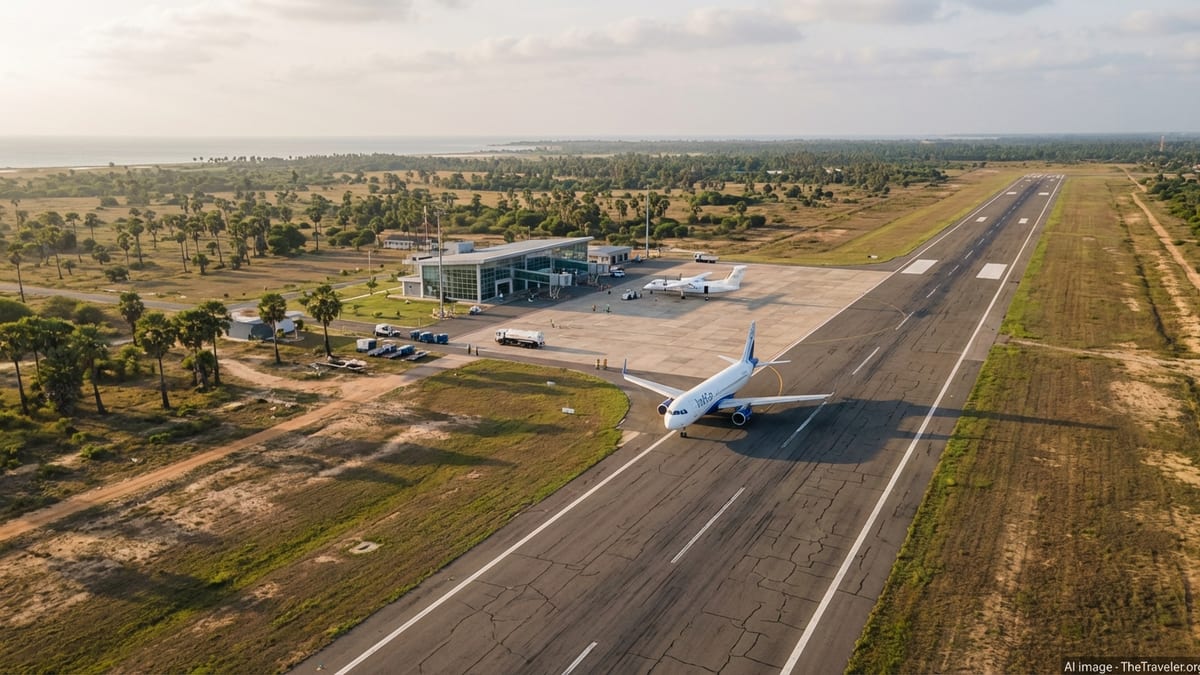
A Strategic Upgrade for Sri Lanka’s Northern Gateway
The planned expansion of Jaffna International Airport, located in Palaly north of Jaffna town, marks the most ambitious aviation investment in Sri Lanka’s Northern Province since the airport’s reopening to international traffic in 2019. Officials say the next phase of development will extend the operational length and strength of the civilian runway, enhance taxiways and parking bays, and upgrade terminal facilities to handle larger single-aisle jets such as the Airbus A320 family.
While Jaffna’s runway was previously refurbished to around 1,400 metres for civilian operations, authorities have confirmed that the second phase aims to support aircraft carrying about 130 passengers, positioning the airport to move beyond turboprop and smaller regional jet services. The move is framed as a targeted, commercially driven upgrade designed to unlock regional demand without repeating the costly overbuilding seen at other Sri Lankan airports.
Airport and Aviation Services Sri Lanka has already highlighted Jaffna as one of the country’s fastest-growing regional hubs, with 2025 delivering its strongest performance since the airport’s international relaunch. That momentum has strengthened the case for infrastructure capable of accommodating more airlines, higher frequencies and new point-to-point links across South Asia.
From Wartime Airfield to Emerging International Hub
Jaffna International Airport has a layered history that underscores its symbolic weight in the current expansion drive. Originally built as a Royal Air Force airfield during the Second World War, it later evolved into a key Sri Lanka Air Force base during the country’s long civil conflict. Large areas of surrounding land were absorbed into a high-security zone, and civilian access was tightly restricted for decades.
Only in the late 2010s did the airport begin a new chapter, with the Sri Lankan and Indian governments collaborating on its partial refurbishment and rebranding as Jaffna International Airport. In October 2019, the airport reopened to international passenger traffic, with scheduled flights linking Jaffna to Chennai, a major South Indian metropolis with deep cultural and family ties to the Tamil-majority north of Sri Lanka.
That reopening was widely interpreted as a gesture toward post-war normalization and regional integration. However, the pandemic and Sri Lanka’s subsequent economic crisis disrupted those early gains, leading to suspended operations and an uneven recovery. The latest expansion blueprint is intended to move the airport beyond tentative beginnings and anchor it as a durable aviation and economic asset for the north.
Larger Aircraft Capacity and the New Route Map
The core technical shift behind the expansion is the ability to reliably handle larger narrow-body jets, particularly the Airbus A320 and similar aircraft widely used on regional routes across Asia. This requires more than just runway length; pavement strength, taxiway geometry, apron layout and rescue and firefighting capabilities all have to be calibrated to higher weight and performance profiles.
Officials have signalled that priority will be given to phased runway works and apron expansion, with a parallel focus on enhancing passenger processing areas and security screening to support busier peak periods. Once the airport can confidently support 130 to 150-seat aircraft on a regular basis, aviation planners expect a reconfigured route map that goes beyond the core Chennai link.
Potential new destinations under discussion include other South Indian cities such as Bengaluru, Hyderabad and Kochi, as well as connections deeper into the subcontinent. Tourism operators also see opportunities for niche links to the Maldives and select Southeast Asian hubs, particularly once Jaffna can offer the aircraft types and schedules airlines prefer for these medium-haul segments.
Tourism Transformation in Sri Lanka’s North
The expansion of Jaffna International Airport is widely expected to reshape tourism dynamics in the Northern Province, a region rich in culture and history yet comparatively underdeveloped as a visitor destination. For years, reaching Jaffna from overseas typically required transiting through Colombo and then undertaking a domestic flight or a long overland journey, adding time, cost and complexity.
Direct or near-direct international access by larger aircraft would significantly alter that calculus. Tour operators anticipate that short-haul travellers from South India, particularly Tamil Nadu, will find it easier to plan weekend or short-break itineraries centred on Jaffna’s temples, colonial-era architecture, coastal landscapes and distinctive cuisine. The city’s growing roster of boutique guesthouses and midscale hotels stands to benefit from more predictable arrivals and slightly higher-spending visitors.
Beyond leisure tourism, Jaffna is positioning itself as a hub for cultural and academic exchanges, aided by new facilities such as the India-backed Jaffna Cultural Centre and the revival of traditional festivals. Improved air access, especially on aircraft that can efficiently transport organized groups, could accelerate this trend, attracting conferences, performing arts tours and heritage-focused travel from across the region.
Economic Lifeline for a Post-Crisis Region
For the Northern Province, where livelihoods have long been shaped by conflict, displacement and underinvestment, the airport’s expansion is also framed as an economic lifeline. Aviation-linked growth is expected to ripple into hospitality, transport, agriculture and small-scale manufacturing, particularly if the airport begins to handle a modest share of air cargo alongside passenger traffic.
Local business chambers argue that larger aircraft capacity will help reduce logistics costs for high-value, time-sensitive goods such as seafood, cut flowers and specialty agricultural products, opening niche export channels to India and beyond. The prospect of more frequent flights also raises the attractiveness of the region for diaspora investors, many of whom have family roots in Jaffna but currently route their visits and capital through Colombo.
The recent traffic data from Airport and Aviation Services showing record annual passenger and aircraft movements at Jaffna in 2025 has bolstered confidence that the airport is gaining enough critical mass to justify further spending. Policymakers say the challenge now is to align infrastructure upgrades with a clear commercial plan that ensures the airport pays its way over time, rather than relying indefinitely on cross-subsidies from Colombo’s main international gateway.
Balancing Ambition With Financial Realities
Government officials have been explicit that Jaffna’s expansion will be measured rather than extravagant. Sri Lanka’s recent experience with heavily indebted infrastructure projects, including the once-maligned Mattala Rajapaksa International Airport in the south, has prompted a more cautious approach to aviation investment. The emphasis for Jaffna is on scalable upgrades that align with realistic demand forecasts.
The current plan centres on a second-phase runway and apron enhancement sized for narrow-body aircraft, coupled with a modest terminal expansion and improved ground handling facilities. More ambitious ideas, such as turning Jaffna into a full-scale alternative to Colombo for long-haul traffic, have been pushed aside in favour of consolidating its role as a regional hub serving India and nearby markets.
Officials in Colombo stress that each step of the project will be preceded by feasibility studies and traffic assessments, with particular attention to airline interest and potential code-share arrangements. At the same time, aviation planners acknowledge that demand can be self-reinforcing; once airlines and passengers see a better-equipped airport with reliable operations, new commercial opportunities are likely to emerge.
India’s Role and Regional Connectivity Across the Palk Strait
India has been a pivotal partner in Jaffna Airport’s modern story, from funding earlier runway refurbishment to supporting initial international services from Chennai. As Sri Lanka looks to the next expansion phase, New Delhi’s strategic interest in improved connectivity with the Tamil-majority north, alongside broader economic and security considerations in the Indian Ocean, is expected to remain a key factor.
The airport’s upgrade dovetails with a broader push to restore and deepen cross-border links across the Palk Strait, where maritime connections have also been revived through high-speed ferry services between Tamil Nadu and the Jaffna peninsula. Together, improved sea and air links are gradually reknitting a travel and trade corridor that was largely severed during the years of conflict.
For India, better connectivity with Jaffna offers both symbolic and practical benefits, from supporting people-to-people ties and religious tourism to enabling more agile disaster response and medical evacuation options. For Sri Lanka, attracting Indian carriers and passengers remains central to the economic case for the airport’s expansion, given India’s dominance in inbound tourist arrivals even during the country’s recent financial difficulties.
Local Communities, Land Use and Sustainability Concerns
The airport’s evolution is not without local sensitivities. Large tracts of land around Palaly were taken over during the conflict, and resettlement, compensation and land release remain politically charged issues in the Northern Province. Community representatives have urged authorities to ensure that any further land acquisition for the airport’s civilian expansion is transparent, limited and backed by fair processes.
Environmental and social impact assessments are also expected to come under close scrutiny, with civil society groups calling for safeguards on noise, emissions and coastal ecosystems. Proponents of the project argue that concentrating growth in a single, well-regulated regional gateway is preferable to piecemeal development along fragile shorelines, especially if modern aircraft handling and ground operations standards are enforced.
There is also a push to align the airport’s growth with wider sustainability goals, including the use of renewable energy for terminal operations and incentives for airlines operating newer, more fuel-efficient fleets. Such steps, advocates say, could help Jaffna position itself as a model for lower-impact regional aviation in South Asia.
Outlook: A Northern Air Hub Taking Shape
As Sri Lanka’s aviation sector rebounds from crisis, Jaffna International Airport’s planned expansion stands out as a test case for how targeted, commercially grounded investments can reshape regional connectivity. By enabling larger aircraft and a broader route network, authorities hope to unlock a new phase of growth in tourism, trade and diaspora engagement in the island’s long-marginalized north.
Much will depend on the pace of construction, the willingness of airlines to commit capacity and the broader macroeconomic environment in Sri Lanka and its key source markets. Yet the airport’s recent traffic performance, combined with political backing in Colombo and ongoing interest from Indian partners, has created momentum that was largely absent just a few years ago.
If the expansion proceeds as planned, Jaffna could, within a few years, evolve from a niche regional link into a recognised northern air hub, complementing Sri Lanka’s main gateways while offering travellers and businesses a more direct route into a region rich with cultural memory and future potential.