

More news on this day
Japan’s busiest international airports are moving into the next phase of digital border control, as Narita lines up alongside Haneda, Kansai and Fukuoka to prepare for the rollout of JESTA, a new pre-arrival screening system that promises to streamline immigration for millions of visa-free travelers in the coming years.
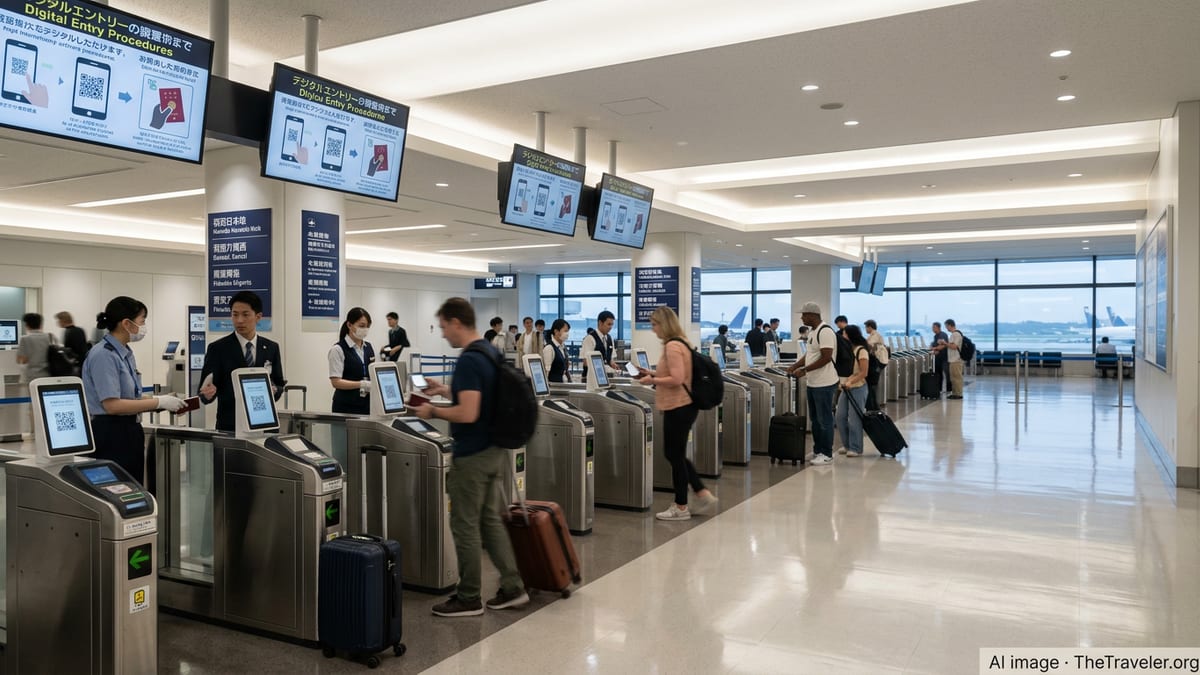
A New Digital Gateway for Visa-Free Visitors
JESTA, short for Japan Electronic System for Travel Authorization, will introduce mandatory pre-arrival screening for travelers from visa-exempt countries, modeled closely on systems already used in the United States and parts of Europe. Under the scheme, visitors will submit personal, passport and travel details online several days before departure, allowing authorities to vet applications before passengers even board their flights.
For Japan’s aviation sector, which has seen international arrivals surge back to record levels, the system is intended to balance two urgent needs: stronger border security and a smoother, more predictable experience at immigration. Officials have positioned JESTA as a core tool in their push to raise annual foreign arrivals toward 60 million by the end of the decade while keeping queues at passport control under tighter control.
Unlike traditional visa procedures, the authorization will be processed entirely online, with an approval linked electronically to a traveler’s passport. Airlines will be required to check for valid JESTA clearance prior to boarding, reducing the risk of ineligible passengers being turned around on arrival and easing pressure on front-line immigration officers at Japan’s gateway airports.
Narita Joins a Network of Early-Adopter Hubs
Narita International Airport, still one of Asia’s largest long-haul hubs, is now working in step with Haneda, Kansai and Fukuoka to prepare systems and passenger flows for the new era of pre-screened arrivals. These four airports collectively handle the vast majority of Japan’s overseas visitors and are being prioritized for early integration of JESTA checks into their existing infrastructure.
In practice, that means close coordination between airport operators, airlines and the Immigration Services Agency to ensure that JESTA status can be verified at check-in and at automated gates. Narita and Haneda in particular, which already process high volumes of connecting passengers across multiple terminals, are focusing on how to handle travelers who arrive without valid authorization, and how to route approved passengers into faster lanes.
Kansai International Airport, serving the Kansai region and key tourist cities such as Osaka and Kyoto, and Fukuoka Airport, a fast-growing gateway to Kyushu and East Asia, are expected to follow similar playbooks. Both already rely heavily on technology, including biometric systems and electronic customs gates, and see JESTA as another layer in a longer-term shift toward more automated passenger journeys.
Building on Existing Automation at the Border
The JESTA rollout does not start from a blank slate. Japan has already deployed a suite of digital tools at its major airports, including automated immigration gates, biometric verification and electronic customs declaration kiosks that allow travelers to register baggage and personal effects before reaching the green and red channels.
At airports such as Narita, Haneda, Kansai and Fukuoka, these systems are designed to cut waiting times by replacing manual checks with face recognition and QR-code scanning tied to online forms. The Visit Japan Web platform, which lets travelers pre-register immigration, customs and quarantine information, is now widely used, creating a foundation of digital familiarity that JESTA can build upon.
JESTA is expected to sit upstream of these existing tools. Rather than only digitizing forms at the airport, the new system moves risk assessment to the planning stage of a trip, allowing immigration authorities to flag potential concerns well before passengers reach Japanese soil. Airports then become the final checkpoint in a process that began days earlier on a traveler’s smartphone or laptop.
Toward a Seamless, End-to-End Travel Experience
For travelers, one of the most visible changes will be the shift in when and where key entry formalities take place. Instead of completing most paperwork on arrival, future visitors from visa-exempt countries will apply for JESTA in advance, receive confirmation electronically and, in many cases, pass through automated lanes at immigration and customs with minimal interaction.
Airport planners say this approach should make travel more predictable. By smoothing out peaks at passport control and customs, terminals can be designed around continuous passenger flows rather than long, pulsed queues that build up after the arrival of wide-body aircraft. That, in turn, supports better use of space, improved signage and staffing strategies focused on assistance rather than manual document checks.
The shift also reflects a wider global trend. As more destinations adopt pre-arrival authorization schemes, international travelers are becoming accustomed to applying online, paying a modest fee and receiving a digital approval tied to their passport. Japan’s challenge will be to ensure that its version is clearly communicated, simple to use and integrated seamlessly with airline systems so that the promise of faster immigration is realized at the gate.
Opportunities and Risks for Japan’s Tourism Ambitions
Tourism businesses across Japan are watching the preparations closely. With inbound travel already a major driver of regional economies, especially in areas served by Kansai and Fukuoka, any new barrier to entry is treated with caution. Industry groups have stressed the importance of keeping JESTA fees reasonable and the application process straightforward, particularly for repeat visitors and older travelers who may be less comfortable with digital forms.
Officials argue that, if implemented carefully, the system should make Japan more attractive, not less. By pre-vetting travelers and reducing bottlenecks at immigration desks, JESTA could help keep overall journey times competitive with other major destinations. It may also provide valuable data on travel patterns, enabling more targeted tourism campaigns and better planning for peak seasons around cherry blossom, autumn foliage and major events.
At the same time, there are risks. Confusion around unofficial websites and third-party facilitators has already prompted warnings from tourism experts, who emphasize that travelers should rely on official information once the government launches its own JESTA portal. Clear communication in multiple languages will be crucial to avoid misinformation and to ensure that Narita, Haneda, Kansai and Fukuoka can deliver on the promise of a faster, smarter welcome to Japan.