

More news on this day
Japan has moved to the forefront of the global hydrogen race with the launch of the world’s first commercial gas engine designed to run on a 30 percent hydrogen blend, underscoring a broader clean energy pivot that is increasingly drawing in neighboring South Korea.
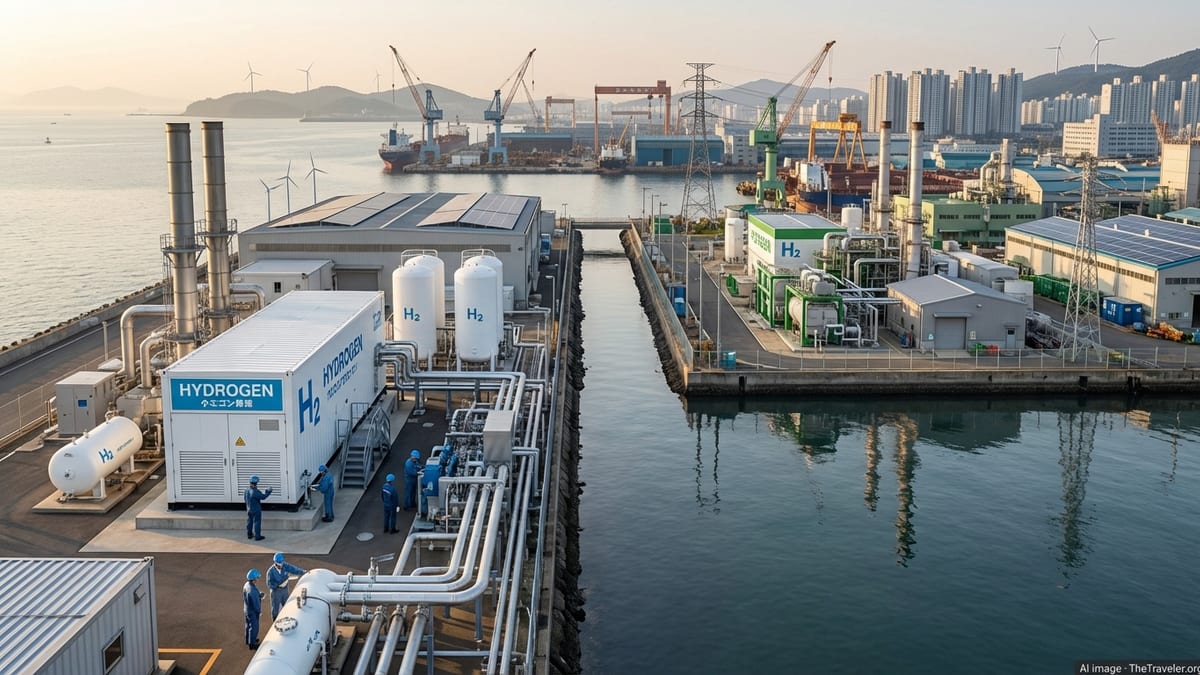
Japan’s 30 Percent Hydrogen Engine Reaches the Market
Kawasaki Heavy Industries has begun commercial sales of a co-firing gas engine capable of operating on fuel that includes up to 30 percent hydrogen by volume mixed with natural gas. After nearly a year of verification testing at the company’s Kobe facilities, the KG series engine is now available with standard service contracts and warranties, signaling a shift from pilot projects to bankable, grid-connected equipment. The unit is initially aimed at industrial sites and local utilities that already operate gas-fired generation and want to cut emissions without scrapping existing infrastructure.
The engine’s 30 percent hydrogen threshold is significant because it can typically be accommodated within current natural gas pipeline and storage specifications, limiting the need for costly network reinforcement. Kawasaki engineers have incorporated safety features to address hydrogen’s higher flammability, including systems to purge residual hydrogen from fuel lines and enhanced leak monitoring. The company argues that its engine allows operators to gradually increase the hydrogen share in their fuel mix as supply becomes more abundant, using today’s gas grids as a bridge to a lower-carbon future.
In performance terms, the 18-cylinder model designed for 50 hertz markets delivers around 7.8 megawatts of power when running on a 30 percent hydrogen blend, comparable to conventional natural gas engines in the same class. That parity is critical for industrial customers who cannot afford reductions in output or efficiency. Industry analysts say the commercial launch is a milestone for combustion-based hydrogen technology, complementing fuel cells and electrolysers in a diversified hydrogen ecosystem.
Hydrogen Engines in Japan’s Wider Energy Strategy
The new engine arrives as Tokyo leans heavily on hydrogen to meet its climate and energy security goals. Japan’s Green Transformation program, backed by tens of billions of dollars in public and private finance, treats hydrogen and ammonia as cornerstone fuels for decarbonizing sectors that are difficult to electrify, including heavy industry and shipping. The government’s long-standing ambition to build a “hydrogen society” is increasingly visible in concrete infrastructure, from liquefied hydrogen import terminals to demonstration plants.
Beyond stationary engines, Japanese manufacturers are already testing large marine engines that can run on hydrogen derivatives such as ammonia. Japan Engine Corporation has completed full-scale trials of a dual-fuel ammonia engine destined for commercial deployment on a gas carrier, supported by public funding and maritime classification approvals. These efforts dovetail with projects like the Suiso Frontier, the world’s first liquid hydrogen carrier ship built by Kawasaki, which is designed to ferry hydrogen from overseas suppliers to Japanese ports.
Domestic engine makers such as Yanmar have also demonstrated 30 percent hydrogen blends in smaller cogeneration systems, validating the technical feasibility of hydrogen-enriched combustion at various scales. Taken together, these initiatives position Japan as a living laboratory for hydrogen technologies, with the 30 percent co-firing gas engine marking one of the first products that ordinary industrial users can purchase off the shelf rather than merely observe in testbeds.
South Korea Accelerates Its Own Hydrogen and Renewables Push
Across the Sea of Japan, South Korea is pressing ahead with its own clean energy transition, pairing a rapid build-out of renewables with an ambitious hydrogen strategy. Seoul’s recently confirmed 11th Basic Plan for Long-Term Electricity Supply and Demand targets a 2038 power mix in which more than 70 percent of electricity comes from carbon-free sources, including nuclear, renewables, hydrogen and ammonia. The plan envisages hydrogen and ammonia combined providing just over 6 percent of power generation by 2038, while the share of coal and liquefied natural gas steadily declines.
South Korea’s government has also set interim goals to raise renewable energy’s contribution to the electricity mix to about 22 percent by 2030, up from single-digit levels in 2024. Recent analysis by think tanks and research laboratories suggests that even more rapid deployment of solar and wind, backed by battery storage, could enable the country to reach roughly 80 percent clean electricity by the mid-2030s while maintaining reliability. Policymakers increasingly frame this shift not only as a climate imperative but as a national security measure that would reduce dependence on imported fossil fuels.
Hydrogen sits at the center of South Korea’s industrial decarbonization agenda. The country aims to scale up the use of clean hydrogen in steelmaking, petrochemicals and heavy transport, establishing domestic production hubs and import terminals along its coasts. This complements a fast-growing network of hydrogen refueling stations and vehicle subsidies, intended to make hydrogen-powered buses, trucks and passenger cars a visible part of daily life in the coming decade.
Hyosung’s 100 Percent Hydrogen Generator Highlights Korean Innovation
One of the clearest examples of South Korea’s hydrogen ambitions is Hyosung Heavy Industries’ commercialization of a generator that operates solely on hydrogen fuel. Since 2024, the company has been running a 1 megawatt hydrogen engine generator at a chemical plant in the industrial city of Ulsan, describing it as the first fully commercial unit of its kind. Unlike co-firing engines that blend hydrogen with gas, Hyosung’s technology is designed to use 100 percent hydrogen, eliminating direct carbon dioxide emissions from combustion.
The generator is installed within an existing industrial complex, providing on-site power and allowing the operator to cut emissions without overhauling its entire electrical system. Engineers had to contend with the challenges of storing and feeding pure hydrogen into the engine while ensuring safe operation in a dense industrial environment. The company’s success has drawn attention from utilities and manufacturers both inside and outside South Korea that are exploring similar applications.
Hyosung positions its hydrogen generator as a template for future distributed power systems, in which localized hydrogen production or imports would feed flexible engines that can ramp up and down to complement variable renewable energy. While current projects rely largely on hydrogen produced from fossil fuels, the company and policymakers envision a progressive shift toward low-carbon and green hydrogen as electrolyser capacity expands and renewable generation grows.
Hydrogen Infrastructure and Cross-Border Supply Chains
For both Japan and South Korea, the deployment of hydrogen engines is inseparable from the question of how to secure large volumes of affordable, low-carbon hydrogen. Japan has invested heavily in demonstration projects to import liquefied hydrogen from resource-rich countries, using specialized carrier vessels and terminal infrastructure. These pilot shipments are helping establish technical standards and safety protocols that could underpin a full-scale international hydrogen trade in the 2030s.
South Korea, meanwhile, is expanding a domestic network of hydrogen refueling stations, storage facilities and planned pipeline corridors, turning industrial clusters such as Ulsan and Incheon into early hydrogen hubs. As of early 2025, the country operated roughly 400 hydrogen refueling stations, with ambitions to reach at least 450 by the end of the decade alongside a growing fleet of hydrogen-fueled vehicles. Policymakers hope that scaling up demand in transport and industry will in turn lower costs for hydrogen supply infrastructure.
Regional collaboration is likely to grow as both countries pursue long-term supply contracts and shared standards. Japanese and Korean companies are already active in overseas hydrogen and ammonia projects, from the Middle East to Australia, often in partnership with European and North American firms. Analysts say that common approaches to certification, safety and emissions accounting will be vital if hydrogen-fueled power plants and engines in both countries are to count fully toward national and corporate climate targets.
Balancing Hydrogen with Renewables and Nuclear Power
Despite the fanfare surrounding new hydrogen engines, energy planners in Japan and South Korea stress that hydrogen is one piece of a broader decarbonization puzzle rather than a catch-all solution. In South Korea’s finalized long-term power plan, renewable energy capacity is set to increase sharply by 2038, even as nuclear power maintains a substantial role in the generation mix. This combination is intended to drive deep emissions cuts while supporting power-hungry industries such as semiconductors and data centers.
Japan faces a particularly complex balancing act as it seeks to decarbonize while managing sensitivities around nuclear power in the wake of the Fukushima disaster. The country is scaling up offshore wind and solar, but land constraints and public opposition to new transmission lines limit the pace at which variable renewables can grow. Advocates of hydrogen engines and ammonia co-firing in thermal power plants argue that these technologies can provide low-carbon, dispatchable capacity that stabilizes the grid when wind and solar output fluctuate.
Critics, however, warn that an overreliance on hydrogen produced from fossil fuels risks locking in emissions and diverting investment from cheaper renewables and energy efficiency. They call for clear timelines and standards requiring a steadily rising share of low-carbon or green hydrogen in any fuel mix used by power plants or engines. Both governments are under pressure to ensure that public subsidies and regulatory support accelerate, rather than delay, the shift to genuinely low-emission energy systems.
Challenges of Cost, Supply and Public Acceptance
Cost remains the primary obstacle to scaling hydrogen engines and related infrastructure. Producing low-carbon hydrogen through electrolysis powered by renewables is still significantly more expensive than conventional hydrogen made from natural gas, and both are dearer than directly burning gas or coal. Transporting and storing hydrogen, whether as compressed gas, liquid or in the form of carriers such as ammonia, adds further expense and technical complexity. The 30 percent co-firing engine targets a transitional niche where modest amounts of hydrogen can displace a portion of fossil fuel use without fully overhauling existing assets.
Supply security is another concern. At present, available hydrogen in both Japan and South Korea is dominated by “gray” hydrogen produced from fossil fuels with high associated emissions. Large-scale deployment of hydrogen engines that genuinely reduce climate impact will depend on how quickly both countries can expand production of lower-carbon hydrogen, either domestically or through imports backed by stringent emissions accounting. Policymakers are exploring contracts for difference and other mechanisms to bridge the price gap during the early years of market development.
Public acceptance and safety perceptions also play a role, particularly in dense urban and industrial areas. High-profile accidents involving gas infrastructure in the past make regulators cautious about approving new hydrogen projects near communities. As a result, engine manufacturers and plant operators in both Japan and South Korea are investing heavily in safety systems, transparent risk assessments and community engagement to build trust. Successful operation of early commercial projects such as Kawasaki’s 30 percent engine and Hyosung’s 100 percent hydrogen generator will be closely watched benchmarks.
Implications for Global Clean Energy Transitions
The latest advances in Japan and South Korea reverberate well beyond East Asia, offering a preview of how hydrogen could complement renewables and nuclear in other advanced economies. The commercial readiness of a 30 percent hydrogen co-firing engine illustrates how incremental upgrades to existing power infrastructure may provide an early pathway to cut emissions, particularly in markets where gas-fired generation is already entrenched. At the same time, South Korea’s focus on a hydrogen-ready power system, with clearly defined long-term targets, shows how planning frameworks can create space for emerging technologies while still expanding wind and solar capacity.
Engine makers and project developers from both countries are already marketing their hydrogen solutions overseas, from marine engines for international shipping to industrial generators for remote or islanded grids. Their success or failure will influence how investors and policymakers elsewhere view the role of hydrogen combustion in the clean energy toolbox. For now, Japan’s world-first commercial 30 percent hydrogen gas engine and South Korea’s early 100 percent hydrogen generator underscore that, in the global race to decarbonize power systems, some of the most closely watched experiments are taking place in the industrial hubs and port cities of Northeast Asia.