

More news on this day
Air travel between Japan, the United States and Guam faced fresh disruption on Monday as around 20 flights operated by All Nippon Airways, Japan Airlines, United Airlines, Delta Air Lines, American Airlines and other carriers were cancelled or severely delayed, snarling connections to key hubs including New York, Newark, Boston, Atlanta and Guam.
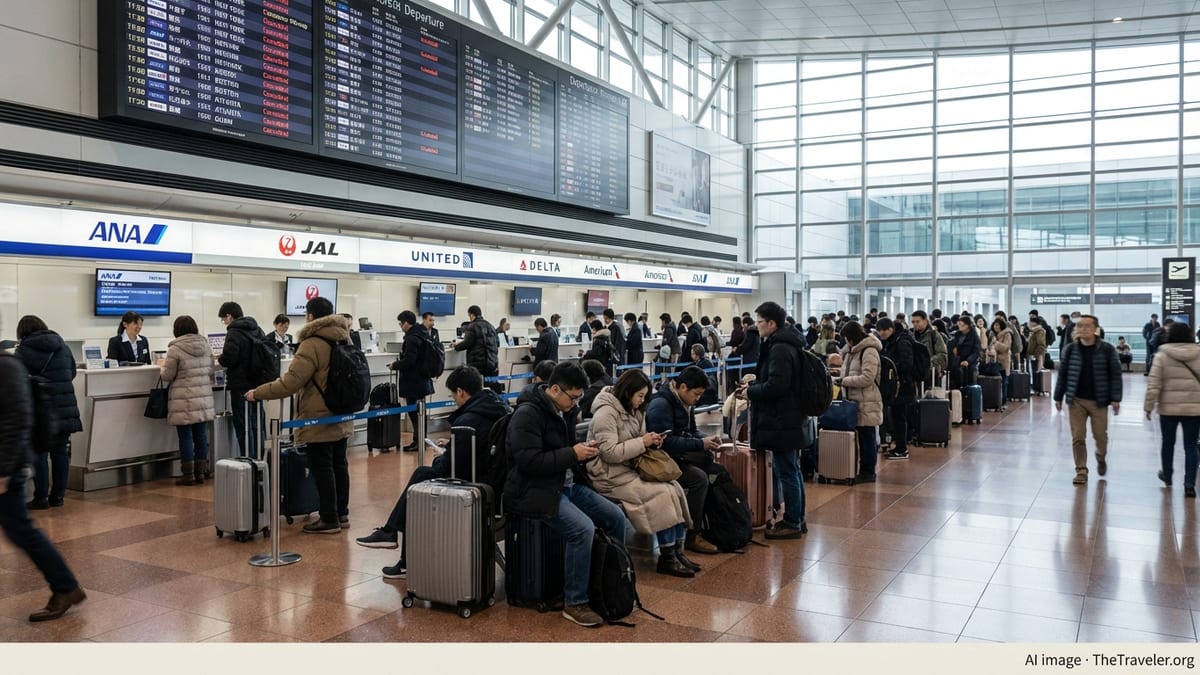
Storm Fallout and Operational Strain Hit Japan’s Gateways
The latest wave of cancellations involving Japan routes comes as airlines worldwide struggle to recover from a historic winter storm that has crippled aviation operations across the northeastern United States. While the blizzard’s core impacts are thousands of miles away, its ripple effects are being felt strongly at Tokyo’s Narita and Haneda airports, as well as at Osaka and Fukuoka, where long-haul schedules must be rewoven around shuttered or capacity-constrained US airports.
Japan’s major carriers ANA and Japan Airlines, together with US partners United, Delta and American, have pulled a mix of transpacific services and onward connections after New York, Newark and Boston saw widespread shutdowns. New schedule data and airport updates indicate that about 20 flights directly linking Japan with the US East Coast and onward gateways such as Atlanta and Guam have either been cancelled outright or heavily rescheduled over a 24 to 36 hour period.
While the number of cancelled flights is modest compared with the thousands grounded in North America, the impact on Japan’s long-haul network is outsized. Transpacific flights operate on tightly choreographed rotations, and each cancellation can displace aircraft and crews for days, leading to missed connections for business travelers, tourists and cargo customers on both sides of the Pacific.
Airport officials in Tokyo said passenger flows through international terminals were substantially slower than usual, with long queues at check-in counters for US-bound flights and rebooking desks handling stranded travelers whose itineraries depended on now-suspended links to New York and other East Coast cities.
Key Routes to New York, Newark and Boston Affected
Flights between Japan and the New York area were among the first to be hit. Carriers including ANA, JAL, United and Delta have cancelled or re-timed services into John F. Kennedy International Airport and Newark Liberty International, citing airport closures, runway snow clearance operations and limitations on arrivals and departures imposed by US air traffic control as the storm system peaked.
Boston Logan International Airport, a key transpacific connection point for some itineraries linking Japan with New England and eastern Canada, has also seen sharp disruptions that are now pushing back into Japan’s schedule. Delta and other US carriers have suspended or significantly reduced Boston operations, forcing late-notice cancellations or rerouting for Japan-originating passengers who planned to connect there onward to regional US destinations.
As the blizzard prompted a travel ban across parts of New York City and surrounding states, including curbs on road access to major airports, airlines had little choice but to proactively cancel long-haul flights that would otherwise arrive without certainty of being able to land, turn around and depart on time. That operational uncertainty has cascaded backward along the route map, forcing Japan-based operations teams to pull flights even where weather conditions in Tokyo remain calm.
Travel analysts noted that the East Coast hubs affected are central to Japan’s economic ties with the US, supporting heavy premium demand from financial services, technology and manufacturing sectors. The current disruption, while temporary, underlines the vulnerability of these crucial business corridors to extreme weather on the far side of the Pacific.
Knock-on Disruptions Extend to Atlanta, Guam and Beyond
Beyond the headline East Coast hubs, additional disruption is emerging on routes that rely on aircraft and crews cycling through those storm-battered airports. Delta’s sprawling network, for instance, has seen cancellations and schedule changes in Atlanta, one of its primary US hubs and an important connecting point for travelers flying between Japan and the southeastern United States or Latin America.
Operational bulletins show that aircraft normally assigned to New York and Boston rotations are being temporarily reallocated or held out of service, leading to the cancellation of some Japan-linked connections via Atlanta. For passengers in Tokyo and Osaka, this often translates into broken multi-leg itineraries, requiring complex rebooking via West Coast gateways such as Los Angeles, San Francisco and Seattle.
Further into the Pacific, services touching Guam have also been affected. Guam functions as both a leisure destination for Japanese travelers and a strategic hub for US military and business traffic. With US carriers adjusting fleets and crews to manage East Coast recovery, some flights connecting Japan to Guam and onward Pacific islands have been trimmed or retimed, compounding the sense of uncertainty for holidaymakers heading into peak winter travel periods.
Industry observers warn that the operational shock can echo for several days, particularly on routes where aircraft utilization is high and spare capacity is limited. Even after the worst of the storm passes, some Japan–US and Japan–Guam flights are likely to remain vulnerable to short-notice schedule changes as airlines work to reposition aircraft.
Japan Airlines and ANA Implement Protective Cancellations
Japan’s two largest carriers, Japan Airlines and All Nippon Airways, have both leaned into what the industry calls “protective cancellations” on certain long-haul routes. Rather than operating flights into uncertain airport and airspace conditions, they are choosing to cancel in advance, giving passengers more time to adjust plans while helping to stabilize their wider networks.
For ANA, this has meant selectively pulling services to New York and adjusting timings on select North American routes that feed into East Coast connections. The airline has issued alerts advising customers that further changes remain possible, encouraging travelers to monitor their booking status closely and consider voluntary changes where travel is not essential in the coming days.
Japan Airlines has taken a similar approach, focusing on maintaining core links to West Coast gateways while being more aggressive in cutting flights that rely on disrupted East Coast airports. JAL has cited safety, crew duty time limitations and the risk of aircraft and staff becoming stranded overseas as primary reasons for the cancellations.
Both carriers are offering flexible rebooking policies, allowing affected passengers to change dates or routes without additional fees within a defined travel window. However, availability is tightening quickly on alternative departures, especially on Japan–US routes that were already running near capacity due to strong demand and limited widebody aircraft supply.
US Carriers Adjust Japan Schedules Amid Northeast Chaos
United Airlines, Delta Air Lines and American Airlines, all of which operate extensive transpacific services serving Tokyo and other Japanese gateways, are rapidly adjusting Japan schedules in response to the storm-damaged Northeast network. Their focus is on preserving core transpacific connectivity while absorbing the shock of hundreds of domestic and transcontinental cancellations closer to the storm zone.
United, with a major hub at Newark and significant operations at New York’s other airports, has trimmed Japan-linked flights that rely on aircraft and crews cycling through the affected East Coast cities. Some Japan-bound services have been consolidated onto fewer departures, leaving passengers to be re-accommodated on alternative dates or routings through West Coast hubs.
Delta, which earlier signaled it would temporarily suspend operations at New York LaGuardia, New York JFK and Boston, has likewise made cuts that spill over into its transpacific network. Flights that would normally connect Japan with these northeastern gateways, often via Delta’s Atlanta and Detroit hubs, are being reduced or restructured, with passengers offered waivers to rebook outside the core storm dates.
American Airlines, a key partner to Japan Airlines within the oneworld alliance, has also adjusted its Japan-facing schedule as it works through widespread cancellations and delays in its own Northeast operation. American is prioritizing the stability of its largest transpacific flows while using alliances to rebook customers across partner networks where possible, including on JAL-operated flights out of Tokyo.
Passengers Face Long Queues, Rebookings and Overnight Stays
For travelers on the ground in Japan, the disruption is being felt in very practical ways. At Tokyo’s Narita International Airport, passengers arriving for overnight and early-morning departures to the United States reported long queues at airline counters, as staff worked to reissue tickets, re-route itineraries and arrange hotel stays for those unable to depart as planned.
Families heading for winter vacations in New York or Guam, business travelers bound for financial district meetings in Manhattan, and students transiting through major US hubs all found themselves navigating a patchwork of options. In many cases, the quickest path now involved flying first to West Coast cities such as Los Angeles or San Francisco, then connecting onto limited remaining services to the Northeast or onward to secondary cities.
Some travelers in Osaka and Fukuoka, where additional delays and cancellations had been reported even before the latest storm-related adjustments, have opted to delay their journeys entirely. Travel agents in Japan noted an uptick in customers requesting to shift trips by several days, preferring to wait for the transpacific network to stabilize rather than risk multi-leg journeys vulnerable to further disruption.
Hotels around major Japanese airports are also feeling the impact, with last-minute bookings rising as airlines issue meal and accommodation vouchers to stranded passengers. Local tourism authorities say the effect is mixed: while some inbound travelers are stuck outside the country, others are unexpectedly extending their stays in Japan, adding unplanned nights in Tokyo and other cities.
Flexible Policies and Practical Advice for Affected Travelers
With cancellations and delays still accumulating, airlines serving Japan are urging passengers to make full use of flexible policies and self-service tools. Most major carriers have issued travel waivers for itineraries touching the hardest-hit US airports over the key storm dates, allowing customers to change travel dates, adjust routings or, in some cases, seek refunds without penalty.
Passengers are being advised to check the status of their flights repeatedly rather than relying on information received at the time of booking. Because schedules are being updated throughout the day, a flight that appears to be operating in the morning may be delayed or cancelled by afternoon, particularly on routes that require complex aircraft repositioning between Japan, the US mainland and Guam.
Travel experts recommend that Japan-based passengers bound for New York, Newark, Boston or Atlanta consider routing through alternative hubs where feasible, even if that means an extra connection. West Coast gateways generally recover more quickly from East Coast storms and often have spare capacity to absorb disrupted travelers, particularly when airlines deploy larger aircraft on key routes.
Travelers connecting onward to smaller US cities or Pacific islands from Japan are being urged to build additional buffer time into their itineraries. Same-day turnarounds that looked comfortable under normal conditions may no longer be realistic amid rolling delays and the risk of missed connections at busy hubs.
Outlook: Recovery Timeline and Wider Travel Implications
Aviation forecasters and industry insiders caution that the disruption to Japan–US and Japan–Guam travel may linger beyond the immediate weather event. Once blizzard conditions ease and airports along the US East Coast fully reopen, airlines will still face the complex task of repositioning aircraft and crews, clearing backlogs of stranded passengers and restoring finely balanced transpacific schedules.
Recovery times will vary by carrier and route, but some analysts expect at least several days of elevated cancellation and delay risk for flights linking Japan with New York, Newark and Boston, given the intensity of the storm and the volume of grounded aircraft in the region. The interplay between domestic US operations and long-haul transpacific flights will be crucial, as airlines decide where to deploy limited widebody capacity first.
For Japan’s tourism industry, which relies heavily on stable air links to major US cities, the timing is challenging. Winter remains a popular period for inbound tourism from North America, and any sustained reduction in capacity or confidence could dent visitor numbers in the short term. Conversely, outbound Japanese travelers may increasingly look to alternative destinations and routings that avoid the most disruption-prone hubs.
As airlines, airports and passengers work through the current wave of cancellations, the episode underscores the fragility of global travel networks in the face of extreme weather events, even when the storm itself is an ocean away. For now, those planning to fly between Japan, the US East Coast and Guam in the coming days are being advised to stay flexible, stay informed and prepare for the possibility that their journey may take longer, and follow a different path, than originally planned.