

More news on this day
Travelers across Japan are facing escalating disruption after more than 60 flights linked to routes through Doha were suddenly cancelled, as Qatar Airways and partner carriers including Japan Airlines, All Nippon Airways and low cost operator Vanilla Air adjusted schedules serving Tokyo, Osaka, Fukuoka, Kagoshima, Okinawa and other key cities.
Get the latest news straight to your inbox!
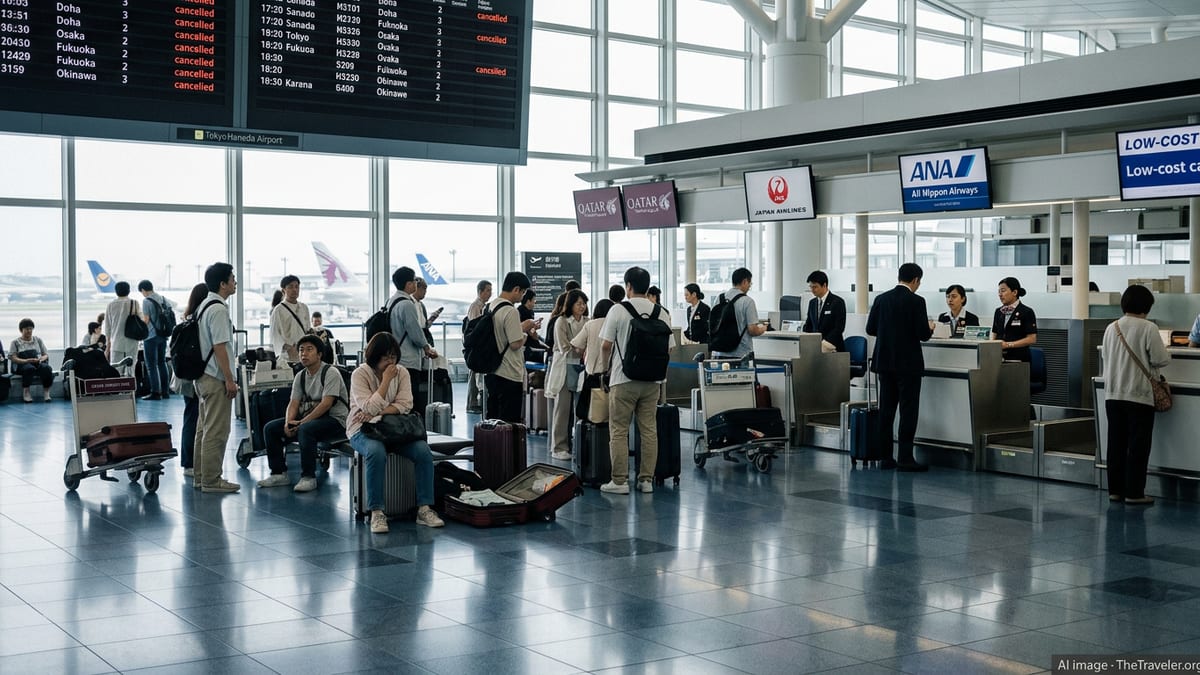
Middle East Crisis Sends Shockwaves Into Japan’s Skies
The latest wave of cancellations in Japan stems from the partial shutdown of Qatari airspace and Hamad International Airport following recent strikes and military activity in the Gulf, which have forced Qatar Airways to suspend or sharply curtail much of its global network. With many Japan bound and Japan originating services funneled through Doha, the disruption has quickly spilled over into East Asia.
Qatar Airways announced it would operate only a limited schedule in early March, prioritizing repatriation services and essential connections while most regular passenger flights remained grounded. That has left multiple daily services between Doha and Japan either cancelled outright or subject to late notice changes, impacting passengers traveling to and from Tokyo Haneda, Tokyo Narita, Osaka Kansai and other gateways.
Because Japan is heavily reliant on connecting traffic for long haul links to Europe, the Middle East and parts of Africa, the loss or downgrading of a major Gulf hub has an outsized effect on its aviation market. Seats that would normally be sold months in advance have vanished from schedules, forcing passengers to rebook on already crowded alternatives via cities such as Seoul, Bangkok and Singapore.
Aviation analytics firms estimate that, since the conflict related closures began, thousands of flights across the wider Middle East and Asia corridor have been cancelled, with Japan now feeling the full force of those knock on effects. The newest tally points to more than 60 flights affecting Japanese routes being pulled over the most recent several day period alone, with further last minute changes still possible.
Tokyo, Osaka, Fukuoka and Resort Routes Most Affected
Among Japanese airports, Tokyo’s twin hubs at Haneda and Narita have seen the highest number of cancellations and schedule reductions, as they handle the bulk of long haul international traffic. Qatar Airways’ daily services that normally link Tokyo to Doha have been especially hard hit, and codeshare segments sold under Japan Airlines and All Nippon Airways flight numbers have disappeared from booking systems as partner aircraft remain parked in the Gulf.
Osaka’s Kansai International Airport, a key gateway for western Japan, has also recorded multiple Qatar Airways cancellations, with ripple effects for travelers heading onward to Europe and the Middle East. Local tourism boards in the Kansai region report growing concern as inbound visitors face complex rerouting, while Japanese residents returning from overseas holidays find themselves stranded or forced to take multi stop journeys home.
Secondary cities and leisure destinations are not immune. Fukuoka on Kyushu, Kagoshima at the southern tip of the main islands and Okinawa’s Naha Airport have all seen itineraries disrupted where passengers were ticketed on through journeys using Qatar Airways connections. In many cases, the domestic legs operated by JAL, ANA or Vanilla Air remain on the schedule, but become effectively useless when the international segment through Doha is removed.
Travel agents say the pattern of disruption has become highly uneven. Some morning departures still operate as planned, while evening flights on the same city pairs are cancelled at short notice as slot availability and airspace permissions in the Middle East evolve day by day. That lack of predictability is adding to anxiety for travelers trying to piece together time sensitive trips for work, study or family commitments.
Qatar Airways Cuts Trigger Domino Effect for JAL, ANA and Vanilla Air
Although Japan Airlines, All Nippon Airways and Vanilla Air are not directly involved in the Middle East conflict, their extensive codeshare and interline partnerships with Qatar Airways mean they are now part of a complex web of disrupted itineraries. Passengers who believed they were booked entirely on Japanese carriers are discovering that one or more long haul legs are actually operated by Qatar Airways, turning their tickets into partial orphans.
To manage the fallout, JAL and ANA have begun waiving some change fees on affected tickets and working with alliance partners in Europe and Asia to find replacement routings. However, with other major Gulf carriers also limiting operations and Asia Europe fares spiking sharply, available seats are limited and often significantly more expensive than the original itineraries, leaving many travelers to choose between long delays or substantial additional cost.
For Vanilla Air and other low cost operators feeding traffic into Japan’s larger hubs, the problem is particularly acute. Their business models rely on high aircraft utilization and tight turnarounds, leaving little room to absorb mass disruptions at a faraway connecting hub. While their domestic and short haul flights continue in most cases, the value proposition for customers evaporates when onward long haul legs through Doha are no longer available.
Industry observers note that the situation underscores how tightly interwoven global airline networks have become. A closure affecting a single hub in the Gulf can cascade within hours into flight boards thousands of kilometers away in Japan, as code shares unravel, crew rotations are reworked and aircraft are redeployed to more stable markets.
What Stranded Passengers in Japan Need to Know Now
For travelers currently in or heading to Japan, airlines and regulators are urging close attention to booking details and real time status updates. Passengers holding Qatar Airways tickets, or itineraries that include a Doha connection even under a Japanese airline code, are advised to check their flight status frequently on official channels and to ensure the airline has up to date contact information.
Those whose flights have already been cancelled are typically being offered a menu of options that may include full refunds, free date changes, or rerouting via alternative hubs such as Seoul, Istanbul or major European gateways. However, availability is constrained and call centers are experiencing heavy backlogs, so many agents recommend using online self service tools where possible and being flexible about travel dates and routing.
Travelers departing from regional airports such as Fukuoka, Kagoshima or Okinawa may need to position themselves to larger hubs in Tokyo or Osaka to access remaining long haul options. In some cases, domestic sectors can be rebooked at no additional charge when tied to an international ticket affected by disruption, but policies differ by carrier and fare type, making it essential to read the fine print or consult a knowledgeable agent.
Consumer advocates in Japan also stress the importance of understanding local and international passenger protection rules, particularly for those connecting onward to or from the European Union, the United States or other jurisdictions with strong compensation frameworks. Depending on the airline operating each segment and where a disruption occurs, travelers may be entitled to refunds, meal vouchers, hotel accommodation or rebooking at no extra cost.
Outlook for Japan Bound Flights in the Coming Weeks
Looking ahead, airline executives caution that it may take weeks for Japan related schedules to stabilize, even if security conditions in the Middle East improve quickly. Aircraft and crews have been displaced, alternative routings are crowding already busy corridors over Central Asia and Europe, and airlines are likely to prioritize the restoration of their most commercially critical trunk routes first.
Qatar Airways has indicated that it aims to gradually rebuild its network as soon as regulators permit, including high demand links to Tokyo and Osaka, but has not yet provided firm timelines for the full resumption of normal service. In the meantime, Japan’s flag carriers are watching demand closely and may adjust their own nonstop offerings to Europe and other long haul markets to capture stranded passengers and support critical travel flows.
Tourism officials in Japan worry that prolonged uncertainty could dampen the country’s hard won recovery in visitor numbers following the pandemic era slump. Spring is one of the busiest seasons for inbound travel thanks to cherry blossom viewing and school holidays across Asia and Europe, and widespread cancellations risk deterring last minute bookings or prompting travelers to shift plans to alternative destinations.
For now, the message from airlines and airports is to plan for disruption to continue, to build in generous buffers for connections and time sensitive commitments, and to keep an eye on rapidly changing travel advisories. With more than 60 flights tied to Japan already scrapped in the latest round of schedule cuts and further adjustments expected, flexibility and patience are likely to be essential companions for anyone flying to or from Japan in the days ahead.