

More news on this day
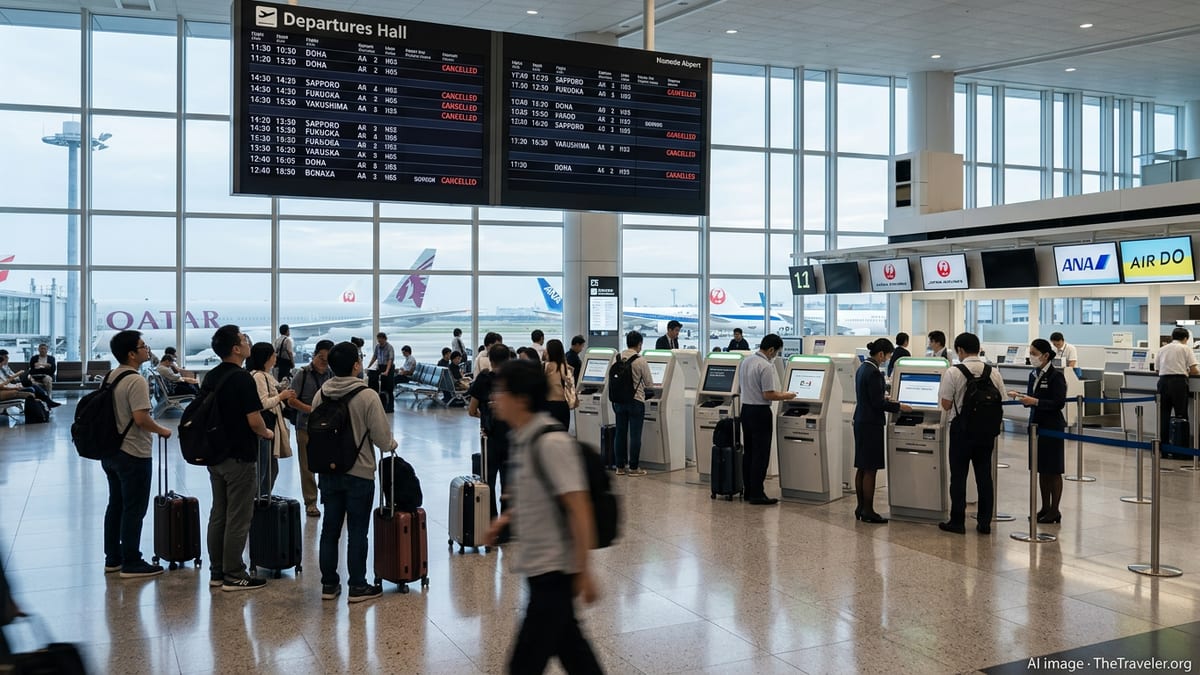
Travellers heading to and from Japan are facing fresh disruption this week as Qatar Airways, Japan Airlines (JAL), All Nippon Airways (ANA) and regional carrier Air Do cancel or consolidate more than 20 flights, affecting key long-haul links via Doha as well as domestic routes serving Tokyo, Osaka, Fukuoka, Hokkaidō, Yakushima and other regional destinations.
Get the latest news straight to your inbox!
Middle East Tensions Ripple Into Japan’s Skies
The latest round of cancellations is closely tied to the continuing closure and restricted use of airspace around Qatar and parts of the Middle East, which has already forced Gulf carriers to ground or reroute hundreds of services worldwide. Qatar Airways, one of the main connectors between Japan and Europe, Africa and the Middle East, has been operating on a sharply reduced schedule since late February, and Japan routes remain among the most affected.
Passengers booked on Qatar Airways services linking Tokyo’s Haneda and Narita airports and Osaka Kansai to Doha have reported short-notice cancellations and rolling schedule changes in recent days. While some repatriation flights have operated on limited corridors, normal commercial services on several Japan routes remain suspended or subject to last-minute adjustment, leaving travellers with disrupted itineraries and extended journey times.
Japanese carriers are not immune to the knock-on effects. JAL has extended the suspension of its own Tokyo–Doha service in coordination with the ongoing instability in regional airspace, cutting off a nonstop Japanese flag-carrier link to the Gulf. ANA, which relies heavily on smooth overflight permissions for its Europe network, has been rebalancing capacity and adjusting schedules, with some long-haul flights reduced or retimed while the situation evolves.
Although the headline numbers of cancelled flights may appear modest compared with the global totals triggered by the conflict, the impact on individual journeys can be severe, particularly for travellers who built multi-stop itineraries through Doha and other Gulf hubs to access Japan’s popular cities and ski, onsen and cultural destinations.
Domestic Frustration: Hokkaidō, Yakushima and Regional Links Hit
Inside Japan, domestic passengers have also encountered disruption, with more than 20 flights involving ANA, JAL and partner airlines including regional specialist Air Do scrubbed or consolidated over the past several days. Routes connecting Tokyo and Osaka with Hokkaidō, as well as links to secondary airports such as Fukuoka and tourist hotspot Yakushima, have seen a patchwork of cancellations and aircraft changes.
Operational strains linked to aircraft rotations, crew availability and maintenance windows are being exacerbated by the long-haul instability. When long-distance flights are delayed or cancelled, aircraft and crews that were due to feed into Japan’s busy domestic network can arrive out of sequence or not at all, forcing carriers to make late adjustments to shorter domestic sectors.
Hokkaidō, a perennial winter and spring favorite for inbound tourists, has been notably affected, as Air Do and ANA shuffle capacity on routes from Tokyo Haneda and Sapporo’s New Chitose Airport. Travellers heading to or from regional cities have reported instances where morning departures were cancelled and passengers rebooked on afternoon or evening flights, compressing schedules and complicating onward rail and hotel plans.
Further south, flights linking Kagoshima and Yakushima, the lush UNESCO-listed island popular with hikers, have seen targeted cancellations and aircraft swaps. While most services continue to operate, the loss of even a handful of daily frequencies can leave leisure travellers with far fewer timing options and may force some to trim or rearrange island stays.
What Affected Passengers Can Expect from Each Airline
Qatar Airways has implemented special guidelines for customers booked to travel during the most turbulent period, including options for free date changes, rebooking on alternative routings and, in some cases, refunds. However, these policies are often limited to tickets with original departure dates within specific windows, and call centres and online chat channels have been heavily congested as passengers seek clarification and alternatives.
Japan Airlines, which has cancelled its Tokyo–Doha flights at least through mid-March, is offering passengers the choice of refunds or rebooking onto other JAL-operated services, typically via its existing European or Asian gateways. For travellers whose itineraries combined JAL with Qatar Airways or other partners, solutions can be more complex, and some may need to work through their original travel agency or online booking platform to piece together a new route.
ANA is focusing on schedule stability for its core domestic and international routes, but where flights are cancelled, the carrier is offering rebooking on the next available ANA or group-operated service. On select domestic sectors, passengers have been shifted between ANA mainline, ANA Wings and partner airlines such as Air Do to keep most itineraries intact, albeit sometimes at different times of day than originally planned.
Regional operator Air Do, whose business centers on linking Hokkaidō with major cities such as Tokyo and Sapporo, is working closely with ANA to consolidate lightly booked flights and protect peak-time frequencies. The airlines have reminded passengers to double-check departure times on the day of travel, even if their flight number has not changed, as aircraft type and schedule tweaks continue to be made at short notice.
Advice for Travellers Headed to Tokyo, Osaka and Beyond
For those planning imminent trips to Japan, particularly via Doha, industry experts recommend monitoring bookings closely and preparing backup options. Travellers with Qatar Airways tickets to Tokyo, Osaka or other Japanese cities should check their flight status repeatedly in the 48 hours before departure and ensure their contact details are correctly registered in the airline’s booking system to receive cancellation or rebooking notifications.
Where possible, passengers are being advised to consider alternative routings that avoid the most restricted airspace, even if it means adding a stop or modest detour time. Routes via East Asian or European hubs that are operating normally may provide more predictable connections, especially for travellers with tight schedules or time-sensitive commitments such as events, tours or cruises in Japan.
Within Japan, travellers heading to regional destinations such as Fukuoka, Sapporo, Asahikawa or Yakushima should allow extra time and build additional flexibility into rail and hotel plans. Booking slightly earlier or later flights, and choosing fully changeable domestic fares where budgets permit, can provide valuable breathing room if last-minute schedule changes occur.
Travel insurance that covers airline cancellations and missed connections is proving especially valuable in the current environment. Policy terms vary widely, and coverage for disruptions linked to conflict or airspace closures is not universal, so passengers are urged to review their policy wording carefully and keep all airline communications and receipts to support any future claims.
Outlook: Gradual Normalisation, but Short-Term Uncertainty
While there are tentative signs that airlines and aviation authorities are working toward more stable schedules in and around the Middle East, analysts caution that full normalisation of Japan–Gulf traffic could take weeks. Qatar Airways has indicated that it will gradually rebuild its network as airspace access improves and operational constraints ease, but the pace of restoration will depend on evolving security assessments and regulatory approvals.
Japanese carriers face a parallel challenge at home: balancing strong demand for both domestic and international travel with the need to keep operations resilient in the face of global shocks. For ANA, JAL and regional partners such as Air Do, that means retaining flexibility in fleet planning and crew rostering while continuing to communicate schedule changes more proactively to passengers.
In the meantime, travellers bound for Tokyo, Osaka, Fukuoka, Hokkaidō, Yakushima and other Japanese destinations should be prepared for a degree of uncertainty, especially if their journey involves a connection in Doha or neighboring hubs. Industry observers say that while the worst of the initial shock may have passed, the coming days will remain a test of airlines’ ability to adapt and of passengers’ willingness to stay flexible as the situation evolves.