

More news on this day
Travel to and from Japan is facing fresh disruption as more than 45 flights across multiple days have been canceled or heavily rescheduled, affecting services operated by major carriers including Delta Air Lines, All Nippon Airways (ANA), United Airlines, El Al and others on routes linking Tokyo, Osaka, Fukuoka, Hokkaido and Okinawa with cities such as Los Angeles and additional international hubs.
Get the latest news straight to your inbox!
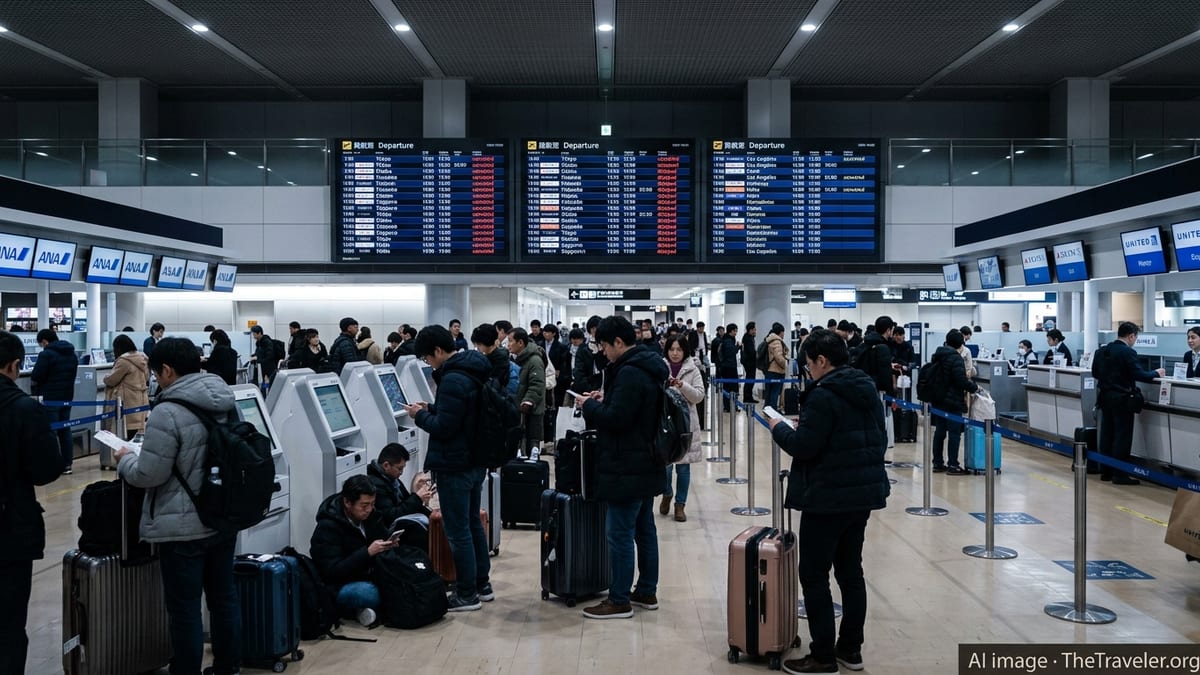
Wide-Ranging Cancellations Across Japan’s Major Gateways
Publicly available flight-tracking data and airline advisories indicate that a new wave of schedule changes is rippling across Japan’s busiest airports, with cancellations and significant delays concentrated at Tokyo’s Haneda and Narita airports, Kansai International Airport serving Osaka, as well as Fukuoka, New Chitose in Hokkaido and Naha in Okinawa. The disruption spans both long-haul and domestic segments, complicating connections at some of Asia’s key transit hubs.
While exact tallies vary by day and source, combined schedule adjustments by multiple airlines now add up to more than 45 canceled flights over a short window, with additional services operating on modified timings or aircraft types. Many of the affected journeys are trunk routes to and from North America and other long-haul markets, with ripple effects on domestic sectors that feed those flights.
Operational data show that capacity reductions are not limited to a single carrier or alliance. Instead, they reflect a patchwork of airline-specific adjustments that together are constraining options for travelers trying to reach Japan for business trips, tourism and family visits at the tail end of the winter travel period.
Industry analysts note that the cancellations are landing at a time when demand for Japan remains relatively strong, particularly to Tokyo and Osaka, intensifying the impact on those who must travel on fixed dates or rely on complex itineraries involving multiple carriers.
Impact on U.S.–Japan Routes and Los Angeles Connections
Among the most closely watched changes are those on routes linking Japan with the United States, especially services touching the West Coast. According to schedule data and airline statements, Delta, United and ANA have all scrubbed or adjusted flights on select days, with Los Angeles repeatedly cited as one of the cities experiencing interruptions in nonstop connectivity to Tokyo and Osaka.
Some of the affected operations involve high-demand transpacific flights that normally serve as key connectors to domestic networks on both sides of the Pacific. When such flights are canceled, passengers may lose not only their long-haul segment but also onward legs within the United States or inside Japan, requiring complete itinerary rebuilds rather than simple time changes.
Airlines have been leaning on alternative gateways such as San Francisco, Seattle and other U.S. hubs when possible, rebooking passengers via different transpacific points or, where capacity permits, shifting them to later departures from Los Angeles. However, with aircraft and crew already tightly scheduled toward the end of the winter season, spare seats on popular dates can be limited.
Travel industry reports also indicate that some premium-cabin and corporate travelers are facing particular challenges, as consolidated services mean fewer high-yield seats are available on the remaining flights. This dynamic may push some passengers to reschedule trips entirely or reroute through third-country hubs in East Asia or the Middle East.
El Al and Other International Carriers Adjust Japan Operations
El Al’s Japan service has drawn attention because it sits at the intersection of shifting security considerations and volatile demand patterns on long-haul routes. Recent disruptions affecting airspace and schedules between the Middle East and East Asia have already led to a series of cancellations and repatriation-style operations by multiple airlines, and El Al’s Tokyo flights have at times been suspended or rerouted in response to rapidly changing conditions.
According to recent coverage of airline schedules, El Al has been recalibrating its long-haul network, including capacity to destinations in Asia. These adjustments have now intersected with the broader pullbacks impacting travel to Japan, meaning passengers using El Al to reach Tokyo may face both outright cancellations and complex rebooking scenarios involving partner carriers or entirely new routings.
Other international airlines that connect Japan with Europe, the Middle East and Oceania have also published disruption notices in recent weeks, often citing a combination of airspace constraints, operational challenges and fleet or crew availability. While not all of these changes are Japan-specific, their combined effect is to reduce the overall number of one-stop options available to travelers whose itineraries begin or end in Japan.
For passengers, this can translate into longer travel times, multiple connections or overnight layovers in intermediate hubs. Travel advisors report that some customers are opting to postpone nonessential trips rather than accept multi-stop journeys that add significant complexity and cost.
Domestic Links to Osaka, Fukuoka, Hokkaido and Okinawa Under Strain
Inside Japan, disruptions to international flights are exerting pressure on the domestic network, particularly at major connecting points such as Tokyo Haneda and Osaka’s Kansai and Itami airports. ANA, Japan Airlines and their regional partners typically feed large volumes of passengers from cities such as Fukuoka, Sapporo’s New Chitose Airport in Hokkaido and Naha in Okinawa into long-haul departures.
When those long-haul flights are canceled or consolidated, the incentive for airlines to operate every associated feeder flight diminishes. Scheduling data and local media reports show that some domestic services have been trimmed or retimed, especially early-morning and late-night departures that were designed around specific international banks of flights.
Travelers originating in regional cities are therefore encountering a double challenge: limited domestic seats into Tokyo or Osaka at convenient times, and reduced onward options to overseas destinations such as Los Angeles, other U.S. cities and select European and Middle Eastern hubs. Same-day connections that once required a straightforward two-leg journey are, in some cases, now stretching into overnight stops.
The situation is particularly sensitive for Hokkaido and Okinawa, two regions that rely heavily on tourism and often see seasonal peaks in international arrivals routed via Tokyo. Local tourism operators are closely watching booking patterns for the coming weeks, as ongoing cancellations could weigh on both inbound and domestic visitor numbers.
What Travelers Can Do If Their Japan Flight Is Affected
Consumer guidance from airlines and travel agencies emphasizes that travelers with upcoming itineraries to or from Japan should monitor their bookings closely and ensure that contact details are up to date in airline profiles. Many carriers now issue schedule-change notices through mobile apps and text messages, and same-day rebooking options can depend on how quickly passengers respond to these alerts.
Publicly available information from airlines shows that most carriers are offering fee waivers or flexible rebooking windows when flights are canceled, particularly on long-haul routes. These policies may allow travelers to shift their trips by several days, reroute through different hubs or request refunds if travel is no longer possible. Conditions vary by airline and fare type, and some discounted tickets may carry more limitations even during disruptions.
Travelers connecting beyond Japan are being advised by travel professionals to pay special attention to minimum connection times and to consider leaving extra buffers between flights. With revised timetables, previously legal connections can become risky, and a missed link in Tokyo, Osaka or another hub may leave passengers stranded until the next available departure, especially on routes that now operate less than daily.
Given the evolving nature of airline scheduling, experts suggest that those with time-sensitive obligations build contingency plans, such as alternative routings via other Asian or North American gateways or the option to advance or delay travel by a few days. Flexible planning, they note, remains one of the most effective tools for navigating the current wave of disruptions affecting Japan-bound flights.