

More news on this day
Hundreds of travelers were left stranded at Narita International Airport near Tokyo and Naha Airport in Okinawa after a fresh wave of flight disruptions rippled across Japan’s domestic network, delaying 219 services and canceling three more on one of the busiest travel days of the late winter season.
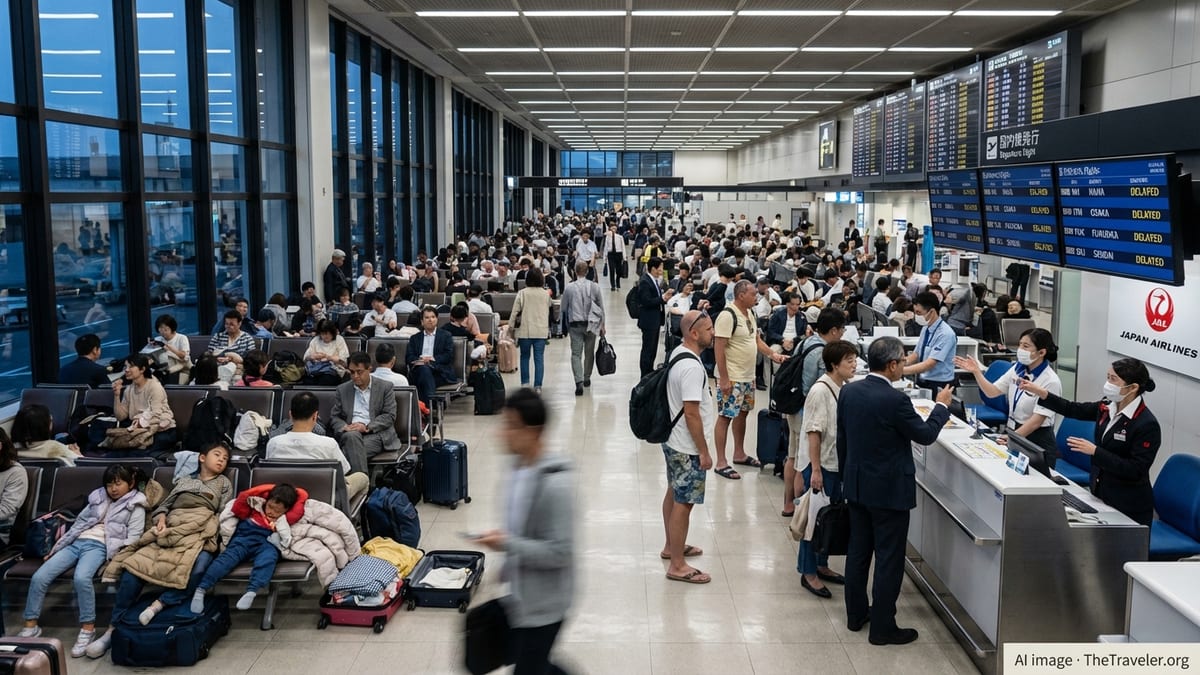
Delays Mount at Narita and Naha as Winter Operations Strain Networks
Operational data from Japanese aviation trackers and airport schedules on Friday and Saturday indicate that Narita and Naha emerged as two of the hardest-hit hubs, with a combined 219 flight delays and three cancellations spreading across the day. While the figures fall short of the worst disruption episodes seen this winter, the concentration of hold-ups at these key domestic gateways left concourses crowded and departure boards dominated by yellow delay notices.
At Narita, which typically handles close to 600 flights a day, a significant share of domestic departures to Osaka, Fukuoka, Sapporo and Naha departed behind schedule after aircraft pushed back late or waited in queues for takeoff slots. Aviation analysts say even modest schedule slippages at a slot-constrained airport like Narita can quickly cascade across the network, particularly when aircraft are operating multiple short-haul rotations in a single day.
Naha Airport, the primary air hub for Okinawa, experienced similar knock-on effects as morning delays bled into midday and evening banks of flights. Services connecting Naha to Tokyo, Fukuoka and other Kyushu and Kansai cities were pushed back, disrupting onward connections and forcing carriers to juggle aircraft and crew assignments. For leisure travelers heading to and from Okinawa’s resorts, the timing proved particularly disruptive, colliding with school holidays and late-winter getaway demand.
While Japan’s winter weather patterns often introduce some operational risk, local airport officials said the latest disturbance reflected a combination of tight scheduling, lingering weather-related air traffic management restrictions, and congestion at major hubs rather than a single extreme weather event.
Japan Airlines, ANA Wings and Jetstar Japan Among Worst Affected
Japan Airlines and All Nippon Airways, together with their regional subsidiaries and partners, again found themselves on the frontline of disruption. ANA Wings, which operates many of the shorter regional legs feeding larger hubs, has already been highlighted in recent months for elevated delay and cancellation rates across Osaka, Tokyo and southern Japan. The latest figures from Narita and Naha continued this pattern, as tightly timed regional turns left little margin to absorb schedule shocks.
Japan Airlines’ expansive domestic network, including flights marketed by the mainline carrier but operated by affiliates, was also heavily exposed. Popular business routes between Tokyo, Fukuoka and Osaka, along with leisure-heavy sectors to Okinawa, saw rolling delays of between 30 and 90 minutes. Airline representatives emphasized that safety remained the overriding priority, but acknowledged that the irregular operations created a difficult experience for passengers already contending with crowded terminals and limited spare seating.
Jetstar Japan, the low-cost carrier based at Narita and partly owned by Japan Airlines, experienced its own share of hold-ups on high-density domestic routes. Budget airlines rely on tight turnaround times to keep fares low, which can leave operations especially vulnerable when even one early-morning departure runs late. As aircraft rotated through Narita, Osaka and Fukuoka, delays accumulated through the day, leaving some passengers waiting hours beyond their scheduled departure times.
Other regional operators serving secondary airports, including carriers like Air Do, StarFlyer and Japan Air Commuter, also reported scattered delays on routes feeding into the main hubs. Although the number of outright cancellations remained low at just three flights, the breadth of airlines and airports touched by the disruption underscored how interconnected Japan’s domestic network has become.
Tokyo, Okinawa, Fukuoka, Osaka and Sendai Feel the Ripple Effects
Beyond Narita and Naha, the disruption radiated out to a wider constellation of Japanese cities. Fukuoka on Kyushu, Osaka’s airports in the Kansai region and Sendai in the Tohoku region all reported elevated delay levels on services tied to the two core hubs. Passengers arriving late into Osaka and Fukuoka, in particular, found their onward domestic connections already boarding or, in some cases, closed.
In Fukuoka, concourses grew crowded as evening banks of flights stacked up, with passengers clustering around information counters to rebook missed connections. Staff deployed additional announcements and digital signage to explain revised departure times, but some travelers reported confusion when new estimates shifted repeatedly as aircraft waited for slots or crews approached duty time limits.
Osaka’s role as both an origin and transfer point magnified the challenge. Flights linking Kansai and Itami airports to Narita and Naha feed a wide range of domestic and short-haul international services. When delays hit those core routes, travelers headed for secondary cities such as Kagoshima, Kumamoto or Toyama often saw their itineraries unravel, forcing them to accept overnight stays or lengthy re-routes via other hubs.
Further north, at Sendai, a smaller but strategically important regional airport, knock-on delays from disrupted Tokyo and Osaka rotations led to later-than-planned arrivals and departures on routes to Hokkaido and Honshu’s eastern seaboard. While fewer flights were involved, the impact on local passengers was still significant, particularly for those depending on tight connections to reach remote communities before nightfall.
Passengers Face Long Queues, Missed Connections and Hotel Scrambles
For the hundreds of travelers stranded in terminal buildings, the statistics translated into long queues, uncertainty and weary hours spent guarding precious seats and power outlets. At Narita, passengers reported check-in lines stretching well beyond the standard queueing zones as delayed inbound aircraft forced last-minute gate changes and pushed back departure times.
Families heading to or from Okinawa found themselves particularly exposed. Many had structured itineraries around fixed resort check-in times, theme park reservations or ferry schedules to outlying islands. When flights out of Naha and Narita slipped by several hours, carefully planned connections to remote islands like Ishigaki and Miyako were lost, leaving travelers to scramble for rare remaining seats on later services or search for last-minute hotel rooms in already busy city centers.
Business travelers also felt the strain as early-morning flights from regional cities into Tokyo and Osaka arrived late, compressing already crowded meeting schedules or forcing virtual alternatives. Several passengers recounted spending extended periods at boarding gates only to see their departure pushed back repeatedly by 15- or 30-minute increments, a pattern that left many uncertain whether to leave for food or remain close to the gate.
Across Narita and Naha, information desks and airline counters remained busy deep into the evening as staff fielded questions about rebooking, compensation and overnight accommodation. While some carriers issued hotel vouchers or meal coupons in line with internal policies, others emphasized that the disruptions were driven by safety and operational constraints, limiting formal compensation options under Japanese regulations.
Weather, Air Traffic Management and Tight Schedules Combine
Aviation analysts point to a familiar but potent combination of factors behind the latest wave of disruption. Seasonal weather patterns, including strong upper-level winds and intermittent low cloud, have periodically reduced runway capacity at congested hubs. When that coincides with peak travel periods, flights must be spaced further apart for safety, reducing hourly movement rates and creating delays that can take hours to unwind.
Japan’s dense domestic network also relies heavily on fast turnarounds and high aircraft utilization, especially for low-cost and regional carriers. A single inbound delay can cascade across three or four subsequent flights if timetable buffers are too slim to absorb disruptions. At airports like Narita, which manage a mix of long-haul international, short-haul international and domestic services, reassigning gates and crews on the fly becomes a delicate logistical puzzle.
Recent data from airport and flight-tracking platforms show that, even on days without headline-grabbing events, a meaningful share of departures from major Japanese hubs now run late, with average delays sometimes exceeding an hour. Travelers accustomed to Japan’s longstanding reputation for punctuality are increasingly encountering a more fragile system, one being stretched by post-pandemic demand recovery, labor constraints and increasingly volatile weather patterns.
Industry observers note that while outright cancellations remain relatively rare compared with the number of flights operating, prolonged and repeated short delays can be just as disruptive for passengers, particularly those on multi-leg itineraries or traveling with children, elderly relatives or mobility needs.
How Airlines and Airports Worked to Clear the Backlog
As the day of disruption unfolded, airlines and airport authorities adopted a range of measures to keep the system moving. Where possible, carriers swapped in larger aircraft on certain busy sectors to consolidate passengers from heavily delayed services, recovering capacity without adding additional movements to crowded runways and taxiways. Extra ground-handling staff were assigned to priority flights connecting to last departures of the day for remote destinations.
At Narita and Naha, airport operators coordinated closely with air traffic control to sequence departures based on both operational readiness and passenger impact, prioritizing flights with large numbers of connecting travelers or those operating to airports with strict night curfews. Digital displays and public address announcements were updated frequently in Japanese and English, with some airports adding extra volunteers to help guide confused passengers through complex terminal layouts.
Japan Airlines, ANA and Jetstar Japan also encouraged passengers with flexible itineraries to accept voluntary rebooking onto flights on less congested days or to switch to alternative routes via Haneda or Kansai where possible. While this strategy helped thin some of the worst peak-time congestion, it did little to ease the immediate frustration for those already at the airport with limited alternatives.
By late evening, operational data indicated that the majority of delayed flights had departed, albeit hours behind schedule in some cases, leaving only a smaller pool of passengers requiring overnight stays and rebooking for next-morning departures.
Guidance for Affected and Future Travelers in Japan
Travel experts say this latest episode should serve as a reminder that even in a country famed for its punctual trains and flights, buffers and contingency plans are increasingly important. Passengers heading through Narita, Naha, Fukuoka, Osaka or Sendai in coming weeks are being advised to allow longer minimum connection times, particularly when transferring between domestic and international terminals or switching between airlines.
Checking flight status via airline apps or airport information portals before leaving for the airport can help travelers avoid unnecessary waiting, while opting for earlier departures in the day can provide more room for recovery if delays occur. For those booking complex multi-leg itineraries across Japan’s islands, selecting through-tickets on a single carrier or alliance can also improve rebooking options when things go wrong.
Consumer advocates emphasize the importance of understanding each airline’s policies on delays, refreshments, hotel accommodation and changes. While Japanese carriers often provide support that exceeds minimum legal requirements, the specifics can vary by ticket type and cause of disruption. Keeping receipts for meals, local transport and hotels can help travelers seek reimbursement where policies allow.
For now, as Narita and Naha return to more stable operations, the hundreds of travelers caught up in the latest wave of delays serve as a visible reminder of the pressures facing Japan’s aviation system and the fine margins on which day-to-day reliability increasingly depends.