

More news on this day
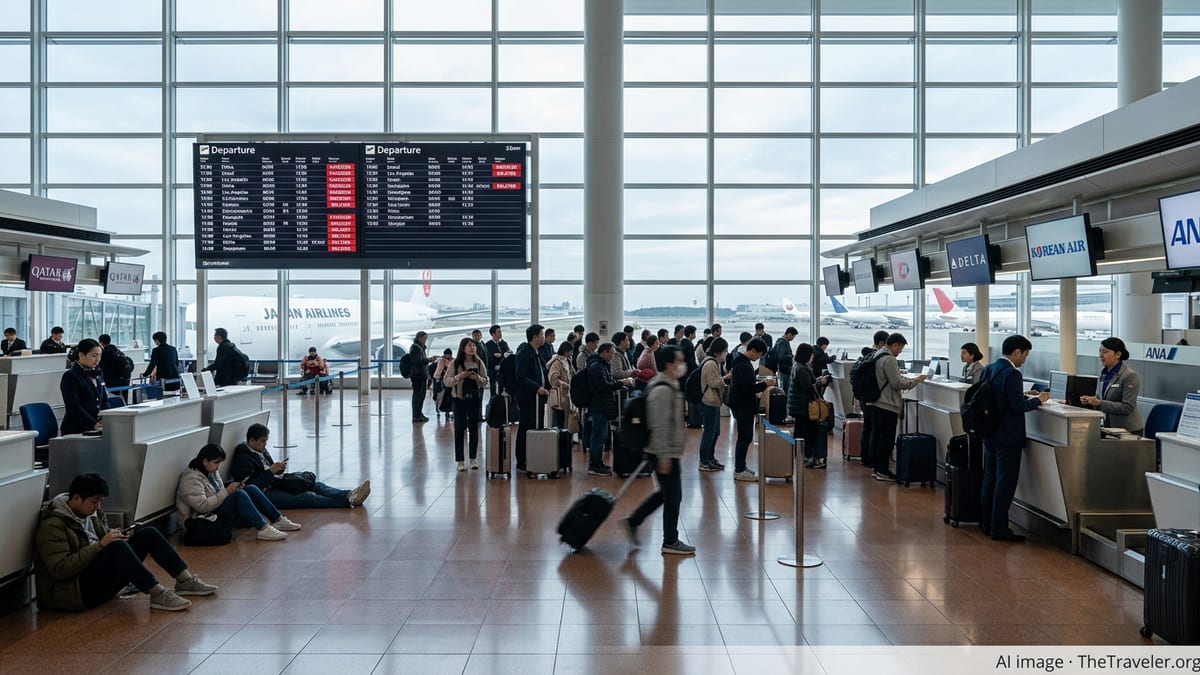
Japan’s main air gateways faced fresh disruption today as more than 20 international and regional flights were canceled, with services operated by Qatar Airways, Delta Air Lines, Korean Air, All Nippon Airways and other major carriers scrapped or heavily delayed across Tokyo, Osaka, Fukuoka, Okinawa and additional routes.
Middle East Airspace Crisis Ripples Into Japan
The latest wave of cancellations in Japan is closely tied to the ongoing closure and restriction of key Middle East air corridors, which has forced Gulf and partner airlines to radically redraw their networks. Qatar Airways, which has been operating a sharply reduced schedule to and from Doha since late February, is now canceling and consolidating select services touching Japanese airports, particularly long-haul connections that normally rely on efficient overflight of the Gulf and surrounding region.
Operational data from regional aviation trackers and airline statements indicate that Japan’s share of today’s wider Asia disruption includes more than 20 outright cancellations involving Japan-bound or Japan-originating flights. While the overall number may sound modest compared with the hundreds of cancellations across Asia-Pacific, the impact is magnified because many of the affected flights are trunk routes linking Japan to major hubs in Europe, the Middle East and North America.
Travel analysts note that flights routed via Doha, Dubai and Abu Dhabi serve as critical connectors for Japanese travelers heading to Europe, Africa and parts of South America, as well as for inbound tourism from those regions. With airspace closures extending flight times by hours or forcing airlines to drop certain services entirely, Japan’s role as a key spoke in these global networks is being temporarily curtailed.
Qatar Airways confirmed it is operating a limited schedule, prioritizing select long-haul markets while canceling or combining others. For Japan, this has translated into last-minute scrubs of some Tokyo and Osaka departures and arrivals, leaving passengers facing unexpected overnight stays and multi-stop reroutes via alternative hubs.
Tokyo, Osaka, Fukuoka and Okinawa Routes Hit Hardest
Among Japan’s airports, Tokyo’s Narita and Haneda, Osaka’s Kansai hub, and the regional gateways of Fukuoka and Naha in Okinawa are bearing the brunt of today’s schedule shake-up. Flights linking these cities to Gulf hubs and secondary Asian cities have seen a mix of outright cancellations and extended delays as carriers adjust to evolving airspace restrictions and congestion along alternative routings.
At Tokyo Narita, a cluster of cancellations affecting services operated by or codeshared with Qatar Airways and All Nippon Airways has disrupted itineraries for travelers heading to and from the Middle East and onward to Europe. Industry monitoring shows a handful of departures scrubbed outright, with others retimed by several hours as airlines attempt to route around closed skies while preserving as many seats as possible.
Osaka Kansai, a key base for both long-haul international flights and regional services, is experiencing similar turbulence. Passengers booked on Qatar Airways departures reported abrupt cancellations over the weekend and into today, with some rerouted on Japan Airlines or All Nippon Airways via Tokyo or other Asian hubs. Korean Air’s services linking Kansai with Seoul have also seen knock-on delays as the carrier reshuffles aircraft and crews across its wider network.
Further west, Fukuoka and Okinawa’s Naha Airport have not been spared. All Nippon Airways has trimmed or canceled selected flights connecting these cities to Tokyo and other major domestic hubs, in part to free up aircraft and crew capacity to support long-haul operations already under strain. Even where flights still operate, schedules are fluid, with gate agents warning travelers to expect late changes.
Delta, Korean Air and ANA Adjust Long-Haul Strategies
Delta Air Lines and Korean Air, which both maintain important transpacific links involving Japan, have joined Gulf carriers in recalibrating their Japan operations. For Delta, the primary pressure point is the complexity of connecting passengers through Japanese hubs to onward services that would normally use Middle Eastern or European airspace now subject to restrictions. Selected flights have been canceled outright where viable alternatives exist, while others have been consolidated to preserve capacity on the strongest routes.
Korean Air is in a similar position, juggling robust demand on transpacific and intra-Asian routes with the operational challenges posed by longer detours and congested airspace. Flights between Korean hubs and Japanese cities such as Tokyo, Osaka and Fukuoka remain mostly intact, but cancellations and significant delays are emerging on services that would have continued onward to the Middle East or connected to disrupted partner flights.
All Nippon Airways, meanwhile, finds itself both a victim of the disruption and a key part of the solution for stranded travelers. While some ANA-operated flights have been canceled as part of broader Asia flight reductions, the airline is also stepping in to carry passengers displaced from affected Qatar Airways and partner services. This has resulted in unusually full cabins, tight connection windows and, in some cases, domestic legs being canceled or downgauged to accommodate reassigned aircraft.
Industry observers say that alliance ties are shaping how the disruption plays out. Passengers on codeshare itineraries involving ANA, Qatar Airways, Delta and Korean Air are being rebooked across alliance partners where possible, but available seats are increasingly scarce on peak routes to and from Japan’s main gateways.
What Today’s Cancellations Mean for Travelers in Japan
For travelers currently in Japan or due to arrive in the coming days, today’s cancellations are a clear signal that the situation remains volatile and that flight plans involving Japan should be considered tentative until close to departure. Even if a flight is still scheduled, last-minute changes to routing, departure time or operating carrier are becoming common as airlines adapt to rapidly shifting airspace permissions and congestion.
Passengers whose flights to or from Tokyo, Osaka, Fukuoka or Okinawa have been canceled are generally being offered free rebooking on the next available service, rerouting via alternative hubs, or refunds where no reasonable alternative exists. However, with demand high and aircraft in short supply, “next available” can mean a delay of 24 hours or more, especially for those traveling in premium cabins or large family groups.
Travelers connecting through Japan on complex itineraries involving the Middle East or Europe are particularly exposed. A canceled leg between Osaka and Doha or a heavily delayed Tokyo departure can cause entire itineraries to unravel, forcing passengers to accept longer routings through secondary hubs or, in some cases, abandon trips altogether. Travel insurance with strong trip interruption coverage is proving valuable for those needing to cover additional hotel nights and incidental expenses.
Experts recommend arriving at the airport earlier than usual, keeping airline apps and email notifications switched on, and being prepared with backup routing ideas in case rebooking becomes necessary. Flexibility with dates, airports and even final destinations can dramatically improve the odds of securing a seat out of or into Japan during this period of heightened disruption.
Outlook: More Short-Notice Changes Likely
Aviation analysts warn that while today’s total of more than 20 cancellations impacting Japan appears manageable in isolation, it is part of a far larger regional picture that is still evolving. As long as Middle Eastern airspace restrictions persist and major Gulf carriers continue to operate reduced schedules, Japanese airports will remain vulnerable to fresh waves of cancellations and retimings, especially on long-haul and connecting services.
In the short term, airlines serving Japan are expected to continue day-by-day schedule adjustments, publishing timetables that may change again within hours as military, regulatory and operational conditions shift. This makes long-range planning difficult for both leisure and business travelers, particularly those relying on time-sensitive connections or attending fixed-date events.
Over the coming weeks, carriers such as Qatar Airways, Delta, Korean Air and All Nippon Airways are likely to prioritize core trunk routes linking Japan with North America, Europe and key Asian hubs, while marginal frequencies and lower-demand services remain at higher risk of cancellation. Travelers booked on secondary routes or late-night departures may want to proactively explore earlier or more direct alternatives.
For now, Japan’s skies remain open but constrained, with today’s cancellations offering a snapshot of a network under stress. Anyone planning to fly into, out of, or through Tokyo, Osaka, Fukuoka or Okinawa in the near future should treat their itinerary as a living document and monitor it continually up to the moment they head to the airport.