

More news on this day
Japan will introduce some of the world’s strictest rules on portable batteries from April 2026, capping passengers at two power banks each and banning their in-flight use on all flights to, from and within the country, in a move officials say is aimed at reducing the growing risk of cabin fires linked to lithium-ion batteries.
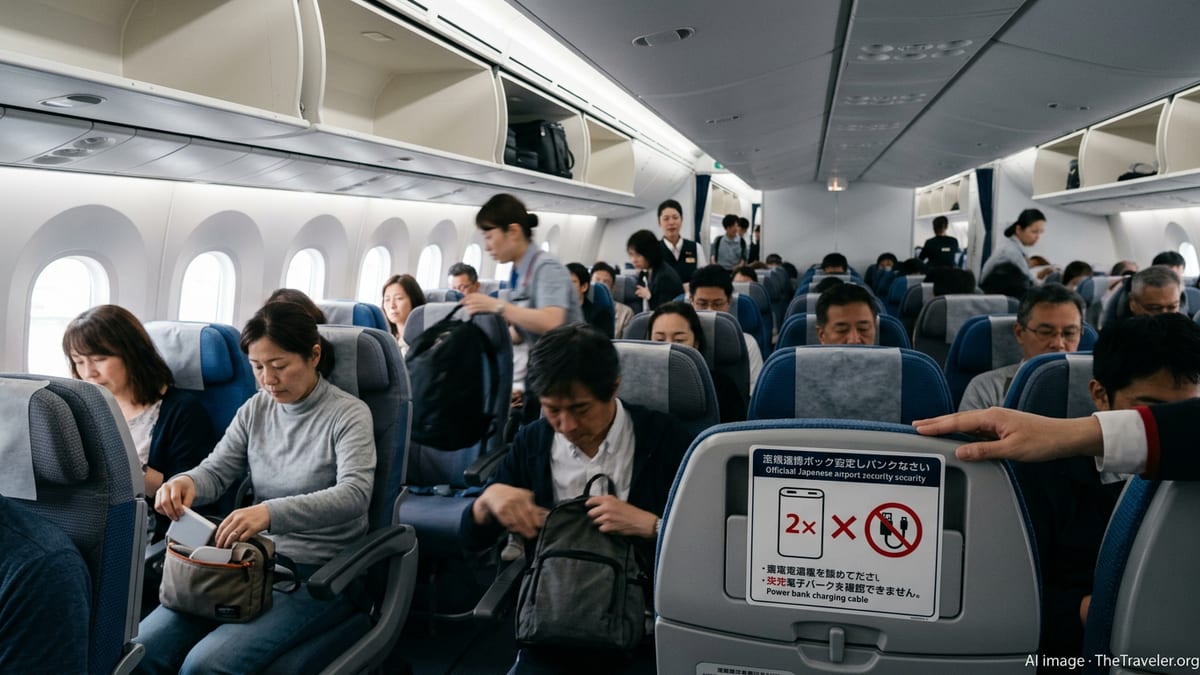
New Nationwide Limits Take Effect From April 2026
Japan’s Ministry of Land, Infrastructure, Transport and Tourism has confirmed that revised aviation safety regulations will take effect in mid-April 2026, requiring all airlines operating to, from and within Japan to enforce tighter controls on power banks carried by passengers. The rules apply to both Japanese and foreign carriers, covering international and domestic services alike.
Under the new framework, travelers will be restricted to carrying a maximum of two spare lithium-ion batteries classified as power banks in their cabin baggage. High-capacity units above 160 watt-hours will remain completely prohibited, while devices below that threshold must be kept in carry-on luggage only, in line with existing international practice. Officials say the focus is less on changing watt-hour limits and more on sharply reducing the number of separate battery packs in the cabin.
The changes also introduce a blanket ban on using power banks during flight. Passengers will no longer be permitted to charge phones, tablets or laptops directly from portable batteries once the aircraft doors are closed. Instead, airlines are expected to encourage travelers to rely on in-seat power where available and to fully charge devices before boarding when outlets are not provided.
Aviation regulators in Tokyo describe the measures as a response to a “series of serious incidents” worldwide involving smoke and fire from lithium-ion batteries in cabins and overhead bins. While such events remain statistically rare, they often demand immediate emergency response from crew and can trigger diversions, making them a key focus of recent safety reviews.
Japan Aligns With a Growing Asia-Pacific Clampdown
Japan’s move places it alongside a growing list of Asia-Pacific and Gulf aviation markets that have already tightened rules on portable batteries. In recent years, Singapore Airlines, South Korean carriers, airlines in Taiwan and Thailand, and several operators in Australia and the United Arab Emirates have all introduced policies that limit the number of power banks permitted and, in many cases, prohibit their use in flight.
South Korea and Taiwan were among the earliest to react after a widely reported fire in an overhead bin on a regional flight in 2025 was linked by investigators to a portable battery pack. South Korean regulators responded by curbing the carriage and charging of power banks in cabins, while Taiwanese airlines quickly followed with outright bans on in-flight use.
In Southeast Asia, the Civil Aviation Authority of Thailand and carriers based in Singapore have progressively tightened guidance, generally allowing only a small number of power banks per passenger and stressing that all must remain in carry-on bags. Many airlines in the region now explicitly forbid charging from power banks during flight, echoing recommendations from international regulators.
Major airlines in Australia and the UAE have moved in the same direction, updating their dangerous goods policies to cap how many spare batteries each traveler can carry and to bar in-flight use on safety grounds. Industry observers note that Japan’s national rules effectively standardize what has until now been a patchwork of airline-by-airline restrictions, signaling a broader convergence of regional practice.
Safety Concerns Behind the Crackdown
The tightening of rules is being driven by concern over thermal runaway, a chain reaction in lithium-ion cells that can cause rapid overheating, smoke and fire. Power banks are seen as particularly problematic because they are often inexpensive, poorly labeled and carried loose in bags, where they can be damaged or short-circuited by coins, keys or other metal objects.
Although only a tiny fraction of the hundreds of millions of passengers who fly each year experience battery incidents, cabin fires rank among the most serious operational hazards for airlines. Even small outbreaks of smoke in overhead bins or seat pockets typically trigger the immediate use of fire extinguishers and can force unscheduled landings, costing carriers time and money while alarming passengers.
International bodies such as the International Civil Aviation Organization and the International Air Transport Association have for years advised that power banks must be kept out of checked luggage, restricted by watt-hour rating and protected from damage. More recently, they have urged operators to consider limiting quantities per passenger and discouraging or banning in-flight use, especially as travelers carry ever more electronics.
Japanese regulators say the decision to move from guidance to binding nationwide rules reflects a desire for clarity. By codifying a simple two-power-bank maximum and a clear prohibition on their use in the air, officials hope to reduce confusion among passengers while giving cabin crews a consistent standard to enforce across all airlines serving the country.
What the New Rules Mean for Travelers
For most leisure travelers, the headline change will be the hard cap of two power banks per person and the loss of the ability to charge from these devices in flight. Passengers who routinely carry several compact batteries for cameras, laptops and phones will need to pare back, redistribute devices among family members or rely more heavily on in-seat power and airport charging points.
Industry guidance indicates that small power banks under 100 watt-hours remain the most straightforward option, as they are generally permitted without individual airline approval, provided the two-unit limit is respected. Travelers with higher-capacity batteries between 100 and 160 watt-hours may still need explicit authorization from their carrier, and some airlines may opt for stricter limits than the Japanese baseline.
Experts advise passengers bound for Japan to check their power bank’s watt-hour rating ahead of time, pack only those they truly need and ensure that exposed ports or metal contacts are protected from accidental short circuits. Many airlines now recommend placing batteries in individual pouches and keeping them where they can be monitored, such as in seat pockets, rather than buried at the bottom of a bulky backpack.
Frequent flyers and digital nomads accustomed to topping up devices throughout long-haul flights may feel the impact most acutely. However, carriers are expected to highlight alternative charging options where available and may use the rule change to promote newer aircraft equipped with universal power outlets and high-output USB-C ports at every seat.
A Step Toward Global Standardization of Battery Rules
Japan’s decision is being closely watched by airlines and regulators in North America and Europe, where current rules are largely aligned with existing international guidance but generally stop short of outright national bans on in-flight power bank use. Some major carriers have already adopted similar policies on their own initiative, limiting both the number of batteries and how they may be used once on board.
Aviation safety specialists say the Japanese framework could accelerate a broader shift toward harmonized global standards, making it easier for passengers to understand what is allowed regardless of airline or route. A commonly cited model would combine a universal carry-on requirement, clear watt-hour thresholds and a simple numeric cap on spare batteries, paired with education campaigns at airports and during booking.
For now, travelers can expect a period of adjustment as airlines update safety briefings, cabin announcements and check-in information to reflect the new Japanese rules. Airport retailers are also likely to respond, highlighting compliant low-capacity power banks and clearer labeling to help passengers avoid confiscations at security or the gate.
While some frequent travelers and gadget enthusiasts may bristle at yet another restriction on what they can bring on board, safety advocates argue that a modest limit on portable batteries is a small price to pay for reducing the risk of in-flight fires in increasingly crowded cabins. As more countries look to Japan’s approach, the era of carrying multiple high-capacity power banks onto a plane may be coming to an end.