

More news on this day
Japan is moving ahead with a nationwide plan to curb overtourism by 2030, aiming to apply tailored controls in around 100 tourism hotspots to safeguard local communities, cultural sites and everyday life as visitor numbers climb toward record levels.
Get the latest news straight to your inbox!
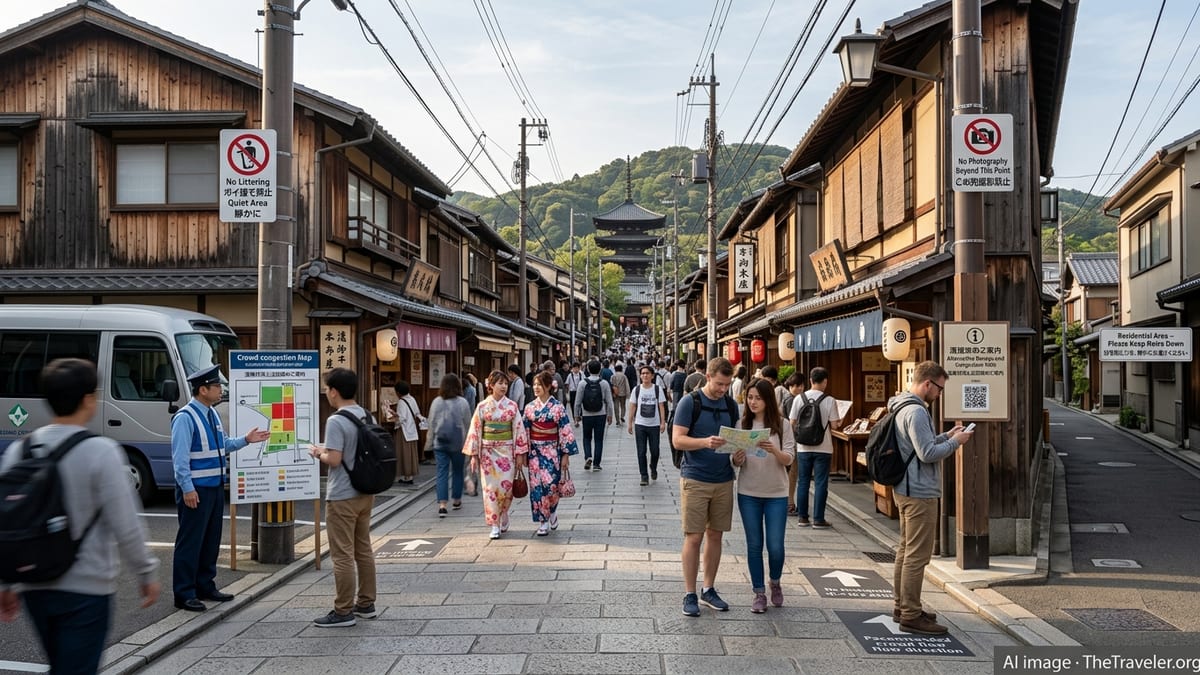
New National Framework Targets 100 Priority Areas
Publicly available policy documents and recent coverage of Japan’s tourism strategy indicate that the government is embedding overtourism countermeasures into its long-term national tourism planning. Central to this approach is a target for roughly 100 regions to adopt structured, data-driven management of visitor flows and local impacts by 2030.
The measures are framed as part of a broader shift from simply boosting arrivals to managing tourism as a shared local resource. Under the evolving framework, prefectures and municipalities will be encouraged to identify specific districts where crowding, traffic congestion, noise and pressure on public services are particularly acute, and then introduce bespoke countermeasures suited to local conditions.
Policy papers linked to Japan’s latest tourism vision outline objectives that go beyond headline arrival targets. They emphasize spreading benefits to regional areas, strengthening cooperation among local governments and tourism businesses, and aligning with sustainable tourism standards that assess environmental, social and cultural impacts in each destination.
Reports on the 2024 and 2025 tourism plans also show that Japan is positioning overtourism controls as a prerequisite for achieving its goal of substantially higher visitor spending by 2030. The thinking presented in these documents suggests that only destinations perceived as livable and well-managed will sustain growth in higher-value tourism over the long term.
Concrete Tools: Fees, Zoning and Time-Based Controls
Local policy experiments already underway provide a preview of the tools that may be adopted more widely as the 100 priority areas are designated. Municipal plans described in Japanese and international media point to a menu of options that includes tourist levies, reservation systems, caps on vehicle access and restrictions on certain behaviors in historic neighborhoods.
Some cities have advanced or proposed higher lodging taxes and special visitor fees designed to fund crowd-control infrastructure, multilingual signage, additional cleaning, and enforcement personnel. Others are testing systems that limit private car or tour bus access in peak seasons, directing visitors instead to public transport or park-and-ride hubs on the urban fringe.
According to sector analyses, authorities are also examining digital tools such as real-time congestion dashboards, QR codes that steer travelers to less crowded sites, and timed-entry systems for popular attractions. These approaches mirror visitor-management models already in use in parts of Europe and aim to smooth demand across hours, days and seasons rather than simply turning visitors away.
Urban planning discussions in Japan increasingly treat tourism districts similarly to event venues, where maximum safe capacities, emergency access routes and noise thresholds are considered in advance. This shift suggests that, as the 2030 horizon approaches, the new national measures will likely blend fiscal, regulatory and technological instruments in a coordinated way.
Balancing Economic Gains With Residents’ Quality of Life
Japan’s strategy emerges against a backdrop of rapidly recovering inbound tourism. Recent statistics widely reported in Japanese and overseas media show that international arrivals have already returned to or surpassed pre-pandemic levels, supported by a weak yen and strong global interest in Japanese culture and cuisine.
At the same time, domestic commentary frequently highlights tensions in a handful of well-known destinations where residents report packed public transport, difficulties accessing local services, and disruptive behavior around residential streets, temples and shrines. These concerns have become a central justification in policy papers for shifting from growth-at-all-costs to a more balanced model.
Analysts note that the national goal of dramatically expanding inbound visitor numbers by 2030 is unlikely to be reversed. Instead, the emerging plan seeks to reconcile that ambition with stricter rules in the most saturated districts, while incentivizing travel to lesser-known regions that remain under-visited yet eager for tourism income.
Several economic studies referenced in government presentations argue that distributing visitors more evenly across the country would not only ease pressure in hotspots but also stabilize employment in regional areas. The planned designation of 100 overtourism focus areas is being described in these materials as a way to prioritize where immediate protections are needed without undermining the broader tourism-led growth strategy.
Regional Diversification and Sustainable Standards
Japan has been promoting regional tourism for more than a decade, but the overtourism debate is accelerating those efforts. Current tourism policy summaries point to a growing emphasis on rural and secondary cities, with investment in transport links, multilingual information and themed travel routes intended to draw visitors beyond Tokyo, Kyoto and Osaka.
One pillar of the approach is the expansion of sustainable destination certification programs that evaluate how communities manage waste, energy, cultural preservation and resident satisfaction. Government-backed guidelines encourage local tourism organizations to set measurable targets in areas such as greenhouse-gas emissions, conservation of natural sites and the protection of cultural landscapes.
By aiming to bring roughly 100 regions into formalized sustainable tourism frameworks by 2030, national planners are attempting to link overtourism controls to broader climate and conservation goals. Policy briefings describe this as a shift from reactive crowd management toward proactive, long-range planning that treats tourism as one element of regional revitalization rather than an end in itself.
Industry observers suggest that destinations able to demonstrate credible sustainability performance could gain preferential access to marketing campaigns and support programs. This would create incentives for local governments to embed overtourism safeguards within broader strategies for community resilience, rather than adopting isolated short-term fixes.
What Travelers Can Expect in the Coming Years
For international visitors, the new measures are likely to be felt in subtle but tangible ways over the rest of the decade. Travel media and industry reports anticipate more advance reservation requirements, clearer codes of conduct in residential and heritage areas, and a wider range of transportation and route options designed to spread foot traffic.
In heavily visited city centers, travelers may encounter higher accommodation taxes or destination-specific fees folded into bookings, while also benefiting from improved wayfinding, cleaner public spaces and more predictable crowd levels at major attractions. Some neighborhoods could see restrictions on short-stay rentals or late-night commercial activity as local governments adjust zoning to protect residential character.
Outside the main gateways, visitors may find expanded tourism offerings in regional hubs and smaller communities that until now have attracted relatively few foreign guests. Regional marketing materials already highlight lesser-known cultural festivals, nature trails and hot spring towns, aligning with the national priority of channeling demand away from overstretched hotspots.
As Japan works toward its 2030 goals, the overtourism agenda is expected to remain a prominent theme in public debate. The emerging framework of 100 managed areas, supported by sustainable tourism standards, is being presented in policy and industry circles as an attempt to keep destinations attractive both for residents and for the growing numbers of travelers drawn to Japan each year.