

More news on this day
Japan is moving to confront mounting overtourism pressures by 2030, setting a new target to double the number of regions formally managing visitor congestion as inbound arrivals surge toward record highs.
Get the latest news straight to your inbox!
New 2030 Target Builds on Existing Tourism Strategy
According to recent policy papers and conference materials, Japan’s national tourism strategy is being recalibrated to put congestion management on a par with growth targets. The government already aims to welcome 60 million international visitors and generate 15 trillion yen in tourism spending by 2030, but now intends to ensure many more destinations are actively equipped to cope with that influx.
Publicly available information indicates that Japan has been rolling out a range of anti-overtourism measures through the Japan Tourism Agency and the Ministry of Land, Infrastructure, Transport and Tourism. These include support for local congestion-control projects, funding for digital visitor management tools and incentives to shift demand away from heavily visited city cores.
The new goal to double the number of regions addressing overtourism by 2030 is framed as a way to move from scattered pilot projects to a more systematic national approach. It signals that congestion is no longer seen as an isolated problem in places like Kyoto and Kamakura, but a structural risk as visitor numbers continue to climb.
Policy documents stress that the strategy is not to reduce overall arrivals, but to spread them more evenly, upgrade local infrastructure and improve the visitor experience while protecting residents’ quality of life.
From Pilot Areas to a Wider Network of Managed Destinations
Japan has spent the past several years testing overtourism responses in a limited set of model areas. Industry analyses and tourism agency materials describe programs in roughly 20 to 50 locations, where authorities are experimenting with crowd monitoring, route diversification, and visitor education campaigns.
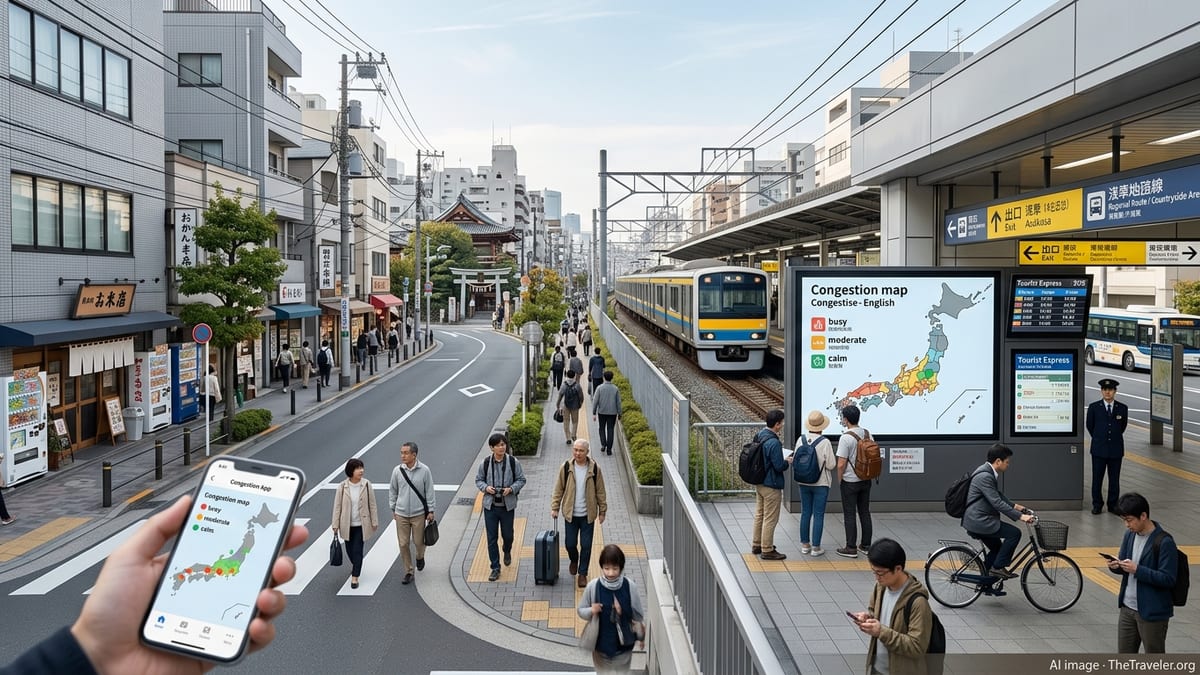
Some of these pilot regions have focused on practical steps such as extending opening hours at popular temples, promoting early-morning and nighttime visits, or rerouting bus services to prevent bottlenecks around key attractions. Others have trialed real-time congestion information on apps and digital signboards to redirect visitors in response to live crowd conditions.
The 2030 target implies that this cluster of early adopters will be scaled into a broader network, with more prefectures and municipalities expected to submit congestion plans, introduce demand-management tools and coordinate with neighboring areas. The direction of travel is toward a nationwide framework where overtourism countermeasures are standard practice rather than exceptional experiments.
Analysts note that achieving this will require not only more funding, but also training for local tourism bodies and closer cooperation among transport operators, accommodation providers and cultural institutions that shape visitor flows.
Digital Tools and Data at the Heart of Congestion Management
Recent conference reports and policy briefings highlight digital transformation as a central pillar of Japan’s anti-overtourism push. Destination management organizations are being encouraged to use real-time data on transport, ticketing and mobile location to anticipate crowding and trigger interventions.
Examples cited in public materials include tourist express buses linked to congestion maps, dynamic digital signage that steers people toward less busy sites, and online reservation systems that cap visitor numbers at fragile locations. In some hot spots, cameras and sensors feed crowd-density information into platforms that both residents and travelers can consult before deciding where to go.
Officials involved in tourism policy have also emphasized the importance of interoperable data across regions, so that congestion in one city can be relieved by offering timely alternatives elsewhere. The ambition to double the number of regions addressing overtourism by 2030 is closely tied to this concept of a connected, data-driven network of destinations.
Observers note that Japan’s broader digital infrastructure plans, such as nationwide fiber and 5G expansion, are expected to support these tourism applications, making congestion management tools accessible even in rural and remote areas.
Balancing Record Visitor Numbers With Local Livability
Travel demand has rebounded strongly since Japan fully reopened its borders, with recent figures indicating that annual foreign arrivals have already surpassed pre-pandemic highs. The combination of a weaker yen, expanded air links and Japan’s enduring cultural appeal has turned the country into one of the world’s fastest-growing tourism markets.
As visitor numbers climb, so have complaints about overcrowded trains, overflowing rubbish, and disruptive behavior in residential districts near popular attractions. Media coverage has documented tensions in parts of Kyoto, Fuji Five Lakes and central Tokyo, where residents report rising noise, traffic and pressure on everyday services.
The government’s new emphasis on congestion management is presented as an attempt to reconcile these pressures with the economic gains from tourism. Policy papers describe overtourism as a risk not only to resident well-being, but also to the long-term appeal of destinations if iconic sites become synonymous with queues and crowding.
By encouraging more regions to adopt active congestion strategies, national planners are seeking to preserve local heritage and daily life while sustaining the sector as a pillar of regional revitalization and national growth.
Spreading Visitors Beyond Big-City Hotspots
A key element of Japan’s approach is to redirect visitor flows away from a narrow set of famed locations toward lesser-known areas with capacity to grow. Reports on government initiatives describe a focus on creating high-value tourism products in regional cities and rural areas, from hot spring towns to coastal and mountain communities.
Designated model destinations outside the major urban centers are being marketed as alternatives for repeat visitors who have already experienced Tokyo, Osaka and Kyoto. Initiatives include developing themed routes, promoting nature and cultural experiences, and improving secondary transport links so that international tourists can more easily reach outlying regions.
This regional diversification agenda is directly connected to the 2030 goal. Doubling the number of regions actively managing congestion is intended not only to protect busy hotspots, but also to ensure that new growth corridors are planned with sustainability in mind from the outset.
Commentators argue that, if successful, the strategy could soften the impact of tourism on a few overburdened cities while distributing economic benefits more evenly across Japan, turning the fight against overtourism into a broader project of regional development.