

More news on this day
Japan has sharply raised its travel alert for six Gulf states as the escalating U.S.-Israeli war with Iran rattles the wider Middle East, disrupting air travel and prompting governments and airlines to reassess security across a region that is usually one of the world’s busiest transit hubs.
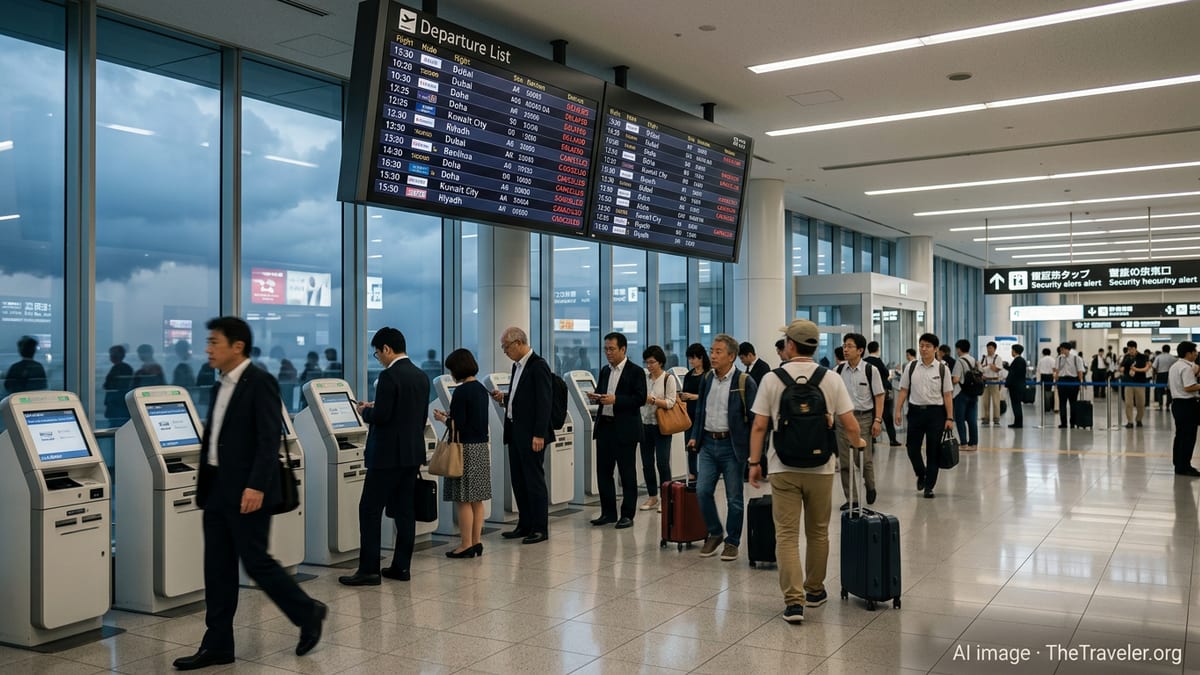
Level 3 Alert Targets Six Key Gulf Destinations
Japan’s Ministry of Foreign Affairs on March 5 raised its travel advisory to Level 3, the second highest in its four-tier system, for Kuwait, Bahrain, Qatar, the United Arab Emirates, Oman and eastern Saudi Arabia. The step formally urges Japanese nationals to avoid all travel to the listed areas and calls on residents already there to consider evacuation or prepare contingency plans in case the security situation deteriorates further.
The move follows a week of intensifying hostilities after coordinated U.S.-Israeli strikes on Iran and subsequent Iranian missile and drone attacks, including targets in the Gulf. Japanese officials cited the risk of further long-range strikes, volatile airspace conditions and the possibility of sudden disruptions to commercial aviation as key factors behind the upgraded warning.
While Japan has previously adjusted its advisories for individual Middle Eastern states, grouping together multiple Gulf Cooperation Council members at Level 3 underscores the scale of concern in Tokyo about spillover risks from the Iran conflict. The advisory does not yet reach the maximum Level 4, which would urge all Japanese nationals to evacuate immediately, but officials stress that the situation remains fluid and under close review.
For international travelers who use Gulf hubs for transit between Asia, Europe and Africa, the change in Japan’s stance signals that a region normally marketed as a safe, efficient connector is now being reevaluated through a security-first lens.
Evacuation Flights and Airline Disruptions
Alongside the advisory shift, Japan has begun arranging chartered aircraft to help bring home its citizens from the most affected parts of the Middle East. Japanese media report that the government is prioritizing nationals in Kuwait, Bahrain, Qatar and the United Arab Emirates, where flight reductions, reroutings and temporary airspace closures have already stranded some travelers and complicated commercial departures.
Gulf carriers and other international airlines have announced a series of schedule changes in recent days, ranging from outright cancellations to longer, indirect routings that avoid sensitive skies. Some services over or near the Strait of Hormuz and along the Iran coastline have been suspended or diverted, increasing flying times and placing additional pressure on alternative corridors.
Travelers transiting major Gulf hubs such as Dubai, Doha or Abu Dhabi are reporting last-minute gate changes, extended layovers and, in some cases, unexpected overnight stays as operations adjust to rapidly evolving security assessments. Even where airports remain open and functioning, airlines are conducting more frequent risk reviews on a route-by-route basis, which can lead to abrupt timetable revisions.
For Japan-based passengers, the combination of official guidance to avoid travel and a more fragile flight network means that anyone planning imminent trips involving Gulf stopovers should verify their bookings with airlines and tour operators well in advance, and consider flexible tickets that allow for date or routing changes without heavy penalties.
Regional Security Backdrop Raises Risk Profile
The heightened alert comes against the backdrop of one of the most serious security crises in the region in years. The latest conflict escalated when U.S. and Israeli forces launched extensive strikes on Iranian territory in late February, prompting waves of Iranian missile and drone attacks, including against targets in the United Arab Emirates and near key shipping lanes in the Gulf.
Those exchanges followed a broader military buildup by the United States across the Middle East earlier in the year, as Washington sought to deter further Iranian actions and reassure partners worried about potential attacks on energy infrastructure and maritime traffic. The result has been a dense concentration of military assets across the Gulf, raising concerns about miscalculation and the risk of both targeted and stray strikes near civilian areas.
Although many Gulf states have invested heavily in advanced air defense systems and rapid-response civil defense capabilities, the recent Iranian barrages have demonstrated that interception rates are not perfect and that falling debris, flight diversions and temporary airspace shutdowns can all affect civilians. For governments like Japan’s, that combination of high-intensity warfare and dense civilian aviation makes the risk calculus far more complex.
Security analysts say that while the chances of tourists or business travelers becoming direct targets remain low, the broader operational environment for travel has clearly deteriorated. The focus now is less on traditional crime or localized unrest and more on regionwide disruptions that can upend itineraries with little warning.
Impact on Non-Japanese Travelers and Transit Passengers
Japan’s advisory is formally addressed to its own citizens, but it will likely resonate with a much wider audience of travelers who depend on Gulf hubs for long-haul connections, including many from North America and Europe. The same airspace constraints, missile risks and potential airport disruptions that worry Japanese authorities are relevant to any passenger crossing the region.
Some Western governments have already updated their own guidance for the Middle East, and a number of airlines serving the Gulf from Asia and Europe have quietly reduced frequencies or shifted routes. Travelers may not see a blanket ban on flying through the region, but they are increasingly being advised to build in more time for connections and to avoid nonessential stopovers where possible.
For business travelers, particularly those in energy, construction and finance who regularly shuttle between Asia and the Gulf, corporate travel managers are beginning to reassess risk thresholds. Companies are reviewing evacuation plans, checking insurance coverage for conflict-related disruptions and, in some cases, postponing non-urgent site visits or conferences.
Leisure travelers planning multi-country itineraries that combine Gulf city stays with onward trips to destinations such as East Africa or Europe are likewise being urged to consider alternative routings through hubs in South or Southeast Asia or via Europe directly. The additional travel time and potential cost need to be weighed against the elevated, though still relatively low, physical risk and the higher likelihood of operational turbulence.
What Travelers Should Do Now
For anyone currently in the Gulf or with imminent travel involving the affected states, the most important step is to stay informed and remain flexible. Travelers should register their presence with their embassy if that service is available, monitor official advisories and local news, and keep close track of airline communications, which may come through apps, email or text messages at short notice.
Passengers should consider maintaining a contingency fund or accessible credit for unexpected hotel nights, rebooked flights or alternative routings. Travel insurance policies should be reviewed carefully, as not all plans cover trip disruption or cancellation linked to armed conflict or government advisories; where possible, upgrading to a policy that explicitly covers such events can provide additional protection.
Those who have not yet departed may wish to reassess whether their trip is essential. If travel is primarily for tourism or non-urgent business, postponing until the regional security picture stabilizes could reduce both personal stress and the risk of becoming caught in a wave of cancellations or airport shutdowns.
Ultimately, Japan’s move to raise its alert level for the Gulf underlines a broader recalibration in how governments and travelers view a region that has long been synonymous with seamless connectivity. Until tensions between Iran and its adversaries ease and airspace restrictions are lifted, anyone planning to pass through these Gulf states should assume a more cautious, preparedness-oriented approach to their journeys.